

If you're looking for more leads at a lower cost, it's time to seriously consider YouTube ads. For personal injury lawyers, nothing builds trust and empathy faster than a well-crafted video. When a potential client is in a vulnerable state, researching legal help after an accident, seeing a human face and hearing a reassuring voice can make all the difference. That's the power of YouTube's visual storytelling—it puts a face to your firm and starts building a connection before they even click.
Why YouTube Is a Goldmine for PI Law Firms
In a market saturated with text-based ads and search results, YouTube lets personal injury firms cut through the noise. It's a powerful blend of emotional connection and razor-sharp, data-driven targeting.
Think about it: you can build immediate trust with authentic video testimonials or a simple introduction from a lead attorney. This isn't just theory; we consistently see a lower average CPL on YouTube compared to traditional search ads, which means your marketing budget stretches further and delivers a better ROI. Plus, with YouTube's targeting options, you can get your message directly in front of accident victims in your specific service area, right when they're looking for answers.
Build Trust on Screen
Video is incredibly effective at humanizing your law firm. A static webpage can feel cold and impersonal, but a video puts a real person on the screen, creating an instant connection.
We saw this firsthand with a mid-sized PI firm that was struggling to stand out. After launching a simple campaign featuring its lead attorney explaining a recent case result, their form submissions jumped by 25%. It wasn't fancy, but it was authentic.
"Video helps clients feel heard before they ever pick up the phone."
So, what kind of videos actually work? Focus on content that provides value and builds confidence:
- Client Testimonials: Nothing is more powerful than a former client sharing their positive experience and successful case outcome.
- Explainer Videos: Short, helpful clips breaking down what someone should do after an accident or explaining their legal rights.
- Direct-to-Camera Ads: A partner at the firm speaking directly to the viewer with a clear, empathetic call-to-action.
A Quick Look at the Numbers
Here’s a simple infographic that breaks down the average Cost Per Lead across the most common digital channels for PI firms.
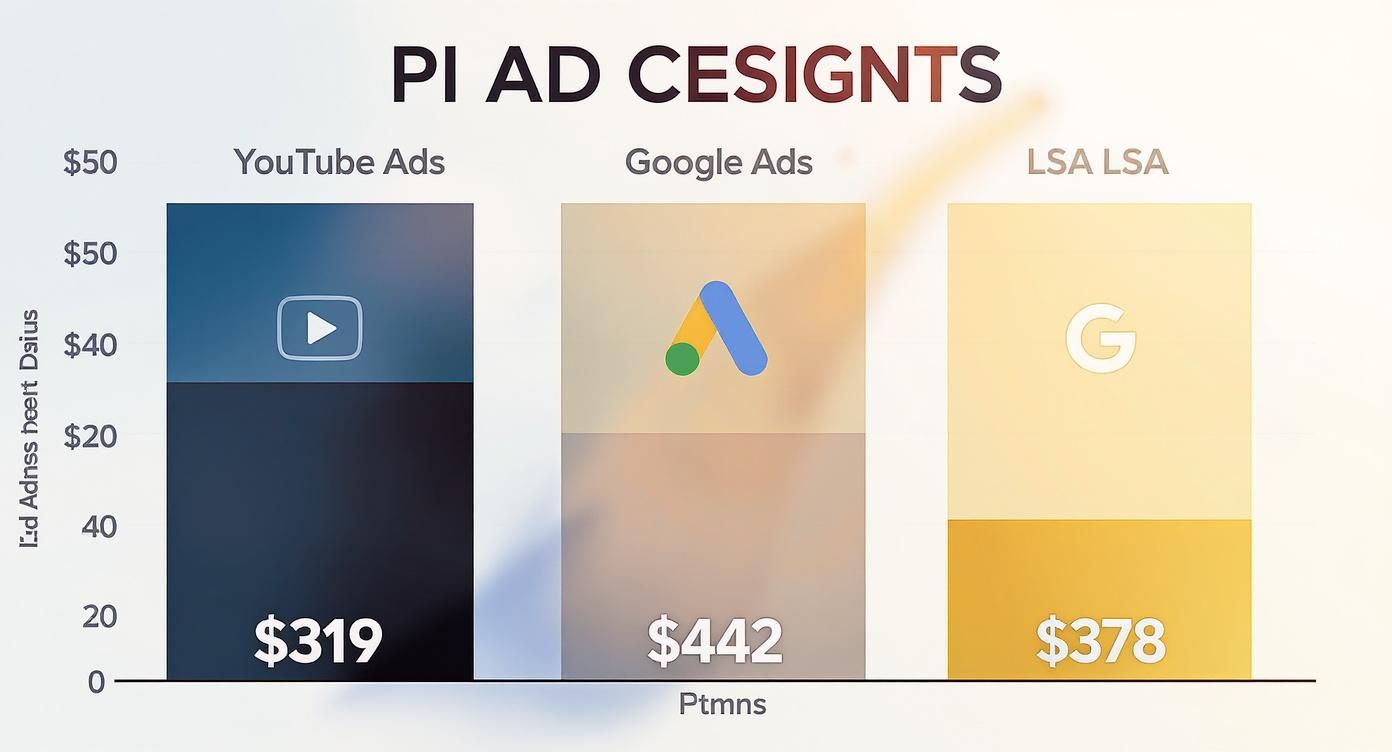
As you can see, the data makes a compelling case. The cost efficiency of YouTube, with an average CPL of $319, is significantly better than Google Search Ads at $442 and Local Service Ads at $378.
The Data Doesn't Lie
Let's dig a little deeper into the cost-effectiveness of these platforms. An industry report analyzing data from 49 different personal injury firms confirmed what many of us have seen in practice. The average cost per lead (CPL) for YouTube ads was $319. While that's a bit higher than Facebook Ads ($286) or Display Ads ($296), it's a bargain compared to the high-intent, high-cost world of Google Search ($442) and LSAs ($378).
This data highlights a sweet spot for YouTube: it captures high-intent users at a much more sustainable cost than search alone. You can read the full research on FWD's website to see the complete breakdown.
To give you a clearer picture, here's how the channels stack up.
Digital Ad Channel Cost Per Lead Comparison for PI Firms
This table compares the average cost to acquire a single lead from the major digital advertising platforms used by personal injury law firms.
| Ad Channel | Average Cost Per Lead (CPL) |
|---|---|
| Google Search Ads | $442 |
| Local Service Ads | $378 |
| YouTube Ads | $319 |
| Display Ads | $296 |
| Facebook Ads | $286 |
The takeaway here is clear: while search is essential for capturing active demand, YouTube offers a more cost-effective way to generate high-quality leads by engaging potential clients earlier in their journey.
Get Your Ad in Front of the Right People
This is where YouTube really shines. The platform’s advanced filtering capabilities allow you to reach exactly the right audience with incredible precision. Forget casting a wide, expensive net.
You can target people based on very specific signals:
- In-market audiences who are actively searching for accident attorneys.
- Custom affinity groups built from people who have recently visited competitor websites.
- Remarketing lists to re-engage visitors who have read your blog posts or watched other videos.
These options ensure your ad budget is spent on viewers who are most likely to need your services, dramatically improving your conversion rates.
For a deeper dive into creating videos that resonate, check out our guide on the power of video marketing for lawyers.
Real-World Targeting in Action
Let's make this tangible. A Texas-based firm we worked with wanted to target car accident victims in the greater Houston area.
Instead of a broad campaign, they got specific. They zeroed in on viewers within a 30-mile radius of the city who had recently watched videos about what to do after a car accident. By layering in-market segments for legal services and demographic filters, they slashed their CPL by 18% compared to their existing search campaigns.
Here's how they did it:
- They uploaded a CSV of local ZIP codes for hyper-local location targeting.
- They selected the "In-market for legal services" audience and layered on accident-related interests.
- They even excluded competitor law firm channels to avoid showing their ads to other attorneys.
This strategic approach put their message in front of people genuinely seeking help, not just casual browsers.
Building Your High-Impact Campaign Strategy
Before you hit record, sketch out a clear path for every dollar. Are you aiming to raise local awareness or drive immediate inquiries? Nail that down first, and every piece of creative falls into place.
Setting Measurable Objectives
You won’t know what’s working unless you track it. Start by crafting objectives that are specific, measurable, and tied to your bottom line.
• Increase brand searches in your metro area by 20% over three months
• Capture 50 qualified leads per month from car-accident audiences
• Bring Cost Per Lead (CPL) below $300 in the first six weeks
“Vague goals like ‘more calls’ never move the needle. Pinpoint exact targets before you launch.”
With clear benchmarks, you can tweak bids in Google Ads based on real performance signals and avoid overpaying for each conversion.
Choosing Ad Formats That Convert
Every YouTube ad format plays a different role. Mix them to guide viewers from awareness to action.
| Format | Ideal Use | Avg Completion Rate |
|---|---|---|
| TrueView In-Stream | Tell a story, build trust | 55% |
| Bumper Ads | Quick brand reminders | 70% |
| YouTube Shorts Ads | Mobile-first tips or CTAs | 45% |
A common play: tease your firm’s expertise in a 6-second bumper, then roll into a 30-second TrueView spot with client success tales.
Advanced Audience Targeting
Getting granular with audiences cuts wasted spend and boosts relevance.
• In-Market Segments: People actively seeking legal help
• Custom Combos: Tap competitor site visitors for tailored messaging
• Remarketing Pools: Re-engage anyone who scrolled past your landing page
Layer these together for a campaign that feels personal—and watch your CTR climb.
Crafting A Location Blueprint
Dialing in on geography slashes CPL and filters out unqualified clicks. A Chicago firm we work with:
• Targeted 15-mile ZIP codes around the Loop
• Excluded distant suburbs with low conversion rates
• Added demographic filters—age brackets tied to accident stats
Result: an 18% drop in cost per lead simply by fine-tuning the map.
Budget Allocation Tactics
Divide and conquer your ad spend for maximum efficiency.
• 60% on bottom-funnel TrueView In-Stream—leads only
• 25% on top-funnel bumpers—brand reach
• 15% on Shorts—fast engagement on mobile
Set daily caps, then monitor pacing. Consistent data helps you scale without surprises. Learn more about allocating resources effectively in our detailed guide on paid advertising for attorneys: Paid Advertising Tips for Attorneys
Integrating Remarketing Sequences
Don’t let warm prospects slip away. Craft a simple three-touch journey:
• First Ad: Quick intro + useful legal tip
• Second Ad: Client success story or testimonial
• Third Ad: Direct call-to-action with contact details
Match the length of this sequence to your average decision window—two to three ads usually hit the sweet spot in personal injury cases.
Tracking Signals That Matter
Focus on the metrics that drive ROI, not just vanity views.
• Cost Per Lead (CPL) – Your headline KPI
• View-Through Rate (VTR) – A read on creative resonance
• Conversion Rate – From watch to form fill
“If views are high but form submissions lag, tighten your targeting or swap out your creative.”
Combine these data points to decide which ad hooks and segments deserve a bigger slice of budget.
Final Checklist Before Launch
- Confirm conversion tracking is firing correctly in Google Ads
- Double-check landing pages mirror your ad’s promise
- Review all compliance elements: disclaimers, attorney info
- Test your ad sequence with YouTube’s preview feature
This quick audit catches costly errors before they go live. Nail these steps, and every dollar will push you closer to your goals.
Creating Ad Content That Connects and Converts
Your ad creative is the heart and soul of your campaign. I've seen firms nail their targeting and bidding, only to fall flat because their ad was generic, uninspired, or just plain off-putting. For personal injury lawyers, effective YouTube ads aren't about flashy productions or ambulance-chaser stereotypes. They’re about making a genuine human connection with someone who is scared, in pain, and probably overwhelmed.
Forget the old playbook of the shouting attorney. The ads that actually work today lead with empathy. They build trust. The entire goal is to make a potential client feel seen and understood, giving them the confidence that your firm is the one to guide them through this mess.
This means your content has to be authentic and direct, but also reassuring. You need to convey authority without being intimidating. It’s a delicate balance, but it’s one you have to strike.
Scriptwriting That Resonates
A framework I’ve seen work time and time again in legal advertising is the classic Problem-Agitate-Solve (PAS) model. It's so effective because it follows the exact emotional arc of someone who's just been in an accident.
- Problem: You start by hitting their main issue head-on. Speak directly to their pain, their confusion, and how this accident has turned their life upside down.
- Agitate: Next, you gently touch on the real-world consequences they're already worried about. Think mounting medical bills, confusing calls from insurance adjusters, or the fear of not knowing their legal rights.
- Solve: This is where you introduce your firm as the calm, experienced solution. You position your team as the guides who can handle the complexity and fight for the compensation they deserve.
The real secret to making the PAS model work is empathy. Your tone should be supportive, not scary. You’re not trying to frighten them into calling; you're showing them you get what they’re going through and have a clear plan to help.
For instance, a script could open with something like, "Hurt in a car wreck? The phone calls from the insurance company can be relentless." That line immediately nails the problem and agitates a common source of stress, perfectly setting you up to present your firm as the solution.
Feature Your Principal Attorney
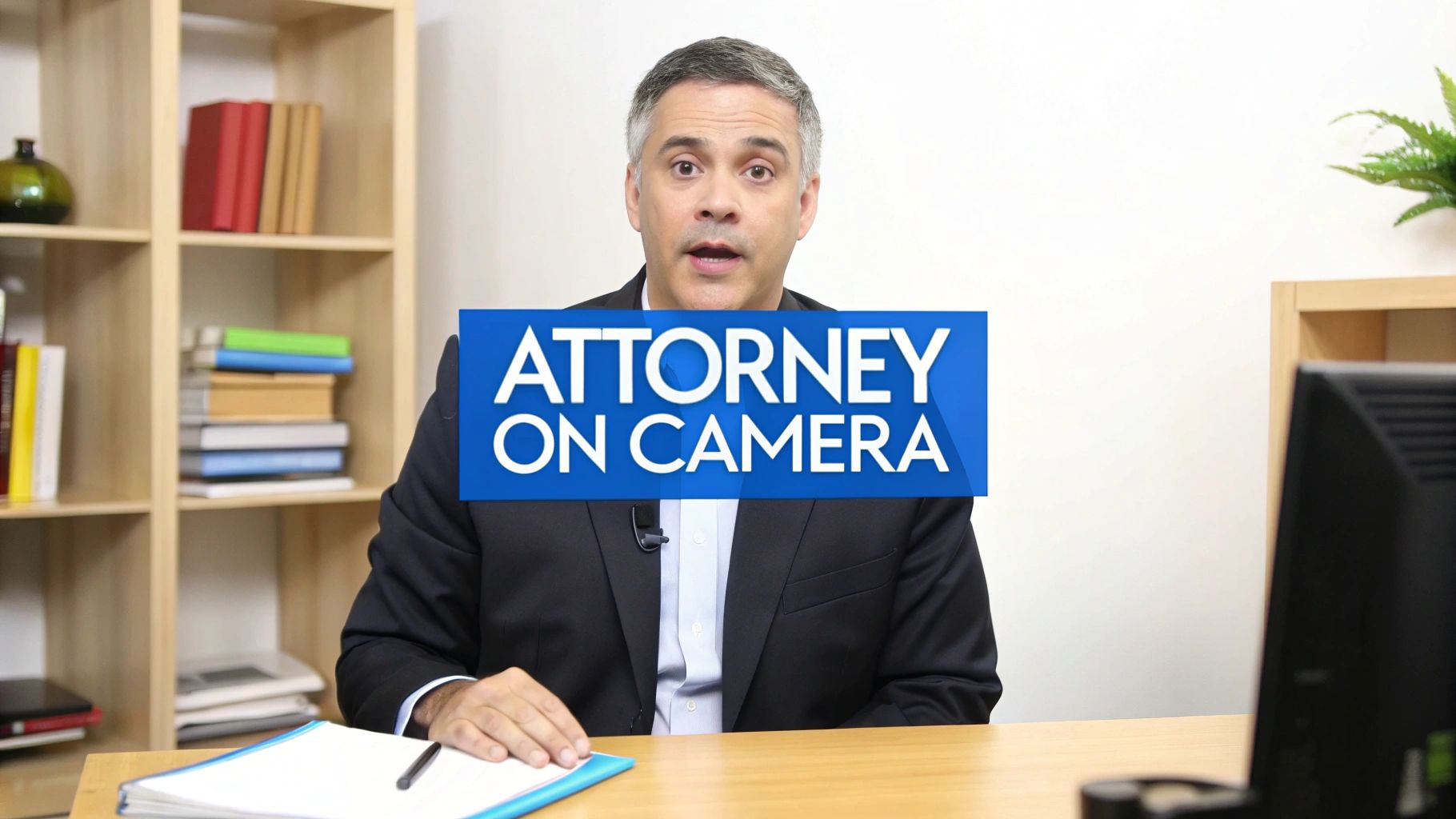
In this business, people hire people—not logos or faceless firms. One of the single most powerful things you can do in your ads is to have a principal attorney speak directly to the camera.
It’s a simple move, but it accomplishes so much:
- Builds Instant Trust: Seeing a real person puts a face to the name, making your firm feel far more approachable and human.
- Establishes Authority: The attorney is the expert. When they deliver the message, it immediately boosts your firm’s credibility.
- Creates a Personal Connection: It gives a potential client the feeling that they already know who they’ll be working with, even before they pick up the phone.
Honestly, a polished, direct-to-camera message from a partner almost always outperforms a big-budget ad with actors. Authenticity wins every time.
Production Tips for a Professional Look
You don’t need a Hollywood budget to create a video that looks professional and trustworthy. The camera on a modern smartphone is more than enough, as long as you pay attention to a few key details.
Focus your energy on these three things:
- Clear Audio: Bad sound is the quickest way to make your ad seem amateurish. Invest in a decent lavalier or shotgun mic to make sure your attorney’s voice is crisp and easy to understand. It's a small cost with a huge impact.
- Good Lighting: You don’t need a complex lighting grid. A simple three-point setup or even a single ring light can eliminate harsh shadows and create a clean, professional look. Even just facing a large window for soft, natural light can work wonders.
- Stable Camera: Nobody wants to watch a shaky video. It’s distracting and looks unprofessional. A simple tripod is non-negotiable for keeping your shot steady.
These small investments signal competence and attention to detail—exactly the qualities someone is looking for in a lawyer.
Crafting a Clear Call-to-Action
Okay, your ad has grabbed their attention and built a connection. Now what? You have to tell them exactly what to do next. A weak or vague call-to-action (CTA) will absolutely destroy your conversion rate.
Your CTA needs to be:
- Specific: Don't just say, "Contact us." A much better option is, "Call now for a free, confidential case review."
- Urgent (but not aggressive): Phrases like, "Don't wait to protect your rights," can create urgency without sounding like a high-pressure sales pitch.
- Easy to Follow: The last few seconds of your ad are prime real estate. Make sure your phone number and website URL are displayed clearly on the screen.
The idea is to remove all friction. Make it as simple as humanly possible for an interested person to move from watching your ad to contacting your firm. A strong CTA is the bridge between a viewer and a lead.
Optimizing Your Post-Click Experience
Getting the click on your YouTube ad is a great start, but it's only half the battle. The moment a potential client lands on your page, a new, even more critical journey begins. If your landing page and intake process don't live up to the promise of your ad, you've just wasted your ad spend and lost a valuable lead.
This post-click experience is where you turn a curious viewer into a qualified case. It needs to be a seamless, trustworthy path from the ad straight to your intake team. Any friction—a confusing page, a clunky form, a slow response—and they're gone.
Let's dig into how to build a post-click experience that actually converts those hard-won clicks into signed clients.
Crafting a High-Converting Landing Page
First things first: your landing page has to instantly reassure the visitor they've come to the right place. This is all about message match. If your video ad featured an attorney talking about truck accidents, your landing page headline better say something like, "Hurt in a Truck Accident? Get a Free Case Review Now." It's a simple concept, but it's amazing how many firms miss this.
Your page should have one job and one job only: get the person to call you or fill out your form. That's it. Ditch the navigation bar, links to your blog, or social media icons. Anything that can distract them from the primary goal is just a leak in your conversion funnel.
A landing page with too many options is a landing page that doesn't work. Keep it ruthlessly simple and direct. Give the user one clear path forward.
Every high-performing personal injury landing page I've seen has these core elements:
- A Punchy, Relevant Headline: It must mirror the ad's core message and connect directly with the visitor's problem.
- Heavy-Hitting Trust Signals: Don't just say you're good; prove it. Use real client video testimonials, recent case results (with dollar amounts, if possible), and professional attorney photos and bios.
- An Unmistakable Call-to-Action (CTA): Use strong, action-oriented language. "Get Your Free Case Evaluation" is far more compelling than a generic "Submit."
Here’s a fantastic example of a legal services landing page that nails the fundamentals. It’s clean, focused, and built to convert.
Look closely: the phone number is huge and impossible to miss, the form is short and to the point, and the trust badges are placed right under the CTA button—reinforcing confidence at the exact moment someone is deciding whether to reach out.
Designing Frictionless Forms
Your contact form is the final gatekeeper. A long, complicated form is a conversion killer, especially on a smartphone—which is where over 60% of YouTube viewing happens.
Keep your form fields to the bare essentials. To get the conversation started, you really only need four things:
- Full Name
- Phone Number
- Email Address
- A short field for them to describe what happened
You can get the nitty-gritty details like the date of the incident or insurance information during the intake call. The less work you make them do upfront, the more likely they are to hit "submit." Make sure your form is mobile-friendly, with big input fields and a button they can't miss.
Perfecting Your Intake Process
So, you got the lead. Now what? Your intake process is the final piece of the puzzle, and it’s where many firms drop the ball. It has to be fast, professional, and empathetic to capitalize on that person's immediate need for help.
Speed is everything. We've seen it time and time again: if you don't respond, your competitor will. Your goal should be to contact every single web lead within five minutes. That kind of rapid response tells a potential client they're a top priority and builds immediate trust.
This is also where technology can give you a serious edge. Many firms are now exploring AI intake for law firms to make sure no lead ever goes cold. These systems can handle initial communication 24/7, qualify prospects, and even schedule consultations automatically. This frees up your human intake specialists to have more meaningful conversations with highly qualified leads. A well-oiled intake system is what closes the loop, turning your investment in YouTube ads for personal injury lawyers into actual, signed retainers.
Navigating Attorney Advertising Compliance on YouTube
Running ads as a personal injury lawyer isn't like selling shoes. Every video you launch on YouTube has to play by two sets of rules: Google's and, more importantly, your state bar’s advertising guidelines. It’s a landscape that trips up even seasoned marketers. Get it wrong, and you're not just looking at a disapproved ad—you could be facing serious disciplinary action.
The real trick is to create an ad that's both compelling and compliant. That high-impact, dramatic reenactment you're envisioning might grab attention, but if it's not handled carefully, it could be deemed misleading. Touting your biggest win is powerful, but promising a specific outcome is completely off-limits. Threading this needle is the key to building a campaign that grows your practice without putting your license at risk.
Common Compliance Pitfalls to Avoid
I've seen a lot of well-meaning firms stumble right into compliance hot water. They’re usually honest mistakes, but they can sink an otherwise brilliant campaign.
One of the biggest no-nos? Making promises about case outcomes. Any language that sounds like a guarantee is a huge red flag for bar associations. Phrases like "We guarantee the maximum settlement" are out. Instead, talk about your firm's experience, your process, and your unwavering commitment to your clients.
Misleading imagery is another common mistake. Stock photos of car crashes or actors playing out dramatic scenes can be seen as deceptive if you don't explicitly state what they are. In my experience, authenticity almost always converts better anyway. Real footage and genuine conversations build trust far more effectively and keep you on the right side of compliance.
Essential Disclaimers for Your Video Ads
Disclaimers aren't just fine print; they're your first line of defense. Think of them as non-negotiable elements that protect your firm and give potential clients the context they need. While the specifics can vary from state to state, a few are pretty much universal.
Make sure your ads always include:
- "This is an advertisement." This needs to be on-screen, clear, and legible. Don't flash it for half a second—give people time to actually read it.
- Identification of the Responsible Attorney. You have to name names. Include the name and office address of at least one attorney at your firm who is responsible for the ad's content.
- No Guarantee of Results. This is a big one, especially if you mention past verdicts or settlements. A simple "Past results do not guarantee future outcomes" is essential.
A quick pro-tip: Don't bury your disclaimers. Regulators can spot attempts to technically comply while intentionally obscuring the message. A tiny, 2-point font that flashes on screen for a millisecond won't cut it. Show a good-faith effort to be transparent.
Guidelines for Using Client Testimonials
Nothing sells your firm better than a happy client. Testimonials are pure gold for building social proof, but you have to handle them with care. A real story from a real client can be the heart of your YouTube ad, but only if you follow the rules.
First, always get explicit, written consent before featuring a client in any ad. Period. It's also a smart move to add a disclaimer that their results were specific to the facts of their case and aren't typical.
And if you use an actor to portray a client? You must conspicuously disclose that fact on-screen. Transparency is everything here.
By staying on top of these compliance checkpoints, you can build a YouTube ad strategy that not only drives new cases but also reinforces your firm's reputation as an ethical, trustworthy advocate. This isn't formal legal advice, of course, but a playbook to help you ask the right questions and build campaigns you can be proud of.
Measuring Success and Maximizing Your ROI
Getting your YouTube ad campaign live is just the starting line. The real work—and where the real money is made or lost—begins the moment that data starts trickling in. A campaign you aren't measuring is just a guess, and guessing is a terrible way to spend your marketing budget.
To figure out if your YouTube ads for personal injury lawyers are actually working, you have to look past the flashy, feel-good numbers like views and impressions. Those metrics are great for your ego, but they don’t sign cases.
The only way to get a solid return on your investment (ROI) is to obsess over the key performance indicators (KPIs) that directly affect your firm's revenue. It's all about connecting every dollar you spend to a real result, whether that's a new lead form hitting your inbox or, even better, a signed retainer. This is how you stop guessing and start making strategic moves that actually grow your practice.
Moving Beyond Vanity Metrics
It's tempting to get excited when your ad racks up thousands of views. But let's be blunt: a view from someone in another state or a click from a tire-kicker who isn't a qualified lead is completely worthless. Real success is measured in business outcomes, not in digital applause.
Your focus needs to be laser-sharp on these critical KPIs:
- Cost Per Lead (CPL): This is your total ad spend divided by the number of legitimate leads (form fills or qualified calls). It answers a simple, crucial question: "How much did it cost me to get one person to raise their hand?"
- Cost Per Signed Case (CPSC): This is the holy grail. It tells you exactly how much you spent in ad dollars to acquire one new, paying client. Getting this number requires tight intake tracking, but it's the truest measure of whether your ads are profitable.
- Lead-to-Client Conversion Rate: Of all the leads your YouTube ads generated, what percentage actually hired your firm? If this number is low, you might have an intake problem, not an advertising problem.
Tracking these metrics is non-negotiable. You can have the most compelling ad creative in the world, but if your CPL is an unsustainable $1,000, your campaign is fundamentally broken.
Setting Up Bulletproof Conversion Tracking
To measure what really matters, you need airtight conversion tracking. Without it, you're flying blind, making decisions in the dark. This means setting up specific conversion actions inside your Google Ads account to flag every time a viewer does exactly what you want them to do after seeing your ad.
For PI firms, this almost always boils down to tracking two key actions:
- Landing Page Form Submissions: Don't just track clicks to the landing page. Place the Google Ads conversion tag on the "Thank You" page—the page a user sees after they hit submit. This is the only way to know you're counting actual, completed leads.
- Phone Calls from Ads or Landing Pages: This is where you absolutely need call tracking software. A tool like CallRail will dynamically swap the phone number on your site, assigning a unique number to your YouTube traffic. It's the only way to know for sure which ads are making the phone ring.
Getting your tracking right is the engine that drives optimization. It feeds Google’s algorithm the right signals, telling it which users are the most valuable so it can go find more people just like them.
Practical Optimization Tactics That Work
Once your tracking is live and you've got some data, the fun part begins: optimization. This isn't a "set it and forget it" task. It's an ongoing process of tweaking and testing based on real-world performance.
A fantastic place to start is A/B testing your ad creative. Make two versions of an ad, but only change one thing: the first five seconds. That opening "hook" is everything. Run both ads to the same audience and watch the numbers. Which one gets a better view-through rate? More importantly, which one delivers a lower CPL? The winner becomes your new control, and you start testing a new challenger against it.
Another powerful move is to constantly analyze your demographic and audience reports. You might find that one age bracket is converting at half the cost of another, or that a specific "in-market" audience is delivering all your best leads. When you see these patterns, pounce on them. Shift your budget away from the laggards and double down on what’s working. This simple reallocation can dramatically boost your campaign's ROI without you having to spend a single extra dollar. It’s all about working smarter.
At RankWebs, we believe that a successful marketing strategy is built on a foundation of solid data and continuous improvement. We provide law firms with the insights and frameworks needed to navigate digital advertising effectively. To learn more about building strategic campaigns that drive real firm growth, visit us at https://rankwebs.com.