


When it comes to getting new clients for your law firm in 2025, paid advertising has a clear edge over SEO. For firms that need to generate high-value case inquiries right now, the speed, precision, and budget control of paid ads are simply unmatched. While SEO is a marathon for building long-term authority, a smart paid campaign can start filling your pipeline in days, not months.
Why Paid Ads Are Winning the Race for Clients in 2025
Let's be direct: the goal is to sign more cases. The classic debate between paid ads and SEO often gets bogged down in long-term theory, but that ignores a crucial business reality—the need for a steady, predictable flow of new clients today. This is where paid advertising, especially pay-per-click (PPC), shines by offering a direct line to that goal with incredible speed and accuracy.
SEO is a waiting game. It can take a solid six months, sometimes more than a year, before you see any meaningful results. In contrast, a paid ad campaign can be up and running almost instantly, driving highly targeted traffic to your firm. This agility is a game-changer if you need to quickly ramp up for a specific practice area, expand into a new city, or just keep cash flow healthy.
This infographic really drives home the core strengths of paid advertising for immediate impact: speed, precision, and predictability.
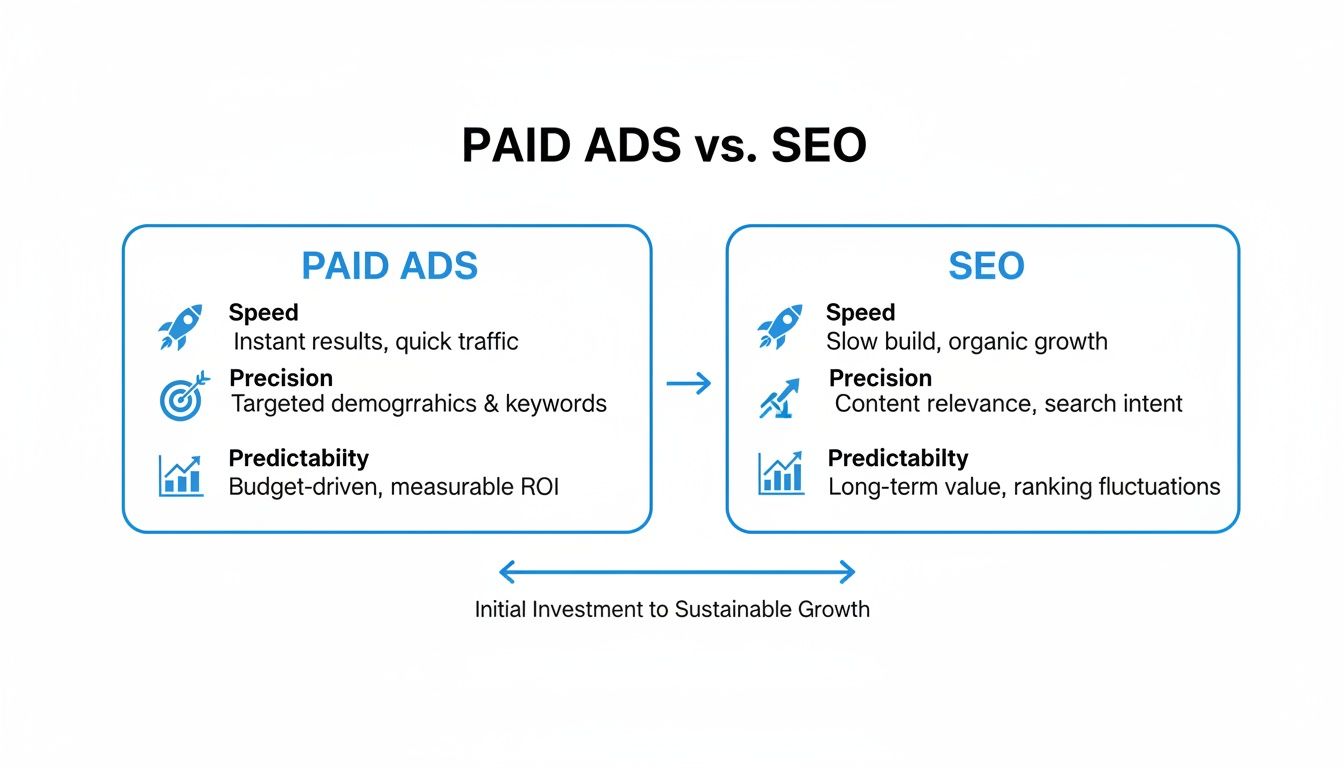
As you can see, paid channels give you the power to launch quickly, zero in on your ideal clients with surgical precision, and forecast your results based on how much you decide to invest.
The Core Strategic Differences
To truly grasp why paid ads are pulling ahead of SEO for law firms, you have to look past the surface. It all boils down to one word: control.
With PPC, you are in the driver's seat. You control your budget down to the dollar, the exact keywords you bid on, the specific audience you want to reach, and where you show up on the search results page. That level of command just isn't possible with organic search, where you're always at the mercy of Google's next algorithm update and your competitors' every move.
For a law firm that needs to generate leads this month, paid advertising isn't just an option—it's a necessity. It turns client acquisition from a waiting game into an on-demand system.
To make the comparison crystal clear, here’s a look at how these two powerful channels stack up for a modern law practice.
Paid Ads vs SEO Head-to-Head Comparison for Law Firms
The table below breaks down the key differences between paid and organic search, focusing on the attributes that matter most to a growing law firm.
| Attribute | Paid Ads (PPC) | Search Engine Optimization (SEO) |
|---|---|---|
| Speed to Impact | Immediate (days to weeks) | Slow (6-18 months) |
| Budget Control | High; direct control over daily/monthly spend | Low; indirect investment in resources |
| Targeting Accuracy | High; granular control over demographics & location | Moderate; based on broad search intent |
| SERP Visibility | Guaranteed top-of-page placement | Earned; fluctuates based on competition |
| Predictability | High; scalable results tied to ad spend | Low; subject to algorithm updates |
This side-by-side view shows that for firms prioritizing immediate, measurable, and scalable growth, the choice is clear. While SEO remains a valuable long-term asset, paid advertising is the engine that can drive near-term success and fuel your firm's expansion in 2025.
How the Digital Landscape Is Shifting Against Organic Search
The old playbook for law firm marketing is officially being rewritten. For years, the undisputed goal was simple: get to the top of Google's organic search results. But the very foundation of how search engines work is shifting, and those hard-won organic rankings are losing their value. The ground beneath traditional SEO is cracking, making paid advertising a much more stable and predictable path to growth.
This isn't just a small tweak; we're witnessing a complete overhaul of the search engine results page (SERP). Google is now aggressively prioritizing paid ads and its own AI-generated answers, shoving organic listings further and further down the page. The blunt reality is that even if you achieve that coveted #1 organic rank, you might still be effectively invisible to your potential clients.
The Rise of the Zero-Click Search
One of the biggest culprits undermining organic search is the surge in AI-powered answers that appear directly on the results page. Features like Google's Search Generative Experience (SGE) are built to give users an immediate, all-in-one answer, completely removing their need to click through to your website. This change effectively hijacks traffic that once flowed freely to top-ranking law firm blogs and articles.
Think about it: when a potential client types in a legal question, Google’s goal is to answer it right there on the spot, often by summarizing—or "scraping"—information from your own website. This AI-generated summary now dominates the most valuable real estate at the top of the page.

In essence, that AI summary box becomes your newest competitor—one that Google itself created and promotes. For any firm relying on informational content to build authority and attract leads, this is a direct threat to your entire client acquisition strategy.
Privacy Changes and the First-Party Data Advantage
There's another major force at play here: user privacy. The slow death of third-party cookies is making it incredibly difficult to track user behavior across different websites. While this change hobbles many advertising platforms, it hands a massive advantage to closed ecosystems with enormous amounts of first-party data. The biggest winner? Google.
As third-party data sources dry up, the hyper-specific targeting available through platforms like Google Ads becomes an even more powerful competitive weapon. Google already knows a user's search history, location, and behavior within its own universe, giving advertisers a level of precision that SEO simply cannot replicate.
Paid advertising within these data-rich environments is the clear workaround. With Google Ads, law firms can pinpoint highly specific demographics, locations, and user intent with incredible accuracy. This capability is quickly becoming one of the main reasons why paid ads outperform SEO in 2025 for landing high-value cases.
When you add it all up, the environment for organic-only strategies looks increasingly tough:
- Shrinking Visibility: Prominent ad carousels and AI answer boxes are pushing organic results below the fold, where click-through rates plummet.
- Traffic Interception: SGE and featured snippets directly answer user questions, killing the incentive for them to ever visit your site.
- Dull Targeting: SEO can only target keywords. Paid ads, on the other hand, can target people based on their specific profiles and behaviors.
The takeaway is clear: the digital playing field is no longer neutral. It's being actively shaped to favor paid channels and instant answers. For law firms that need a reliable, predictable stream of qualified leads to grow, a paid-first or heavily integrated advertising strategy is no longer optional—it's essential.
Paid Ads: The Fast Track to Impact and Scale
For any law firm, the time it takes to get a return on your marketing dollars isn't just a number on a spreadsheet—it's a make-or-break factor for your cash flow and ability to grow. This is where the starkest difference between paid advertising and SEO comes into sharp focus. Paid ads give you a direct, powerful way to generate an immediate impact, turning client acquisition from a slow, simmering strategy into a system you can turn on whenever you need it.
A well-built paid search campaign can go live and start sending highly targeted traffic to your site within days, sometimes even hours. This means your firm is in front of potential clients who are actively looking for legal help right now, not six months down the line. That speed is a massive advantage in the hyper-competitive legal space.
Compare that to SEO, which is, by its very nature, a long game. Building up the domain authority, creating the necessary content, and earning the backlinks required to rank for valuable legal keywords is a marathon, not a sprint. It typically takes a firm 6 to 18 months to see a meaningful, consistent flow of leads from organic search.
The Power of Predictable Growth
Beyond sheer speed, paid advertising gives you a level of control and scalability you simply can't get with SEO. Your firm's visibility is directly tied to your budget. Need to ramp up your personal injury caseload this quarter? You can dial up your ad spend. Just landed a massive case and need to pull back for a bit? You can pause your campaigns with a click.
This control leads to predictable growth. You can model your client acquisition costs and forecast how many leads—and signed cases—a specific budget will generate. It turns your marketing from an unpredictable expense into a scalable growth engine.
The real reason paid ads are set to outperform SEO in 2025 for immediate business goals is simple: you can directly buy predictable outcomes. SEO promises future value, but paid ads deliver measurable results this week.
This predictability is critical for real-world business decisions. For example, if your firm is launching a new family law practice, you can't afford to wait a year for SEO to catch up. A targeted Google Ads campaign lets you enter that market immediately, test your messaging, and start signing clients from day one. Our guide on crafting effective Google Ads for law firms dives much deeper into these specific strategies.
Turning Speed into Real Business Opportunities
The ability to act quickly opens up strategic advantages that are just impossible with an SEO-only approach. Think about these common situations where speed and scale are everything:
- Capitalizing on High-Value Cases: A new local regulation or a major public event can create a sudden surge in demand for a specific case type. Paid ads let you capture that intent the moment it happens.
- Filling the Pipeline Fast: For a new or expanding firm, a healthy pipeline is the key to survival. Paid ads can provide that immediate influx of inquiries you need to build a client base and get revenue flowing.
- Testing New Markets: Before you invest heavily in a new geographic area, you can run a small, localized ad campaign to see what the demand is like and fine-tune your messaging with real-world feedback.
The data backs up this strategic thinking. For law firms with time-sensitive goals, like hitting aggressive client acquisition targets, paid search delivers immediate scale and a much higher short-term conversion velocity than SEO. In 2025, this means firms are allocating more of their budgets to PPC because it delivers measurable traffic and leads in days, while it takes SEO 6–18 months just to catch up. You can explore more on 2025 Google Ads benchmarks from Wordstream to see the numbers for yourself.
At the end of the day, SEO is essential for building your firm's foundational brand equity over the long haul. But paid advertising gives you the tactical agility and immediate financial return you need to fund that long-term growth and win today.
Comparing Financial Returns and Long-Term Value
The financial debate between paid ads and SEO often gets stuck on a simple, tired argument: paid ads are just an expense, while SEO is a permanent asset. While there's a kernel of truth there, it’s an oversimplification that misses the bigger picture of a modern law firm's financial strategy. Let's dig deeper into how each channel actually contributes to your bottom line, both right now and down the road.
The biggest financial advantage of paid advertising is its power to generate immediate revenue contribution. This isn't just about getting clicks; it's about drawing a straight line from your ad spend to signed cases. This direct attribution model lets your firm calculate a crystal-clear Return on Ad Spend (ROAS), turning marketing into a predictable financial lever you can pull anytime.

This immediate cash flow is absolutely critical. It keeps the lights on, covers payroll, and—most importantly—provides the capital to reinvest in more growth. That includes funding your long-term SEO ambitions. Think of it as the engine that powers the entire marketing ecosystem.
Measuring Short-Term Profitability with ROAS
For paid ads, ROAS is the only metric that truly matters. It answers one simple question: for every dollar we put into ads, how many dollars are we getting back in revenue? A positive ROAS means your campaigns are directly profitable, funding their own existence while adding to the firm's bottom line.
Of course, tracking this properly requires more than just counting clicks and form fills. The most successful firms I've worked with track leads all the way through to a signed retainer, assigning a real dollar value to each conversion. Mastering this is the key to making paid ads work, and you can get a deeper look by exploring our guide on the importance of ROI and analytics for lawyer PPC campaigns.
Paid ads provide the financial velocity needed for immediate growth. You invest today and see a measurable financial return this quarter, allowing for rapid, data-driven decisions that can scale your firm quickly.
This immediate financial feedback loop is one of the clearest reasons why paid ads outperform SEO in 2025 for firms focused on aggressive, near-term growth. SEO's payback period is simply too long to meet urgent financial targets.
Balancing with SEO's Long-Term Capital Efficiency
Now, this doesn't mean you should ignore SEO's financial power. Far from it. While it demands a significant upfront investment in content, technical work, and outreach—with a notoriously delayed payback—its long-term ROI can be incredible. Once you secure a top organic ranking, the resulting traffic and leads come at a marginal cost of practically zero. It's incredibly capital-efficient over time.
A 2025 analysis of home-services firms highlights this dynamic perfectly. It found that while a paid ad spend of $2.27 million generated $10.08 million in revenue (a solid 4.4x ROAS), an SEO investment of just $539,651 generated $10.75 million (a massive 19.9x ROAS). The data clearly shows SEO's long-run efficiency. But it also reveals that paid ads produced a comparable amount of absolute revenue in a fraction of the time.
The table below breaks down these core financial trade-offs in a more direct way.
Financial Performance Comparison: Paid Ads vs. SEO
| Financial Metric | Paid Ads (PPC) | Search Engine Optimization (SEO) |
|---|---|---|
| Time to ROI | Short-Term (Weeks to Months) | Long-Term (12-24 Months) |
| Cash Flow Impact | Immediate Revenue Contribution | Delayed Payback Period |
| Cost Structure | Ongoing Operational Expense | Upfront Capital Investment |
| Long-Term Efficiency | Lower; ROI tied to continuous spend | High; traffic is "free" once ranked |
| Financial Risk | Low; easily scalable and pausable | High; significant upfront cost with no guarantees |
Ultimately, the right financial path depends entirely on your firm’s current position and growth goals. If you have the capital and the patience to wait, SEO is a powerhouse investment for the future. But if you need to generate revenue, sign cases, and fund your growth now, paid advertising is an unmatched financial tool to make it happen.
When Paid Ads Are the Smartest Choice for Your Firm
Look, a balanced marketing strategy is always the long-term goal. But let's be realistic—some situations demand immediate results, and that’s where paid advertising shines. Knowing when to pull the paid ads lever is what separates a good marketing plan from a great one. Think of it less as just another marketing task and more as a precision tool for hitting urgent business goals, fast.
For most law firms, the conversation isn't about if paid ads work. It's about when they deliver the biggest punch. These are the real-world moments where the speed and control of pay-per-click (PPC) make it the undeniable winner.
Driving Immediate Growth in High-Stakes Situations
Imagine a multi-car pileup on a major highway in your city. That’s a tragedy, but it’s also a critical, fleeting moment for a personal injury firm. The window to reach people searching for representation is incredibly small—maybe a few days, a week at most.
Waiting around for your SEO to kick in is a non-starter. Search volume for "local car accident lawyer" will explode and then disappear. This is exactly why paid ads outperform SEO in 2025 for time-sensitive cases. You can spin up a targeted ad campaign in a matter of hours, guaranteeing your firm is the first thing potential clients see when they desperately need help.
Here are a few other clear-cut moments when paid ads are the right call:
- New Firm Launch: You're the new kid on the block, and you need to make a splash against firms that have been around for decades. Paid ads get your name out there instantly, driving that first critical wave of inquiries to get cash flowing and build momentum.
- Practice Area Expansion: Let's say your firm is adding a mass torts division. Cracking the first page of Google organically for those keywords could take years. With paid ads, you can jump right into the market, start generating leads, and fine-tune your messaging from day one.
The core advantage of paid ads in these situations is strategic agility. It allows a firm to capitalize on fleeting opportunities and address urgent business needs without being constrained by the long, unpredictable timeline of organic search.
Validating Markets and Messaging
Here’s another way to use paid ads smartly: for market validation. Before you sink a huge investment into opening a new office or launching a niche practice, why not test the waters first? A small, controlled ad campaign gives you invaluable, real-world data on demand, cost-per-lead, and what messages actually connect with people.
For instance, a family law practice thinking about expanding into the next county over can run a geo-targeted PPC campaign for a month. If it brings in a steady stream of qualified leads at a cost that makes sense, you've got a green light for the expansion. If it flops, you just saved yourself a massive headache and a lot of money.
This kind of rapid-fire testing is something you simply can't do with an SEO-only approach, proving once again why paid ads are often the smarter, more decisive choice for growth.
Building an Integrated Marketing Strategy for Your Law Firm
The smartest law firms I work with don't see paid ads and SEO as an either/or decision. They understand it's not a rivalry for budget. Instead, they build a powerful, integrated marketing engine where each channel makes the other stronger. The real goal isn't to pick a winner but to create a hybrid model that pulls in immediate revenue while building long-term, sustainable growth.
This approach works because paid ads and SEO shine at different points in a potential client's journey. Paid ads are second to none for capturing high-intent clients right when they're ready to hire an attorney. SEO is the foundational workhorse, the one that builds your brand authority, trust, and a consistent pipeline of lower-cost leads over time.
When you run both in harmony, your firm can dominate the entire search results page, showing up for clients at every single decision point.
Strategic Budget Allocation for Law Firms
The right budget mix between paid ads and SEO comes down to one thing: your firm's current stage of growth and your business goals. There’s no magic formula here, but a phased approach gives you a clear roadmap. Think of your budget as a direct reflection of your immediate needs versus your long-term ambitions.
Here’s a practical framework I use with my clients, based on their firm's maturity:
-
New or High-Growth Firms (80/20 Split): A new firm needs clients now. It's about survival and cash flow. I'd recommend dedicating 80% of your marketing budget to paid ads for immediate leads and revenue. The other 20% goes into building your foundational SEO—things like technical site health, local listings, and core content—which will pay dividends down the road.
-
Established and Scaling Firms (50/50 Split): If your firm is established, you can afford to play the long game. A 50/50 split lets you maintain a steady stream of high-value cases from paid ads while you aggressively scale your organic presence. This builds a defensible, long-term asset and ultimately drives down your client acquisition costs over time.
The core idea is to use the immediate, predictable revenue from paid advertising to fund the long-term, capital-efficient growth of SEO. One channel fuels the other in a virtuous cycle.
Your Integrated Marketing Checklist
Making a hybrid strategy work requires tight coordination. If your teams are siloed, you’ll just waste money and miss opportunities. By integrating SEO with other digital marketing strategies, you can build a system where the data from one channel directly improves the performance of the other.
Use this checklist to get your paid and organic efforts working together:
-
Define a Unified Client Persona: Make sure your SEO content and your ad targeting are aimed at the exact same ideal client. This kind of consistency is what builds a strong, recognizable brand message.
-
Align Keyword Research: Your PPC campaigns will quickly tell you which keywords convert—the ones with true commercial intent. Feed that real-world data directly into your SEO content strategy. It allows you to prioritize topics that drive actual cases, not just vanity traffic.
-
Implement Robust Conversion Tracking: You need end-to-end tracking that follows a user from their very first click (paid or organic) all the way to a signed retainer. This is the only way you’ll ever know the true ROI of each channel and how they assist each other.
-
Create a Unified Performance Dashboard: Stop looking at Google Ads and Google Analytics reports in isolation. Build a single dashboard that shows your combined performance. This is how you make smarter, holistic decisions about your budget and overall strategy.
Your Top Legal Marketing Questions, Answered
When it comes to digital marketing, law firm partners understandably have tough questions about where their money and effort should go. Let's cut through the noise and get straight to the answers you need to make smart, informed decisions for your firm.
What's a Realistic Paid Ads Budget for My Firm in 2025?
There’s no magic number here, because your budget is tied directly to your practice area, your city, and how fast you want to grow. That said, for a firm in a competitive market, a solid starting point is usually between $5,000 and $15,000 a month. Keep in mind, high-stakes practice areas like personal injury often demand a much bigger investment to see results.
Your actual costs will pivot on a few key factors:
- Competition: The bid for a keyword like "car accident lawyer" in Los Angeles is worlds apart from "family law attorney" in a smaller town.
- Case Value: The more a potential case is worth, the more you can reasonably invest to get that client in the door.
- Your Goal: Are you just trying to get your name out there (brand awareness), or do you need the phone to ring now (lead generation)? Each goal comes with a different price tag.
If Paid Ads Are Working, Can We Just Ditch SEO?
I hear this question all the time, and while it's tempting, it's a huge strategic mistake. Relying solely on paid ads is like renting a house instead of buying one. The second you stop paying the rent, you’re out on the street. Your traffic vanishes overnight.
Think of SEO as the foundation of your firm's digital real estate. It builds lasting brand authority, credibility, and a pipeline of low-cost leads that you own, not rent. A hybrid strategy isn't just better—it's the only sustainable path forward.
Putting all your eggs in one basket is a risky game. What happens when Google's algorithm changes, your ad costs spike, or a new competitor with deep pockets enters the ring? A PPC-only strategy is fragile. The truly smart move is to use the immediate cash flow from paid ads to fuel the long-term, authority-building work of your SEO.
What PPC Metrics Actually Matter for a Law Firm?
Clicks and click-through rates (CTR) are fine, but they're vanity metrics. They tell you people are seeing your ad, not whether it’s actually making you money. To measure what really counts, you have to connect your ad spend to real business outcomes.
For a law firm, these are the three metrics that tell the true story:
- Cost Per Qualified Lead (CPQL): This shows exactly what you’re paying for a lead that has a legitimate chance of becoming a signed case.
- Client Acquisition Cost (CAC): This is the bottom line. It’s the total marketing cost—from first click to final signature—to land a new client.
- Return on Ad Spend (ROAS): This is the simplest measure of profitability. For every dollar you put into ads, how many dollars in revenue came back out?
When you focus on these metrics, you stop guessing and start running campaigns that drive measurable growth for your firm.
At RankWebs, we build proven frameworks that help law firms answer these questions with confidence. Find out how to create a balanced, results-driven marketing strategy by visiting us at https://rankwebs.com.