


Using ChatGPT for law firm marketing isn't some far-off idea anymore—it's a real, hands-on way to work smarter and connect with more clients. Think of it as a powerful assistant, one that helps you draft SEO-friendly content, automate parts of your client intake, and organize your marketing efforts, all with you in the driver's seat.
The Reality of AI in Modern Legal Marketing

Let's be clear: bringing AI into your marketing plan isn't about replacing lawyers with algorithms. It’s about giving your team a tool that can take over the tedious, time-draining tasks. This frees up your skilled professionals to do what they do best—practice law and build client relationships.
Consider ChatGPT a force multiplier for your firm. It can sketch out a blog post in seconds, generate a month's worth of social media ideas, or help you test different ad headlines. This gives smaller firms a fighting chance to compete with the big players, letting you produce high-quality content without needing a massive marketing department.
How Clients Are Finding Lawyers Now
The search for legal help is evolving. Google is still king, of course, but there's a new behavior taking root. People are starting to use conversational AI for their initial research, asking detailed questions they wouldn't normally type into a search engine.
This isn't a slow trickle; it's a flood. Projections show that by 2025, the number of potential clients using tools like ChatGPT to find a lawyer will jump from 9% to over 28% in just two years. What’s really telling is that 94% of those users still turn to Google to double-check what they find. This points to a new dual-search habit you can't ignore.
This shift is a major signal for law firms. Your online strategy needs to cater not only to traditional search engines but also to the AI platforms that are quickly becoming the first stop for people seeking legal guidance.
Setting the Right Expectations
Before you jump in, it's crucial to have the right mindset. ChatGPT is an incredibly useful tool, but it comes with some hard-and-fast rules. It’s an assistant, not a substitute for a legal expert.
Here's what that looks like day-to-day:
- Human Oversight is Non-Negotiable: A qualified legal professional must review, edit, and sign off on every single piece of AI-generated content for accuracy and ethical compliance.
- Client Confidentiality is Absolute: Never input confidential client information into ChatGPT. Protecting attorney-client privilege is your top priority.
- AI Augments, It Doesn't Replace: The goal is to make your team more effective, not to replace the nuanced judgment and experience that only a human professional can provide.
Getting these ground rules straight from the beginning is key. For a deeper dive into this strategic shift, check out our guide on how AI is changing law firm marketing. With this approach, you can ethically and effectively build a smarter marketing engine for your firm.
Building Your Law Firm's AI Content Engine

Before you can get ChatGPT to create compelling marketing content, you need to turn it from a generalist tool into a specialized assistant that truly gets your firm's unique identity. It all starts with a proper setup and then systematically teaching the AI what makes your practice stand out.
First things first, you’ll face the choice between the free version of ChatGPT and a paid subscription like ChatGPT Plus. While the free version is a good starting point, any law firm serious about marketing should view the paid tier as a non-negotiable investment. It delivers better performance, priority access, and access to more powerful models and features.
More importantly, paid plans offer better data privacy controls—an absolute must for any legal practice. You're building a key part of your marketing operations here. The small monthly fee is a necessary business expense for the reliability and security you gain.
Define Your Firm's Voice and Tone
Stop before you write a single prompt. The first real step is creating a "Brand Voice" document. This internal guide is your blueprint for training ChatGPT to produce content that sounds like it came from you, not a machine. Generic content simply won't connect with potential clients facing real legal challenges.
Your brand voice document should be crystal clear on a few points:
- Tone of Voice: How do you want to sound? Are you empathetic and reassuring, or direct and authoritative? Pin down 3-5 core attributes like "Compassionate, Professional, and Clear."
- Target Audience Personas: Who are you really talking to? Create a profile of your ideal client for each practice area, digging into their specific pain points and what they desperately need to hear from an attorney.
- Key Differentiators: What makes your firm the right choice? List your unique selling points, whether it’s a specific track record of success, a hyper-local focus, or a truly client-first approach.
- Formatting Rules: Get specific. Do you use the Oxford comma? Do you prefer an active voice? Are your paragraphs short and to the point? Nail these details down now.
This document is your source of truth. You’ll be feeding snippets of it directly into ChatGPT’s instructions to ensure every single piece of content feels authentic to your brand.
Use Custom Instructions for Unwavering Consistency
This is where the magic happens. The "Custom Instructions" feature is how you turn that brand voice document into direct orders for the AI. It allows you to provide background information that ChatGPT remembers for every single conversation, saving you from repeating the same instructions over and over again.
Here’s a practical way to structure it:
-
"What would you like ChatGPT to know about you to provide better responses?"
- This is your firm's bio. Be specific about your practice areas, the states you serve, and your ideal client. For example: "I am the marketing director for a personal injury firm based in Austin, Texas. We handle car accidents, slip and falls, and wrongful death cases. Our clients are everyday people looking for compassionate, straightforward legal help after a traumatic event."
-
"How would you like ChatGPT to respond?"
- This is where you translate your brand voice rules into commands. Try something like: "Write in a professional yet empathetic tone. Avoid legal jargon and use plain English. All content must be easy to read online, using short paragraphs and bullet points. Always conclude blog posts with a call-to-action inviting readers to contact our firm for a free consultation."
By setting these instructions, you're essentially programming a baseline personality for your AI assistant. It’s the single most important step for achieving consistent, high-quality outputs and a crucial part of using ChatGPT for law firm marketing successfully.
This foundational work is what elevates ChatGPT from a simple text generator into a true extension of your marketing team—one that's ready to create on-brand materials at a moment's notice.
Mastering Prompts for High-Impact Legal Content
If you've ever tried using ChatGPT and gotten a bland, uninspired result, you've experienced a fundamental truth: generic prompts lead to generic content. To get the AI to produce marketing copy that actually connects with potential clients, you have to get good at writing detailed instructions.
Think of it like briefing a junior associate. The more precise your directions, the better the final work product. It's not about being a tech genius; it's about being a clear communicator.
The best prompts I've seen—and the ones we use every day—are built on three core pillars: Context, Persona, and Constraints. Giving the AI a clear understanding of the situation, who it should be, and the rules it must follow is the difference between a vague, unusable draft and a polished piece that feels like it came directly from your firm.
This simple flowchart breaks down how these pieces fit together.
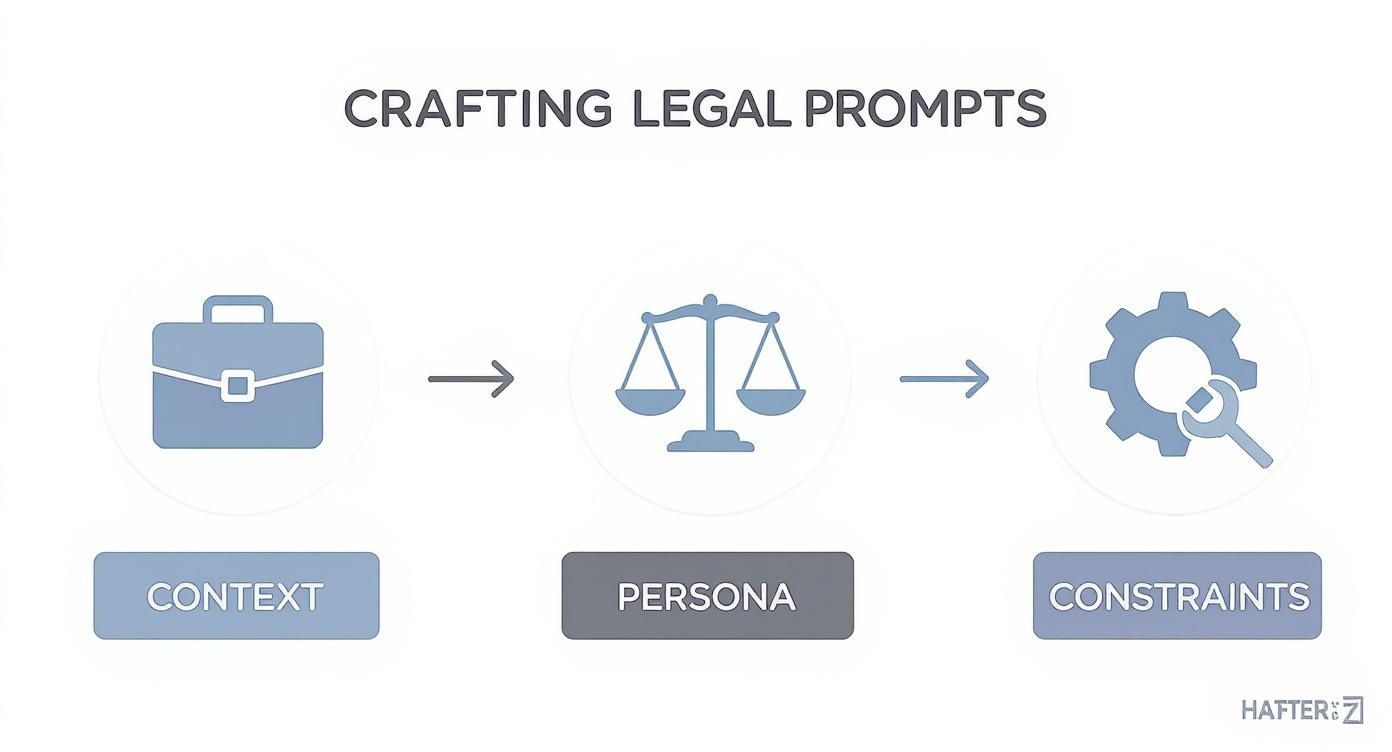
As you can see, you start with the foundational context, layer on a specific persona, and then apply clear constraints. This gives the AI a structured command it can execute effectively.
Setting the Scene With Rich Context
Context is the "what" and "why" behind your request. It’s the background information that grounds the AI, so it isn't just guessing what you want.
Simply asking for "a blog post about car accidents" is a recipe for a cookie-cutter article that won't rank or resonate. You need to give it the crucial details that make the topic relevant to your firm and your ideal client.
So, what does rich context look like in practice?
- Practice Area: Be specific. Is this for a personal injury firm? A criminal defense firm handling DUIs?
- Geographic Location: This is critical. Mention the city and state, since laws and local concerns vary wildly.
- Topic Specificity: Drill down from "car accidents" to something like "the first 5 steps to take after a minor car accident in Houston, Texas."
- Target Audience: Who are you talking to? Define them clearly: "drivers who have never been in an accident before and are feeling overwhelmed and unsure of their rights."
This level of detail immediately narrows the AI’s focus, ensuring the output is truly helpful for someone in that specific legal and emotional situation.
Adopting the Right Persona
Next up is the "who." This is where you tell ChatGPT what voice and tone to adopt. Is it a seasoned partner offering authoritative advice, or a compassionate guide speaking to a victim’s anxieties? Your firm's brand voice is the perfect source for this.
By assigning a persona, you turn the AI from a bland information machine into a character that can actually connect with your audience. An effective persona command includes both a role and specific tonal attributes.
My Pro Tip: Don't just tell ChatGPT to be "professional." That's too vague. Instead, combine a role with descriptive adjectives. A prompt asking it to act as a "compassionate and reassuring personal injury lawyer from Texas" who is "calm, clear, and avoids complex legal jargon" will produce a far more empathetic and readable piece of content.
Defining Clear Constraints and Formatting
Finally, you need to set the rules. Constraints are the "how" and "what not to do" of your prompt. This is your chance to control everything from word count and structure to SEO keywords and the final call to action.
Effective constraints are specific and actionable. They leave no room for misinterpretation and ensure the content is ready for its intended destination, whether that’s your website’s blog or a LinkedIn post.
Here are a few essential constraints to get you started:
- Word Count: "The blog post should be approximately 800-1,000 words."
- Structure: "Organize the content with an introduction, three main sections with H3 subheadings, and a conclusion."
- SEO Keywords: "Naturally include the following keywords: 'Houston car accident lawyer,' 'what to do after a crash,' and 'Texas auto accident steps'."
- Formatting: "Use short paragraphs (2-3 sentences max) and include a bulleted list summarizing the key takeaways."
- Call to Action (CTA): "End with a clear CTA inviting the reader to call our firm for a free, no-obligation consultation."
When you combine all three elements, you get a comprehensive brief that guides the AI to produce exactly what you need.
Here are a few prompts I’ve used that follow this structure, showing how you can apply it to different marketing tasks.
Sample ChatGPT Prompts for Law Firm Marketing Tasks
| Marketing Task | Example Prompt Structure |
|---|---|
| Blog Post Idea Generation | Context: I am a family law attorney in Chicago focusing on high-net-worth divorce. My target audience is affluent individuals concerned about asset protection. Persona: You are a marketing strategist specializing in legal content. Your tone is sophisticated and discreet. Constraints: Generate 10 blog post titles that address my audience's specific pain points. The titles must be engaging and SEO-friendly. |
| Website Service Page | Context: Write a service page on "Slip and Fall Accidents" for my personal injury firm's website in Miami, Florida. The goal is to explain premises liability and encourage potential clients to contact us. Persona: Act as an expert personal injury attorney. Your tone should be authoritative but accessible, avoiding overly technical legal language. Constraints: The page must be 700 words. Include the keyword "Miami slip and fall attorney" 5 times. Format with short paragraphs and H3 subheadings for readability. End with a CTA to "Schedule a Free Consultation." |
| Social Media Post | Context: Create a LinkedIn post for my business immigration law firm based in Silicon Valley. The topic is the recent changes to H-1B visa requirements. The audience is tech startup founders and HR managers. Persona: You are a knowledgeable and forward-thinking immigration lawyer. Your tone is informative and confident. Constraints: The post must be under 200 words. Use 3-5 relevant hashtags like #H1B, #BusinessImmigration, and #StartupLaw. Include a link to our detailed blog post on the topic. |
| Email Newsletter Snippet | Context: Draft a short section for my real estate law firm's monthly email newsletter. The topic is the importance of title insurance for first-time homebuyers in Austin, Texas. Persona: You are a friendly, helpful real estate attorney who wants to educate and empower clients. Your tone is reassuring and easy to understand. Constraints: The snippet should be around 150 words. Use a bulleted list to highlight 3 key benefits of title insurance. End by inviting readers to contact us with questions. |
Getting this three-part structure down—Context, Persona, and Constraints—is the key to making ChatGPT a genuinely useful tool for your firm's marketing. It allows you to move beyond just generating words and start creating strategic assets that attract, inform, and convert the clients you want.
Automating Client Intake and Firm Workflows

While generating content is a huge win, the real operational magic of ChatGPT happens when you use it to automate the repetitive tasks that eat up your staff's valuable time. I'm talking about the administrative drag that bogs down your paralegals and intake specialists day in and day out.
Client intake is the perfect place to start. Every single person who reaches out is a potential case, but that initial flood of inquiries can be completely overwhelming. This is where you can use AI to build a system that ensures no lead ever falls through the cracks.
Building a 24/7 Digital Front Desk
Picture this: it’s 10 PM, and a potential client, stressed and searching for help after a car accident, lands on your website. Your office is closed, but an intelligent chatbot is there to greet them. By plugging into the ChatGPT API, you can essentially build a digital front desk that never sleeps.
This isn't just a glorified contact form. A properly configured chatbot engages people conversationally, asking the crucial qualifying questions you need answers to.
- Gathering Basic Case Details: The bot can ask for the date of the incident, a quick summary of what happened, and the type of injuries they sustained.
- Asking Qualifying Questions: You can program it to screen for key criteria, like whether they've already hired an attorney or if they were at fault. This helps filter inquiries before they even hit your team's desk.
- Managing Expectations: The bot can clearly explain the next steps, letting the person know that a team member will review their information and be in touch during business hours.
This first touchpoint provides immediate value to the potential client while delivering a neat, structured summary to your intake team. It frees your staff from mind-numbing data entry and lets them focus on having high-value conversations with genuinely qualified leads. We cover the nuts and bolts of this in our complete guide to AI intake for law firms.
Integrating AI with Your Existing Tech Stack
The real power here is unlocked when you get ChatGPT talking to the tools your firm already uses every day. This is where integration platforms like Zapier or Make come into play. Think of them as the universal translators that let ChatGPT communicate with your CRM, email platform, and case management software.
You're essentially creating an automated assembly line for client data. Instead of someone manually copying information from a web form and pasting it into your CRM, you can build automations that do it instantly.
Connecting ChatGPT to your CRM is a game-changer. An inquiry comes through your website chatbot, and an automation instantly creates a new contact record in Clio or Lawmatics, summarizes the conversation, and assigns a task for an intake specialist to follow up.
This kind of seamless integration practically eliminates the risk of human error and dramatically cuts down your response time—a critical advantage in a competitive legal market.
Real-World Automation Scenarios
Let's get practical. Here are a couple of tangible workflows you can set up right now to slash manual work and improve how you communicate with potential clients:
-
Automated Inquiry Summaries: When a new lead form hits your website, an automation can grab the text and send it to ChatGPT with a simple prompt: "Summarize this client inquiry into five bullet points, highlighting the practice area, incident date, and primary legal issue." That clean summary then gets posted directly into a dedicated Slack channel for your intake team to see immediately.
-
Drafting Personalized Follow-Up Emails: Once a new contact is created in your CRM, it can trigger an automation that sends the client's details to ChatGPT. The prompt could be something like: "Draft a warm, empathetic follow-up email to this potential personal injury client. Acknowledge their recent car accident and confirm that our team will be calling them shortly to discuss their case." The output is then saved as a draft in your email, ready for a quick one-click review and send.
These automations don't replace the human touch; they amplify it. By handling the tedious first steps, they empower your legal pros to connect with potential clients faster and with better context, creating a far better experience from the very first interaction.
Navigating Ethical Obligations and Data Privacy
Bringing AI like ChatGPT into your law firm’s marketing is a game-changer for efficiency, but it also brings a whole new set of ethical lines you absolutely cannot cross. Your duty to protect client confidentiality and uphold attorney-client privilege isn't just a guideline; it's the foundation of our profession. That doesn't change when you start using AI.
Let's get straight to the point. The golden rule is simple: never, ever input confidential or personally identifiable client information into a public AI model. No names, no case details, no specific dates—nothing that could even hint at a client's identity. You have to treat the platform as if everything you type will be plastered on a billboard. Many of these public models learn from user inputs, and you can't risk that.
This isn’t just about client data, either. The same goes for any privileged internal firm communications or proprietary work product. The convenience of having an AI summarize a complex document for you is never worth the catastrophic risk of a data leak.
The Unwavering Duty of Supervision
Think of ChatGPT as the world's most enthusiastic, yet completely unsupervised, junior paralegal. It's brilliant one moment and can confidently make things up the next. This is why the ethical duty of supervision is non-negotiable. A licensed attorney must personally review, verify, and approve every single word of AI-generated content before it sees the light of day.
This human oversight is your firm’s only real defense against some unique risks that come with AI:
- AI "Hallucinations": This is when an AI just invents things and states them as fact. It might cite a non-existent case, misquote a statute, or create a legal precedent out of thin air. It happens more often than you'd think.
- Legal Inaccuracies: The AI’s knowledge is only as good as its last training update, which could have been years ago. It also doesn't understand jurisdictional nuances. It cannot, under any circumstances, provide legal advice.
- Misleading Information: Your marketing content has to play by your state bar’s advertising rules. An AI might accidentally generate copy that over-promises results or creates an unjustified expectation, putting your firm in hot water.
At the end of the day, the buck stops with a licensed attorney. You are responsible for the accuracy and ethical compliance of your firm's marketing content, not the AI. There are no excuses for publishing something that's wrong or misleading.
Fact-Checking and Upholding Professional Standards
Every single claim, statistic, or legal point generated by ChatGPT needs to be meticulously fact-checked. If the AI drafts a blog post on local premises liability laws, an attorney practicing that law in that specific jurisdiction must confirm every detail is accurate and current.
It's also worth keeping AI's real-world impact in perspective. While its role is growing, we aren't seeing a flood of traffic from it just yet. For instance, recent data from late 2025 shows that ChatGPT drives only about 0.4% of total traffic to the average attorney's website. That number can creep up to 1.7% in specialized areas like Employment Law, but it shows we're still in the early days.
This reality only reinforces the need for human-verified, expert-driven content. As you work through these challenges, digging deeper into AI-generated content for law firms will give you the context needed to maintain your firm's hard-earned credibility.
Using AI in your marketing is all about balancing its incredible power with your professional judgment. If you establish strict data protocols and a rock-solid human review process, you can use these tools to your advantage—safely, effectively, and without compromising the ethical duties you swore to uphold.
Measuring Success and Optimizing Your AI Strategy
Look, getting ChatGPT integrated into your marketing is a great first step, but it's just that—a first step. The real magic happens when you start tracking what’s working, what’s falling flat, and have the guts to adapt. Success isn't about pumping out more content. It's about getting that content to hit specific, meaningful business goals for your firm.
Your focus needs to be laser-sharp on the key performance indicators (KPIs) that actually move the needle. Sure, social media likes are a nice little ego boost, but they don't keep the lights on. Let's concentrate on the data that shows real-world impact.
Defining Your Core AI Marketing KPIs
To get a real sense of whether your AI-assisted efforts are paying off, you have to zero in on the metrics that reflect genuine client interest and firm growth. This is where you get a clear picture of your return on investment.
Start by getting a handle on these essential data points:
- Website Traffic from New Content: Keep a close eye on the organic traffic hitting the blog posts and service pages you've created with ChatGPT's help. Are people actually finding them through search engines?
- Lead Generation and Conversion Rates: This is the big one. How many contact forms or phone calls can you trace back to your AI-enhanced landing pages? This tells you if your copy is actually compelling someone to act.
- Time and Cost Savings: Do the math. Figure out how many hours your team is saving by automating first drafts or initial client messages. Then, put a dollar value on that time to see the true efficiency gains.
The New Landscape of AI Search
The way potential clients find legal help is undergoing a massive shift. While getting direct clicks to your website from a ChatGPT conversation is still in its infancy, this new kind of "AI search" is an opportunity you can't ignore. People are having longer, more detailed conversations with AI, which signals a much higher level of intent.
This means your firm’s content has to be the real deal—authentic, expert-driven, and the kind of stuff an AI model would actually trust and cite. Fluffy, surface-level articles just won't cut it anymore. Your goal is to become the source of truth for your practice area.
Let's not forget the financial side of things. The competition is fierce, and we're seeing pay-per-click (PPC) costs for competitive legal keywords hitting an insane $1,000 per click. In this kind of market, investing in high-quality, AI-optimized content isn't just a smart move; it’s a financial necessity if you want to stay visible without a ridiculously high ad spend. If you want to dig deeper, check out these insights on skyrocketing law firm marketing costs.
Creating a Cycle of Review and Refinement
Your AI marketing strategy can't be a "set it and forget it" project. The tech is always changing, client search habits evolve, and your firm's own goals will shift. You absolutely need a regular, disciplined process for reviewing performance and making smart, data-driven tweaks.
I recommend doing this every quarter. Sit down with your team and ask the hard questions:
- Which content topics are bringing in the best leads? Find out what’s resonating with your ideal clients and then double down on it.
- Are our automated intake systems saving time without hurting lead quality? Maybe it's time to adjust your chatbot's questions to better screen inquiries.
- Is our content getting picked up by AI models? It's worth using a few prompts to see how AI summarizes topics in your field and whether your firm's content is being used as a source.
By constantly measuring, learning, and refining, you’ll go from just using ChatGPT to strategically mastering it for your law firm's marketing. This is the iterative process that will keep your firm agile, efficient, and—most importantly—visible in a ridiculously competitive market.
Your Questions Answered
When law firms start exploring AI for marketing, a few key questions always come up. It's smart to be cautious. Think of ChatGPT as a powerful assistant—one that needs constant supervision from a licensed attorney, not a replacement for your legal expertise or ethical judgment.
Can ChatGPT Provide Legal Advice?
Let's be crystal clear: absolutely not. This is the brightest red line you can't cross.
ChatGPT is a language tool; it has zero legal training, no license to practice, and no concept of jurisdiction. Any "legal-like" text it generates must be treated as unverified information and reviewed meticulously by a qualified lawyer. Letting AI generate legal advice isn't just a bad idea—it's a serious ethical violation.
Is It Safe to Use Client Information with ChatGPT?
Another hard no. You have to assume that anything you type into a public AI tool could be absorbed into its training data.
Never, ever input confidential, privileged, or personally identifiable client details. Doing so is a direct breach of attorney-client privilege and your fundamental duty of confidentiality. Stick to anonymized or completely hypothetical scenarios for all your prompts.
The non-negotiable rule when using ChatGPT for law firm marketing is that client data stays out. Your ethical duties to protect client information always come first, without exception. Protecting your client's privacy is paramount.
How Can We Make Sure AI Content Sounds Like Our Firm?
This is where the human element really shines. It all comes down to giving the AI a solid brief.
Before you even start, nail down your firm's brand voice. Document your tone (e.g., authoritative but approachable), style preferences, and who your ideal clients are. Then, plug these details into ChatGPT's "Custom Instructions" feature. This essentially trains the AI on your brand, so the content it produces feels authentic to you from the get-go.
What’s the Real ROI of Using ChatGPT?
The return on investment really boils down to two things: efficiency and opportunity.
- Efficiency: You'll save a ton of time. Think about how much faster you can draft blog posts, summarize client inquiries, or handle repetitive administrative tasks. That time saved is time your team can spend on billable hours or high-value strategy.
- Opportunity: You can scale your marketing without scaling your budget. Producing a steady stream of high-quality, SEO-optimized content becomes much more manageable. Over time, that improved online visibility brings in more of the right kinds of leads.
At RankWebs, we provide the actionable insights and proven frameworks your firm needs to navigate these changes. Discover strategies designed specifically for the legal industry.