


The future of law firm marketing isn't a subtle evolution; it's a complete paradigm shift. By 2025, success will be defined by a decisive pivot away from scattered, old-school tactics toward a fully integrated, digital-first strategy. Relying on print ads and a static website is no longer enough. The firms that win will be those that use technology to build efficient, data-driven, and genuinely client-focused marketing machines.
Charting the Course for Digital Dominance

Think about a small personal injury firm that built its practice on local newspaper ads and a couple of well-placed billboards. For years, it worked. But now, the phones are quieter. Why? Because their ideal clients aren't scanning the classifieds; they're on their smartphones, searching for "car accident lawyer near me" at 10 PM. This isn't a hypothetical; it's the reality for countless firms that are falling behind the curve.
The marketing rulebook has been torn up and rewritten. The challenge now isn't about shouting the loudest with broad-stroke advertising. It's about being present and helpful in the exact moments a potential client needs you, meeting them online with the right answer at precisely the right time.
The numbers don't lie. By 2025, an estimated 65% of law firms will dedicate the lion's share of their marketing budgets to online channels. This isn't a guess—it's a direct response to client behavior, especially when you see that 66% of legal call conversions now come directly from organic search. You can dig deeper into these law firm marketing statistics from recent industry studies to see just how profound this shift is.
Old Playbook vs. New Strategy
To thrive, you have to understand this fundamental pivot. The old methods were about broadcasting a one-way message. The new strategy is about creating two-way connections through technology. It’s about building a marketing engine that runs 24/7, attracting, engaging, and converting potential clients with an efficiency that was unimaginable a decade ago.
Throughout this guide, we'll unpack the critical components of a modern marketing plan. We’ll look at how AI can become a force multiplier for your small team, how to master the crucial balance between paid ads and organic search, and why the client's digital experience is your single most powerful marketing asset.
The core of the future of law firm marketing in 2025 isn't about replacing lawyers with robots. It’s about empowering them with smart tools that automate repetitive tasks, deliver sharper insights, and free them up to do what they do best: practice law and build rock-solid client relationships.
The table below gives you a clear, side-by-side look at this transformation, contrasting the outdated tactics with the modern strategies you need to master.
Law Firm Marketing Then vs Now: A 2025 Snapshot
This table contrasts traditional law firm marketing methods with the modern, digital-first strategies essential for success in 2025.
| Marketing Pillar | Traditional Approach (Pre-2020s) | 2025 Digital-First Strategy |
|---|---|---|
| Client Acquisition | Print ads, billboards, generic mailers | Hyper-local SEO, targeted Google Ads, social media |
| Lead Nurturing | Manual follow-up calls and emails | AI-driven email automation, personalized content |
| Client Intake | Paper forms, in-person meetings | Digital intake forms, 24/7 automated chatbots |
| Brand Building | Local reputation, word-of-mouth | Online reviews, expert content, video marketing |
Seeing the old versus the new laid out like this makes it clear: the path forward is digital. Firms that embrace these changes won't just survive; they will set the new standard for growth and client service.
1. AI is Now Your Marketing Team's Cornerstone
Let's be clear: artificial intelligence isn't some far-off concept anymore. It's here, and it’s fundamentally changing how successful law firms find and connect with clients.
Think of AI as the ultimate marketing paralegal. It takes on the data-crunching, repetitive work that eats up so much time, which frees up your team to focus on what humans do best: building relationships and thinking strategically. For smaller firms, this is a game-changer. It puts sophisticated marketing tools within reach, letting you compete with the big players without needing a massive budget.
The numbers don't lie. The legal industry's adoption of AI has been explosive, jumping from just 19% in 2023 to a massive 79% in 2024. Right now, 45% of legal professionals are using it every single day. This isn't just a trend; it's a fundamental shift in how law firms operate and grow.
Automate Lead Qualification Around the Clock
One of the most powerful, immediate wins with AI is that you never have to miss a lead again. An AI-powered chatbot on your website is your 24/7 receptionist, ready to engage potential clients the moment they land on your site.
Picture this: someone gets into a car accident at 11 PM on a Friday. They aren't waiting until Monday morning to find a lawyer. They're online, right now, looking for help. A well-designed chatbot can instantly:
- Ask critical qualifying questions ("Were you injured in the accident?").
- Capture their name, phone number, and email.
- Even schedule them for an initial consultation directly in your calendar.
By the time you get your morning coffee, you have a qualified lead already on the books. You didn't just capture a client you would have otherwise lost; you provided a seamless, immediate response that starts the relationship off on the right foot.
Create Hyper-Relevant Local Content
Great content is the engine of your SEO, but consistently creating high-quality, localized articles is a huge resource drain. This is where AI content tools become an incredible assistant, helping you scale your efforts without compromising on quality.
Let's say you're a personal injury firm in Austin. You can use AI to:
- Brainstorm local topics: Quickly generate a list of blog ideas like "What to Do After a Bike Wreck on South Congress" or "How to Navigate an Accident in an I-35 Construction Zone."
- Build smart outlines: Structure an article with all the key headings and talking points relevant to Texas law and local Austin landmarks.
- Produce a solid first draft: Get a well-written draft that your legal experts can then review, refine, and inject with their own hard-won experience.
A Word of Caution: AI is a tool, not a replacement for your expertise. The "human-in-the-loop" model is absolutely essential. An attorney must always review any AI-generated content to ensure it’s legally accurate, reflects your firm's voice, and meets ethical standards.
This blend of AI efficiency and human oversight is what the future of law firm marketing in 2025 looks like. It lets you produce more content that speaks directly to the questions clients in your city are asking. For a look at the different platforms out there, check out our guide on the top AI tools for legal marketing.
Implement Personalized Email Nurturing
Very few potential clients are ready to sign a retainer after one visit to your website. They need more information and more time. AI-driven email automation helps you stay in front of them with personalized messages that actually feel helpful.
Stop sending generic newsletters. Instead, you can build automated email sequences triggered by a person's specific legal issue.
- Someone who inquired about a car accident could get a series of emails about dealing with insurance adjusters, the personal injury claim timeline, and examples of past cases you’ve won.
- A lead for a slip and fall might receive content about premises liability law and the importance of documenting their injuries.
This kind of tailored follow-up builds trust and positions your firm as the go-to expert. When they’re finally ready to make a decision, you’re the obvious choice.
Balancing the Books: Paid vs. Organic Search
In the legal world, marketing often feels like a balancing act. You've got paid ads on one side, promising instant leads, and organic SEO on the other, offering slow but steady growth. Many firms get stuck, unsure where to place their bets. But the smartest play in 2025 isn't about choosing one over the other—it's about making them work together.
Think of SEO as buying property for your firm online. Every great blog post you write or backlink you earn is like adding a new room or a valuable upgrade. This digital real estate gains value over time, bringing in a consistent flow of "free" traffic and cementing your reputation as an authority. It’s a long-term asset that keeps paying you back for years.
Pay-Per-Click (PPC) ads, on the other hand, are like renting a massive billboard on the busiest highway in town. As soon as you pay, your firm is front and center, pulling in immediate traffic and phone calls. But the moment you stop paying the rent, that billboard comes down, and the traffic disappears. It's all about speed and visibility, but it demands a constant cash flow.
The Rising Price of "Renting" Your Audience
The problem with renting that billboard space is that the price is going up—fast. For law firms, the costs are becoming astronomical. By 2025, the average cost-per-click (CPC) in the legal sector is projected to hit $8.58, with the cost-per-lead (CPL) climbing to a staggering $131.63. These aren't just numbers; they're a warning sign that a data-driven, strategic approach to paid search is no longer optional.
Simply throwing more money at Google Ads is a recipe for disaster. To get a positive return, firms have to get incredibly smart about how they spend.
How to Make Paid and Organic Work Together
The most successful firms don't treat paid and organic search as separate silos. They see them as two sides of the same coin, with data from one feeding directly into the strategy for the other.
Here’s how you can create that powerful synergy:
- Test-Drive Keywords with PPC: Before you pour hours into writing a definitive guide on a legal topic for SEO, run a small ad campaign targeting those keywords. If the ads get clicks and—more importantly—qualified leads, you've just proven the topic is worth a long-term investment.
- Borrow Winning Language from Your Ads: Look at your best-performing ads. Which headlines and descriptions get the most clicks? That’s your audience telling you exactly what they want to hear. Weave that same powerful language into your website’s page titles, meta descriptions, and headers to boost your organic click-through rate.
- Bring Visitors Back with Retargeting: Someone might find your blog through a Google search, read a great article, and then leave. Use paid ads to follow up. If they read your post on "what to do after a truck accident," you can show them a simple ad offering a free case evaluation, gently reminding them why they came to you in the first place.
The goal is to build a self-sustaining feedback loop. Paid ads give you instant data on what works right now, while SEO builds the long-term authority that steadily lowers your dependency on paying for every single click.
Squeezing Every Drop of Value from Your Ad Budget
With ad costs on the rise, every dollar has to count. This means moving away from broad, "spray-and-pray" campaigns toward hyper-focused initiatives. If you're new to the game or need to sharpen your strategy, this in-depth guide to Google Ads for law firms is a great place to build your foundation.
Here are three practical ways to make your ad spend work harder:
- Focus on High-Intent Keywords: Go all-in on terms that signal someone is ready to hire a lawyer, like "personal injury lawyer near me" or "car accident attorney free consultation." These are the money keywords.
- Get Hyper-Local with Your Targeting: Don't target an entire state when your clients come from a 30-mile radius. Narrow your ads to specific cities, zip codes, or even a few miles around your office. This stops you from wasting money on clicks from people you can't actually help.
- Use Negative Keywords Relentlessly: You have to tell Google what you don't want. A personal injury firm should constantly be adding terms like "pro bono," "legal jobs," and "criminal defense" to their negative keyword list. This one step can save you thousands on irrelevant clicks.
Winning the Local SEO Battleground

For most law firms—especially those in personal injury or smaller practices—local search isn't just part of the marketing plan. It’s the whole game. Looking ahead to 2025, it's clear Google no longer works like a simple list of websites. It's become a local "answer engine."
When a potential client searches for a lawyer, Google's main job is to solve their problem right there on the results page. This fundamental shift makes one asset more critical than almost any other: your Google Business Profile (GBP). It's not just a listing anymore; it's your digital front door.
A neglected GBP is a constant missed opportunity. But a fully optimized profile? That becomes a client-generating machine, working for you around the clock. It's what separates the invisible firms from the first one someone calls after an accident.
Turning Your GBP Into a Client Magnet
Start treating your Google Business Profile with the same care you give your firm’s homepage. It needs constant attention, fresh content, and active engagement to show Google that your firm is authoritative, active, and relevant to people searching nearby.
Of course, the first step is making sure every field is complete and accurate. The real work, though, is in the active management. That means you need to be:
- Gathering a steady stream of reviews. Positive reviews are the most powerful form of social proof you have. A consistent flow of new reviews is a huge trust signal for both potential clients and Google's algorithm.
- Using the Q&A feature proactively. Don't just wait for people to ask questions. Get ahead of it by populating this section with clear answers to common questions about consultations, fees, and case types.
- Publishing localized content. Regularly upload high-quality photos of your team and office. Use Google Posts to share case results, talk about community involvement, or offer helpful legal tips.
Think of your GBP as a living, breathing entity. Every positive review, every answered question, and every new photo feeds the algorithm, telling Google that your firm is a credible and engaged local business.
Mastering the Art of the Five-Star Review
Reviews are the lifeblood of local SEO. In the future of law firm marketing 2025, you absolutely must have a proactive strategy for getting them. You can't just cross your fingers and hope happy clients leave a review; you have to make it easy and natural for them to do so.
Set up a simple, automated system. When a case concludes successfully, send a follow-up email or text with a direct link to your GBP review page. This one small step removes all the friction and dramatically increases the chances you'll get that valuable feedback.
And when a review does come in—good or bad—respond quickly and professionally. A thoughtful reply to a positive review shows you’re grateful, while a constructive response to a negative one shows you take feedback seriously. This public conversation builds trust with everyone who sees your profile.
Building Authority Beyond Your Profile
While your GBP is the centerpiece, true local dominance comes from building authority all over the web. This means showing your firm's deep connection to the local community through citations and backlinks.
- Local Citations: Make sure your firm’s name, address, and phone number (NAP) are listed identically across all major legal directories like Avvo, FindLaw, and Yelp. Consistency is everything.
- Community Backlinks: Earning links from other local businesses or organizations is incredibly valuable. Sponsoring a local charity event, speaking at a community college, or getting featured in a local news story can generate powerful backlinks that lock in your local authority.
By concentrating on these areas, you fortify your firm's digital footprint and become the obvious choice for clients in your area. For a deeper dive, our complete guide to local SEO strategies for lawyers provides a more detailed roadmap to success.
Turning Your Client Experience Into Your Best Marketing Channel
Think of it this way: spending thousands on slick ad campaigns while your client intake and communication are clunky and slow is like trying to fill a bucket riddled with holes. You can pour water in all day long, but most of it will leak right out. This “leaky bucket” is one of the biggest silent profit killers I see in law firms.
By 2025, the firms that truly pull ahead will be the ones that plug those leaks. They get that a smooth, transparent, and positive client journey is more powerful than any ad campaign. A fantastic client experience doesn't just keep clients from leaving; it becomes your most potent marketing engine, churning out five-star reviews and priceless word-of-mouth referrals.
Today's clients are used to the instant updates and on-demand service they get from companies like Amazon and Uber. They bring those same expectations to their legal matters. They won't put up with being left in the dark for weeks, waiting for a callback, or wrestling with stacks of paperwork.
Fixing the Leaks in Your Client Journey
Fixing the leaks in your firm’s client service means swapping friction for flow. It’s about using technology not to replace the human connection, but to supercharge it by automating all the administrative tasks that get in the way of real communication and progress.
You can start transforming your client experience by zeroing in on three key areas:
- Launch a Secure Client Portal: Give your clients a single, secure online hub where they can check their case status, see important documents, and message your team anytime. A simple tool like this cuts out countless "just checking in" phone calls and gives clients the peace of mind they’re looking for.
- Automate Key Communications: Set up simple email or text message workflows that automatically notify clients about key milestones. A quick update like, "Good news! We've just filed the initial complaint on your behalf," keeps them in the loop and feeling engaged, all without adding to your team's manual workload.
- Simplify Onboarding with Digital Forms: Ditch the thick paper intake packets that have to be mailed, signed, and mailed back. Instead, use secure digital intake forms from a platform like Lawmatics that clients can fill out on their phone or computer in minutes. This drastically speeds up onboarding and cuts down on frustrating admin errors.
The goal is to design a client journey so remarkably positive that your clients become your most enthusiastic advocates. When their case is over, they don't just feel relieved; they feel genuinely cared for and empowered, making them eager to share their story with others.
From Satisfied Client to Active Promoter
When you deliver this level of service, you change the entire dynamic. It's no longer a one-off transaction; it becomes a lasting relationship. A client who has had an amazing experience is far more likely to do your marketing for you—and their endorsement is infinitely more credible than any ad you could ever buy.
Just think about the compounding effect here. One happy client leaves a glowing five-star review on Google, which boosts your local search ranking and convinces a new prospect to pick up the phone. Another client tells their friend who was just in an accident about how your firm kept them informed every single step of the way, leading directly to a high-value referral.
This is exactly how the leading firms will build sustainable growth in 2025. They’ve figured out that marketing isn't just the stuff you do before someone signs on the dotted line. The most powerful marketing happens from the moment they sign that retainer until long after their case is resolved. It’s a continuous loop where excellent service creates powerful social proof, which in turn attracts more of your ideal clients.
Your Actionable Law Firm Marketing Roadmap for 2025
Knowing the trends is one thing; putting them into practice is another. Let's turn all that insight into a clear, year-long plan that builds real momentum and gets you tangible results.
This roadmap breaks the work down into manageable quarterly chunks. Instead of feeling overwhelmed and trying to do everything at once, you can focus your firm's energy on specific, high-impact areas that build on each other. The goal here is steady, sustainable growth.
Quarter 1: Build Your Digital Foundation
The first 90 days are all about getting your house in order. Before you can worry about bringing in tons of new clients, you have to make sure your core digital assets are solid, professional, and actually set up to convert the visitors you already get. Think of it as checking the foundation of a house before you start adding new rooms.
Your primary goals this quarter are to:
- Conduct a full website audit. Get under the hood of your site. Check its mobile-friendliness, page speed, and overall user experience. Every single page should have a clear, obvious call-to-action.
- Completely optimize your Google Business Profile. This is non-negotiable for local search. Fill out every section, upload at least 10 high-quality photos, and start proactively answering questions in the Q&A section.
- Set up key performance indicators (KPIs). You can't improve what you don't measure. Establish baseline numbers for website traffic, keyword rankings, and lead sources so you have a starting point to track progress all year.
Quarter 2: Launch Content and Reputation Initiatives
With a solid foundation in place, Q2 is when you start creating assets that attract new clients and build critical trust. This is where you actively show off your expertise and use social proof to convince potential clients that your firm is the right choice. You want to become a go-to authority in your local market.
Key action items for this quarter include:
- Develop a localized content strategy. Pinpoint the top five questions your ideal clients are always asking. Then, create detailed blog posts or videos that answer each one better than anyone else.
- Implement a review generation system. Set up simple automated emails or texts that ask happy clients for a Google review right after their case is resolved. Aim for 5-10 new reviews this quarter.
This is all about guiding someone from a curious prospect to a vocal supporter of your firm.
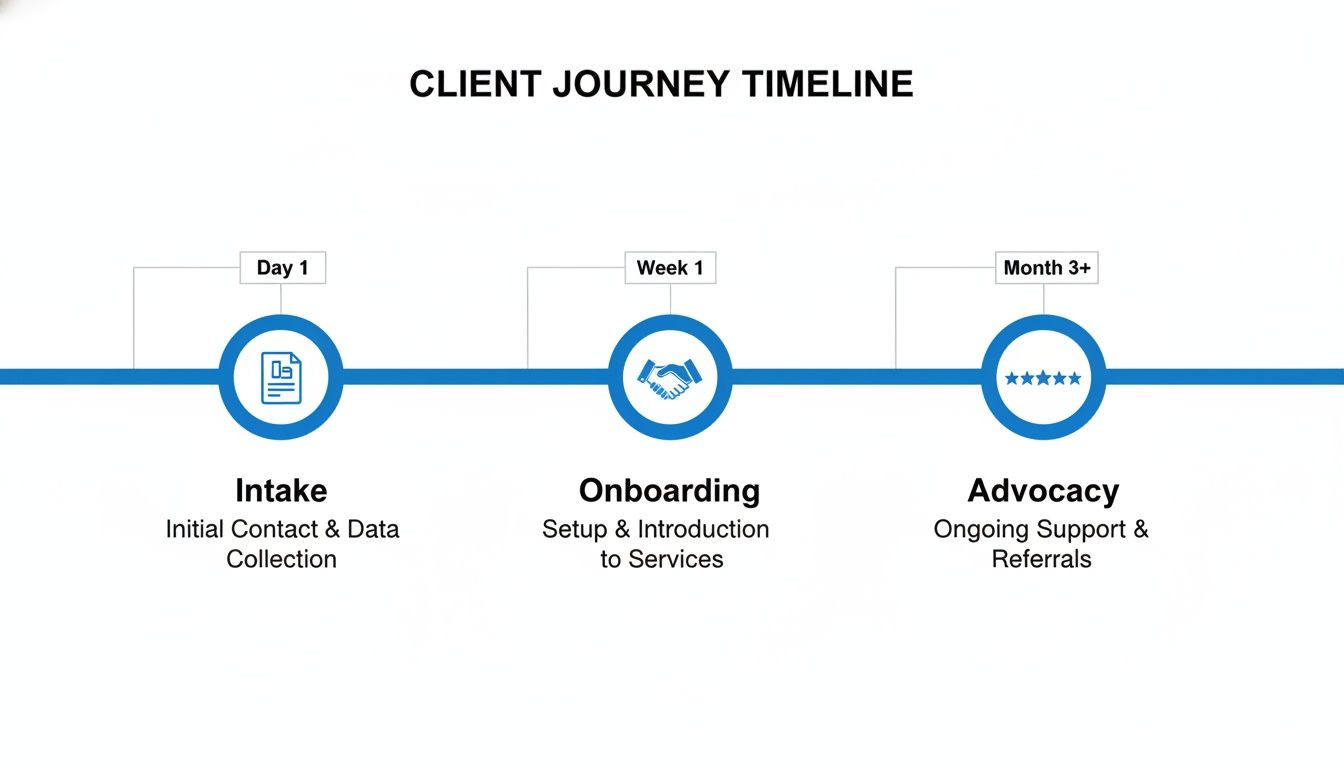
Nailing the intake and onboarding process is what turns a one-time client into a lifelong advocate who sends you referrals.
Quarter 3: Activate Paid and Automation Campaigns
Now it's time to pour some fuel on the fire. In Q3, you'll tap into paid advertising to bring in leads right away, while using automation to follow up with them efficiently. This powerful one-two punch lets you scale up your client acquisition without burying your team in manual tasks.
- Launch a hyper-targeted Google Ads campaign. Don't boil the ocean. Focus only on high-intent keywords within a tight geographic area around your office.
- Set up an automated email welcome series. Create a simple sequence for new leads that introduces your firm, sets expectations, and provides helpful initial info.
Quarter 4: Analyze, Refine, and Plan for Next Year
The final quarter is for stepping back and looking at the data. Use the insights you've gathered over the past nine months to make smarter decisions and set an intelligent budget for the year ahead. This is your chance to double down on what’s working and cut what isn't.
Your focus should be on reviewing your KPIs, calculating your true cost-per-lead and cost-per-case, and outlining a marketing budget that's based on data, not guesswork. This forward-looking approach ensures the future of law firm marketing in 2025 is one of intentional, predictable growth for your firm.
Your Quarterly Marketing Roadmap for 2025
Here’s a snapshot of the entire year, broken down into a simple, actionable plan. Use this table as your guide to stay on track and build a modern marketing engine for your firm.
| Quarter | Primary Focus | Key Action Items |
|---|---|---|
| Q1 (Jan-Mar) | Digital Foundation | • Conduct website & SEO audit • Fully optimize Google Business Profile • Establish baseline KPIs and tracking |
| Q2 (Apr-Jun) | Content & Reputation | • Develop local content strategy (blogs/videos) • Launch automated review generation system • Target 5-10 new Google reviews |
| Q3 (Jul-Sep) | Activation & Automation | • Launch a targeted Google Ads campaign • Implement an automated email welcome series • Begin using first-party data for targeting |
| Q4 (Oct-Dec) | Analysis & Planning | • Review annual KPI performance • Calculate Cost-Per-Lead and Cost-Per-Case • Develop a data-driven 2026 budget |
This roadmap provides a clear path forward. By focusing on one area at a time, you methodically build a powerful marketing system that will serve your firm for years to come.