


Think of all the moving parts in your firm's client acquisition process—spreadsheets here, email inboxes there, a separate list for contacts over there. It's a recipe for chaos. Legal marketing software brings all of those scattered efforts into one unified system, acting as a central command center for growth.
What Legal Marketing Software Does and Why It Matters Now

This kind of software connects every part of a potential client's journey, from their first visit to your website all the way through to intake. It's the engine that powers your firm's growth. Instead of just guessing which marketing channels are actually bringing in cases, the software gives you hard data and automates the tedious follow-up that often falls through the cracks.
Essentially, it's designed to solve the exact problems that hold most firms back from predictable, sustainable growth.
Solving the Core Challenges of Firm Growth
Modern law firms all wrestle with the same nagging issues that old-school, manual processes just can't fix. The right software turns these headaches into a genuine competitive advantage.
Here are the key problems it's built to solve:
- Fragmented Client Data: Potential client information gets lost in different systems, leading to missed opportunities and a clunky experience. The software pulls everything into a single, clean record.
- Inconsistent Follow-Up: Manually tracking every lead is impossible to do perfectly. Automation ensures every single prospect gets a timely, personalized touchpoint, which dramatically boosts conversion rates.
- Inability to Prove ROI: How do you show partners that the marketing budget is actually making money? Analytics dashboards link specific campaigns directly to signed cases, showing exactly what’s working.
The table below breaks down the main jobs this software handles.
Core Functions of Legal Marketing Software
| Core Function | Primary Goal | Example Activity |
|---|---|---|
| Lead Management | Capture, track, and score every potential client. | A prospect fills out a form on your site, and a new client profile is automatically created in the system. |
| Client Relationship Management (CRM) | Maintain a centralized database of all client and prospect interactions. | Logging all calls, emails, and meetings with a potential client to ensure a seamless handoff. |
| Email Marketing Automation | Nurture leads with targeted, automated email campaigns. | Sending a series of educational emails to prospects who downloaded an ebook on estate planning. |
| Analytics & Reporting | Measure marketing performance and demonstrate ROI. | Generating a report that shows which blog posts generated the most qualified leads last quarter. |
| Intake & Onboarding | Streamline the process of converting a qualified lead into a new client. | Automating the sending of intake forms and retainer agreements once a lead is ready to sign. |
This overview shows how each feature works together to build a powerful, cohesive system for growth.
Make no mistake, adopting these platforms is no longer a fringe strategy. The legal marketing tech space has exploded, with the number of software providers jumping from 200 to 309—a 54.5% increase. This boom proves that firms are finally recognizing technology as a non-negotiable tool for business development.
At its core, this software transforms marketing from a cost center into a measurable revenue driver. It provides the structure and intelligence needed to build a sustainable pipeline of new clients in an increasingly competitive environment.
Ultimately, getting on board with software for legal marketing isn't just about modernizing. It’s about building a systematic, repeatable process for attracting, nurturing, and converting the right clients for your firm. Beyond these platforms, you might also find value in exploring our guide on AI tools for legal marketing to further sharpen your growth strategies.
Key Features That Drive Law Firm Growth

Truly effective software for legal marketing is so much more than a digital Rolodex; it’s the engine that powers your firm's growth. The best platforms bundle several crucial tools into a single, cohesive system, transforming a series of disjointed tasks into a smooth, efficient process for bringing in new clients.
To pick the right software, you first need to understand its core components. Think of it like a high-performance car. The engine is essential, but you're not winning any races without a transmission, steering, and a dashboard telling you how fast you're going. Each feature in a legal marketing platform plays an equally vital role in getting your firm to the finish line.
Client Relationship Management for Legal Needs
The heart of any solid legal marketing platform is its Client Relationship Management (CRM) tool. A generic, off-the-shelf CRM tracks sales leads, but one built specifically for the legal field understands the distinct path a potential client takes—from a tentative online search to a signed retainer agreement. It’s designed to manage complex relationships, not just simple transactions.
This specialization is what makes it so powerful. A legal-focused CRM comes equipped with fields and workflows for the things that actually matter to a law firm, like:
- Conflict Checks: You can instantly search your entire database to flag potential conflicts of interest before you even book a consultation. This is a critical safeguard against ethical headaches down the road.
- Intake Management: Build out custom intake forms and automated workflows to gather all the necessary client information systematically. Nothing important gets missed during those crucial first interactions.
- Referral Tracking: Easily log and monitor where your best cases are coming from. Was it a referral from another attorney, a past client, or that new Google Ads campaign? Now you'll know for sure.
A purpose-built CRM ensures that every piece of client data is captured in a way that is relevant and actionable for your practice. It moves you from scattered notes and spreadsheets to a single source of truth for all client and prospect interactions.
Marketing Automation to Nurture Leads
Let's be realistic: most people aren't ready to hire an attorney the moment they land on your website. Marketing automation is what keeps your firm top-of-mind, nurturing those relationships by delivering the right message at the right time, all without you lifting a finger.
Picture this: a potential client downloads your "Guide to Estate Planning" from your blog. An automation sequence can kick in, sending them a series of pre-written, helpful emails over the next few weeks. This drip campaign educates them further, subtly positions your firm as the go-to expert, and builds trust. When they're finally ready to make a call, yours is the first number they dial.
This isn’t just about blasting out emails, either. It’s about intelligent, personalized communication. The best systems can segment your audience automatically. For instance, a visitor who read about "business formation" will receive a completely different set of follow-up materials than someone who was looking into "contract disputes," making your marketing feel personal and far more effective.
Content Management System for SEO and Authority
Your firm’s collective knowledge is one of your most powerful marketing assets. An integrated Content Management System (CMS) gives you the tools to publish that expertise through blog posts, articles, and detailed practice area pages, all from within your marketing platform.
A good CMS for law firms does more than just let you hit "publish." It comes packed with features designed to help you get found by the right audience on search engines.
- SEO Tools: Get built-in guidance for optimizing page titles, meta descriptions, and keywords to climb the ranks on Google.
- Simple Editing Interface: An intuitive editor means anyone on your team—from paralegals to partners—can create and format professional-looking content without needing to be a web developer.
- Lead Capture Integration: Seamlessly embed contact forms, chatbot prompts, and calls-to-action right into your articles to turn passive readers into active leads.
By consistently sharing valuable insights through your CMS, you establish your firm as an authority and create a reliable stream of inbound leads from people actively searching for the solutions you provide.
Analytics and Reporting That Show ROI
How do you actually prove your marketing efforts are paying off? Powerful Analytics & Reporting dashboards are the answer. They translate mountains of raw data into clear, understandable insights that answer the one question every partner asks: "What's our return on this investment?"
Instead of relying on gut feelings, you can see in black and white which marketing channels are delivering your most profitable cases. A robust analytics dashboard will show you:
- Lead Source Performance: Pinpoint exactly how many leads came from Google searches, social media, your email newsletter, or attorney referrals.
- Conversion Rates: Understand what percentage of your website visitors turn into leads, and what percentage of those leads ultimately become clients.
- Client Acquisition Cost (CAC): Calculate precisely how much it costs to sign a new client from each different marketing channel.
This is the data that allows you to make smart, confident budget decisions. You can double down on the strategies that work and stop wasting money on those that don't, finally drawing a straight line from your marketing activities to your firm's bottom line.
How to Choose the Right Software for Your Firm
Picking the right software for legal marketing isn't about finding the platform with the flashiest demo or the longest feature list. It’s about finding the one that actually solves your firm’s real-world problems. A slick presentation is nice, but if the tool doesn't fix your daily bottlenecks—like messy lead follow-up, a broken intake process, or zero visibility into marketing ROI—it's just an expensive distraction.
Making the right call here requires a clear-headed, methodical approach. Think of it like preparing for a case: you gather evidence and get to the bottom of the core issues long before you even consider a legal strategy. In the same way, before you look at a single piece of software, you have to diagnose your firm's unique growth challenges first.
Start with a Needs Analysis
The first step is always to look inward and pinpoint your biggest pain points. A small personal injury firm drowning in unqualified leads has a completely different set of needs than a corporate law practice that's struggling to nurture long-term client relationships. You have to get specific about what’s really holding you back.
A good needs analysis helps you build a "must-have" list that cuts right through the sales pitches and marketing fluff. Think about these common hurdles and see which ones hit closest to home for your team:
- Lead Volume vs. Lead Quality: Is the phone not ringing enough? Or is it ringing off the hook with low-quality inquiries that waste your intake team’s valuable time?
- A Disorganized Intake Process: Are potential clients slipping through the cracks because follow-up is all over the place? Is client information scattered across sticky notes, spreadsheets, and different email inboxes?
- Proving Marketing ROI: Are you pouring money into marketing campaigns but have no hard data connecting that spend to new clients and actual revenue?
- Client Communication Gaps: Does your firm struggle to keep up with professional, consistent communication with both prospects and existing clients?
An honest look at these areas gives you a solid blueprint for what any software solution absolutely must do for you. That clarity is your best defense against making a bad investment.
Your Core Evaluation Checklist
Once you've got a firm handle on your needs, you can start looking at potential platforms. Use this checklist to compare your options and make sure you're covering the non-negotiables for any modern law firm.
- Ease of Use: Let's be blunt: if the software is clunky or overly complicated, your team just won't use it. Period. Look for an intuitive interface that feels like it’s helping you, not giving you another complicated chore to do.
- Legal-Specific Features: Generic sales CRMs just don't get the legal world. Your software needs features built specifically for law firms, like conflict checking, referral source tracking, and intake workflows designed for legal cases.
- Integration Capabilities: Your marketing software can't be an island. It must connect smoothly with the tools you already use, like your Legal Practice Management Software (LPMS), billing systems, and even your website. For more on that, it's worth comparing the top content management systems for law firms to understand how all the pieces should fit together.
- Scalability: The software that serves you well as a five-person firm should still be the right fit when you grow to twenty. Make sure the platform can scale with your practice without forcing you into a costly and disruptive switch down the road.
- Data Security and Compliance: Client confidentiality is everything in this business. Confirm that any vendor you consider uses robust security measures like end-to-end data encryption and follows all relevant data privacy regulations. This is one area where there's no room for compromise.
By focusing on these core pillars, you move beyond the surface-level sales pitch and dig into what truly matters for your firm's daily operations and long-term success. A tool that checks these boxes is more likely to be adopted successfully and deliver a positive return on investment.
When you're in the trenches talking to vendors, it’s easy to get sidetracked by impressive features you may never use. Having a structured set of questions ready keeps the conversation focused on what your firm truly needs to succeed.
Key Questions to Ask Legal Marketing Software Vendors
| Category | Question to Ask | Why It Matters |
|---|---|---|
| Onboarding & Support | What does your onboarding process look like, and what kind of ongoing support is included? | A great tool is useless without proper training. You need to know if they'll help you get started and be there when you run into trouble. |
| Integrations | Can you show me a live demo of how your software integrates with [Your LPMS, Email, etc.]? | Don't just take their word for it. Seeing the integration in action proves it's a seamless connection, not a clunky workaround. |
| Pricing & Contracts | Are there any hidden fees for implementation, data migration, or premium support? What are the contract terms? | You need a crystal-clear understanding of the total cost of ownership and the flexibility of your commitment before you sign anything. |
| Security & Compliance | How do you ensure compliance with legal ethics rules and data privacy regulations like GDPR or CCPA? | This question tests their understanding of the legal industry's unique obligations. Their answer should be detailed and reassuring. |
| Roadmap & Updates | What new features are on your product roadmap for the next 6-12 months? | This shows whether the company is innovative and invested in improving its product or if the platform is likely to become outdated. |
This checklist isn't just about getting answers; it’s about starting a conversation that reveals whether a vendor truly understands the business of law.
Ultimately, choosing the right software for legal marketing is a strategic business decision, one that directly impacts your firm's ability to grow. A thoughtful, needs-first evaluation process ensures you invest in a solution that doesn't just put out today's fires but also lays the foundation for a more profitable and organized future.
Integrating Software with Your Existing Tech Stack
Your marketing software can't be a lone wolf. Its real value comes alive when it talks to the other systems that run your firm. Without that connection, you're just creating another data silo—a digital dead end that forces your team into mind-numbing, error-prone manual data entry.
Think of it like an orchestra. Your marketing platform might be the attention-grabbing violin section, but it needs the steady beat of your Legal Practice Management Software (LPMS) and the harmony of your billing tools to create a masterpiece. Integration is the conductor making sure every instrument plays in perfect time.
The goal is to get a single, clear picture of the entire client journey, from the first time they see an ad to the day their final invoice gets paid.
This diagram shows the basic steps your firm should take when picking a platform. It highlights that your final decision has to consider how well the new piece fits into your existing operational puzzle.
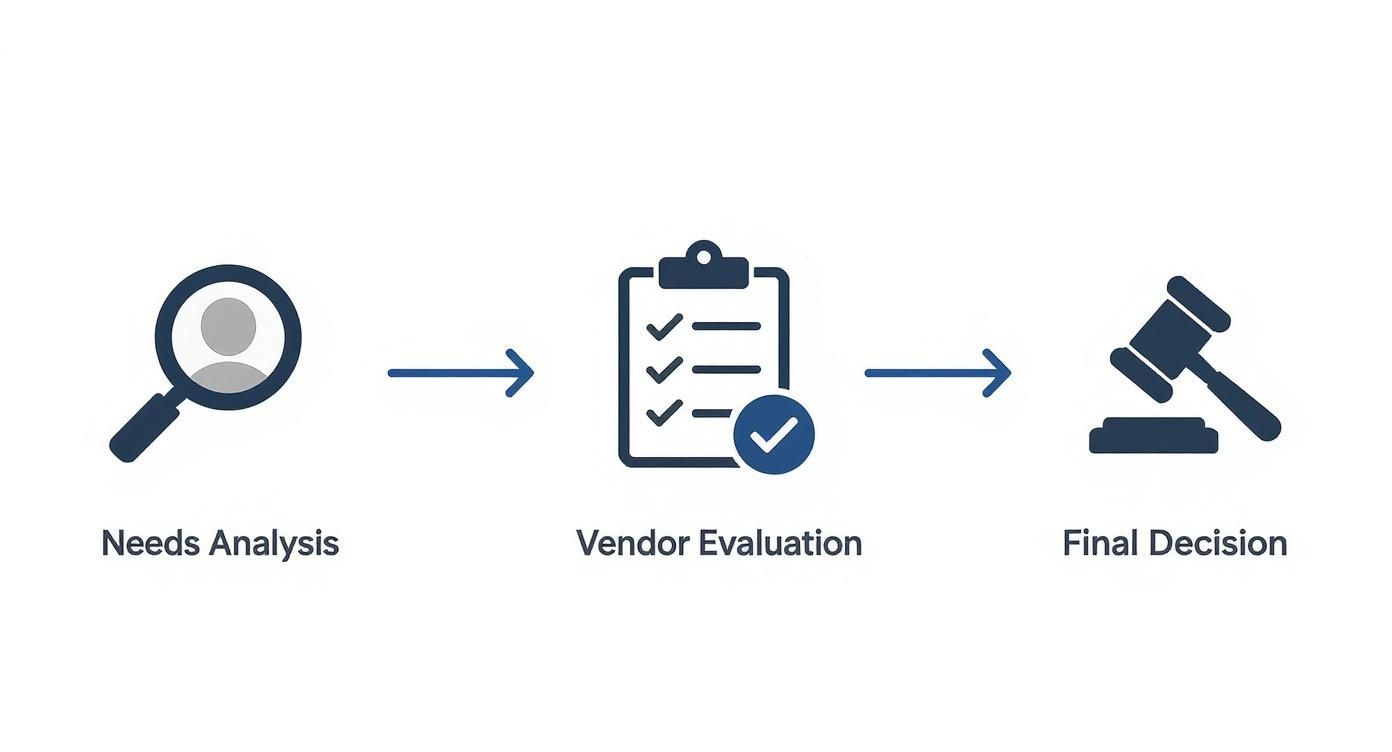
As you can see, evaluation is the critical middle step. It’s where you prove that a potential tool can actually communicate with the systems you already depend on every single day.
The Critical Link to Your LPMS
For any law firm, the single most important integration is the one between your software for legal marketing and your LPMS. This connection is the bridge between finding new business and actually doing the legal work, automating the handoff from a promising lead to a paying client.
When these two systems are properly connected, the workflow becomes incredibly smooth. For instance:
- Automated Client Onboarding: As soon as a lead signs a retainer in your marketing CRM, their contact info, case type, and initial notes are automatically pushed into your LPMS. A new matter is created instantly, without anyone lifting a finger.
- Smarter Conflict Checking: Information from a new lead can be immediately run against the client database in your LPMS, flagging potential conflicts long before they become a real problem.
- A Complete Conversation History: All the early communication—emails, texts, form submissions—can be synced from the marketing platform directly to the client's file in the LPMS. This gives attorneys a full history of every touchpoint.
This kind of integration closes the dangerous gap where crucial client information gets lost in translation between your marketing and legal teams. It guarantees a professional onboarding experience for the client and saves countless non-billable hours.
Connecting Marketing Efforts to Revenue
The second must-have connection is with your billing and accounting software. This is what finally allows you to draw a straight line from your marketing budget to actual revenue, giving you the hard ROI data that managing partners always want to see.
It's no surprise that the legal billing software market, a key integration partner, was valued at $2.15 billion and is projected to hit $4.28 billion. This growth is all about the demand for data-driven insights. Cloud-based tools are making it easier than ever to link these systems with marketing platforms. You can dive deeper into these trends in this legal billing software market analysis.
When these systems work together, you get a full 360-degree view of what a client is truly worth to your firm.
Key Benefits of Integration
Here’s how a connected tech stack directly helps your firm’s bottom line:
- Calculate True Client Lifetime Value (LTV): By linking marketing source data to billing records, you can finally see which channels (like Google Ads, SEO, or referrals) bring in the most profitable long-term clients, not just the most leads.
- Get Invoices Out Faster: When a new client is created from a marketing lead, their information is already in the billing system, ready for time tracking and invoicing to start right away.
- Improve Data Accuracy: Automating data transfer between systems slashes the risk of human error. No more typos in client names or incorrect billing addresses that cause payment delays and frustrate clients.
Ultimately, integrating your software for legal marketing with your core operational tools turns it from just another app into the central nervous system of your firm's growth engine.
How to Measure Your Marketing Success and ROI
Let's be honest: partners want to see results, not just a list of marketing activities. Pouring money into software for legal marketing is a waste if you can't prove it’s actually making the firm money. The great thing is, these platforms are designed to cut through the noise of "vanity metrics"—like website traffic or social media likes—and get right to the data that impacts your bottom line.
Measuring your success isn't just about defending the marketing budget. It's about making smarter decisions. When you track the right Key Performance Indicators (KPIs), you can confidently put more resources into what’s working and stop wasting time and money on what isn't. This is how you build an efficient, predictable growth engine for your firm.
Moving Beyond Vanity Metrics
The first thing to do is change your mindset. A spike in website traffic feels good, but it doesn't pay salaries. Your software's analytics dashboard is the tool that finally connects the dots between a marketing campaign and a signed client. It's time to stop chasing digital noise and start focusing on business outcomes.
Instead of getting lost in surface-level numbers, your focus should boil down to three core metrics that tell the real story of your firm’s growth. These are the bedrock of any serious marketing measurement strategy.
- Client Acquisition Cost (CAC): Simply put, how much does it cost you in marketing and sales to bring in one new client? The lower the CAC, the more efficient your marketing machine is.
- Client Lifetime Value (LTV): This is the total revenue you can expect from an average client over the entire time they work with your firm.
- Lead-to-Client Conversion Rate: What percentage of interested people actually become paying clients? This number tells you how good your intake process is.
When you can track these figures right inside your software, you can finally answer that all-important question: "What did we actually get for our marketing spend?"
Building a Performance Dashboard
A good legal marketing platform will let you build a custom dashboard that puts these critical KPIs front and center. Think of it as your firm's marketing command center, giving you a live view of performance without ever having to touch a complicated spreadsheet.
A thoughtfully designed dashboard should clearly visualize the entire client journey, from the moment they first find you to the day they pay their final invoice.
The goal is to draw a clear, undeniable line from a specific marketing campaign—like a Google Ad or a blog post—directly to a signed retainer agreement and the revenue it generated. This is how you transform marketing from an expense into a strategic investment.
Your dashboard should be set up to automatically pull in and display the following:
- Lead Sources by Volume and Quality: You need to see which channels (Organic Search, Paid Ads, Referrals, etc.) are sending you the most leads. More importantly, you need to see which channels are sending you the best leads.
- Conversion Rates at Each Stage: Watch how prospects move through your intake funnel. What percentage of website visitors fill out a form? Of those, how many book a consultation? And how many of those consults turn into new clients?
- CAC by Marketing Channel: Break down your acquisition cost for each channel. You might discover that while Google Ads bring in a higher volume of leads, SEO delivers new clients at a fraction of the cost.
- LTV for Different Case Types: Figure out which of your practice areas produce the most valuable clients over the long haul. This insight is gold—it tells you exactly where to focus your marketing efforts for maximum profitability.
By checking in on this data regularly, you empower yourself to make sharp, strategic adjustments. You can shift your budget to the channels with the best ROI, tweak your intake process to close more deals, and walk into any partner meeting with confidence, ready to show marketing’s tangible contribution to the firm's financial health.
Navigating Ethical Rules and Data Security
Bringing powerful marketing software into your law firm isn't just about getting more clients. It's about growing your practice the right way. We're all bound by strict rules of professional conduct, and those obligations follow us online and into every digital tool we use.
Think of your marketing platform as a digital extension of your office. You wouldn't leave confidential client files sitting out on the reception desk, and you can't be careless with their digital data either. The risk of an ethical stumble is real, but it’s completely manageable if you have the right systems in place. This isn't about being scared of technology; it's about being smart and responsible with it.
Upholding Client Confidentiality in the Cloud
At the heart of our profession is the duty to protect client confidentiality. When you use cloud-based software, you're essentially handing over incredibly sensitive information—from a potential client’s first nervous inquiry to detailed notes about their case—to a third-party vendor. That’s a big deal, and it demands serious due diligence.
Before you even think about signing a contract, you need to kick the tires on the software's security. Any vendor worth their salt in the legal tech space gets this. They know the stakes are high and should have ironclad measures in place to protect your firm’s data.
Here’s what to look for:
- End-to-End Data Encryption: This is non-negotiable. It means all your data is scrambled and unreadable to anyone without the key, both when it's sitting on a server and when it's moving across the internet.
- Strict Access Controls: The platform must let you decide who sees what. You should be able to set specific permissions so that only the right people can view or handle sensitive client information.
- Compliance Certifications: Look for vendors who meet established data security standards like SOC 2 or ISO 27001. These aren't just acronyms; they're proof that the company takes security seriously.
Protecting client data isn't just another feature on a checklist; it's an absolute ethical mandate. At the end of the day, your firm is responsible for safeguarding this information, no matter which software you use.
Staying Compliant with Attorney Advertising Rules
Beyond keeping data safe, all of your marketing has to play by the rules your state bar has laid out. These regulations dictate everything from how you describe your services to the way you interact with potential clients. Marketing software doesn't give you a free pass—it just gives you new, powerful tools that you must use compliantly.
For instance, an automated email campaign can’t make misleading claims or guarantee a certain outcome. That’s a fast track to an ethics complaint. Likewise, any website copy or social media posts you create using the software need a final review by a human—you—to make sure you’re not accidentally crossing the line into improper solicitation. The tech can do the heavy lifting, but the ethical judgment call is always yours.
Ultimately, using legal marketing software safely boils down to two things: picking the right partner and maintaining your own strict oversight. When a compliant tool is paired with your firm's commitment to ethical practices, you can grow with confidence, knowing you’re not putting your clients or your license at risk.
Answering Your Top Questions About Legal Marketing Software
Even after you're sold on the idea, the practical side of things can still feel a bit fuzzy. It's one thing to see the potential, but another to picture how a new piece of technology will actually fit into your firm's day-to-day operations.
Let's tackle some of the most common questions we hear from attorneys and firm administrators when they're thinking about making the switch.
How Long Does This Actually Take to Set Up?
This is probably the biggest question on everyone's mind, and the answer is usually much better than you'd expect. We're not talking about a months-long IT nightmare. For most modern, cloud-based platforms, you can be up and running in a matter of weeks.
A good vendor won't just hand you the keys and walk away. They'll lay out a clear onboarding schedule, help you pull your data from whatever old systems you're using, and make sure your team gets the training they need to feel confident from day one. That hands-on support is what makes the whole transition smooth instead of stressful.
Is This Really Worth It for a Solo or Small Firm?
Absolutely. In fact, for smaller firms, this kind of software isn't just helpful—it’s a game-changer. Many platforms offer flexible plans designed specifically for solo attorneys or small teams, so you're not paying for features you don't need.
Think of it this way: these tools automate the time-consuming administrative work that bogs down a small practice. Suddenly, you can compete with the marketing muscle of much larger firms, all without hiring a full-time marketing person.
For a smaller firm, this software acts as a force multiplier. It automates follow-ups, organizes leads, and provides the kind of marketing intelligence that was once only available to firms with massive budgets.
Can This Software Help Us Get More Attorney Referrals?
Yes, and this is one of its most powerful—and often overlooked—features. A solid legal CRM is perfect for managing and nurturing your professional network. You can track every relationship, note where each referral came from, and even set up automated reminders to send a thank-you note or check in.
This turns your referral strategy from a haphazard, "hope for the best" approach into a predictable system. By staying top-of-mind with your contacts, you transform those casual connections into a steady stream of high-quality cases.
At RankWebs, we provide actionable insights and proven frameworks to help law firms navigate these decisions. Our strategies are designed specifically for the legal industry to drive sustainable growth. Learn more about our approach.