

A law firm doesn’t have to choose between SEO and paid ads. In fact, the smartest move is masterfully integrating both. SEO lays a solid foundation for your firm’s credibility, while paid ads deliver the speed and precision needed to land new cases right now.

The Modern Law Firm’s Client Acquisition Dilemma
Budget allocation in a competitive legal market isn’t just about dollars—it’s about timing and impact. You need cases in the door today, but you also want a reputation that attracts clients for years to come.
For most firms, that means striking a balance between short-term cash flow and long-term authority. You might need a signed retainer this week, yet you still have to plant the seeds for future visibility.
Consider how each channel plays its part:
- Paid Ads (PPC) operate like a rapid-response team. They put your name in front of prospects the moment they’re searching for legal help, capturing high-intent leads ready to act.
- Search Engine Optimization (SEO) is a steady builder. It establishes your website as a trusted resource, driving sustainable traffic and growing your lead pipeline over time.
Depending solely on one channel is like trying to build a house with only a hammer or a saw. Each tool has its role—and you need both to create a structure that lasts.
This guide goes far beyond simple pros and cons. Instead, you’ll learn how to weave SEO and paid ads into a cohesive system—when to shift budget, which KPIs to watch, and how to align each channel with your firm’s growth goals.
SEO vs Paid Ads At a Glance for Law Firms
Before we dive deeper, here’s a quick snapshot to highlight the core differences and help you decide where to lean in any given scenario.
| Attribute | SEO (Organic Search) | Paid Ads (PPC) |
|---|---|---|
| Time to Results | Long-Term (6–12+ months) | Immediate (Days–Weeks) |
| Cost Model | Investment That Grows Over Time | Expense (Pay-Per-Click) |
| Lead Flow | Continues As You Invest | Stops When Budget Stops |
| Primary Goal | Build Authority & Organic Traffic | Generate Immediate, Targeted Leads |
| Best For | Long-Run Market Presence | Quick Lead Generation & Testing |
This table offers a clear, side-by-side view so you can quickly choose the right mix for your next campaign.
Comparing the Financial Models and Long-Term ROI
When you're trying to figure out where to put your marketing dollars, you have to look past the monthly invoice. SEO and paid ads aren't just two different ways to get your firm in front of clients; they're fundamentally different financial strategies. One builds lasting value in your firm, while the other is purely transactional.
Think of SEO as a capital investment in your firm’s most important digital asset—your website. Every piece of content you publish, every technical issue you fix, and every backlink you earn is like a capital improvement on a piece of real estate. The upfront cost can be steep, but the value it builds compounds over time, generating returns that aren't tied to a per-click fee.
Paid ads, on the other hand, operate as a direct, transactional expense. This is a model built for one thing: getting immediate, predictable results. You pay to get in front of high-intent clients right now. The moment you stop paying, the leads dry up. It’s like a utility—the more you spend, the more leads you can generate, but you're not building any permanent equity.
The True Cost of Client Acquisition
The cost model of each channel is what really shapes its return on investment (ROI). With paid ads, the cost per click (CPC) can get incredibly high in competitive legal markets. It’s not uncommon to see CPCs in the hundreds of dollars for keywords like "personal injury lawyer" or "DUI attorney." While it works, this creates a linear ROI; your return is always directly tied to what you spent that month.
SEO works on a completely different financial clock. The first few months demand a significant investment with very little to show for it. But once you start securing those organic rankings for valuable keywords, your firm starts getting a steady stream of qualified traffic and leads. Your cost per lead effectively goes down every single month as that initial investment keeps paying off.
SEO is about building a lead-generation machine that you own. Paid ads are about renting one. The long-term financial stability of your firm depends on understanding which one to prioritize and when.
This is a critical distinction when you’re comparing SEO vs. paid ads for a law firm that wants sustainable growth. The financial model of SEO is designed to steadily lower your client acquisition cost over several years, while PPC offers a predictable—but perpetually fixed—cost.
Calculating the Long-Term Financial Impact
When you stretch the timeline out over a few years, the financial gap between these two strategies becomes impossible to ignore. Study after study confirms that organic search is where most potential clients start their journey, and SEO delivers a much higher long-term return.
For example, recent legal marketing reports show that around 96% of legal consumers turn to a search engine first. Organic listings are the main driver of law firm website traffic, pulling in about 50–53% of all visits. The same analyses estimate SEO returns that completely overshadow short-term ad performance. Some sources even cite three-year ROIs for law firm SEO in the 400–600% range, while PPC delivers a fraction of that when viewed as a multi-year investment.
This exponential growth in SEO's value is what sets it apart. The authority and trust your website builds with search engines are assets that don't just vanish. It’s why so many established firms are able to ease off their paid ad spending over time. To get this right, you have to know how to calculate these returns; you can explore our guide on measuring ROI from lawyer SEO to build a clear financial picture for your firm. Ultimately, a strategic approach to your marketing budget is what will define your firm's profitability and standing in the market.
Analyzing Lead Quality and Client Intent

It’s not just about getting more calls and form fills. The real goal is attracting the right clients—the ones who become valuable cases and grow your firm. This is where the difference between SEO and paid ads really snaps into focus. Each channel speaks to a potential client with a completely different mindset.
SEO is all about capturing people along their entire journey, not just at the moment of crisis. Think about it. Someone in the early stages of a legal issue isn't searching for a lawyer; they're searching for answers. They're typing questions into Google, trying to understand their situation.
By providing those answers, you build a relationship before they even know they need an attorney. When they finally do decide to hire, they remember the firm that helped them from the start. They’ve already read your blog posts and pre-qualified themselves, leading to a much higher quality inquiry.
The High-Urgency Nature of Paid Ad Leads
Paid ads, on the other hand, are built for speed and urgency. They’re designed to catch the person frantically searching for "car accident lawyer near me" or "DUI attorney open now." Their need is immediate, and their intent is to hire. Now.
This is a massive advantage when you need to bring in cases quickly. These leads are often ready to sign, skipping the long research phase because they need a fast solution to a pressing problem.
The trade-off? Urgency often means less loyalty. A person clicking on an ad is likely contacting multiple firms they see at the top of the page. Their decision is often based on who answers the phone first, not who has the best long-term reputation.
SEO Attracts Informed and Educated Clients
The true power of a solid SEO strategy is its ability to build trust before you ever speak to a potential client. When someone finds your firm through an article that clarifies their legal questions, you immediately become an authority in their eyes.
This creates a different kind of lead entirely. These prospects are often:
- More Educated: They have a solid grasp of their situation and the services you provide.
- Better Vetted: They’ve already consumed your content and decided your expertise fits their needs.
- Less Price-Sensitive: The trust you've built makes your expertise the primary factor, not just your fee.
A lead from SEO often starts the conversation with, "I read your guide on my issue, and it was incredibly helpful." A lead from a paid ad is more likely to ask, "How quickly can you help me?" That simple difference reveals everything about their intent.
This pre-qualification saves your intake team a ton of time. SEO leads are usually a much better fit for your practice areas right from the jump. To really capitalize on this, firms are now using sophisticated tools to distinguish between lead types automatically. Adopting methods like AI-powered lead scoring for attorneys helps you instantly identify which inquiries are most likely to become high-value cases, ensuring your team focuses on the best opportunities first.
Ultimately, the choice comes down to what your firm needs right now. Are you building a pipeline of informed, high-value clients for the long haul, or do you need to sign cases today? A smart strategy uses both—paid ads for immediate impact while SEO builds a foundation of trust that attracts your ideal clients for years to come.
Evaluating Timelines and Speed to Results
When you're deciding between SEO and paid ads for your law firm, one of the most practical questions is always the same: how fast will my phone start ringing? The answer gets right to the heart of the strategic difference between these two channels. Your firm’s immediate need for cases versus its long-term growth plan will point you in the right direction.
Paid advertising is the undisputed sprinter in this race. You can take a well-built Google Ads or Local Services Ads campaign from an idea to live in just a few days. Once it's running, it can start driving qualified calls and contact forms almost instantly, connecting you directly with potential clients who need help now.
That kind of speed is a game-changer for firms needing to manage cash flow, fill their case pipeline quickly, or test the waters in a new practice area. If your main goal is to sign new clients this month, paid ads offer the most direct and predictable path to get there.
SEO: The Strategic Marathon
SEO, on the other hand, is a marathon. It requires patience and consistent, focused effort. Building the kind of authority and trust it takes to rank for competitive legal keywords doesn't happen overnight. For most law firms, you should plan on seeing a meaningful, steady flow of organic leads within 9 to 12 months.
That timeline isn’t just a random number. It’s a realistic reflection of how long it takes for search engines to recognize and reward your hard work in:
- High-Quality Content: Regularly publishing detailed articles, practice area pages, and legal guides that genuinely answer your potential clients' questions.
- Technical Optimization: Making sure your website is fast, works perfectly on mobile devices, and is easy for Google to crawl and understand.
- Authority Building: Earning valuable backlinks from reputable sources like legal directories, local news sites, and industry associations.
While the initial payoff is slow, the results are incredibly powerful and built to last.
Paid ads are like renting a billboard on the busiest highway in town—your visibility disappears the moment you stop paying. SEO is like buying the land and building your office right off the exit ramp—it becomes a permanent, valuable asset.
This foundational work creates a real, sustainable advantage over your competition. Once your firm establishes strong organic rankings, you're no longer completely reliant on your monthly ad budget to keep the leads coming in. You're building an asset that will pay dividends for years.
Matching Timeline to Firm Goals
So, which is right for you? It all comes down to your firm's current situation. The different speeds of SEO and paid ads aren't a bug; they're a feature you can use to your advantage.
Let's look at a couple of common scenarios for law firms:
- Scenario A: The New Firm — A personal injury lawyer just hung their shingle and needs to generate revenue immediately to cover overhead. Paid ads are the obvious starting point to bring in those first critical cases and build some momentum.
- Scenario B: The Established Firm — A firm with a steady stream of clients wants to become the go-to name in their city over the next two years. SEO is the primary investment here, building an authoritative online presence that will drive down their client acquisition costs over the long haul.
Ultimately, this whole timeline discussion shows why a hybrid approach often works best. You can use paid ads for that immediate impact while your long-term SEO strategy gains traction. This ensures your firm has a steady stream of leads today and a powerful engine for growth tomorrow.
Building a Hybrid Strategy for Maximum Impact
The whole "SEO vs. paid ads" debate completely misses the mark for law firms. The smartest, most successful practices I've seen don't pick a side—they build a unified engine where both channels work together, making the whole system more powerful.
With a hybrid strategy, your firm can grab immediate case opportunities with ads while you methodically build an unshakeable market presence with SEO for the long haul. This isn't just about running two campaigns at the same time. It's about creating a smart feedback loop where the data and momentum from one channel directly fuel the other. The end result? Your firm dominates the entire search results page.
Scenarios for Synergistic Growth
What this integrated approach actually looks like in practice really depends on where your firm is right now. A brand-new practice has totally different needs than an established market leader. Getting these scenarios right is the key to spending your marketing dollars wisely.
Scenario 1: The New Family Law Practice
A freshly launched family law firm needs clients today. They need to get cash flowing and start building a name for themselves. Just focusing on SEO at this stage would be a painfully slow and frustrating waiting game. A hybrid model is non-negotiable here.
- Immediate Impact (Paid Ads): First things first, they launch a hyper-targeted Google Ads campaign. The focus is on high-intent, "ready-to-hire" keywords like "divorce lawyer consultation" and "emergency child custody attorney." They'll also tightly restrict the ads geographically to their specific service area, making a limited budget go much further. This is all about getting the phone to ring with qualified leads right now.
- Long-Term Foundation (SEO): At the same time, they start investing in foundational SEO. This means methodically building out comprehensive, authoritative content on complex topics—think deep dives into asset division, state-specific alimony laws, and child custody arrangements. This content isn’t going to rank overnight, but it’s the bedrock for establishing the website as a trusted resource that will pull in high-quality organic leads for years to come.
Scenario 2: The Established Personal Injury Firm
Let's say we have an established PI firm that already ranks well for big-money keywords like "car accident lawyer" and "wrongful death attorney." Their goal has shifted from getting started to total market domination and squeezing every last drop of value out of their leads.
- Defensive and Offensive Plays (Paid Ads): This firm uses paid ads with surgical precision. They run remarketing campaigns to get back in front of people who visited their site but didn't call, keeping their firm top-of-mind. They also get aggressive with conquesting campaigns, bidding on their competitors' brand names to intercept clients who are searching for other local firms by name.
- Protecting the Castle (SEO): With their strong organic position, they keep investing in SEO to defend and expand their turf. They aim to produce content that answers every possible question a potential client might have, cementing their status as the authority in their market. This powerful SEO presence delivers a steady flow of low-cost leads, which frees them up to be more strategic and aggressive with their ad spend.
The Data Feedback Loop
One of the most powerful—and often overlooked—parts of a hybrid strategy is how the data flows between channels. Paid ad campaigns give you a treasure trove of immediate market intelligence that could take months, or even years, to figure out with SEO alone.
Think of paid ads as your firm's real-time market research lab. The conversion data, click-through rates, and keyword performance you gather should directly inform and speed up your entire SEO strategy.
For example, your Google Ads data might show that the keyword "motorcycle accident lawyer brain injury" has a shockingly high conversion rate. That’s a massive signal. You can immediately task your team with creating the most comprehensive, in-depth content pillar on that exact topic for your SEO efforts. This data-first approach takes the guesswork out of the equation and focuses your time and money on what you already know works. You can learn more about how to create a cohesive marketing plan by integrating SEO with other digital marketing strategies.
Recommended Budget Allocation Models
Your budget mix shouldn't be set in stone. It needs to be a living thing that adapts as your firm grows and your goals change. While there's no single "right" answer, these models are a solid place to start.
| Firm Stage & Objective | Recommended Budget Mix | Rationale |
|---|---|---|
| New Firm (Aggressive Growth) | 70% Paid Ads / 30% SEO | Puts the priority on immediate lead generation and cash flow to get the practice off the ground. |
| Growing Firm (Balanced Approach) | 50% Paid Ads / 50% SEO | A balanced mix that meets near-term lead needs while making the crucial investment in long-term organic authority. |
| Established Firm (Market Leader) | 30% Paid Ads / 70% SEO | Leans on a dominant organic presence for cost-effective leads, using ads for strategic and offensive plays. |
Ultimately, the goal is to get to a point where your organic rankings are so strong that they bring in a consistent volume of high-quality leads, reducing your dependence on paid ads. Making this transition is what drastically lowers your firm's overall cost to acquire a client over time, building a much more profitable and sustainable practice. SEO builds the asset; paid ads capitalize on the opportunities along the way.
Measuring Success with the Right KPIs
Effective marketing isn’t about just feeling busy; it’s about driving measurable results that actually grow your firm’s bottom line. When it comes to the SEO vs. paid ads debate, the only way to know what’s really working is to track the right Key Performance Indicators (KPIs). You have to move past vanity metrics, like raw website traffic, if you want to make smart budget decisions.
For SEO, success isn't just about hitting the #1 spot. It's about what that ranking does for your case pipeline. The focus needs to be on metrics that show real client engagement and intent.
With paid ads, the story is told through financial efficiency. Every dollar you spend has to be accounted for with a clear return, which means having a laser focus on the direct cost of acquiring not just a lead, but a profitable case.
This decision tree shows how a firm's goals can guide its marketing strategy.
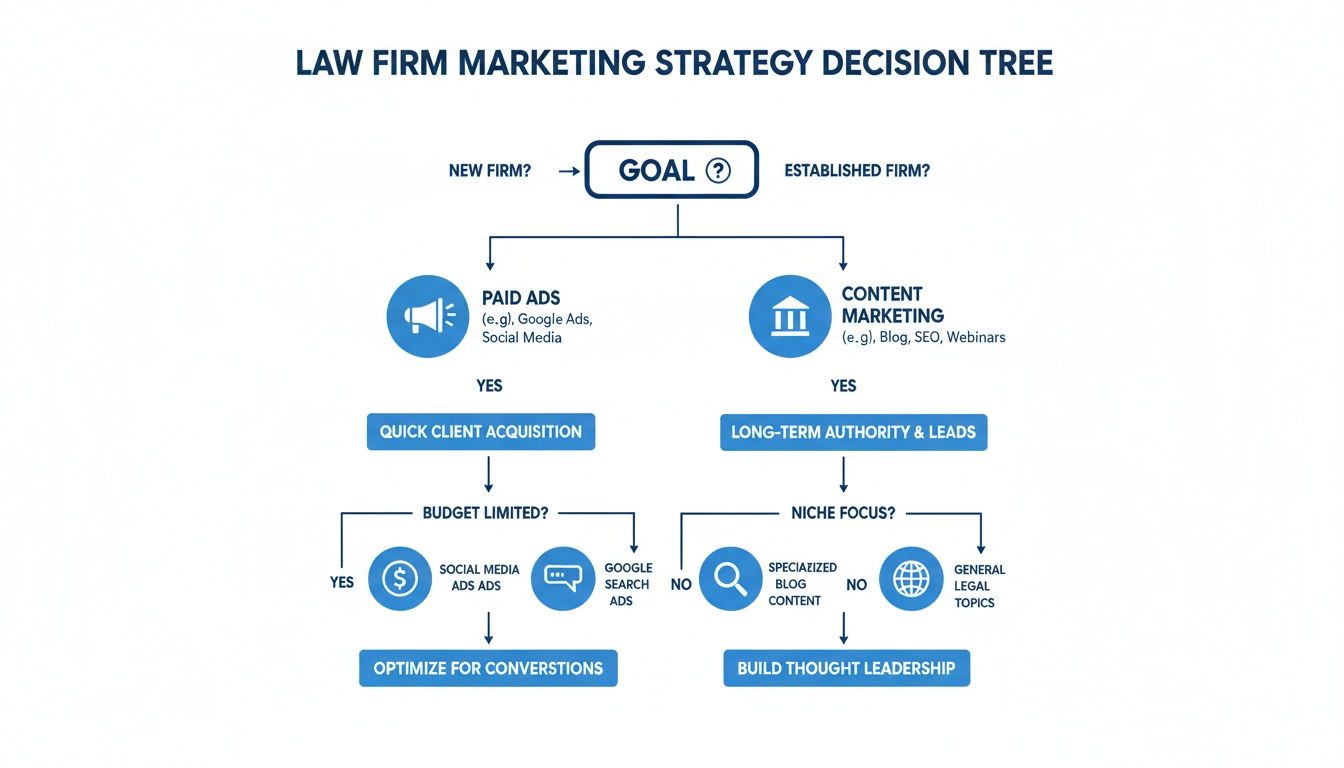
As you can see, the right path forward depends entirely on whether your firm needs clients right now or is building for a dominant market presence down the road.
Core KPIs for Law Firm SEO
Your SEO dashboard should be a mirror of your business growth, not just a report on online visibility. Instead of getting lost in broad traffic numbers, you need to prioritize these action-oriented KPIs that prove your strategy is attracting the right kind of attention.
- Organic Lead Conversions: This is the ultimate proof of SEO success. You absolutely must track the number of qualified phone calls and form submissions that come directly from your organic search traffic each month.
- Google Business Profile Actions: For any local law firm, this is a goldmine of high-intent activity. Keep a close watch on clicks-to-call, direction requests, and website visits that start right from your map listing.
- Keyword Rankings for High-Value Terms: Zero in on your rankings for "money" keywords—the ones people type when they’re ready to hire, like "personal injury lawyer near me" or "family law attorney consultation." Moving from page two to the top three for these terms can single-handedly transform your case volume.
A rising tide of unqualified traffic can easily sink a law firm by overwhelming its intake process. The goal isn’t more visitors; it’s more of the right visitors who are ready to become clients.
Tracking these specific metrics is what ties your SEO efforts directly to revenue.
Essential KPIs for Law Firm Paid Ads
With paid advertising, every single click has a price tag, making financial accountability non-negotiable. Your reporting should clearly and definitively answer one question: Is our ad spend generating profitable cases?
Here are the paid ad KPIs that matter most:
- Cost Per Lead (CPL): This calculates exactly how much you spend in ads to get a single person to call or fill out a form. It's the primary indicator of your campaign's day-to-day efficiency.
- Client Acquisition Cost (CAC): Taking it a step further, CAC measures the total cost to actually sign a new client. This number includes your CPL plus any intake or other operational costs involved in sealing the deal.
- Conversion Rate: This is the percentage of people who click your ad and then take the action you want them to, like calling your firm. A high conversion rate is a sign that your ads and landing pages are hitting the mark.
- Return on Ad Spend (ROAS): This is the bottom-line KPI. It shows the total revenue generated for every dollar you put into advertising. A 5:1 ROAS, for instance, means you’re earning $5 for every $1 invested.
By closely monitoring these distinct sets of KPIs for both SEO and paid ads, your firm can finally move beyond guesswork. You'll have a clear, data-driven dashboard that shows precisely how your marketing investment is translating into sustainable growth.
Frequently Asked Questions
When it comes to deciding between SEO and paid ads, a lot of questions come up. Even with a solid plan, partners and marketing managers often wrestle with the same practical concerns. Let's get straight to the most common ones.
If My Law Firm Has a Limited Budget, Where Should I Start?
If you're working with a tight budget, your first move should almost always be Local SEO. It’s the highest-impact, lowest-cost place to begin. Getting your Google Business Profile in order is non-negotiable—this means accurate details, a full list of services, good photos, and a steady stream of new reviews. This is your ticket to showing up in local map searches, which is where many potential clients start.
But what if you absolutely need to sign new cases this month to keep the lights on? In that scenario, a small, laser-focused paid ads campaign is the smarter play. Concentrate on your most profitable practice area and target a very specific geographic area. This will give you a much faster return than spreading a small budget too thin on a broader SEO effort that needs time to gain traction.
How Do SEO and Paid Ads Work Together?
Think of them as two sides of the same coin—they are far more powerful when you use them together. Paid ads give you instant data. You'll quickly find out which keywords actually convert into paying clients, and that's invaluable information you can feed directly into your long-term SEO strategy.
When you run both SEO and paid ads at the same time, you can completely dominate the search results page. Seeing your firm in the ads and the top organic spot builds massive credibility and trust. This one-two punch captures more clicks and dramatically boosts your total number of leads from search.
This creates a smart feedback loop. Your ads make your SEO better, and your strong organic presence can even lower your ad costs over time.
How Long Until I See a Return From SEO?
Let's be realistic. While you might see some encouraging signs—like climbing a few spots in the rankings—within 3-4 months, you should budget for a 9 to 12-month timeline to see a meaningful, positive return on your SEO investment.
SEO is a long game. It doesn't have the instant gratification of a paid ad campaign, but the payoff is a sustainable, compounding asset. Once your SEO foundation is built (usually after that first year), it should consistently bring in high-quality leads at a much lower cost-per-case than any paid channel could ever offer.
At RankWebs, we specialize in helping law firms make these kinds of strategic decisions. We focus on proven frameworks that build a balanced marketing engine for sustainable growth. See our approach and find more resources at https://rankwebs.com.