


Let's get straight to it: the vast majority of people who visit your law firm's website will leave without ever picking up the phone or filling out a form. It’s just the nature of the game. Retargeting is your firm’s digital second chance—a smart, professional way to reconnect with those potential clients who showed interest but weren't quite ready to commit.
This isn't about chasing people down. It's a strategic approach to stay top-of-mind, ensuring that when a prospect is ready to make that critical decision, your firm is the first one they think of.
Why Your Firm Can't Afford to Ignore Retargeting

Think about a typical scenario. Someone is in a car accident and starts searching for a personal injury attorney. They land on your website, read a few case results, but then their phone rings, and they close the browser. Just like that, a high-value lead has vanished. Without a retargeting plan, they're likely gone for good.
Retargeting acts as a sophisticated digital safety net. By placing a small, discreet tracking pixel on your site, you can “tag” these visitors. This allows you to serve them tasteful, professional ads for your firm as they browse other sites or scroll through social media feeds like Facebook or LinkedIn. It’s a subtle, yet incredibly powerful, reminder of your expertise.
Turning Website Visitors into Signed Clients
The real beauty of this approach is its efficiency. You stop casting a wide, expensive net hoping to find someone in need of legal help. Instead, you focus your marketing budget only on people who have already raised their hand by visiting your website. These are warm leads, and they are exponentially more likely to convert than someone who has never heard of you.
Retargeting transforms your marketing from a single touchpoint into an ongoing, professional conversation. It’s the digital equivalent of a follow-up call, making sure your firm remains a visible, trusted option long after that initial site visit.
The legal space is fiercely competitive. It's no surprise that 45% of law firms are already investing in remarketing to re-engage potential clients who didn't convert the first time around.
Initial Retargeting Opportunities for Your Firm
To get started, it helps to identify the low-hanging fruit. Here’s a quick look at the most valuable visitor segments you can target right away to start recapturing lost leads.
| Visitor Segment | Potential Value | Retargeting Goal |
|---|---|---|
| Practice Area Page Visitors | Very High | Serve ads specific to that practice area (e.g., DUI, divorce) to show direct relevance and expertise. |
| Blog/Resource Readers | High | Offer a related downloadable guide or webinar to capture their contact info and nurture the lead. |
| Contact/Consultation Page Visitors | Extremely High | These visitors were on the verge of converting. Show them testimonials or case results to build trust and encourage them to complete the form. |
| General Homepage Visitors | Medium | Re-introduce your firm's primary value proposition and direct them to a high-converting practice area page. |
By segmenting your audience this way, you can tailor your messaging for maximum impact instead of running generic, one-size-fits-all ads.
The Strategic Edge It Gives Your Practice
A smart retargeting plan delivers clear advantages that go well beyond simple brand awareness. It’s about precision and relevance.
- Practice-Specific Messaging: You can show ads about your family law services exclusively to people who visited those specific pages on your site. No wasted impressions.
- Cost-Effective Lead Nurturing: It is far cheaper to re-engage a warm audience that already knows you than it is to pay top dollar for a brand-new, cold click from a PPC campaign.
- Build Authority and Trust: When your firm's name consistently and professionally appears on reputable platforms, it reinforces your credibility and builds confidence in your expertise.
Ultimately, a solid strategy helps you plug the leaks in your marketing funnel and maximize the ROI on every dollar you spend driving traffic to your site. We dig into more of these advantages in our article about the benefits of retargeting for lawyers. By intelligently reconnecting with interested prospects, you dramatically increase the odds of turning a simple website click into a scheduled consultation.
Laying the Technical Groundwork for Smart Retargeting
Before a single ad goes live, we have to get the technical foundation right. This is all the behind-the-scenes work that makes effective retargeting for law firms actually work. Getting this part locked down isn't just a suggestion; it’s the only way you’ll gather the clean, precise data needed to run intelligent campaigns that don’t waste your money.
Think of it like the discovery phase of a case. You wouldn't walk into a courtroom without your evidence, and you shouldn’t launch ads without the tools to track every meaningful interaction on your website. This setup ensures you're making a calculated investment, not just throwing money at the wall.
Get Your Tracking Pixels in Place
The heart of any retargeting strategy is a small snippet of code, often called a pixel or a tag. For our purposes, the two non-negotiables are the Meta Pixel (for Facebook and Instagram) and the Google Ads tag. When someone lands on your site, these pixels place an anonymous cookie in their browser, which lets the ad platforms recognize them later.
Installing them isn't as scary as it sounds. You could have a developer hard-code them into your website's header, but a far better way is to use Google Tag Manager (GTM). GTM is essentially a digital toolbox for all your marketing tags. Instead of bugging a developer for every little code change, you can manage everything from one clean dashboard. It’s a massive time-saver.
The goal here is simple: track user behavior accurately so you can serve the right ad to the right person at the right time. Your pixels are the data collectors that make this kind of precision a reality.
Nailing this setup is critical. For a more detailed walkthrough of the initial configuration, you can review this step-by-step guide on setting up effective retargeting campaigns for lawyers.
Define What a "Win" Looks Like (Your Conversions)
Just tracking site visitors is table stakes. The real power comes from telling the ad platforms what actions on your site actually matter to your firm. We call these conversion events. A conversion isn't just a click—it's a tangible action that signals a potential client is taking a step toward hiring you.
For a law firm, these high-value actions are very specific. If you don't define them properly, your campaigns will be flying blind, unable to tell the difference between a curious browser and a serious lead.
Here are the essential conversion events every firm should be tracking:
- Contact Form Submissions: This one’s the gold standard. You must know precisely when someone fills out your "Request a Consultation" or "Case Evaluation" form.
- Phone Call Clicks: Many people, especially on their phones, will just call. Tracking clicks on your phone number (the "tel:" link) is crucial for measuring these inbound leads.
- Live Chat Engagements: If you have a live chat widget, you need to track when someone starts a conversation. It's a direct line to a potential client showing clear intent.
- Key Page Views: A visit to your "Contact Us" or "Case Results" page isn't a direct lead, but it signals someone is more serious than the average visitor. Tracking these helps you build smarter audience segments.
- Resource Downloads: Do you offer a free guide, like a "What to Do After a Car Accident" checklist? Tracking these downloads helps you identify and nurture people who are still in the research phase.
Double-Check Your Work
Once your pixels and conversion events are set up in Google Tag Manager, there's one last thing to do: make sure it all works. Don't skip this quality check.
There are free browser extensions that make this easy, like the Meta Pixel Helper and Google Tag Assistant. Just go to your website and perform the actions you set up as conversions—click the phone number, visit the contact page, fill out a test form. The extensions will light up and show you if the correct tags are "firing."
This quick check confirms the ad platforms are getting the data they need to build your audiences and measure success. It’s a five-minute task that can save you from a world of wasted ad spend and headaches down the road.
Building Smart Audiences That Drive Cases
Let's be honest: blindly retargeting every single person who lands on your website is a fantastic way to burn through your ad budget and irritate potential clients. Effective retargeting isn't about volume; it's about precision. The real magic happens when you move beyond the default "All Visitors" list and start segmenting visitors into smart, high-value audiences.
This is how you get hyper-relevant. It's the difference between shouting from a generic billboard and having a direct, meaningful conversation with someone about their specific legal problem. You’ll create strategic segments based on how people actually behave on your site, allowing you to deliver a message that truly connects.
Moving Beyond the Default "All Visitors" Audience
When you first launch a retargeting campaign, platforms like Google and Meta will nudge you toward targeting everyone who visited your site in the last 30 or 90 days. It’s easy, but it’s lazy. This approach throws someone who spent five minutes reading your truck accident case results into the same bucket as someone who bounced off your homepage in two seconds.
They are not the same prospect. They shouldn't see the same ad.
Smart segmentation allows you to tailor your messaging based on what a visitor has already shown you they're interested in. This doesn't just boost ad performance; it shows potential clients that you're paying attention and understand their situation.
Before we dive into who to target, here’s a quick look at the technical flow that makes it all possible. You have to get the foundation right to gather the data you need.
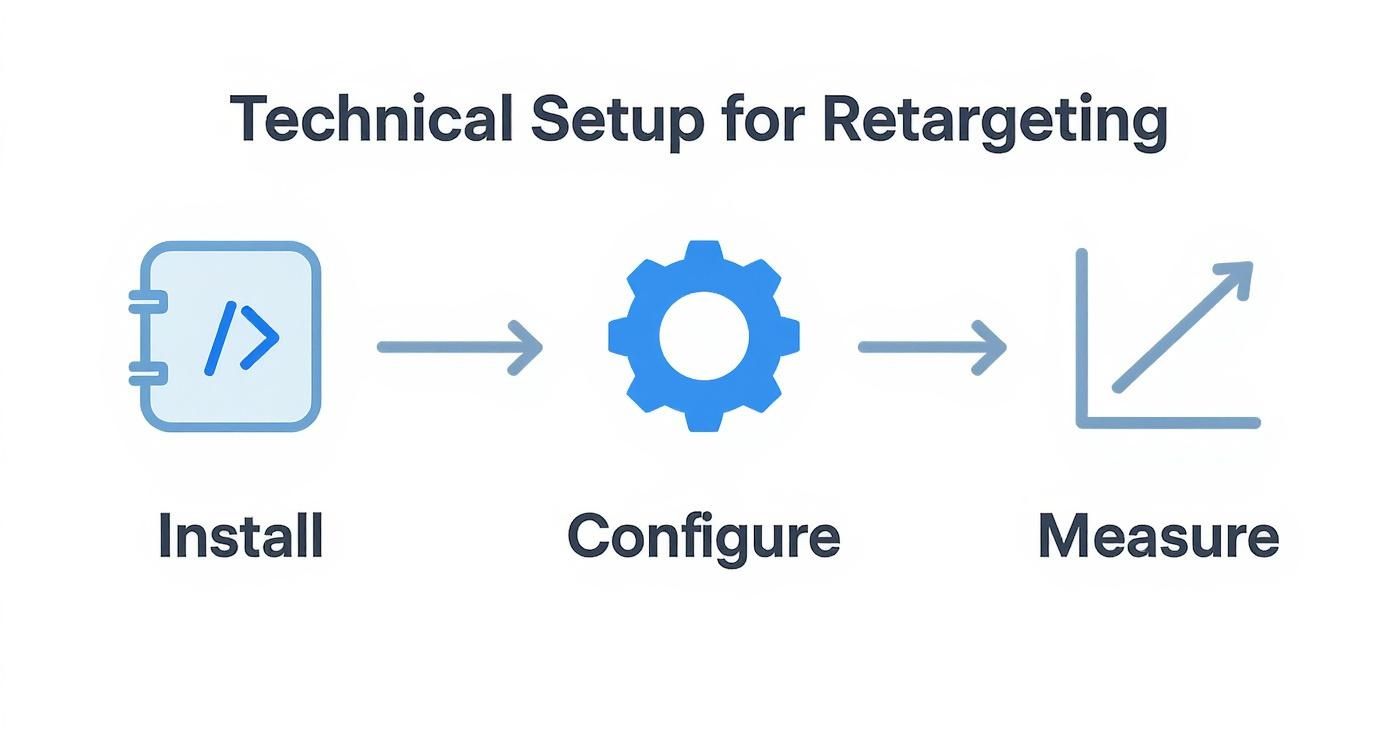
This process—installing your tracking, configuring your audiences, and measuring what works—is the engine that powers everything else.
High-Value Audience Segments for Law Firms
To get started, let’s focus on building audiences that signal real intent. These are groups of people who have taken specific actions on your site, telling you they're more than just casual browsers.
Here are three incredibly powerful audience segments every law firm should build right away:
-
Practice Area Inquirers: This is your bread and butter. This audience is made up of people who viewed a specific practice area page—think
/family-law/divorceor/personal-injury/car-accidents—but never made it to your "Thank You" page (which means they didn't fill out a form). You know exactly what legal issue they're researching, making this group highly valuable. -
High-Intent Prospects: This group goes beyond a simple page view. You can define this audience based on engagement signals. For example, you could create a segment of users who spent more than three minutes on your site or watched over 50% of an embedded case study video. Their behavior shows they’re actively engaged and looking for answers.
-
Consultation Page Drop-Offs: These are the people who got right to the goal line and stopped. They visited your
/contact-usor/request-consultationpage but, for whatever reason, didn't submit the form. This is your lowest-hanging fruit. Often, all they need is one final nudge, like an ad featuring a client testimonial, to build that last ounce of trust.
The goal is to create a tiered system. Your messaging and budget should always prioritize the "Consultation Page Drop-Offs" over the general "Practice Area Inquirers," because their actions signal a much higher level of intent to hire an attorney.
By segmenting your visitors this way, you can craft ads that speak directly to where they are in their journey. A "Practice Area Inquirer" could see an ad highlighting your firm's wins in that field, while someone from the "Consultation Page Drop-Offs" group might see a reassuring message about your free, confidential case evaluation.
The Critical Role of Exclusion Audiences
Just as important as deciding who to target is deciding who to exclude. Wasting ad spend on the wrong people is one thing, but creating a poor brand experience for existing clients is another. Exclusion audiences are simply lists of users you actively prevent from seeing your retargeting ads.
This isn't optional; it's a non-negotiable step for any serious campaign.
Here are the two most important exclusion audiences you need to set up immediately:
- Existing Clients & Staff: You can easily create a list-based audience by uploading a simple file of your current clients' and employees' email addresses. This stops you from wasting money advertising to people who have already hired you or who work down the hall.
- Converted Leads: This is a dynamic, pixel-based audience of everyone who has already landed on your "Thank You" page. There is zero reason to keep showing "Request a Free Consultation" ads to someone who just did exactly that. It's annoying for them and a total waste of your budget.
Implementing these exclusions makes your campaigns more efficient and professional. It shows you respect your audience and your own marketing dollars, focusing every bit of effort on bringing new, qualified cases in the door. This meticulous approach is what separates a basic retargeting campaign from a high-performing client acquisition machine.
Creating Ads That Build Trust and Inspire Action

When it comes to legal advertising, your message is everything. A potential client is often navigating a stressful, vulnerable chapter of their life. Before you can ever hope to inspire action, your ads have to build a foundation of trust. This is where your retargeting strategy shifts from a technical exercise to a fundamentally human one.
The ads you put in front of them shouldn't feel like an aggressive sales pitch. They need to land as a helpful, timely reminder from a professional advisor. It’s a careful balancing act between empathy, professionalism, and showing a clear way forward.
Crafting Copy That Connects and Converts
A generic, one-size-fits-all message is a surefire way to get ignored. The language you use has to be tailored precisely to the audience segment you’re speaking to. The real key here is to mirror their specific situation back to them, showing you understand exactly what they're going through.
Think about two very different visitors to your website:
- The Estate Planning Visitor: This person browsed your pages on wills and trusts. They're thinking about the future, security, and protecting their family. Your ad copy should reflect that with language around foresight and peace of mind. A headline like, "Secure Your Family's Future," will resonate far more than a blunt, "Need an Estate Lawyer?"
- The DUI Defense Visitor: This individual is facing an urgent, frightening, and highly sensitive problem. Your copy has to be discreet, direct, and convey urgency. Using phrases like, "Confidential Consultation Available 24/7," immediately addresses their biggest concerns and starts building trust.
This kind of messaging detail is at the core of effective retargeting for law firms. It proves your expertise and empathy right from the start.
Your ad copy should always serve as a bridge from the problem to the solution. Acknowledge their challenge, then immediately position your firm as the clear, professional path to resolving it.
This approach works. Data consistently shows that retargeting ads are 76% more likely to get a click than standard display ads. When the messaging is on point, their power is undeniable.
Choosing Visuals That Build Credibility
Your images are just as critical as your words. Potential clients are looking for signals of professionalism and authenticity. This is not the place for cheesy, generic stock photos of gavels, scales of justice, or courthouse steps.
Your visuals should build a personal connection and introduce the real people behind your firm's name.
- Professional Headshots: Use high-quality, professional photos of your attorneys. It puts a face to the firm, making it feel more human and approachable.
- Authentic Office Photos: Showing your actual office environment helps prospects visualize working with you. It adds a layer of transparency and credibility that stock photos simply can't match.
- Team Photos: A shot of your legal team collaborating can convey a sense of deep expertise and reassure clients that they have a dedicated group supporting their case.
Using your own, authentic imagery is a simple but powerful way to stand out from competitors and build trust before you ever speak. For more on this, check out our guide on designing effective retargeting ads for lawyers.
The All-Important Call to Action
Finally, every ad needs a clear, direct, and low-pressure call to action (CTA). In the legal field, overly aggressive CTAs like "Call Now!" can feel intimidating or pushy. Your objective is to make the next step feel both safe and easy.
Instead, try CTAs that emphasize value and confidentiality:
- "Request a Confidential Consultation"
- "Download Our Free Guide"
- "Schedule a Free Case Evaluation"
- "Learn More About Your Options"
These CTAs lower the barrier to entry and align with the client’s need for information and reassurance. By combining segment-specific copy, authentic visuals, and a gentle CTA, your retargeting ads will do their job: recapturing attention and turning interested prospects into qualified leads for your firm.
Staying on the Right Side of Ethical Lines
Legal advertising operates under a microscope. Every ad, every piece of copy, is subject to strict ethical rules from state bar associations. When you start retargeting for law firms, those rules don't suddenly vanish. You have to be proactive about compliance, not just to protect your firm, but to make sure your campaigns actually run without getting shut down.
It's not just about the law, either. The platforms themselves have their own rulebooks. Both Google Ads and Meta (for Facebook and Instagram) categorize legal services as a “sensitive” area. This means their ad review process is much tougher, and they're quick to disapprove anything that even sniffs of making a promise or preying on someone's personal hardship.
State Bar Rules Meet Retargeting
Your state bar's advertising guidelines are the ultimate authority. While they differ from state to state, a few common principles almost always apply to your retargeting ads.
-
No Guaranteed Outcomes: This is a big one. You absolutely cannot say things like "We'll win your case." That’s an immediate red flag for any bar association. Instead, shift your focus to what you can promise: your experience, your process, and your dedication. Think along the lines of "Experienced Representation" or "Fighting for Your Rights."
-
Handle Testimonials with Care: Many states have very specific rules about using client testimonials or past case results in advertising. If you feature them, you’ll likely need a clear disclaimer, such as "Results may vary" or "Past results do not guarantee future outcomes." You must check your local bar rules on this; don't just guess.
-
The "Advertising Material" Disclaimer: This is non-negotiable in most places. The words "Advertising Material" or something similar must be clearly visible on your ads. It's a simple step, but forgetting it can lead to serious ethical trouble.
The bottom line is this: your digital ads have to be just as truthful and professional as a TV spot or a newspaper ad. The technology has changed, but the ethical duties haven't.
Navigating Platform Policies and Privacy Laws
Once you've cleared the state bar hurdles, you still have to satisfy the ad platforms and comply with data privacy laws. These are black-and-white rules—break them, and your ad account gets suspended.
A critical piece of this puzzle is your website's privacy policy. It needs to be updated to explicitly say that you use tracking technologies (like pixels and cookies) for advertising. This isn't just a suggestion; it's a requirement from platforms like Google and is essential for staying compliant with major regulations like GDPR in Europe and CCPA in California.
A Practical Compliance Checklist
Before you spend a single dollar, run through this checklist. It will help you cover your bases and launch your campaigns with confidence.
-
Know Your Local Rules: Start by reading your state bar's guidelines on digital advertising. Don't assume you know them. This is your primary source of truth.
-
Update Your Privacy Policy: Make sure your website clearly discloses the use of tracking pixels for retargeting and tells visitors how they can opt out.
-
Add Required Disclaimers: Put "Advertising Material" (or your state's required phrase) on all your ad creatives.
-
Audit Your Ad Copy: Be ruthless. Cut any language that sounds like a promise or guarantee. Frame your value around your expertise and the process you follow for clients.
-
Get Cookie Consent: Use a consent management banner on your website. This gives users a clear choice to opt in or out of tracking cookies and is a must-have for GDPR and CCPA compliance.
By making compliance a core part of your strategy from the very beginning, you’ll minimize risk and build a professional, sustainable advertising presence that gets results without landing you in hot water.
Figuring Out What's Working (and Fixing What Isn't)
Getting your retargeting campaigns live is just the first step. The real magic happens next, when you start digging into the data to see what’s actually bringing in new clients and what’s just wasting your budget. This is how you turn ad spending from a shot in the dark into a reliable client-generation machine.
Forget about vanity metrics. Clicks and impressions might look impressive on a report, but they don't pay the bills. The only numbers you should care about are the ones that directly impact your firm's revenue.
The Only KPIs You Really Need to Watch
For a law firm, a campaign's success isn't about how many people saw your ad; it's about how many qualified potential clients picked up the phone or filled out a form. Your entire analysis should boil down to two key performance indicators (KPIs) that give you the real story on your campaign's financial performance.
- Cost Per Qualified Lead (CPQL): This is your most important metric, hands down. It answers one simple question: "How much did it cost me to get a real potential client to contact us?" If you spend $500 and get 10 form submissions, but only two are from people you can actually help, your CPQL is $250, not $50. That distinction is everything.
- Return on Ad Spend (ROAS): This one connects your marketing spend directly to your firm's bottom line. It can be a little trickier for law firms to track perfectly because of longer case timelines, but it's essential for understanding profitability. You can start with a simple estimate: divide the average value of a new signed case by your total ad spend.
Key Takeaway: If you track nothing else, track CPQL and ROAS. These two numbers cut through the noise and force you to focus on activities that actually grow the firm. They turn your retargeting from an expense into a strategic investment.
Your Blueprint for Ongoing Optimization
Once you're tracking the right data, optimizing your campaigns becomes a clear, repeatable process. I recommend setting aside time every single week to look at the performance data. You're looking for patterns that tell you where your money is best spent.
Start by asking a few fundamental questions:
- Which audiences are converting? Are you seeing a lower CPQL from your "abandoned the consultation form" audience compared to a broader group like "practice area page visitors"?
- What creative is resonating? Is the ad with the client video testimonial outperforming the one with a stock photo of a gavel?
- Which platform is the winner? Is the Google Display Network bringing in better leads than your Meta campaign?
The answers you find are your roadmap. If one audience or ad is a clear winner, put more budget behind it. Don't be afraid to pause the ads and audiences that are lagging. This constant cycle of testing, measuring, and adjusting is how you squeeze every last drop of performance out of your ad spend.
Got Questions About Law Firm Retargeting?
Even the most well-laid plans bring up questions. It's natural. When I talk with firms about retargeting, a few practical concerns almost always come up before they're ready to flip the switch on a new campaign. Let's walk through them.
Is This Going to Be Expensive?
This is usually the first question I get, and the answer is one of my favorite things about this strategy: retargeting is one of the most cost-effective plays you can run.
Think about it. You're not trying to win over a cold audience. You're talking to people who already know you. They've been to your site. This "warm" audience is so much cheaper to reach than trying to outbid your competition on hyper-expensive keywords like "car accident lawyer near me." You’re spending pennies on the dollar to re-engage interested prospects, which means a much healthier return on ad spend.
How Long Should We Run These Campaigns?
Retargeting isn't a short-term sprint; it's a marathon. You should plan for it to be an always-on part of your marketing engine.
The reality is that someone's journey from a fender bender to actually calling an attorney can take weeks, sometimes months. By running your retargeting campaigns continuously, you ensure your firm is right there, top-of-mind, the moment their need becomes urgent and they decide to take action.
I always tell clients to think of retargeting as their digital follow-up system. It works tirelessly in the background, making sure you catch those high-value leads that would otherwise slip through the cracks when the time is right for them.
Are We Going to Annoy People with Our Ads?
A completely valid concern. No one wants their firm to be seen as a pest. Luckily, every major ad platform has a built-in solution for this: frequency capping.
Tools on platforms like Google Ads and Meta let you put a hard limit on how many times one person can see your ad in a given day or week. You can set it to something reasonable, like no more than five times a day, to stay present without being overbearing. Pair that with exclusion lists (so you stop showing ads to people who've already contacted you), and you avoid ad fatigue entirely. The goal is to be a helpful reminder, not a nuisance.
What’s the Difference Between Retargeting and Remarketing?
You'll hear these two terms thrown around, and honestly, most people use them interchangeably. But if you want to get technical, there's a subtle difference.
- Retargeting is what we've been talking about—using a pixel to serve ads to anonymous website visitors as they browse other sites on networks like Google Display.
- Remarketing technically refers to reaching out to a list of known contacts, usually through email. Think of sending a follow-up email to a list of people who downloaded one of your guides.
In the world of paid ads, everyone will know what you mean when you say retargeting for law firms. The core concept is identical: getting back in front of a warm audience that has already engaged with you.
At RankWebs, we provide actionable insights and proven frameworks to help law firms navigate the complexities of digital advertising. Learn more about building a strategic marketing plan that drives real growth at https://rankwebs.com.