


The way law firms get clients is changing. It's no longer about picking one tactic and hoping for the best. Instead, you need a smart, connected strategy that blends Paid Ads, Local SEO, Organic content, and AI-driven tools. Let's break down what this new rulebook looks like and how you can use it to win.
Why Your Old Marketing Playbook Is Obsolete
Remember when a few Google Ads and a decent website were enough? Those days are gone. The entire arena for client attention has been redrawn, and the old marketing tactics just don't have the same punch.
We're facing a perfect storm of skyrocketing ad costs, the explosion of artificial intelligence, and a whole new world of data privacy rules. Just running a few ads or putting up a blog post now and then is like bringing a cavalry charge to a drone fight—you're using yesterday's weapons for today's battle.
Success now demands a totally different mindset. Stop thinking of your marketing efforts as separate channels working in silos. The winning approach is a holistic one, where every piece—your ads, your local presence, your content—works together. This creates a powerful, self-reinforcing system that does a much better job of attracting, engaging, and ultimately signing the modern client.
The Forces Driving Change
A few key trends are forcing this evolution. Getting a handle on them is the first step to building a marketing strategy that can actually stand the test of time. It's not just about getting an edge anymore; it's about survival.
- Intense Competition: The price you pay for a single click on a competitive legal keyword can be absolutely eye-watering. A strategy built only on paid ads is simply not sustainable for most firms.
- Smarter Clients: Potential clients are doing their homework. They research extensively online long before they ever pick up the phone, and they expect more from you than a simple advertisement.
- Technological Acceleration: AI and new digital tools are advancing at a breakneck pace. This is creating a massive gap between the firms that jump on board and those that get left behind.
The rise of AI in the legal space is staggering. Adoption among legal professionals shot up from just 19% in 2023 to 79% in 2024. This isn't happening in a vacuum; it’s part of a bigger trend where high-growth firms are pouring money into their digital campaigns. And for good reason—the numbers don't lie. The average three-year return on SEO for law firms is an incredible 526%.
The data paints a very clear picture: firms that adapt are the ones pulling ahead. The practices seeing real growth are investing in a balanced digital presence, from sophisticated ad campaigns to genuinely helpful video content. They understand that their website and their visibility in organic search are their most valuable marketing assets, with 65% of practices confirming their site delivers the best returns.
You can dig into more legal marketing statistics to see the full scope of this shift. This guide is designed to give you the framework you need to navigate this new world and build a marketing engine that fuels real, sustainable growth for your firm.
The Four Pillars Of Modern Legal Marketing
If you're trying to grow your law firm, you can't just throw money at one channel and hope for the best. A smart, modern marketing plan is built on four pillars that have to work together: Paid, Local, Organic, and the new but critical layer, AI.
Think of it like building a case. Paid ads are your opening statement—fast, attention-grabbing, and designed for immediate impact. Organic is the long, patient work of discovery, building an undeniable foundation of evidence over time. Local is your connection to the jury pool, building trust right in your community. And AI? That's your brilliant paralegal, finding connections and efficiencies you'd never see on your own.
This diagram shows why this shift is happening. Costs are skyrocketing, AI is changing the game, and firms that don't adapt their strategy are simply getting left behind.
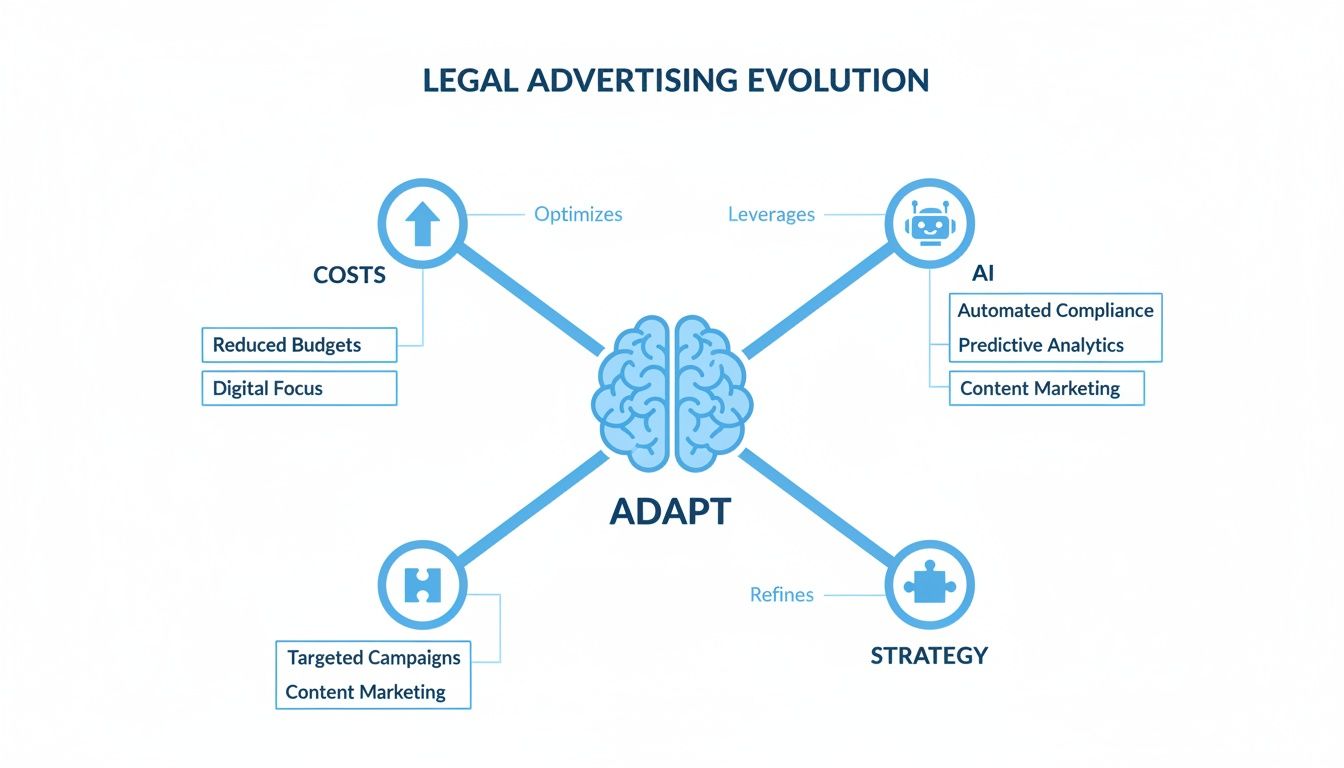
It’s clear that winning today isn't just about adopting a new tool here or there. It's about fundamentally rethinking how you allocate your time and budget to get a real competitive edge.
Pillar 1: The Immediacy Of Paid Advertising
Need leads now? Paid advertising is your answer. Platforms like Google Ads put your firm directly in front of people actively looking for a lawyer. It's like buying a billboard on the most valuable digital highway in the world—you pay for the spot, and you get seen instantly.
But that speed isn't cheap, especially in cutthroat practice areas like personal injury. Success isn’t about having the deepest pockets; it’s about being the smartest advertiser. That means laser-focused targeting, ad copy that speaks directly to a client's pain point, and landing pages that turn a click into a call. Paid ads are essential for driving immediate inquiries and for quickly testing what messages resonate with your market.
Pillar 2: The Foundation Of Local Marketing
For the vast majority of firms, clients live right down the street. Local marketing is how you become the go-to legal authority in your own backyard. It's about making sure that when someone searches for a "personal injury lawyer near me," your firm is the first, most trusted name they see.
A strong local game is built on a few key things:
- Google Business Profile (GBP): This is your digital front door. It needs to be perfect—filled with professional photos, clear service descriptions, and accurate contact information.
- Local Service Ads (LSAs): That "Google Screened" badge at the very top of the search results is pure gold. It’s an immediate signal of trust that puts you ahead of the competition.
- Reputation Management: Actively asking for and responding to client reviews on Google and other sites is no longer optional. It's the social proof that convinces potential clients to pick up the phone.
You can't skip this. A powerful local presence is the bedrock of your entire marketing strategy.
Pillar 3: The Long-Term Value Of Organic Marketing
Organic marketing, which is mostly Search Engine Optimization (SEO) and content, is how you build a real, lasting asset for your firm. Paid ads disappear the moment you stop paying. A top organic ranking is like owning the building your office is in—it generates value month after month, year after year.
This pillar is all about creating genuinely helpful content—blog posts, guides, FAQs, and videos—that answers the real questions your potential clients are typing into Google. By providing value upfront, you earn their trust and build your website's authority. It’s a marathon, not a sprint, but the leads you get from organic search are often the highest quality and come at a far lower long-term cost.
Pillar 4: The AI-Driven Strategic Layer
This last pillar isn't really a separate channel. It's a strategic brain that makes the other three pillars work a whole lot smarter. AI is your force multiplier, acting as a super-analyst that finds opportunities and efficiencies 24/7.
AI isn’t some far-off idea anymore. It's here, and 79% of law firms are already using it to work more efficiently.
It can automate tedious marketing tasks, analyze data to predict which inquiries will turn into high-value cases, and help you personalize your follow-up at scale. Think of it as the element that connects everything, making your paid, local, and organic efforts more intelligent and much more profitable.
This table breaks down the core components of a modern legal marketing mix, helping firms decide where to allocate resources based on their goals.
Comparing The Four Pillars Of Legal Marketing
| Pillar | Primary Goal | Time to Results | Typical Cost | Best For |
|---|---|---|---|---|
| Paid | Immediate lead generation & brand visibility | Days to Weeks | High (Pay-Per-Click) | Firms needing quick case volume or testing new markets. |
| Local | Dominate "near me" searches & build community trust | Weeks to Months | Low to Medium | All firms serving a specific geographic area (PI, family, etc.). |
| Organic | Build a long-term asset & generate high-quality leads | Months to Years | Medium to High (Content/SEO) | Firms focused on sustainable growth and brand authority. |
| AI | Improve efficiency & decision-making across all channels | Immediate & Ongoing | Varies (Tool-based) | Firms looking to optimize their marketing spend and operate smarter. |
Each pillar plays a distinct role, and the most successful firms learn how to balance them to create a marketing engine that is both powerful today and sustainable for the future.
How AI Is Reshaping Client Acquisition
Let’s get one thing straight: artificial intelligence isn't just another tech buzzword. It's a fundamental change in how law firms find, connect with, and ultimately sign new clients. The best way to think about it is like giving your marketing team a superpowered paralegal.
This AI paralegal can tirelessly handle all the repetitive, data-heavy tasks that bog your team down. This frees up your actual people to focus on what matters most: building relationships, refining strategy, and doing the high-value work that truly moves the needle. This is how we're reshaping legal advertising—by putting data, not just gut feelings, at the core of your growth.
From Manual Grind to Automated Intelligence
One of the first places you’ll feel AI's impact is in content creation. We’ve all been there, staring at a blank page, trying to write the perfect blog post. Generative AI tools can now produce high-quality first drafts for articles, social media updates, and newsletters—all geared toward the specific questions your ideal clients are asking.
Of course, this doesn't replace the critical eye of a lawyer for the final review. What it does do is slash the time spent on grunt work. Instead of spending a day on one article, your team can generate several versions, test different headlines, and quickly figure out what resonates with potential clients.
While 79% of law firms now use AI for internal tasks, the real competitive edge comes from using it for smarter client acquisition. The firms that figure this out first are going to pull away from the pack.
This levels the playing field. A small firm can now build out a comprehensive content library that would have once required a massive marketing department, making it possible to compete with the big players in organic search.

Predicting Your Next Best Client
Beyond just creating content, AI's predictive power is a true game-changer. These systems dig into your past case data, analyze how people behave on your website, and even look at wider market trends. The goal? To forecast which leads are most likely to become your next high-value clients.
Just imagine knowing that visitors from a specific town who read your blog post on slip-and-fall accidents are 80% more likely to sign a retainer. That kind of insight is pure gold. It lets you:
- Spend Smarter: Stop wasting ad budget and focus it on the exact demographics and online behaviors that deliver the best return.
- Personalize Your Follow-Up: You can customize your outreach based on what the AI predicts a lead needs, making your firm feel incredibly responsive.
- Prioritize Intake: Your intake team can stop chasing dead-end leads and focus their energy on the people the AI has flagged as high-potential.
This completely flips the script on marketing. You stop being reactive—just waiting for the phone to ring—and become proactive. You’re anticipating what clients need and showing up as the solution before they even start searching for your competitors.
Qualifying Leads Around the Clock
Finally, AI-driven chatbots and intake systems are your 24/7 front desk. They engage potential clients the second they hit your website, day or night. And these aren't the clunky, frustrating bots from a few years ago.
Modern AI can ask smart qualifying questions, collect key case details, and even get an initial consultation booked on your calendar—all without a human lifting a finger. This immediate response is critical. When someone needs a lawyer, their problem is urgent. The firm that provides instant answers and a clear path forward wins.
We dive much deeper into this technology in our guide on AI intake for law firms, but the bottom line is simple. This seamless, always-on process means you never let a good lead slip through the cracks again.
Winning in the High-Stakes World of Paid Ads
Paid advertising, especially Pay-Per-Click (PPC), makes a seductive promise to law firms: show up at the very top of Google, right now. It's the most direct path to getting your name in front of someone who desperately needs your help, at the very moment they start searching. But that speed comes with a hefty price tag, particularly in the cutthroat legal market.
Let's be blunt: the cost of entry is staggering. We're in the middle of a bidding war where some legal keywords have climbed to an eye-watering $1,000 per click on platforms like Google Ads. This frenzy is fueled by a simple fact—a whopping 58% of all traffic in the legal space now comes from paid search. And yet, there's a disconnect. An incredible 97% of legal professionals who try PPC find it too expensive to turn a real profit. Still, the fastest-growing firms are doubling down, spending 5.2 times more on digital ads than their slower-moving peers. Find out more about why law firm marketing costs are rising in 2025.
This creates a battlefield where just throwing money at ads is a guaranteed way to lose. To win, you have to stop thinking like a general carpet-bombing an area and start acting like a sniper.
Adopting a Sniper Strategy
Picture a huge, well-funded firm bidding on a broad keyword like "car accident lawyer." That’s the shotgun approach. They're spraying their budget everywhere, just hoping to hit something. A smaller, smarter firm can't compete in that arena. So, you don't. You adopt a sniper strategy, focusing everything on precision and efficiency.
This means you stop chasing the big, expensive keywords and start zeroing in on highly specific, long-tail phrases and hyper-local targets. Instead of "personal injury attorney," a sniper aims for "slip and fall lawyer in downtown San Diego" or "T-bone accident attorney near me." These phrases get fewer searches, but the person typing them has much higher intent. You're connecting with people who are much further along in their search for the right lawyer.
"The goal of paid advertising is no longer just to get a click. It's to get the right click—from a qualified potential client who is a perfect fit for your firm's expertise and location."
This focused approach means your ad budget is spent only on the most relevant audience, which drastically increases your odds of turning that expensive click into a profitable case.
Crafting Compelling Ads and Landing Pages
Once you have your target locked in, your ad and your landing page have to work together perfectly to seal the deal. Generic ads that just list your firm's name and practice area are invisible. Your message has to speak directly to the client's pain point and offer a clear solution.
For instance, a personal injury ad shouldn't just say, "Injured? Call us." Try something more specific and empathetic, like: "Hurt at Work? Get a Free Case Review & Don't Pay Unless We Win." This copy tackles a specific situation (a work injury), gives a clear next step (free review), and removes a major hurdle (the cost).
That targeted message has to carry all the way through to your landing page. It should feel like a seamless continuation of the ad.
- Mirror the Ad's Message: The headline on the landing page must echo the promise you made in the ad.
- Remove Distractions: Get rid of site navigation and other links. The only goal is for them to contact you.
- Showcase Social Proof: Immediately build trust with client testimonials, recent case results, and attorney awards.
By optimizing every step of this journey, you squeeze maximum value out of every single dollar you spend. For a more detailed breakdown of these tactics, check out our complete guide to paid advertising for attorneys. A surgical, intelligent paid ad strategy allows even smaller firms to compete and win, proving that in legal advertising, the biggest budget doesn't always come out on top.
Building Your Firm's Sustainable Growth Engine
Paid ads and AI tools are fantastic for speed and precision, but let's be honest—they're a rental. The moment you turn off the spend, the lead flow can screech to a halt. A truly durable marketing plan needs a foundation that builds value on its own, an engine that works for you 24/7. This is where organic and local SEO come in.
Think of it like this: paid advertising is renting a billboard on the busiest highway in town. It works as long as you're paying the bill, but you're not building any real equity. Organic and local marketing are like buying the land and building your own office. It takes more work upfront, but you end up with a valuable asset that attracts a steady stream of high-quality clients for years.
This shift in thinking is at the heart of reshaping legal advertising. We're moving away from a series of expensive, short-term campaigns and toward building a long-term business asset—a powerful, self-sustaining presence that isn't totally dependent on a constant firehose of cash.

Dominate Your Local Market
For most law firms, clients aren't just clicks and impressions; they're your neighbors. Local SEO is all about making your firm the go-to legal authority right in your own backyard. When someone in your city searches for a lawyer, you want your name to be the first one they see—and the one they trust.
The foundation for this is your Google Business Profile (GBP). This isn't just another directory listing; it's your digital storefront, and getting it right is non-negotiable.
Here’s what a well-oiled GBP looks like:
- Complete and Correct Information: Your firm's name, address, phone number, and hours must be perfect. Consistency across the web is key.
- Rich Media: Don't just tell people about your firm, show them. High-quality photos of your office and team build instant familiarity and trust.
- Service Details: Be specific. List your practice areas with clear descriptions so potential clients know exactly how you can help.
- Active Engagement: Use features like Google Posts to share firm updates or the Q&A section to answer common questions before they're even asked.
This ground-level work is what gets you featured in the local map pack—often the most valuable real estate on the entire search results page.
The Power of Client Reviews
Beyond your GBP, your local reputation is built on social proof. Client reviews are the modern-day word-of-mouth referral, and they are incredibly persuasive. A consistent stream of recent, positive reviews tells both Google and potential clients that your firm is the real deal.
An effective review strategy is never passive. It means asking satisfied clients for feedback when their case wraps up. It also means responding professionally to every review, good or bad.
This simple act of engagement shows you care about client feedback and are dedicated to top-tier service. That alone can be the final nudge that makes someone choose you over a competitor.
Building Authority with Valuable Content
While local SEO anchors you in your community, organic SEO is about building your firm's authority across the wider digital world. You do this by creating genuinely helpful content that answers the exact legal questions your ideal clients are typing into Google.
Stop writing content that just sells your services. Start providing real value. Think about what keeps potential clients up at night and create blog posts, guides, and FAQs that address their concerns.
For instance, a personal injury firm could create:
- A Step-by-Step Guide: "What to Do Immediately After a Car Accident in California"
- An Explainer Article: "Understanding the Statute of Limitations for Personal Injury Claims"
- A Detailed FAQ Page: Answering common questions about insurance settlements and navigating medical bills.
This kind of content does so much more than just pull in traffic. It positions your attorneys as knowledgeable experts who are invested in helping people. Over time, Google sees this value and rewards you with higher rankings. This leads to a steady flow of highly qualified leads who already see you as a trusted advisor before they even pick up the phone. That's the essence of a true growth engine.
Measuring What Matters and Proving Your ROI
Any marketing strategy, no matter how clever, is just a money pit if you can’t prove it works. For years, law firms were told to track clicks and impressions, but let's be honest—those numbers don't pay the bills. They're vanity metrics. They might look impressive in a report, but they don’t tell you if your firm is actually signing more cases.
The real goal is to draw a straight line from every dollar you spend to the clients you sign. It’s about moving past surface-level data and focusing on the numbers that actually reflect the health of your practice. Success isn't about getting more website traffic; it’s about getting more high-value clients.
This means asking better questions. Forget "How many people saw our ad?" Start asking, "How much did it cost to sign our last five clients, and what's the value of their cases?"
Moving Beyond Vanity Metrics
To get a crystal-clear picture of your return on investment (ROI), you need to zero in on three business-centric metrics. These KPIs cut through the noise and give you an honest look at what’s really happening with your marketing.
-
Cost Per Qualified Lead (CPQL): This is your first and most important filter. It’s not just about getting form fills; it's about how much you spend to get a lead with a legitimate case that your firm can actually take on. A low cost per lead is worthless if the leads are junk.
-
Client Acquisition Cost (CAC): This metric takes things a step further. CAC measures the total marketing and sales cost required to officially sign one new client. It's the ultimate benchmark for your marketing efficiency.
-
Lifetime Value (LTV): This is the total revenue a client is expected to generate for your firm. A high LTV means your marketing is attracting the right kind of cases—the ones that fuel real growth.
The most profitable law firms live by a simple rule: your LTV must be significantly higher than your CAC. If you spend $5,000 to acquire a client whose case is only worth $4,000, your marketing engine isn't just inefficient; it's broken.
Calculating Your Core Growth Metrics
Knowing what these metrics are is half the battle; the other half is calculating them. The formulas themselves are simple, but they demand that you track everything—from your ad spend to a client's first call all the way to their signed retainer.
-
CPQL = Total Marketing Spend / Number of Qualified Leads
Let's say you spend $10,000 on a Google Ads campaign that brings in 20 qualified leads. Your CPQL is $500. Now you know the real cost of getting a viable prospect to raise their hand. -
CAC = Total Marketing & Sales Spend / Number of New Clients Acquired
If that same $10,000 campaign ultimately resulted in signing four new clients, your CAC is $2,500. That’s the true price tag for each new case on your roster. -
LTV = (Average Case Value) x (Number of Cases Per Client) x (Average Client Lifespan)
For most personal injury firms, the last two parts of that equation are simply one. So, if your average settled case is worth $15,000, that’s your LTV. Your goal should be a healthy LTV to CAC ratio, ideally 3:1 or higher.
By keeping a close eye on these numbers, you can finally make smart, data-driven decisions about your budget, kill campaigns that aren't profitable, and double down on the ones that are. For a deeper dive, check out our complete guide on measuring legal SEO success with key metrics and tools.
Frequently Asked Questions
It's natural to have questions when the ground is shifting under your feet. Let's tackle some of the most common ones we hear from law firms trying to make sense of these new marketing realities.
How Can a Small Law Firm Compete in Paid Search?
Trying to outspend the big players on broad keywords like "car accident lawyer" is a losing game for a small firm. The secret isn't a bigger budget; it's a smarter strategy. You have to be more nimble and more precise.
Instead of fighting for the most expensive terms, get specific:
- Hyper-Local Targeting: Don't just target a city; focus on the specific neighborhoods or even zip codes where your ideal clients live and work.
- Long-Tail Keywords: Go after detailed phrases that signal real intent, like "rear-end collision attorney in the Mission District." These searches are made by people who are much further along in their journey to hire a lawyer.
When you pair this laser-focused ad strategy with a strong local SEO foundation and a steady stream of glowing client reviews, you create a powerful combination. You're not just buying clicks; you're building trust and authority in a niche the big firms often overlook.
Will AI Replace Our Firm's Marketing Team?
Not a chance. Think of AI as the world's most efficient paralegal for your marketing team, not its replacement. It’s a tool that can amplify your team’s efforts, freeing them from the drudgery of routine tasks.
AI is brilliant at the 'what'—crunching the numbers, identifying patterns, and executing repetitive tasks. But it can’t handle the 'why.' Your team provides the strategic direction, ethical oversight, and genuine human connection that AI simply can't replicate.
Let AI handle the initial content drafts, analyze campaign data, and automate reporting. This frees up your human experts to focus on what really matters: building relationships, crafting a compelling brand story, and making the tough strategic calls.
What Is the First Marketing Priority for a New Law Firm?
For a firm just starting out, your number one priority should be Local SEO. It is, without a doubt, the most cost-effective way to plant your flag and start attracting clients right in your backyard.
Before you spend a dime on ads, get your local foundation right. Start by creating and completely optimizing your Google Business Profile. From there, make it a mission to get reviews from your first happy clients. And be obsessive about making sure your firm's name, address, and phone number (NAP) are identical everywhere online. This foundational work is what gets you seen by people searching for a lawyer "near me," and it builds the credibility you need to grow.
At RankWebs, we don't just talk about these changes; we help firms implement the frameworks to thrive in them. To see how you can build a resilient marketing engine for your firm, learn more at https://rankwebs.com.