


So, what exactly is predictive analytics in the world of lawyer advertising? Think of it as using your firm's history—all your past data, case outcomes, and client interactions—to make incredibly smart guesses about the future. It uses statistics and machine learning to pinpoint who your best potential clients are and how to reach them, all before you spend your first marketing dollar.
This isn't about just looking at last quarter's numbers. It’s about building a system that helps you identify high-value clients and optimize ad spend with precision, turning marketing from a game of chance into a science.
Moving Beyond Guesswork in Legal Marketing

For too long, law firm advertising has felt like casting a wide, expensive net and just hoping for the best. You pour money into campaigns, unsure of what the return will be. Imagine, instead, knowing exactly which potential clients are most likely to sign with your firm before you even launch an ad.
That's what predictive analytics brings to the table. It's like a strategic GPS for your marketing budget, giving you turn-by-turn directions to find the most valuable clients and case types, avoiding costly wrong turns.
Answering Critical Marketing Questions
Instead of relying on gut feelings or what worked "last time," this approach lets you answer crucial business questions with hard data. It allows your firm to get ahead of the curve, shaping your strategy based on what's likely to happen, not just what already did.
Predictive models can help you tackle questions like:
- Where should I spend my next advertising dollar to get the biggest bang for my buck?
- Which marketing channels will bring in the most valuable cases?
- What specific neighborhoods or zip codes are hotbeds for potential clients?
- Which types of cases are most likely to be profitable for the firm long-term?
This isn't about getting lost in spreadsheets. It’s about making complex data simple and actionable, turning it into an indispensable tool for any competitive law firm. The goal is to make every decision an informed one that drives real, sustainable growth.
The Tangible Impact on Firm Growth
Firms that are making this shift are already seeing a big difference. In 2025, early adopters of predictive analytics in their marketing reported a 40% increase in qualified leads when compared to firms sticking with older methods.
Even better, they cut their costs significantly. These firms saw a 25% reduction in their cost per lead, with their average cost for a lead from a Google Ads campaign dropping from $2,000 to $1,500. You can explore more of these key law firm marketing metrics to see just how much of an impact this can have.
By forecasting outcomes, firms can allocate resources with unprecedented precision. It's about transforming your marketing budget from a necessary expense into a powerful, revenue-generating investment.
Ultimately, using predictive analytics for your advertising gives you a serious competitive advantage. It helps you work smarter, not harder, by attracting more of the right kinds of clients and building a more profitable, resilient practice for the years ahead.
How Predictive Models Forecast Client Behavior

So, how does predictive analytics for lawyer advertising actually work? Think of a predictive model as the most experienced detective on your team. It doesn't rely on gut feelings or hunches. Instead, it meticulously sifts through every scrap of evidence your firm has ever collected to spot the subtle patterns and hidden connections that even the sharpest human eye might miss.
These "clues" are simply your firm's data—everything from past case outcomes and client demographics to ad clicks and website behavior. By analyzing all this historical information, the model makes an educated guess about what’s going to happen next. It essentially forecasts which leads are on the path to becoming your next high-value clients.
The Detective’s Toolkit: Finding Clues in Your Data
A predictive model is only as smart as the data it’s given. For a law firm, this means feeding it a rich, diverse diet of information that tells the full story of your past marketing campaigns and client intake cycles. Without quality data, your model is like a detective showing up to a crime scene with an empty evidence bag.
To get a clearer picture of what’s needed, here’s a breakdown of the essential data that fuels these models.
Key Data Inputs for Legal Predictive Models
This table outlines the essential data types law firms need to collect to effectively implement predictive analytics for their advertising campaigns.
| Data Category | Specific Examples | Purpose in Predictive Models |
|---|---|---|
| Historical Ad Campaign Data | CTR, CPC, ad copy variations, keywords, ad platform (e.g., Google Ads, Facebook), device type. | Identifies which marketing channels, messages, and targeting parameters attract the most valuable leads. |
| CRM & Case Management Records | Client demographics (age, location), case type, intake notes, lead source, case duration, final settlement/verdict amount. | Connects marketing efforts to actual business outcomes, revealing the true ROI of different campaigns. |
| Website & Digital Analytics | Pages visited, time on site, blog articles read, contact form submissions, call tracking data, chat transcripts. | Uncovers the digital "body language" of promising prospects, showing what content and user paths lead to conversion. |
| External Market Data | Geographic accident statistics, local economic indicators, seasonal legal trends, competitor ad spending patterns. | Provides broader context, helping the model understand external factors that influence client demand and case value. |
By connecting these dots, the model begins to build a sophisticated understanding of what truly separates a casual website visitor from a future client with a significant case.
Decoding the Three Main Model Types
Once you have the data, you can apply different types of predictive models to answer specific questions. Think of these as the different analytical techniques your detective uses to crack the case. For legal advertising, the work usually boils down to three core approaches.
1. Classification Models: Predicting Lead Quality
A classification model acts as a powerful gatekeeper, sorting your incoming leads into simple, actionable categories. Its main job is to answer a crucial question: "Is this lead likely to become a high-quality client?"
It learns from the attributes of all your past successful conversions and then assigns a probability score to every new lead. For example, it might discover that leads from a specific zip code who searched for "truck accident lawyer after highway pile-up" and spent over three minutes on your case results page have an 85% probability of signing. This insight allows your intake team to stop guessing and start prioritizing their time on the inquiries that matter most.
A classification model essentially builds a data-driven profile of your perfect client. It then scans every new lead in real-time to see how well they match that winning profile.
2. Regression Models: Forecasting Case Value
While classification tells you if a lead will convert, a regression model predicts how much that potential case might be worth. This is absolutely critical for optimizing your ad spend, because we all know that not all cases are created equal.
This model looks at factors from past cases—like injury severity, jurisdiction, and details from the initial consultation—to estimate a potential settlement range. This helps you decide exactly how much you can afford to spend to acquire a particular type of lead, making sure your marketing budget flows directly toward the most profitable opportunities.
3. Clustering Models: Uncovering Hidden Audience Segments
Finally, clustering models are the master organizers of your data. They group your prospects and past clients into distinct segments based on shared behaviors, needs, and characteristics that go far beyond basic demographics.
Instead of just targeting "males aged 35-55," a clustering model might identify a previously invisible, high-value segment like: "suburban commuters who drive more than 20 miles daily and have shown interest in bad-weather accident content." This level of detail allows you to create incredibly personalized ad messaging that speaks directly to a person's unique situation, which can dramatically boost engagement and conversion rates.
Using Predictive Insights to Win High-Value Cases
Knowing how predictive models work is one thing. Actually using them to make your firm more profitable? That’s where the magic happens. For law firms, this is about turning abstract data into practical strategies that directly boost your bottom line. This is precisely where predictive analytics for lawyer advertising proves its worth, giving savvy firms a serious competitive advantage.
The central idea is surprisingly straightforward: use your firm's own history to find more of your best cases. It’s like analyzing the DNA of your past wins to create a data-driven blueprint for finding the next one.
Identify and Target High-Value Case Types
Every lawyer knows some cases are just plain better than others. The real trick has always been finding more of the home runs without blowing your budget on ads that bring in a flood of low-value, high-maintenance clients. Predictive analytics cracks this code by pinpointing the specific traits of your most profitable cases.
Imagine a model sifting through your closed-case files. It might discover that personal injury cases involving commercial trucks in certain industrial zones, especially when reported within 48 hours, end up with a 90% higher average settlement. Suddenly, your marketing isn't a broad "personal injury" campaign anymore. It's a surgical operation targeting a hyper-specific, incredibly valuable niche.
Armed with that kind of insight, you can completely overhaul your ad campaigns to attract this exact profile.
- Geotargeting: You can focus your ad spend on the specific zip codes and transport corridors the model flagged as hotspots.
- Keyword Strategy: Start bidding more aggressively on long-tail keywords that match the high-value profile, like "semi-truck accident lawyer near industrial park."
- Ad Copy: Write ads that speak directly to the circumstances of these ideal clients. You’ll build immediate trust because you're showing them you get it.
Optimize Ad Spend in Real Time
The days of "set it and forget it" ad budgets are long gone. Predictive models make your budget dynamic, shifting funds in real time to ensure every dollar is pulling its weight. Forget waiting weeks for a performance report; these systems can make adjustments on the fly.
For example, a model might predict a surge in high-quality leads from Facebook Ads on weekday mornings, while Google Search Ads tend to deliver on weekend evenings. The system can automatically shift your budget—pumping more into Facebook during those peak morning hours and then redirecting it to Google when the data shows a higher chance of conversion. This constant optimization loop is all about maximizing your return on investment.
Predictive analytics turns your ad budget into a fluid, intelligent asset. It constantly seeks out the highest-value opportunities and reallocates resources to capture them, minimizing waste on low-potential channels or times.
You can dive deeper into how artificial intelligence is changing the game for paid advertising by exploring advanced strategies for AI for PPC optimization. This approach ensures you're not just spending money, but investing it with precision.
Personalize Your Message for Higher Conversions
Generic ad copy and one-size-fits-all landing pages are a recipe for mediocre results. Predictive analytics allows for a much deeper level of personalization based on what a user is likely looking for. By analyzing a user’s behavior—the search terms they used, the pages they've visited, their demographic info—the model can make a pretty good guess about their intent.
This means you can dynamically change your website’s headline or call-to-action to match what a visitor needs to see. Someone searching for "motorcycle accident compensation" could land on a page with a headline that reads, "Maximizing Your Motorcycle Accident Settlement," complete with testimonials from past biker clients. That kind of personalized experience can massively increase engagement and conversion rates because you’re showing potential clients you understand their unique situation from the very first click.
Forecast Client Lifetime Value for Smarter Acquisition
Finally, predictive models can look beyond a single case to estimate a client's potential Client Lifetime Value (CLV). This is huge for practice areas where one case can lead to referrals or future legal work. The model learns to identify the characteristics of clients who have historically brought the most long-term value to your firm.
This insight gives your firm the confidence to spend more to acquire certain types of clients, knowing the long-term payoff will be worth it. It’s a strategic shift from simply getting a new case to building a portfolio of high-value, long-term client relationships—the true foundation of sustainable growth.
Your Roadmap to Implementing Predictive Analytics
Making the leap to predictive analytics might sound intimidating, but it's an achievable goal for any ambitious law firm. This isn't some massive, multi-year overhaul. It's a series of deliberate, practical steps.
This roadmap will walk you through how to implement predictive analytics for lawyer advertising and start turning your firm's data into its most powerful marketing asset. The journey, however, doesn't start with technology—it starts with strategy.
Step 1: Define Your Business Objectives
Before you even think about data or software, you need to know what you’re trying to accomplish. Vague goals like "get more leads" won't cut it. You have to get specific, measurable, and tie every objective directly to your firm's bottom line.
Think of these objectives as your North Star. They'll guide every decision you make and give you a clear benchmark for measuring your return on investment.
Start with one or two concrete goals. For instance:
- Reduce Cost-Per-Acquisition (CPA): Aim to lower your CPA for high-value case types by 15% within six months.
- Increase Lead Quality Score: Focus on increasing the average quality score of incoming leads by 25% in the next quarter.
- Improve Conversion Rate: Target a 10% lift in your lead-to-client conversion rate for a specific practice area.
Step 2: Conduct a Thorough Data Audit
With your goals set, it's time to look at your raw materials: your data. A data audit means finding, gathering, and cleaning up all the information your predictive model will need to learn from. This is arguably the most critical phase. As the old saying goes: garbage in, garbage out.
Your audit should pull data from all your systems—your CRM, case management software, website analytics, and advertising platforms like Google Ads. The aim is to create a single, clean, unified dataset. This ensures your model's predictions are built on a solid foundation of accurate information.
Think of your data as the case file for your future marketing success. A thorough audit ensures you have all the necessary evidence organized and ready before you present your argument. Incomplete or messy evidence leads to a weak case.
This visual shows a simplified flow for how this works in practice—identifying, targeting, and converting the cases you actually want.
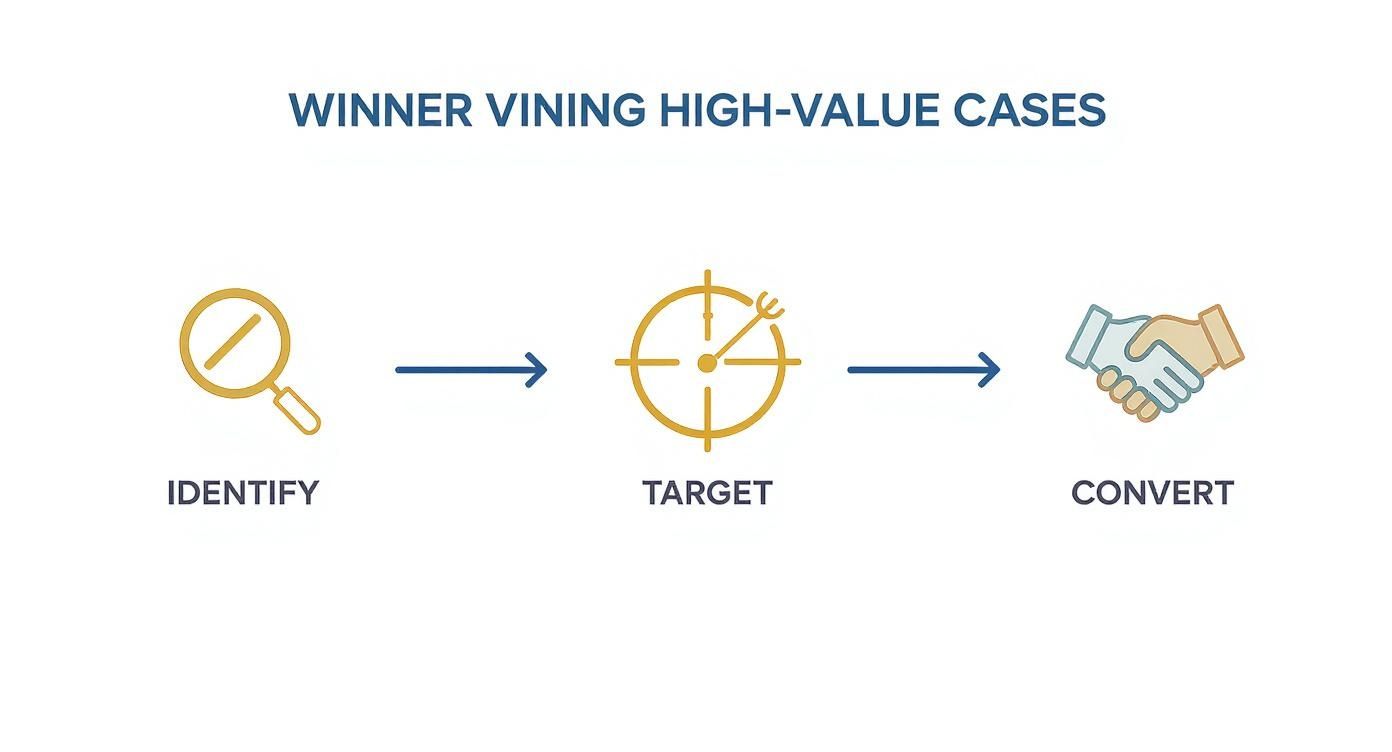
This process shows exactly how firms can move from broad analysis to focused client acquisition, turning data-driven insights into tangible results.
Step 3: Make the Build Versus Buy Decision
Next, you'll hit a fork in the road. Should you build a custom predictive model from scratch or buy a subscription to an existing software-as-a-service (SaaS) platform?
- Building a custom solution gives you total control but requires a major investment in data scientists and infrastructure. This is usually a path for very large firms with unique needs.
- Buying a SaaS platform is a much faster and more cost-effective way to get started. These tools are built for the legal industry and handle all the heavy lifting of model development and maintenance.
For most small to mid-sized firms, the "buy" approach is the most practical choice. And it’s a popular one—by 2025, over 70% of mid-sized and large law firms in the U.S. and U.K. had integrated predictive analytics into their advertising, reflecting a huge shift toward data-driven marketing. You can learn more about these 2025 legal marketing benchmarks and see how quickly the industry is adopting these tools.
Step 4: Train and Test Your First Model
Once you have your clean data and your chosen tool, it’s time to train your first model. This simply means feeding your historical data into the system and letting it learn the patterns that signal a high-value lead. A great starting point is a simple classification model that scores incoming leads based on their likelihood to convert.
After the initial training, you have to test its accuracy. A classic A/B test works perfectly here. Run two campaigns side-by-side: one guided by the model’s predictions and one using your old targeting methods. This will give you a clear, real-world measurement of the lift you’re getting from predictive insights.
To dig deeper into the technology, our guide on AI tools for legal marketing covers a range of options available to firms today.
Step 5: Monitor and Refine Continuously
Implementation isn't a "set it and forget it" project. It's an ongoing process of improvement. You need to constantly monitor your model and retrain it with new data to keep its predictions sharp and relevant.
Set up a regular review—maybe quarterly or bi-annually—to check performance against the business goals you set in Step 1. This refinement loop is what transforms your marketing from a static expense into a dynamic, learning system that gets smarter and more efficient over time, securing your firm's competitive edge for years to come.
Measuring Success and Proving Your ROI
A great strategy is worthless if you can't prove it works. When you invest in predictive analytics for lawyer advertising, you absolutely have to connect it to your firm's bottom line. To make a strong case for it, you need to look past vanity metrics like clicks and impressions and get right to the key performance indicators (KPIs) that actually drive growth.
This isn't just about showing off a fancy new tool. It’s about demonstrating, with hard numbers, how it directly contributes to the firm's profitability. Every predictive insight has to be tied to a real-world business outcome, drawing a straight line from your data-driven strategy to the new clients walking through the door.
Focusing on Bottom-Line KPIs
To show the real value of your investment, you have to speak the language of the partners and stakeholders: money. The right KPIs will clearly show the financial impact and improved efficiency that predictive modeling brings to the table.
Here are the metrics that matter most:
- Cost Per Acquisition (CPA): This is the ultimate test of efficiency. Predictive analytics should drastically lower your CPA by focusing your budget only on the leads most likely to become clients, cutting out the wasted spend.
- Lead-to-Client Conversion Rate: When your models are working, they feed your intake team a steady diet of high-quality leads. A rising conversion rate is a clear signal that you’re successfully identifying better prospects from the start.
- Case Value by Source: These tools are fantastic for attributing new cases back to the exact campaigns that generated them. This helps you track not just the number of cases you’re signing, but also their average value, proving you’re bringing in more lucrative work.
Keeping an eye on these metrics gives you a solid foundation for judging success. It’s also crucial to understand the importance of ROI and analytics for lawyer PPC campaigns, as those core principles are the bedrock of proving your marketing's worth.
Building an Undeniable Business Case
The best way to get continued buy-in is to show a massive improvement in your overall marketing return on investment (ROI). Predictive analytics gives you the data to build that case with surgical precision. And the difference it can make is not small.
In 2025, law firms using predictive analytics reported a 526% return on investment (ROI) from their digital advertising efforts within three years, compared to a 200% ROI for firms not using these tools.
That’s a staggering gap. It comes from the ability of these models to tell you which channels and ad creatives will deliver the best leads before you spend a fortune finding out the hard way. You can see more about how firms are pulling this off, along with other key legal marketing statistics on andava.com.
Attribution Models That Tell the Full Story
You also have to give credit where credit is due. A solid attribution model ensures your predictive analytics efforts are properly recognized for the clients they bring in. Don't just settle for a simplistic "last-click" model, which gives all the glory to the final touchpoint before a conversion. That's rarely the full picture.
A data-driven attribution model is the way to go. It looks at every single touchpoint in a prospect's journey—from the first ad they saw to the form they finally filled out—and assigns partial credit based on how much each interaction contributed. This approach paints a far more accurate picture of how predictive targeting influenced the entire client acquisition process.
When you present these results to the partners, tell a story. Start with the "before" snapshot: your old CPA and conversion rates. Then, roll out the "after" data, showing the concrete improvements your new strategy delivered. By framing everything in terms of higher profits and less waste, you’re not just showing numbers; you’re telling a powerful story of success.
Navigating Ethical and Privacy Guardrails

Working with powerful data comes with serious responsibility, especially in a field like law where trust is everything. While predictive analytics for lawyer advertising can make your marketing incredibly efficient, it also opens up some tricky ethical and privacy questions. Getting this right isn't just about ticking compliance boxes—it's about protecting your clients and your firm's reputation.
The entire process has to be built on a rock-solid foundation of data privacy. We've all seen the headlines about regulations like Europe's General Data Protection Regulation (GDPR) and the California Consumer Privacy Act (CCPA). These laws set clear, strict rules for handling personal data. For law firms, this means your data practices must be fully compliant, completely transparent, and always centered on getting informed consent.
Preventing Algorithmic Bias
Beyond the letter of the law is the very real ethical problem of algorithmic bias. A predictive model is only as good as the data it learns from. If your firm's historical data reflects past societal biases—even unintentionally—your model will learn and even amplify them. This could easily lead to discriminatory advertising, like certain groups of people never even seeing your ads for specific legal services.
Imagine a model trained on old case data that accidentally learns to ignore leads from lower-income zip codes for a lucrative practice area. Not only is that an ethical disaster, but it's also just bad business. You're leaving perfectly good cases on the table.
The point of using this data is to uncover future opportunities, not to cement past inequalities. A biased model isn't just an ethical failure; it's a business failure, plain and simple.
To get ahead of this, you have to be proactive about building fairness and transparency directly into your models from day one.
Best Practices for Responsible Implementation
Building these ethical guardrails into your strategy isn't optional. It’s a critical step that protects potential clients, shields your firm from legal trouble, and ultimately drives better, more equitable results.
- Conduct Regular Audits: Don't just set it and forget it. You need to routinely check your models and their results to spot and fix any biases that creep in over time.
- Maintain Data Anonymity: Whenever you can, use anonymized or aggregated data for model training. This minimizes the risk of exposing sensitive personal details and keeps the model focused on behaviors, not individuals.
- Be Transparent About Data Usage: Make sure your privacy policy is written in plain English and clearly explains how you use data for advertising. Being upfront like this builds trust from the very first click.
Common Questions About Predictive Legal Marketing
Adopting a new way of thinking about marketing always stirs up some good questions. When it's something as powerful as predictive analytics for lawyer advertising, firms rightfully want clear answers before they invest time and money.
Let's cut through the noise and address some of the most common concerns head-on. This isn't about theory; it's about giving you the practical clarity to see exactly how this fits into your firm's growth plans.
Is This Technology Only for Big Firms With Deep Pockets?
Not anymore. It’s a common myth that you need a massive budget to play this game. While predictive analytics was once the exclusive territory of large, national firms, that has changed dramatically.
The rise of specialized legal marketing platforms has brought this technology within reach for small and mid-sized practices. Many of these tools offer flexible pricing models, so you can get powerful predictive insights without needing an in-house data science team or a huge upfront investment.
How Much Historical Data Do We Really Need to Get Started?
You probably have enough to begin right now. While more data is always helpful, you don't need a decade's worth of records to make this work. A solid starting point is 12-24 months of consistent data from your key systems, like your CRM and primary ad channels (think Google Ads).
This window usually gives a model enough information to spot conversion patterns, account for seasonality, and understand what a quality lead looks like. Remember, quality and consistency trump sheer volume every time. One year of clean, well-organized data is far more valuable than ten years of messy, incomplete records.
Can This Actually Tell Me Who Is Going to Sign a Retainer?
This is a really important distinction to make. Predictive analytics gives you powerful probabilities, not absolute certainties. It's not a crystal ball that will tell you, "John Smith will sign a retainer tomorrow at 2 PM."
What it will do is identify that a lead matching John's profile has an 80% higher probability of converting into a high-value case compared to your average lead. It’s all about stacking the odds in your favor.
This insight allows you to focus your resources on the opportunities most likely to succeed, dramatically improving your overall efficiency and ROI.
By knowing where to focus, you can prioritize your time, energy, and follow-up efforts on the prospects that are statistically most likely to become your best clients.
At RankWebs, we provide actionable insights and frameworks to help firms navigate the future of legal marketing. Discover how to build a more profitable practice at https://rankwebs.com.