

If you want your personal injury lawyer ads to actually bring in cases, you need a strategy built for today, not a decade ago. It’s no longer about just buying clicks; it's about a smart mix: capturing people actively searching for a lawyer on platforms like Google Ads and Local Service Ads (LSAs), while also building your firm's brand on social media. The secret sauce? Tying it all together with a relentless focus on one number: your cost per signed case, not just the cost of a lead.
Why Personal Injury Advertising Has Changed Forever
Let's be honest, the old PI advertising playbook is dead. We all remember the catchy jingles on late-night TV and the giant faces staring down from billboards. Those methods were great for name recognition, but they were a shotgun approach—expensive, impossible to track, and wildly inefficient. In today's hyper-competitive market, that's just a fast way to burn through your marketing budget.
The entire game has shifted online, and it's an absolute battleground.
Competition has intensified to a level most firms were not prepared for. CPCs for valuable keywords have skyrocketed, the search results page is saturated with competitors, and your local rivals are more sophisticated than ever. Simply bidding on "car accident lawyer" on Google isn't a strategy anymore; it's a money pit. The numbers don't lie. A recent analysis showed that spending on legal services ads blew past $2.5 billion. You can dig into more legal ad spending trends to see just how competitive it's become.
Ten years ago, the best-performing PI ad might have been a billboard. Today, it’s a 15-second video targeted with AI to a specific demographic within a five-mile radius of your office.
This new reality demands a much sharper approach. It’s not about who has the biggest budget anymore. It’s about who has the smartest strategy. You have to understand how to use each channel for what it’s best at—the immediate, high-intent searches on Google, the trust-building verification of LSAs, and the brand-building power of a platform like Meta. Firms clinging to the old ways are just getting left behind.
The Foundations of a Winning Personal Injury Ad Campaign
Before a single dollar of your ad budget gets spent, you need a plan. Just tossing money at Google Ads and hoping for the best is a surefire way to burn through your marketing funds with nothing to show for it. A successful campaign is about building a solid strategic foundation first.
Identify Your Audience
The first piece of the puzzle is figuring out your true audience. It's easy to say "people who've been injured," but that's painting with way too broad a brush. Think deeper. Your audience is a spectrum:
- Injury Victims: The person who was just in a wreck, frantically searching for help on their phone.
- Family Members: The worried spouse or adult child doing the heavy lifting on research.
- Referral Partners: Professionals like chiropractors or ER doctors who could send cases your way.
Each group requires a slightly different message and platform.
Define Your Objective
Once you know who you're talking to, you need to define what you want them to do. Not every ad has the same job. Is your primary focus on getting the phone to ring right now? Or are you playing the long game?
- Lead Generation: This is the bread and butter. The goal is to drive immediate calls, form fills, and live chats for high-value case types.
- Brand Awareness: This is about increasing name recognition in your city. When an accident happens, your firm should be the first one that comes to mind.
Choose Your Platforms
Now it’s time to decide where to fight your battles. Each advertising platform has its own strengths in the world of personal injury advertising.
For high-intent leads who are actively looking for a lawyer right now, nothing touches Google Search and Local Service Ads. But for building your brand and running powerful retargeting campaigns, platforms like Facebook, Instagram, and YouTube are your best friends. The smartest strategies use a mix of these.
Discuss Geographic Targeting
Finally, you absolutely have to nail down your geographic targeting. Spending money on clicks from people outside your service area is one of the quickest ways to drain your budget. Decide if you want to dominate a tight local radius around your office or cast a wider net across several counties (a multi-market strategy). Getting this right ensures every penny is spent reaching potential clients you can actually help.
Google Ads for Personal Injury Lawyers
Even with all the shiny new platforms, Google Ads is still the backbone of PI lead generation. It’s where you find people the very moment they need you most. Getting this right means a steady flow of quality cases.
The competition is fierce. Personal injury is one of the most expensive battlegrounds in the pay-per-click (PPC) world. While paid search drives a massive 58% of all legal industry traffic, the intense bidding wars can make it feel prohibitively expensive. You can dig into more of these legal marketing statistics to see just how high the financial stakes are. To win here, you can't just throw money at broad keywords; you have to be surgical.
Insider Tips for Winning on Google
Beyond just structuring your campaigns correctly, a few key tactics can make all the difference.
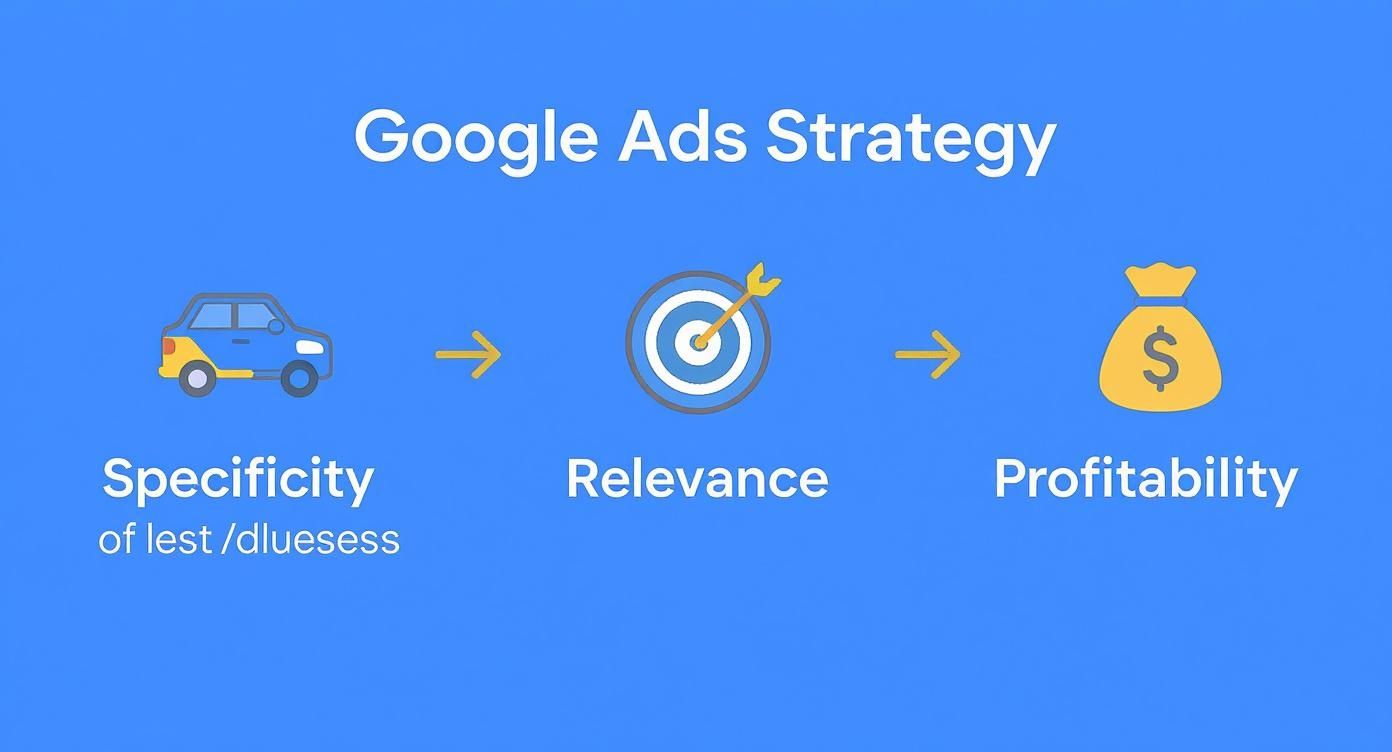
- Split campaigns by injury type. The single biggest mistake I see firms make is jamming all their keywords into one giant campaign. A "slip and fall" is a completely different world from a "truck accident." Create separate campaigns for each core practice area (Car Accidents, Motorcycle Accidents, etc.) to make your ad copy hyper-relevant and improve your Quality Scores.
- Use call-only and search ads together. Some people want to click and read before they call. Others, especially on a cell phone, just want to talk to a human now. Running both captures both types of potential clients.
- Obsess over negative keywords. You must proactively block searches from people looking for jobs, law school info, or legal help in a different state. From day one, add terms like "jobs," "salary," "free," "pro bono," and the names of states you don't practice in. This one task can save you thousands.
- Track Cost Per Signed Case, not just Cost Per Lead. The only number that truly matters is your Cost Per Signed Case (CPCase). I’ve seen firms get excited about a low CPL, only to find out those leads were duds. A $500 lead that turns into a six-figure case is infinitely better than five $100 leads that go nowhere.
For a deep dive on what happens after the click, check out our guide on how to optimize landing pages for lawyer PPC ads.
Local Service Ads (LSAs): The Most Underrated Channel
Think of Google's search results page as prime real estate. If traditional PPC ads are on the first floor, then Local Service Ads for personal injury are the penthouse suite. They sit right at the very top, even above the paid search ads.
You’ve seen them: the boxes with headshots, star ratings, and that all-important "Google Screened" green checkmark. That badge isn't just decoration. It’s a signal to potential clients that Google has vetted your licenses, insurance, and background. It builds trust instantly.
Getting set up requires going through Google's verification, but it's worth the effort. Your rank is driven by proximity, responsiveness, and—most importantly—your client reviews. This is why LSA leads are often warmer and more qualified.
From my own campaigns, I can tell you this: our LSAs often produce a 40% lower CPL compared to search ads for the same practice areas. In some markets, like South Florida, we’ve seen LSAs outperform search ads 3:1 on cost per case. It's a game-changer.
To succeed with LSAs, make asking for reviews a standard part of your case-closing process. A well-maintained Google Business Profile is also non-negotiable, as LSAs pull information directly from it. For a detailed walkthrough, see our guide on optimizing Google Business Profiles for lawyers.
Social Media Ads for Personal Injury Firms (Facebook, Instagram, YouTube)

Nobody opens Facebook hoping to find a lawyer. But that’s exactly why social media is so powerful. Its strength lies in brand awareness and retargeting—making sure you’re the first name people think of when trouble strikes.
The real goal is to humanize your law firm. The best personal injury ad examples on social media don't look like ads at all.
- Testimonial Videos: A short, sincere video from a past client is more persuasive than any ad copy you could write.
- Community Involvement: Sponsoring the local little league team? Show it. This builds incredible goodwill.
- Case Success Stories: Ethically frame a successful outcome by focusing on the client's journey.
Social media's targeting is incredibly sophisticated. You can use demographics, interests, and—most powerfully—lookalike audiences. By uploading a list of past clients, a platform like Meta will find new users who share similar characteristics. It’s a brilliant way to find your next ideal client.
Remember compliance. State bar associations have strict rules. Never make promises ("We'll win your case"), watch for sensitive language, and always include necessary disclaimers. You can dive deeper into these trial lawyer advertising trends here.
How AI Is Changing Personal Injury Advertising
Artificial Intelligence isn't a far-off concept anymore. For personal injury lawyer ads, AI is a practical tool that gives smart firms a real advantage.
AI doesn’t replace strategy—it amplifies it. A bad plan executed by a brilliant AI is still a bad plan.
Here's how AI personal injury marketing is already making an impact:
- Keyword and Audience Discovery: AI tools can churn through massive amounts of data to find new keyword opportunities and audience pockets you would have never found on your own.
- Ad Copywriting: Tools like ChatGPT and Bard can help brainstorm dozens of ad headlines and descriptions in minutes, freeing you up to focus on strategy.
- Predictive Bidding and Budget Optimization: Platforms like Google Ads use AI to analyze thousands of signals in real-time to adjust your bids, squeezing the most conversions from your budget.
- Automated Follow-Up Systems: The moment a lead comes in, AI-powered CRMs and chatbots can begin the follow-up process, ensuring no lead ever goes cold.
By tying these tools together, you ensure you capitalize on every single lead your ads generate. Check out our guide on integrating live chat and chatbots for immediate client engagement for a step-by-step approach.
Creative That Converts: What Makes a PI Ad Work
A winning ad isn't just about targeting; it's about the message. Effective creative is built on four pillars: a clear call-to-action (CTA), empathy, credibility, and trust.
- Headlines That Focus on Benefit: Instead of "Smith & Jones, Attorneys at Law," try "Injured? Get Legal Help Fast." It speaks directly to the user's immediate need.
- Authentic Visuals: Ditch the cheesy stock photos. Use real images of your firm's staff, your actual office, and, when appropriate, real client success stories. Authenticity builds trust.
Here are a couple of quick examples of effective messaging:
- Example 1 (Google Ad):
- Headline: Car Accident Lawyer in [City] | No Fee Unless We Win
- Description: Hurt in a crash? Our local attorneys fight for the compensation you deserve. Free, immediate case review. Call now.
- Example 2 (Facebook Ad):
- Visual: A short video of an attorney explaining the first 3 steps to take after an accident.
- Text: An accident can be overwhelming. We're here to help you navigate what comes next. Learn more about your rights in our free guide.
Compliance & Ethics in Personal Injury Advertising
The single biggest minefield in personal injury advertising is compliance. State bar associations have very strict rules that you must follow to protect your firm and your license.
- Disclaimers are Non-Negotiable: Every ad must include necessary disclaimers, such as "Results may vary," "No fee unless we win," or "This is an advertisement."
- Reference ABA and State Bar Guidelines: The rules can vary by state. Always be familiar with your specific jurisdiction's guidelines on what constitutes ethical advertising.
- AI and Legal Advertising Regulation: The law is still catching up to AI. Be cautious about using AI to generate content that could be seen as misleading or making unsubstantiated claims. Human oversight is critical.
Measuring Ad Success
Launching a great ad campaign is only half the job. If you aren’t measuring what matters, you’re just guessing. Real success in personal injury lawyer ads boils down to tracking the KPIs that directly impact your firm's bottom line.
The KPIs You Should Actually Care About
- Cost Per Lead (CPL): Your baseline. What you pay for every phone call or form fill.
- Conversion Rate: The percentage of ad clicks that become a lead.
- Call-to-Case Ratio: How many inquiries it takes to sign a new client. This is a crucial metric for judging lead quality.
- Cost Per Signed Case (CPCase): The holy grail. The one number that tells you exactly how much you spent to acquire a paying client.
Many firms think ads don’t work because they never close the feedback loop between calls and signups. They panic over a high CPL, completely missing that the campaign was producing their most valuable cases.
Conclusion: The Future of Personal Injury Advertising
The world of personal injury advertising is only getting more crowded and more expensive. The firms that will dominate won't just be the ones with the deepest pockets—they'll be the ones who are the most nimble and data-driven. Success favors firms that test and evolve.
The formula for winning is straightforward: Paid Ads + AI + Fast Follow-Up = Growth.
This means using powerful channels like Google Ads to capture active searchers, layering in AI to refine targeting, and having an ironclad process to ensure every lead gets a response within minutes.
Every year, ads get smarter. The law firms that do too—win.
At RankWebs, we’re not just about running ads; we're about building strategic, data-driven campaigns that create sustainable growth for law firms. We help you navigate these complex challenges to drive the leads that turn into valuable cases. Find out more about how we help at https://rankwebs.com.
Article created using Outrank