

When a potential client desperately needs a lawyer, where do they turn? More often than not, it's a search engine. Paid advertising gives your firm a direct line to these individuals at the exact moment they're looking for help. It's a way to generate immediate, targeted visibility and attract clients who are ready to take action.
Unlike SEO, which is a long-game strategy, paid ads offer a much more predictable path to client acquisition. You can place your firm at the very top of search results or on relevant social media feeds, driving consistent growth in a market that gets more crowded by the day.
Why Paid Advertising Is Essential for Law Firm Growth

Let's be honest: just having a website isn't enough anymore. Organic marketing, like blogging and building your site’s authority with SEO, is absolutely critical for long-term success. Think of it like building a stellar reputation in your community—it’s powerful, but it takes years of hard work to really pay off.
Paid advertising is different. It’s like buying the most visible billboard in town right on the highway your ideal client is driving down. It delivers an immediate, laser-focused presence right in front of people with urgent legal problems.
Gaining a Competitive Edge
Here’s the reality: your competitors are already running paid ads. They’re capturing high-intent leads that could have been yours. If you're not in the game, you're essentially letting other firms sign the clients you want.
Paid advertising levels the playing field. It gives your firm a direct channel to people actively searching for an attorney, allowing you to compete for the best cases, right now.
This guide is your roadmap to doing paid advertising for attorneys the right way. We'll walk you through the entire process, including:
- Platform Selection: Figuring out where to spend your money, from Google Search to social media.
- Ethical Compliance: Navigating the tricky rules from state bar associations to keep your campaigns clean.
- Smart Budgeting: Allocating your budget and mastering bidding strategies to get the most for your money.
- Performance Tracking: Focusing on what really matters—signed cases and a solid return on your investment.
A Strategic Investment, Not an Expense
The potential cost of legal ads can seem daunting, but that's the wrong way to look at it. The key is to see it not as a cost, but as a strategic challenge to be managed. A properly executed campaign delivers a measurable return, turning your ad spend into an engine for predictable growth.
A common mistake is viewing paid advertising as a cost center instead of an investment vehicle. When tracked properly, every dollar spent should have an expected return in the form of qualified leads and new client retainers, making it one of the most accountable marketing channels available.
This article will show you how to build, launch, and fine-tune campaigns that don't just compete, but actually win in today's demanding legal market.
Navigating the High Cost of Legal PPC
Jumping into pay-per-click (PPC) advertising for law firms can feel like stepping onto a high-stakes auction floor. But instead of fine art, you're bidding for the attention of a potential client right at their moment of need. It’s a crowded, competitive, and frankly, expensive place to be.
The reason for the sticker shock is classic supply and demand. A single personal injury case can be worth a fortune, so firms are more than willing to bid aggressively to capture that one click that could turn into a massive settlement. This intense competition drives up the price for everyone else in the game.
Why Every Click Costs a Fortune
The whole system runs on Cost-Per-Click (CPC), which is exactly what it sounds like: the fee you pay every single time someone clicks your ad. This isn't some fixed menu price, though. It’s constantly changing based on a few key factors that signal how valuable a potential client might be.
Here’s what moves the needle:
- Practice Area: Keywords like "mesothelioma lawyer" or "car accident attorney" are some of the priciest on the internet. Why? The cases they represent are potentially worth millions. On the flip side, something like "traffic ticket lawyer" will have a much lower CPC because the case value is smaller.
- Geographic Location: Trying to get noticed in a major city like Los Angeles or New York? You'll pay a premium. Bidding in a smaller, rural town costs a lot less simply because there are fewer firms fighting for the same eyeballs.
- Keyword Intent: The words someone types into Google tell a story. A broad search like "what to do after an accident" is an early-stage query. But a high-intent search like "best personal injury lawyer near me" signals they're ready to hire, making that click far more valuable and expensive.
This high-cost reality is a major hurdle. The average CPC for legal search ads is a staggering $9.21, a figure that dwarfs most other industries. But here’s the interesting part: despite the expense, 58% of all traffic in the legal world comes from paid search. What’s more, 75% of firms admit they’d use PPC if they just had a bigger budget. You can find more compelling statistics about legal marketing that paint the full picture.
This data tells us one thing loud and clear: PPC is expensive because it works. The goal isn't to run from the cost—it's to get smarter about how you spend your money.
Finding the Gold in Long-Tail Keywords
So, how do you compete if you don't have a blank check? The secret is to shift your focus from those broad, insanely competitive keywords to more specific, long-tail keywords. These are the longer, more detailed phrases people use when they know exactly what they're looking for.
Think of it like this: the keyword "injury lawyer" is a giant billboard on the busiest highway. It gets a ton of impressions, but most of the drivers zipping by aren't your target audience, and that billboard space costs a fortune.
A long-tail keyword strategy is all about precision over brute force. Instead of shouting at a massive, distracted crowd, you're starting a quiet conversation with a small group of people who are much closer to making a hiring decision.
A long-tail keyword, such as "truck accident lawyer for brain injury in Houston," is like a perfectly targeted flyer handed directly to someone who has just described their exact problem. The audience is smaller, yes, but their intent is crystal clear, and the cost to reach them is often dramatically lower. By zeroing in on these hyper-specific phrases, you pull in truly qualified leads and get a much healthier return on every dollar you spend.
Choosing the Right Advertising Channels for Your Firm
Deciding where to spend your advertising dollars is a lot like selecting a jury. You need to find the right people, in the right place, at the right time. You wouldn't try to find a personal injury client at a corporate tax seminar, and you shouldn't waste your budget advertising on a platform your ideal clients never use.
The secret to effective paid advertising for attorneys is matching your message to the platform and the mindset of the person seeing your ad. Are they frantically searching for help after an accident, or are they casually scrolling through social media? The answer to that question tells you exactly where to put your money.
Capturing Immediate Client Intent with Search Ads
When someone has an urgent legal problem, their first move isn't to browse—it's to search. They head straight to Google or Bing and type in phrases that scream "I need a lawyer now," like "DUI attorney near me" or "emergency child custody lawyer."
This is where search advertising is unbeatable. Your firm’s ad appears right at the top of the search results, offering a direct solution at the precise moment of need. You aren't interrupting their day; you're answering their call for help. This makes search ads a lead-generation powerhouse, especially for practice areas driven by urgency like personal injury, criminal defense, and family law.
For a deeper dive, our comprehensive guide to Google Ads for law firms breaks down more advanced tactics.
Building Your Brand on Social Media
While search ads are great for capturing existing demand, social media ads are all about creating it. Platforms like Facebook and LinkedIn are incredible tools for getting in front of potential clients based on specific demographics, job titles, or life events. This isn't about finding someone in a moment of crisis; it's about building your firm's reputation over the long haul.
- Facebook Ads: Perfect for practices that serve individuals. Think estate planning or family law. You can target people based on their age, location, and even major life events like getting engaged or starting a family.
- LinkedIn Ads: This is the undisputed king for B2B practices. If you handle corporate law, intellectual property, or employment litigation, LinkedIn allows you to put your message directly in front of company founders, executives, and in-house counsel.
Think of social media advertising as a long game. You're building trust and establishing your firm as the go-to authority, so when a legal need does arise, your name is the first one they remember.
This infographic shows a simple way to think about your keyword strategy based on how much budget you have to work with.
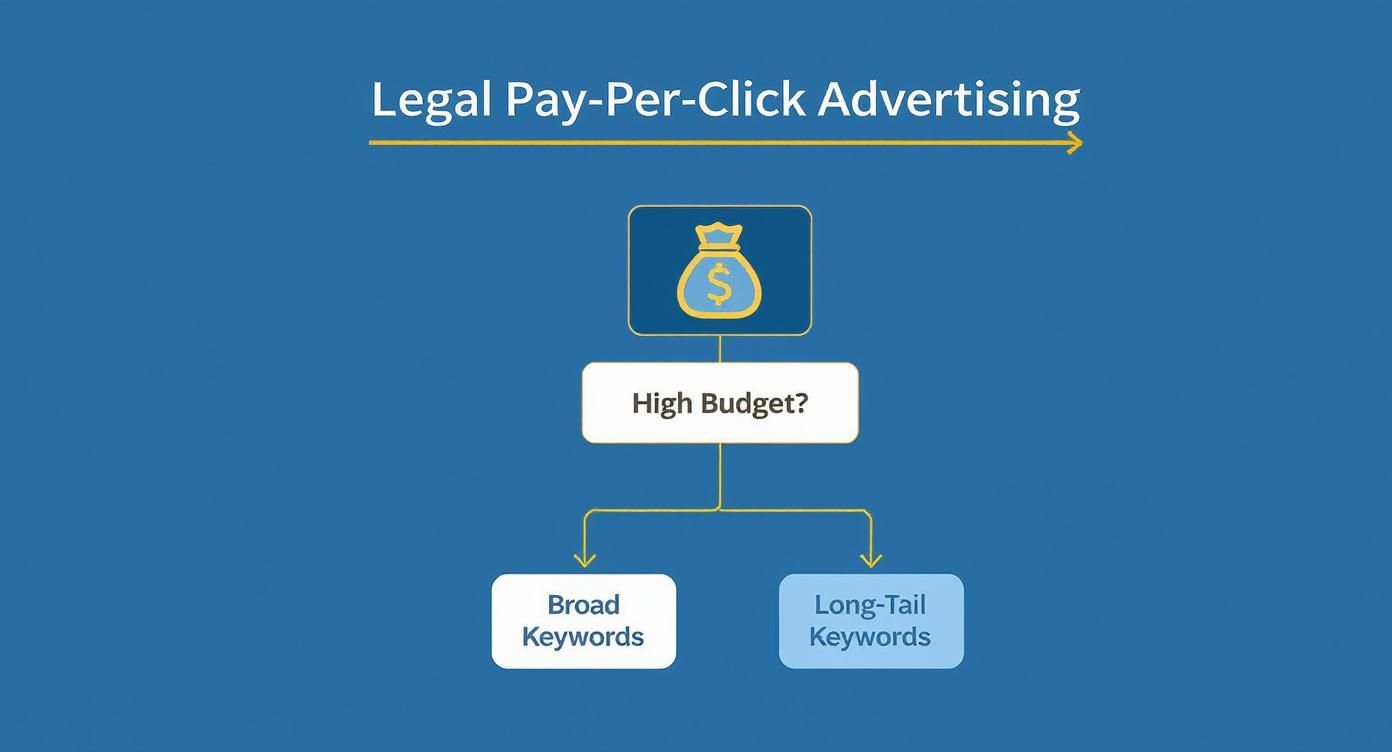
As you can see, a firm's budget often dictates whether it's smarter to compete for broad, high-cost keywords or to find an edge with more specific, long-tail phrases.
Visual Storytelling with YouTube and Display Ads
Sometimes, text just isn't enough. YouTube and display ads give you a chance to connect with potential clients on a more human, emotional level. Video, in particular, lets you tell a story, introduce your attorneys, and build a sense of trust that a simple text ad can't match. Imagine the impact of a short, reassuring video that walks a potential client through the confusing personal injury claim process.
Display ads—the banner ads you see on various websites—are your secret weapon for retargeting. The strategy is simple: show your ads to people who have already visited your website but didn't contact you. It's a gentle, persistent reminder that keeps your firm top-of-mind while they're still weighing their options, and it works wonders for bringing them back when they're finally ready to make a call.
Advertising Channel Comparison for Law Firms
To tie it all together, think about how each channel aligns with your firm's specific goals. The table below offers a quick summary to help you match your practice area to the platform where you're most likely to find success.
| Channel | Best Use Case | Target Audience | Example Practice Area |
|---|---|---|---|
| Google & Bing Search | Capturing high-intent leads from active searchers | People with an immediate legal need | Personal Injury, Criminal Defense |
| Facebook & Instagram | Building brand awareness and demographic targeting | Individuals based on life events, interests | Family Law, Estate Planning |
| Reaching professional audiences and B2B clients | Business owners, executives, in-house counsel | Corporate Law, Intellectual Property | |
| YouTube Ads | Building trust through video storytelling | Broad audiences based on viewing habits | Any area with complex client stories |
| Display & Retargeting | Keeping your firm top-of-mind for past visitors | Website visitors who have not yet converted | All practice areas |
Ultimately, the best approach often involves a strategic mix of these channels. By understanding what each one does best, you can build a comprehensive advertising plan that finds clients wherever they are.
Building an Ad Campaign That Works—And Stays Compliant

For a law firm, a successful paid ad campaign isn't just about getting clicks. It’s a delicate balance between persuasive marketing and strict ethical compliance. Before you even think about spending a dollar, you have to accept that the legal profession plays by a different set of rules. Getting them wrong doesn't just waste your budget—it can put your license on the line.
Your state bar association sets the terms. These aren't just suggestions; they are the non-negotiable rules of the road that dictate everything from the words in your ads to how you present your credentials. Getting this part wrong can have serious consequences, which is why compliance has to be step one.
The Non-Negotiables of Ethical Legal Advertising
While every state has its own specific quirks, a few core principles are universal. These rules exist to protect potential clients from being misled and to uphold the integrity of our profession. There's no room for interpretation here.
At a minimum, you're looking at these obligations:
- No Misleading Claims: You absolutely cannot guarantee outcomes. Superlatives like "best" or "top-rated" are off-limits unless you have the objective, verifiable proof to back them up. The goal is to inform, not to create an unjustified expectation of success.
- Client Confidentiality is Sacred: Never, ever use client names, sensitive case details, or even testimonials in an ad without their explicit, informed, and written consent. And even when you get it, you need to tread very carefully.
- Label Everything Clearly: All of your ads must be clearly identified as such. You’ll often see phrases like "Advertising Material" or "Attorney Advertising"—many states require this language to be placed prominently on your ads and landing pages.
This can be a minefield to navigate on your own. For a much deeper dive, we've put together a guide on the ethical considerations every lawyer should know about PPC advertising. Frankly, it's required reading before you launch a single campaign.
Structuring Your Campaign for Maximum Impact
Once you’re confident on the compliance front, it's time to build a campaign that actually brings in good cases. The trick is to abandon the "one-size-fits-all" mindset and get hyper-specific with your targeting. This all starts with a clean, logical campaign structure.
Think of your campaign structure like the filing system in your office. You wouldn't just toss all your client files into one massive drawer, would you? Of course not. You’d organize them by practice area, then by client. Your ad campaigns need that same logic.
A well-structured campaign is a mirror of your firm's practice areas. If you handle both personal injury and family law, each needs its own dedicated campaign. Inside those campaigns, you’ll have distinct ad groups, keywords, and messaging that speak directly to the unique problems of those potential clients.
This granular approach does a few critical things. It lets you control your budget with surgical precision, write incredibly relevant ad copy, and send people to landing pages that match exactly what they were searching for. That's how you dramatically increase your chances of getting a call.
Writing Ad Copy That Connects (and Converts)
Your ad copy is your digital first impression. It needs to be compelling enough to get someone to click, but professional enough to start building trust from the first word. The goal is to connect with a potential client’s immediate problem while staying well within those ethical guardrails.
So, instead of making big, sweeping promises, focus on empathy and clarity. Speak to their pain point directly. For example, instead of an ad that screams, "We'll win your case!", a much better and more ethical approach is, "Hurt in an accident? Get a free, confidential consultation to understand your rights."
Designing Landing Pages That Drive Action
Here’s the single biggest mistake I see firms make: they spend good money on ads only to send that valuable traffic to their generic homepage. Your homepage is built for browsing; it’s a digital brochure. A high-intent lead from an ad needs something different—a dedicated landing page.
A high-performing landing page has one job and one job only: to convince the visitor to take one specific action. That's it.
Here are the must-have elements of an effective legal landing page:
- A Compelling Headline: It must match the promise you made in your ad.
- Clear, Concise Copy: Get straight to the point. Focus on the visitor's problem and how you can help.
- A Single Call-to-Action (CTA): Use a prominent button with clear text like "Schedule Your Free Consultation" or "Download Our Free Guide."
- Social Proof: This is where you can use approved testimonials, case results (without revealing confidential details), or awards to build credibility.
- A Simple Contact Form: Ask only for what you absolutely need to follow up. Name, email, phone, and a brief message box is usually plenty.
By pairing rock-solid ethical compliance with a strategically built campaign, you create a powerful, repeatable system for attracting qualified leads and turning your ad spend into measurable firm growth.
How to Master Your Budget and Measure True ROI
When it comes to paid advertising, the law firm with the biggest budget doesn't always win. The real winners are the ones with the smartest strategy. Think of your budget as the fuel for your campaign's engine—how you manage it determines whether you reach your destination or run out of gas halfway there. A clearly defined budget is your first and best defense against wasteful spending.
This all starts with moving past guesswork. While the legal world has seen a huge shift toward data-driven marketing—with 83% of firms now hiring agencies to run their campaigns—a surprising 47% of lawyers still don’t have a formal annual marketing budget. That makes effective planning almost impossible. To get a real competitive edge, you need to manage your advertising spend with the same diligence you apply to a complex case file. You can see more on how firms are modernizing their marketing in this recent statistical report.
Choosing Your Bidding Strategy
Once you’ve set a budget, you need to tell the ad platforms how to spend it. This is where bidding strategies come in. These are essentially instructions you give Google or Facebook on how to bid for you in the ad auction, and each one is built for a different goal.
-
Manual CPC (Cost-Per-Click): This puts you in the driver's seat. You set the absolute maximum you're willing to pay for a single click on a keyword, and the platform will never go over it. It’s perfect for firms that want granular control and have the data to back up their bid decisions.
-
Maximize Clicks: This automated strategy tells the platform one thing: get me as many clicks as possible within my daily budget. It’s a solid choice for brand-new campaigns where you need to quickly gather data and see which keywords are actually driving traffic.
-
Target CPA (Cost-Per-Acquisition): Now we're getting sophisticated. With Target CPA, you tell the platform exactly how much you're willing to pay for a specific action—like a submitted contact form or a new client call. The platform’s machine learning then hunts for users most likely to convert at or below your target cost.
The right bidding strategy should be a direct reflection of your firm's immediate goal, whether that’s gathering early data or generating qualified leads at a predictable cost.
Moving Beyond Vanity Metrics
So many firms fall into the trap of measuring all the wrong things. They get excited about seeing thousands of ad impressions or a high click-through rate. And while those numbers aren't totally useless, they are vanity metrics. They look impressive on a report but don’t tell you if you're actually signing new cases.
An impression just means your ad was on someone's screen. A click just means they landed on your website. Neither one pays the bills. True success in legal paid advertising is measured by tangible results for your business.
The most critical shift a law firm can make is to stop asking "How many clicks did we get?" and start asking "How much did it cost to acquire a qualified lead?" This single change in perspective separates firms that waste money from those that generate a predictable return.
To make this leap, you have to start tracking the metrics that directly impact your bottom line.
Tracking What Truly Matters
To measure the right things, you need the right tools. These tools are the bridge between a potential client clicking your ad and becoming a paying client, giving you a clear view of what’s actually working.
Two pieces of technology are absolutely non-negotiable here:
- Conversion Tracking Pixels: This is a small snippet of code you place on your website. It "fires" whenever a user completes a goal, like submitting your "Contact Us" form. This data tells you precisely which ads and keywords are generating leads.
- Call Tracking Software: Let's face it, many potential clients—especially those in urgent situations—would rather pick up the phone. Call tracking assigns unique, trackable phone numbers to your different campaigns, so you know exactly which ad prompted someone to call your office.
With these in place, you can finally measure the two most important key performance indicators (KPIs) in legal advertising: Cost Per Lead (CPL) and Client Acquisition Cost (CAC). Getting these numbers right is fundamental to success, and you can learn more about the importance of ROI and analytics for lawyer PPC campaigns in our detailed guide. When you focus on these true business metrics, you can confidently pour more resources into the campaigns that are actively growing your firm.
7. Common Mistakes to Avoid and Your Next Steps
Running a successful paid advertising campaign is often less about what you do right and more about what you don't do wrong. It’s easy to burn through a lot of money with very little to show for it, all because of a few common, costly mistakes. Knowing what these pitfalls are is the first step toward building a strategy that actually brings in new cases.
One of the most frequent blunders we see is directing expensive ad traffic to a firm's general homepage. Think of your homepage as a digital brochure—it's meant for broad exploration. Someone clicking an ad for a "car accident lawyer," however, isn't exploring; they have an immediate, specific need. They need a dedicated landing page that speaks directly to that problem and pushes them toward one clear action, like calling your office.
Another classic mistake is bidding on overly broad keywords. A term like "lawyer" is a black hole for your budget, attracting all sorts of irrelevant searches. The real art of paid advertising for attorneys is in targeting specific, high-intent phrases that signal someone is actively looking to hire. That’s how you connect with qualified potential clients instead of just curious browsers.
Three Costly Campaign Pitfalls
Even if you get the landing page and keywords right, a campaign can still go off the rails. Here are three all-too-common errors that can quietly sabotage your results:
- Irrelevant Ad Copy: Your ad has to be a direct, compelling answer to the user's search. If they google "motorcycle accident lawyer," your ad headline better say something very close to that. Generic ads get ignored, which tanks your Quality Score and drives up your costs.
- Forgetting Negative Keywords: A negative keyword list is your campaign's bouncer—it keeps the wrong crowd out. For a personal injury firm, adding terms like "jobs" or "paralegal" as negatives prevents you from wasting money on clicks from job seekers. It's a simple step that saves a surprising amount of cash.
- Flying Blind Without Conversion Tracking: This is the big one. If you aren't tracking which ads and keywords are generating actual calls and form submissions, you're just guessing. You have no real idea what’s working, making it impossible to optimize your campaigns for a better return.
The goal isn't just to get cheaper clicks; it's to acquire clients at a profitable cost. Without accurately tracking every lead back to its source, you're just gambling with your marketing budget instead of making informed investments.
Your Path Forward
Now that you know what to watch out for, you can approach paid advertising with a smarter plan. What you do next really depends on your firm's resources and where you are on this journey.
If your firm is completely new to paid ads, our advice is always to start small and stay focused. Pick one high-value practice area and stick to a single platform, like Google Ads. Launch a tightly targeted campaign with a modest budget to get your feet wet. This lets you learn the ropes, gather some initial data, and figure out what messages connect with your audience before you start spending more.
For firms that already have campaigns running but aren't seeing the results they want, it might be time to call in an expert. Legal marketing is a highly specialized and competitive field. Vetting and hiring a dedicated legal marketing agency can give you the expertise you need to handle complex bidding strategies and navigate the strict ethical rules. The right partner can be the key to unlocking real, sustainable growth.
Answering Your Top Questions
Stepping into paid advertising brings up a lot of questions. Let's tackle some of the most common ones we hear from attorneys who are weighing their options.
What's a Realistic Ad Budget for a Law Firm?
There's no one-size-fits-all answer here, but we can establish a smart baseline. The best way to think about your budget is to work backward from what a new client is worth to your firm. Once you know that, you can decide what you’re willing to invest to acquire that client.
For firms just starting out with paid ads, a test budget of $3,000 to $5,000 per month is a solid place to begin. This gives you enough runway to collect meaningful data on what’s working without breaking the bank. Once you see a positive return, you can confidently scale up from there.
How Long Does It Take to See Real Results?
Paid ads offer much quicker feedback than something like SEO, which can take months to show traction. You’ll see impressions and website traffic almost as soon as your ads go live.
But when we talk about real results—qualified leads and new cases—the timeline looks a little different.
- First 24-48 Hours: You'll start seeing immediate traffic and click data. This tells you the ads are running correctly.
- First 1-2 Weeks: The first leads should start trickling in as the ad platform's algorithm begins to learn who to show your ads to.
- First 60-90 Days: This is the critical period. After two or three months of gathering data and making adjustments, you can establish a predictable cost per lead and get a clear picture of your actual return on investment.
Think of the first couple of months as an intelligence-gathering mission. The goal isn't immediate profit; it's to learn what works so you can build a truly profitable campaign for the long haul. Patience here pays off.
Can I Just Run These Ads Myself, or Do I Need to Hire an Agency?
You absolutely can run your own campaigns. The real question is, should you? The platforms are deceptively complex, the ethical rules for legal advertising are unforgiving, and with legal keywords being so expensive, a few simple mistakes can cost you thousands.
For most attorneys, hiring a marketing agency that specializes in the legal field is the more strategic choice. They already know how to navigate the compliance minefield, perform the exhaustive keyword research required, and fine-tune campaigns to bring down your client acquisition costs. Ultimately, their expertise leads to a much better return on your investment and frees you up to do what you do best.
At RankWebs, we give law firms the proven frameworks and clear insights needed to build strategic campaigns that drive real, measurable growth. See how to pair paid advertising with a dominant SEO strategy at https://rankwebs.com.