


From the first click to a signed retainer agreement, optimizing your law firm’s intake process with AI is about automating lead capture, qualification, and scheduling. This isn't just about efficiency; it's about building a system that converts more leads into paying clients. By using AI-powered tools like intelligent chatbots and predictive lead scoring, you ensure no opportunity slips through the cracks and your team's valuable time is spent only on the best prospects.
The result? Reduced costs and more signed cases. It’s that simple.
Why AI Is Reshaping Law Firm Client Intake

Let's be honest: the path from a potential client's frantic Google search to a signed retainer is often leaky and inefficient. Traditional intake, with its reliance on manual follow-ups and delayed callbacks, just can't keep up with today's clients who expect instant answers. This is precisely where artificial intelligence moves from being a buzzword to a bottom-line solution.
AI takes a messy, unpredictable flow of leads and turns it into a smart, scalable system. Instead of your staff spending hours filtering through contact forms—many from people who aren't a good fit—an AI-driven funnel handles the initial heavy lifting. It works 24/7 to capture, qualify, and even nurture leads, making sure every single person who reaches out gets an immediate, professional response.
The Modern Client Expectation Gap
Clients today move at the speed of the internet. When they have a legal problem, they want help now. Waiting even a few hours for a response often means they've already moved on to the next law firm in their search results.
This creates a major gap between what clients expect and what many firms can realistically provide. An AI-powered system is the bridge. It closes that gap by offering:
- Instantaneous Engagement: AI chatbots can greet website visitors the second they arrive, answer common questions, and gather preliminary case details without any human intervention.
- 24/7 Availability: Your intake process no longer clocks out at 5 PM. AI is always on, ensuring you never miss a lead from someone doing late-night research.
- Personalized Interaction: Good AI doesn't feel robotic. It can tailor conversations based on the user's answers, making that first touchpoint feel helpful and relevant.
This isn't just a small improvement; it's a massive strategic advantage. Companies that have adopted AI for lead management are already seeing incredible results. Projections show conversion rates can jump by 25–50%, while the cost of handling each lead can drop by as much as 60% by 2025. These numbers come from AI's unique ability to analyze hundreds of data points to prioritize the best prospects and automate follow-ups, freeing your team to focus on what they do best.
Key Takeaway: The real power of an AI intake funnel is its ability to meet modern clients where they are—online and impatient. It turns initial curiosity into a qualified consultation before your competitors even have time to check their email.
By putting these tools in place, firms can build a more resilient and profitable marketing engine. For a deeper dive into how this technology is shifting the entire legal marketing field, check out our guide on how AI is changing law firm marketing.
The rest of this playbook will walk you through the practical steps to build your own AI-driven funnel.
Building Your Foundation to Capture Every Lead
Before you can even think about optimizing your intake process, you have to plug the leaks. It’s like trying to fill a bucket with holes in it—pointless. The first order of business is building a solid foundation that can see, catch, and track every single potential client from the moment they land on your website.
Think about it: most firms are spending a small fortune on marketing, but if you ask them which specific ad brought in their best case last month, they just shrug. That's not just a blind spot; it's a massive waste of money. Getting your tracking right isn't optional, it's the cost of entry.
Pinpointing Your Best Lead Sources
You have to know exactly where your leads are coming from. Was it that Google Ad you're running for "car accident lawyer"? A specific post on your firm's Facebook page? Or a link from a local business directory? Flying blind with your marketing budget is a recipe for disaster.
To get this clarity, there are two tools I never see successful firms skip:
- UTM Parameters: These are just little tags you add to the end of your URLs. They sound technical, but they're simple. They tell your analytics software where someone clicked from—the source (like Google), the medium (like PPC), and even the specific campaign ("Q3 Brain Injury Campaign"). Suddenly, you can see which ads are actually making the phone ring, not just getting clicks.
- Call Tracking: Let's be honest, many of your best potential clients aren't going to fill out a form. They're going to pick up the phone. A service like CallRail uses Dynamic Number Insertion (DNI) to show a unique phone number to visitors from different marketing channels. When they call, you know instantly that the lead came from your billboard, your Google Ad, or your Avvo profile.
When you combine UTMs and call tracking, something magic happens. You finally connect the dots between your marketing spend and actual, paying clients. You can confidently pour more money into what’s working and kill what isn’t.
Moving Beyond Static Contact Forms
Okay, so you can track where people are coming from. Now what? You have to actually capture their information. For decades, law firm websites have relied on the same tired "Name, Email, Phone, Message" contact form. It’s passive, it’s boring, and it puts all the work on the potential client.
This is where AI-powered tools completely change the game. Instead of a digital suggestion box, you can install an interactive system that actively engages visitors and pulls out the critical details your team needs.
Deploying Intelligent Chatbots and Smart Forms
Think of AI chatbots and smart forms as your 24/7 digital receptionist. They never sleep, they never call in sick, and they're ready to engage a potential client the second they arrive on your site. More importantly, they act as an initial triage, gathering the key facts before a human ever gets involved.
For example, a well-designed chatbot for a personal injury firm doesn't just ask for a name and number. It starts a conversation:
- "To make sure I get you to the right person, could you tell me if you were in a car accident, a slip and fall, or something else?"
- "I'm sorry to hear about that. When did the incident happen?"
- "And were you injured as a result?"
See the difference? It feels less like filling out paperwork and more like a helpful conversation. It’s no surprise that tools like Smith.ai or ApexChat can handle a huge chunk of initial inquiries, freeing up your paralegals and intake specialists to focus on high-value conversations.
Smart forms work on the same principle. If a visitor selects "Family Law" on your practice area page, the form can instantly add questions about whether children are involved or if there are significant shared assets. You get the crucial details you need without making someone fill out a 20-field monstrosity.
By putting these foundational pieces in place—rock-solid tracking and intelligent lead capture—you build a system that doesn't just stop leads from falling through the cracks. You enrich every single lead with context, making the next steps of qualification and scheduling vastly more efficient. This is the bedrock of a modern, profitable client intake funnel.
Leveling Up: AI Qualification and Scheduling
Once you've got a steady stream of leads coming in, the real work begins. Manually sifting through every form submission and chat transcript is a massive time-drain, and frankly, it's where most law firms' intake processes fall apart. This is the moment to let AI take the wheel, moving you from just collecting leads to actively and automatically prioritizing the best ones.
This is the heart of building a truly efficient, AI-driven intake system. You’re essentially creating a smart, tireless paralegal that pre-screens every potential client. The goal? To make sure your team only spends their valuable time on conversations with people you can actually help—the ones most likely to become clients.
The diagram below shows how the pieces fit together. You start by tracking where a lead came from, capture their information with a tool like a chatbot, and then enrich that data before the AI even starts its qualification work.
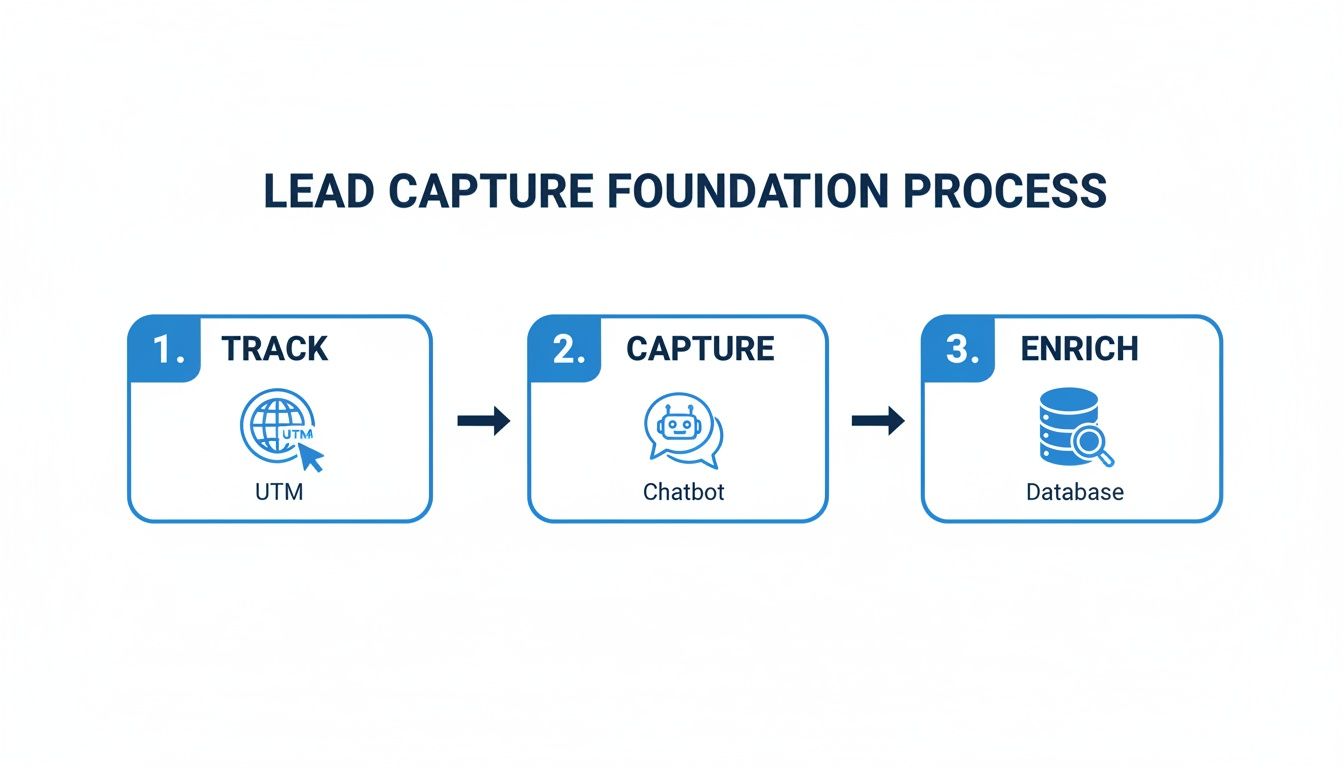
Think of it as setting the stage perfectly so the AI can perform its role flawlessly.
Setting Up AI-Powered Lead Scoring
How do you separate the high-potential cases from the tire-kickers? Lead scoring. It's a simple concept: assign points to each lead based on criteria you set. A high score means "call them now," while a low score might mean "not a good fit."
AI puts this entire process into overdrive. Instead of relying on basic if/then rules, AI can analyze the nuances of a conversation from a chatbot or pick up on specific details hidden in a lengthy form submission.
Here’s how a personal injury firm might set this up in the real world:
- High-Value Signals (+20 points): The person mentions a specific, severe injury ("brain injury," "spinal cord"), confirms the incident was recent, and clearly states they were not at fault. These are the red-hot leads.
- Medium-Value Signals (+10 points): The lead is located in a key county your firm serves and their case type (e.g., car accident) is right in your wheelhouse.
- Low-Value Signals (-15 points): The incident happened years ago (outside the statute of limitations), it's a practice area you don't handle, or they're in a state where you aren't licensed.
Once these rules are in place, your CRM can instantly flag the high-scorers for immediate follow-up from your intake team. No more digging through a crowded inbox to find the gold.
Automating Nurture Sequences and Follow-Ups
Let's be realistic: not every great lead is ready to sign on the spot. Some need more information, while others just need a little time. This is where most firms drop the ball and where automated nurture sequences become your secret weapon.
Using AI, you can trigger personalized email or text message workflows based on a lead's score or the specific answers they gave.
My Two Cents: A truly effective nurture sequence doesn't just send generic "just checking in" emails. It provides real value. If a lead mentioned they were in a "truck accident," the system can automatically send them an email with a link to your blog post on "Who's Liable in a Commercial Truck Accident?" This builds trust and keeps your firm top of mind until they're ready to talk.
Automating this outreach isn't just a "nice-to-have"—it's a game-changer for your firm's bottom line. Just look at the difference it can make.
Manual Intake vs AI-Powered Intake Comparison
This table gives a clear picture of the efficiency gains when you shift from a traditional process to an AI-automated one.
| Metric | Manual Intake Process | AI-Powered Intake Process |
|---|---|---|
| Initial Response Time | Hours to days | Seconds to minutes |
| Lead Qualification | 15-30 minutes per lead | Instantaneous |
| Scheduling Time | Multiple emails/calls per lead | 1-2 minutes (self-service) |
| Data Entry | Manual, prone to errors | Automated, consistent |
| Follow-Up | Inconsistent, manual reminders | Automated, personalized sequences |
| Team Capacity | Limited by staff availability | 24/7, handles high volume |
The data is pretty compelling. When you automate these tedious touchpoints, you empower your existing team to handle significantly more volume without getting overwhelmed. Research shows AI can cut down manual lead-handling work by 15–40% and slash qualification times by up to 70%. This means the same intake team can manage 2-5x more leads.
Seamlessly Connecting to Your Calendar
The last, and maybe most critical, piece of the puzzle is scheduling. The endless email tag trying to find a meeting time is a notorious conversion killer.
By integrating your AI qualification system directly with a scheduling tool like Calendly, you create a completely frictionless path from initial inquiry to a booked consultation.
Here’s what that looks like in action:
- A potential client engages with your AI chatbot on your website.
- The AI asks the right questions, qualifies them based on your rules, and assigns them a high score.
- Instead of saying "someone will call you," the chatbot immediately presents a link to your intake specialist's live calendar.
The lead picks a time that works for them, and it's on the books. No human intervention needed. This self-service model is what modern clients expect, and it ensures that when your team finally gets on a call, they're talking to a qualified, engaged, and motivated prospect.
This single step transforms your website from a digital brochure into a powerful, automated client acquisition machine. To get deeper into the nuts and bolts of setting these systems up, check out our comprehensive guide on AI intake for law firms.
Blending Automation with a Human Touch (and Staying Compliant)

Let's be clear: automation is a powerful tool, but it's not a silver bullet. While an AI can sift through data and handle routine queries with incredible speed, it completely lacks the empathy and intuition needed to connect with a person in distress. A fully automated intake process is a recipe for disaster—it's guaranteed to alienate potential clients and miss the subtle flags that point to a complex, high-value case.
The goal isn't to replace your people; it's to make them better. This is where a human-in-the-loop system comes in. You essentially teach your AI to know its limits and hand off the conversation at just the right moment. Your AI stops being a simple gatekeeper and becomes a highly efficient assistant for your intake team.
This hybrid approach is really the secret sauce to optimizing intake: from click to client using AI. You get the efficiency of technology without sacrificing the personal connection that ultimately builds trust and wins cases.
Designing Smart Escalation Paths
Your AI needs a playbook. It needs to know exactly when to raise its hand and ask for help from a human. These escalation triggers are the safety net, catching the nuanced situations that automation just can’t handle on its own.
Think of these as tripwires that instantly ping your team when their expertise is needed.
- Keyword Flags: Program the AI to listen for words that signal urgency, complexity, or emotional distress. Terms like "statute of limitations," "severe injury," or even emotionally charged words like "devastated" should be an immediate trigger for a human handoff.
- Behavioral Cues: Sometimes it’s not what they say, but how they say it. If a user asks the same question three times, uses confusing language, or flat-out says, "I need to talk to a person," that's your cue. A human needs to jump in, period.
- High-Value Indicators: When your lead scoring identifies a potential home-run case—say, a multi-vehicle commercial trucking accident—the system shouldn't just book a meeting. It should flag the lead for immediate, white-glove outreach from a senior member of your intake team.
My Two Cents: Don't just dump all escalations into one generic email inbox. We've had great success setting up dedicated Slack channels. An alert in a
#High-Value-Leadschannel gets a much faster, more senior response than one in a#Chatbot-Helpchannel.
Navigating the Murky Waters of Ethics and Compliance
Any efficiency you gain from AI is completely wiped out if it lands your firm in hot water over ethical violations or privacy breaches. The legal profession has iron-clad rules, and your automated systems must be built from the ground up to follow them. This part is non-negotiable.
The two biggest landmines are the unauthorized practice of law (UPL) and data security. You have to meticulously program your AI to provide information, not legal advice.
Avoiding the Unauthorized Practice of Law
An AI chatbot can tell a user you handle personal injury cases. It cannot suggest they have a strong claim for damages. It can explain what a statute of limitations is in general terms, but it can never advise them on the specific deadline for their potential case. The line is bright, and you can't cross it.
Here’s how to stay on the right side of the bar:
- Lead with a Disclaimer: Every single AI interaction needs to start with a crystal-clear statement that it's an automated assistant, not an attorney, and cannot provide legal advice.
- Script and Vet Every Response: Have your attorneys pre-approve all the AI's scripted answers. The language must be purely informational. Instead of, "You have a strong case," the AI should say, "We frequently handle cases with similar details. Would you like to schedule a free consultation with an attorney?"
- Make Legal Questions an Escalation Trigger: Any question that even sniffs of asking for legal advice must immediately route the conversation to a human.
Protecting Client Data and Privacy
The moment a potential client types their name into your chat window, you are responsible for that data. With regulations like GDPR and a patchwork of state-level privacy laws, mishandling consumer data can lead to serious penalties.
Build your AI intake funnel with security as a top priority. This means vetting your software vendors for their encryption standards, data handling policies, and server security. It also means being transparent with users about what data you're collecting and why. For a deeper dive into this, our guide on AI compliance and ethics in legal marketing is a great resource. Building an efficient system is one thing; building one that's trustworthy is everything.
Measuring Success and Launching Your AI Intake System
A new system is only worth the investment if it actually moves the needle. Launching your AI intake funnel isn’t the finish line; it’s the starting block. To get this right, you have to look past vanity metrics like website traffic and zero in on the key performance indicators (KPIs) that directly impact your firm's bottom line.
Forget about gut feelings. The real goal here is to create a data-driven feedback loop. Every test, every tweak gets measured and analyzed, feeding back into the system to make your intake process stronger and more efficient. This is how you turn a promising piece of tech into a predictable client-generation machine.
Defining Your Most Important KPIs
You could track dozens of different metrics, but only a handful truly matter for intake performance. Drowning in data is just as bad as having none at all. I always advise firms to start by focusing on these core KPIs that tell the complete story, from the first click all the way to a signed client.
-
Lead-to-Consultation Rate: This is your north star. What percentage of the leads your AI qualifies as "good" actually end up booking a consultation? This number tells you how well your system moves promising prospects down the field.
-
Cost Per Qualified Lead (CPQL): Don't get fooled by a low cost-per-lead. That number is often a mirage. The real question is, how much are you spending to get a lead that meets your specific case criteria? Paying a low price for junk leads is just throwing money away.
-
Client Acquisition Cost (CAC): Here it is—the ultimate measure of success. When you add up all your marketing and intake expenses, how much does it cost to sign a new case? Your AI system’s primary job is to drive this number down over time.
-
Intake Response Time: When the AI flags a high-value lead, how quickly does a human on your team follow up? In the world of legal intake, speed is everything. This KPI is a critical measure of the handoff between your automated and human systems.
By tracking these KPIs in a simple dashboard, you'll see at a glance whether your system is working. You'll know if your marketing spend is paying off and if your new funnel is actually producing results.
A/B Testing for Continuous Improvement
Let’s be honest: your first chatbot script will not be your best one. The secret to long-term success in optimizing intake: from click to client using AI is relentless testing. A/B testing, where you simply compare two versions of something to see which one performs better, is your best friend here.
You don't have to overcomplicate it. Start with small, impactful tests. For instance, you could pit two different opening lines in your chatbot against each other for a week. Does "How can I help you today?" get more people to engage than a more direct "Were you recently in an accident?"
Pro Tip: When you're testing, only ever change one thing at a time. If you change the chatbot's opening question and the color of the chat widget, you'll have no idea which change actually caused the results. Keep your variables isolated to get clean, actionable data you can trust.
This constant process of refinement makes a massive difference. Seemingly small improvements in your conversion rates at each stage of the funnel compound on each other, leading to a significant increase in signed cases by the end of the year.
Your Phased Rollout Plan
Trying to flip a switch and go from zero to a fully automated system overnight is a recipe for chaos. A phased rollout is a much smarter approach. It minimizes disruption, gives your team time to adapt, and lets you work out the kinks in a controlled environment before the system is live across the entire firm.
Here's a practical launch sequence that works:
- Start with One Practice Area: Pick your highest-volume or most process-driven practice area, like car accidents. Build and test the entire AI funnel just for those case types first.
- Train a Small "Champion" Team: Choose a few tech-savvy intake specialists or paralegals to be your advocates. Train them thoroughly, get their honest feedback, and empower them to become the go-to experts for the rest of the team.
- Run in "Silent Mode": Before the AI goes live, let it run in the background for a week. Have it score leads without taking any action, then compare its decisions to what your human team did. This is the best way to fine-tune your qualification rules based on real-world data.
- Go Live and Monitor Closely: Once you launch for that first practice area, watch your KPIs like a hawk. Be ready to jump in and make adjustments based on what you're seeing.
- Expand and Scale: After a successful pilot, you can start rolling out the system to other practice areas with confidence, using what you learned to make each subsequent launch even smoother.
This measured approach builds trust and ensures your team is ready for the change. The heavy investment flowing into AI sales and marketing tools—private investment in generative AI reached approximately $33.9 billion in recent years—is financing more advanced and user-friendly systems. This capital is driving the development of smarter tools that make a phased rollout easier than ever, helping firms see a return on their investment much faster. For a deeper dive into this trend, you can explore the full Stanford University report on AI adoption.
Answering Your Questions About AI in Legal Intake
Taking the plunge into new technology can feel like a big step, especially in a profession built on precision, confidentiality, and trust. As law firms start to explore AI for their client intake, a lot of practical questions come up. It's only natural.
Let's cut through the noise and address some of the most common concerns I hear from attorneys. This isn't about chasing the latest shiny object; it’s about making a smart, strategic move for your firm's future.
How Much Does an AI Intake System Cost?
This is always the first question, and the honest answer is: it really depends. The price tag is tied directly to how complex your needs are and the scale of your operation. You can find options ranging from a few hundred dollars to several thousand per month.
For instance, a smaller firm just wanting to catch more website leads after hours might find a great off-the-shelf AI chatbot for around $200-$500 a month. It’s a solid starting point for basic inquiries. On the other hand, a larger firm looking for a fully-managed system with custom lead scoring that plugs right into their CRM and handles automated scheduling is looking at a more significant investment, likely in the $2,000-$5,000+ per month range.
But framing it as just a "cost" is the wrong way to think about it. It’s an investment.
The Bottom Line: A well-implemented AI system should more than pay for itself by lowering your client acquisition cost (CAC) and giving your team back valuable hours. Do the math: how much is just one more signed case worth to your firm each month? Often, the technology costs less than the revenue from that single new client.
Will AI Replace My Intake Staff?
Not a chance. This is probably the biggest myth out there. The whole point of using AI to optimize your intake process is to make your existing staff better, not to show them the door. AI excels at the repetitive, high-volume, and frankly, low-value tasks that are currently eating up your team's day.
Think of AI as the most efficient assistant you've ever had—one that works 24/7 without a coffee break. It does the initial screening, collects the basic facts, and gets qualified people on the calendar. This frees up your skilled intake specialists to focus on the human element where they truly shine:
- Building Rapport: Having genuine, empathetic conversations with high-potential clients.
- Handling Complex Cases: Using their experience to navigate the tricky, nuanced situations that a machine just can't handle.
- Closing New Business: Putting their energy into turning promising consultations into signed retainer agreements.
When you automate the grunt work, your team becomes more effective, and their jobs become more fulfilling. The professionals who know how to work with AI are becoming more valuable, not obsolete.
How Do I Ensure Client Data Is Secure?
Security is everything. It’s completely non-negotiable. The moment a potential client types sensitive information into a chat window or form, you're on the hook to protect it. Vetting your AI vendor on their security practices is one of the most critical steps you'll take.
Any platform you consider has to follow strict security protocols. Here’s a quick checklist of what to demand:
- End-to-End Data Encryption: All information must be encrypted, both while it's being sent over the internet (in transit) and when it's stored on their servers (at rest).
- Regulatory Compliance: The provider must be compliant with key regulations like GDPR or any state-specific privacy laws that apply to your firm.
- Strict Access Controls: You need to have total control over who inside your firm can view or manage the intake data.
Don't be afraid to grill potential vendors on their security measures before you sign anything. A reputable company will have clear, confident answers and the documentation to prove it. This due diligence is what protects your clients and your firm’s hard-won reputation.
What Is the Implementation Process Like?
Getting started is usually less painful than firms imagine, especially if you take it one step at a time. This isn't a "flip the switch" situation. A proper rollout is a structured process designed to cause as little disruption as possible.
The timeline can be as short as a few weeks for a simple chatbot or stretch to a couple of months for a comprehensive overhaul of your entire intake system. Most projects I've seen follow a similar roadmap:
- Discovery & Strategy: The vendor sits down with you to truly understand your current workflow, your different case types, and what you’re trying to achieve.
- Configuration & Scripting: This is where the magic happens. The AI is programmed with your firm's unique qualification questions, conversation flows, and rules for when to hand off to a human.
- Integration: The new system gets connected to your existing tech stack—your CRM, calendars, and any email marketing tools.
- Testing & Training: You run internal tests to work out the kinks, and your team gets trained on the new process so they know exactly what to do.
- Launch & Optimization: You go live! From there, you keep a close eye on the performance data, making small tweaks to continuously improve results.
A good partner will hold your hand through every stage, making sure the transition is smooth and that you start seeing a positive impact right away.
Ready to stop letting good leads slip through the cracks? The team at RankWebs focuses on providing law firms like yours with the actionable insights and proven frameworks needed to build smarter marketing and intake systems. Explore our resources and see how to put these strategies to work at https://rankwebs.com.