

Think of Google Local Service Ads (LSAs) as the digital equivalent of a high-quality referral, but one that puts your law firm right at the very top of a Google search. And it only happens at the exact moment a potential client is looking for the legal help you provide, in your specific area. At its core, that’s what LSAs are: a high-trust ad platform built to connect lawyers with people who are ready to pick up the phone.
The Power of Prime Placement
For years, the game for law firms on Google has been a relentless battle for the top spots in paid search and organic results. Local Service Ads completely upended that game. They introduced a brand new, exclusive ad unit at the absolute top of the search page—above the traditional ads, above the map pack, above everything.
This isn't just about being first. This prime real estate is all about grabbing the attention of the most motivated clients. When someone searches for "personal injury lawyer near me" or "divorce attorney," the LSA box is the very first thing they see. It’s impossible to miss, featuring headshots, star ratings, and that all-important Google Screened badge.
Here’s a look at what a potential client sees when they search.
As the screenshot shows, LSAs are designed to get you "seen at the top of Google," with a clean, simple layout that puts your most important details front and center. It’s a visual-first approach that starts building trust before someone even thinks about clicking to your website.
A New Model: Pay Per Lead, Not Per Click
One of the biggest game-changers with local service ads for attorneys (Google LSAs) is how you pay. Forget the old pay-per-click (PPC) model you know from traditional Google Ads. LSAs run on a pay-per-lead system.
What does that mean? It means you only get charged when a prospective client actually contacts your firm through the ad—whether it’s a direct phone call or a message request. You’re no longer paying for clicks from people who are just browsing or doing preliminary research. This model directly ties your marketing budget to real, tangible opportunities, cutting down on wasted ad spend.
"And if a lead isn't legitimate—say, it's a sales call, a wrong number, or for a practice area you don't handle—you can dispute it. Google will listen to the call recording and, if they agree it’s not a qualified lead, they’ll credit the cost right back to your account."
The Trust Signal of the Google Screened Badge
That little green checkmark next to your name isn’t just decoration. The Google Screened badge is a powerful symbol of credibility. To get it, attorneys and their firms have to go through a pretty thorough background check with Google.
This includes:
- State Bar License Checks: Google verifies that every attorney listed is licensed and in good standing.
- Background Checks: Both the firm owner and, in some cases, client-facing professionals are screened.
- Insurance Verification: You have to show proof of your firm’s professional liability insurance.
This whole screening process acts as a filter, giving potential clients peace of mind that they’re about to call a vetted, legitimate professional. In the legal world, where trust is everything, that badge instantly distinguishes you from the competition. It’s Google’s way of telling searchers, "We've done the initial homework on this firm for you."
Since they were rolled out for legal services, LSAs have become a truly dominant force. Studies have shown these ads capture a staggering 33% of all first-page clicks for valuable lawyer-related searches. That means one-third of your potential clients are clicking on an LSA before they even see the traditional ads or organic listings. You can dive deeper into the numbers in this in-depth LSA click study.
Passing the Google Screened Verification Process
Earning the Google Screened badge is what makes Local Service Ads tick, but let's be honest—the verification process can feel like preparing for a major trial. It’s rigorous for a reason. This isn't just some administrative hoop to jump through; it's the very foundation of the trust that makes LSAs so powerful for attorneys.
Think of it as Google doing its own due diligence on your firm so it can confidently recommend you to its users. When you get through it, you've earned a powerful endorsement that immediately sets you apart from the competition. This section will walk you through each requirement, giving you a clear roadmap to get approved without any headaches.
Your Pre-Submission Checklist
Before you even start the formal application, get your documents in order. Trust me, this will save you a ton of back-and-forth and frustrating delays down the road. Google's entire goal here is to verify your firm’s legitimacy, your personal credentials, and your professional standing. Treat it like preparing an evidence file for a case—organization is everything.
You'll need to gather some specific information covering a few key areas:
- Firm-Level Details: This is the basic stuff—your official business name, address, phone number, and the year your firm was established.
- Individual Attorney Credentials: Every single client-facing attorney you want to feature will need to submit their own information.
- Proof of Good Standing: A non-negotiable step is verifying your state bar license.
- Insurance Documentation: You'll need to provide proof of your firm’s professional liability insurance.
Do yourself a favor and get these items scanned and saved in a dedicated digital folder. It makes the actual application process worlds easier. The initial setup is simple enough, but the real test is in the details of the verification stages.
Navigating Each Verification Stage
The process isn't a single step; it's a multi-layered check at both the firm and individual attorney levels. You have to clear every stage to get the badge.
-
Initial Application and Business Verification: First, you’ll create your LSA profile and plug in your basic business details. Google then does a quick check to confirm your firm exists and the information is accurate.
-
State Bar License Checks: This one is critical. Google directly verifies that every attorney on the profile is an active member in good standing with their state bar. A pro tip: make sure the name on your application exactly matches the name on your bar registration. Any small discrepancy can stall the whole process.
-
Background Checks: Google uses third-party services to run background checks. This will apply to the firm owner and sometimes other attorneys in the practice. It's a standard procedure for every professional in the "Google Screened" program.
-
Proof of Insurance: You’ll be asked to upload a copy of your certificate of liability insurance. Make sure the policy is current and meets the minimum coverage requirements for your practice area and state.
This simple flowchart shows what happens from the client's perspective once your LSA is live and running.
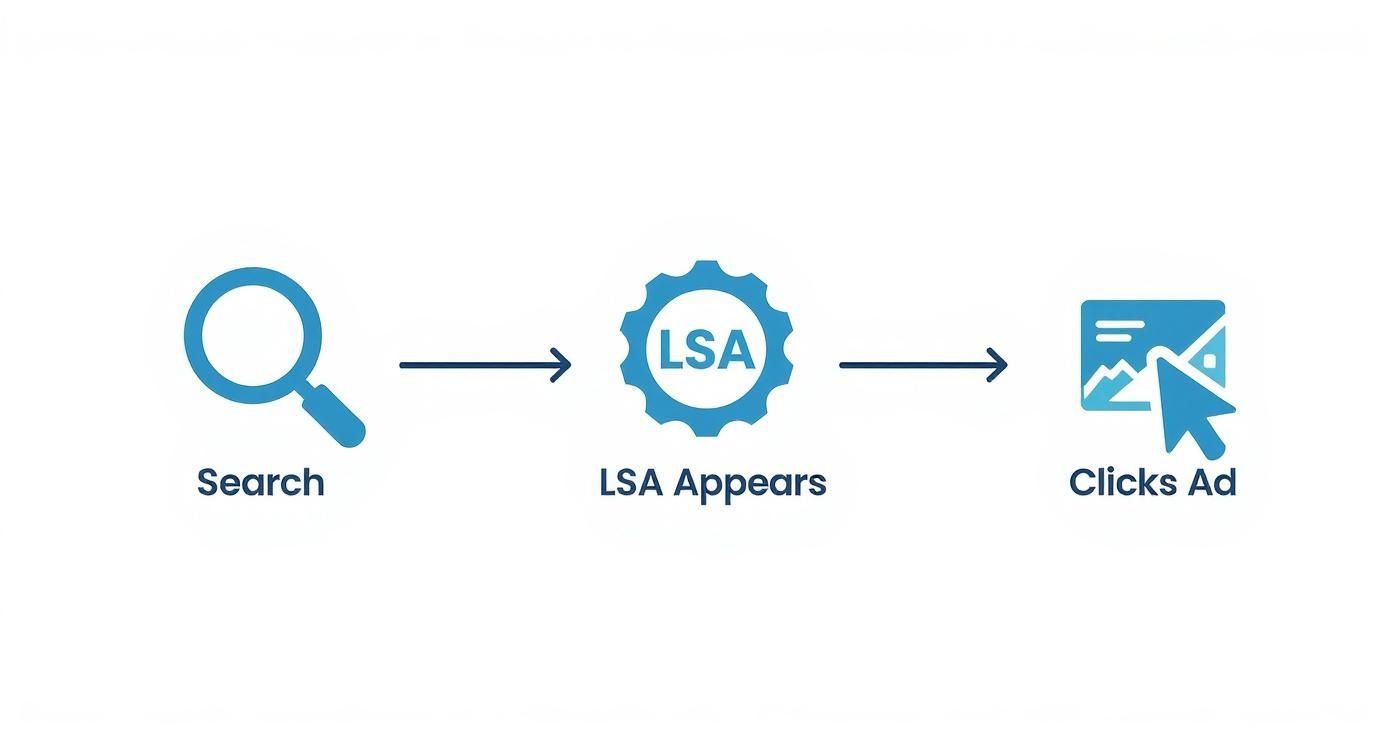
As you can see, that Google Screened badge is the first thing a potential client sees, acting as a powerful trust signal that encourages them to click and call you directly.
The Bottom Line: The verification process isn’t just about checking boxes for Google. It's about building instant credibility. Every step—from the bar check to the insurance verification—is a piece of evidence telling potential clients that your firm is legitimate, professional, and ready to help.
Getting through this process is what separates you from the unvetted masses in the standard search results. It’s the upfront investment required to tap into the stream of high-quality leads that local service ads for attorneys (Google LSAs) are famous for. Approach it with the diligence it deserves, and you'll set your firm up for a very successful run.
Choosing Between LSAs, Google Ads, and SEO
When it comes to digital marketing, law firms have three heavy hitters in their corner: Local Service Ads (LSAs), traditional Google Ads (PPC), and Search Engine Optimization (SEO). It's a common misstep to see these as an "either/or" choice. A much better way to think of them is as a team of specialists, each playing a critical and distinct role in your client acquisition strategy.
Think of LSAs as your firm’s rapid-response team, built to connect with clients at the exact moment they’ve decided to hire. When a potential client searches "personal injury lawyer near me" with their phone in hand, LSAs put your Google Screened profile front and center. This channel is all about speed and capturing high-intent leads.
Google Ads and SEO, on the other hand, play a different game. They are essential for building a deep, sustainable pipeline of cases over the long haul, reaching people who are still figuring out their options or doing initial research.
Speed and Visibility: The Immediate Impact of Ads
The biggest, most undeniable advantage of both local service ads for attorneys (Google LSAs) and traditional Google Ads is pure speed. You can launch a campaign today and have your firm appearing in front of potential clients by tomorrow. For firms that need to generate calls now or want to go after a very specific type of case, this is invaluable.
When it comes to prime real estate, though, LSAs win, hands down. They occupy the most valuable spot on Google's search results page—right at the very top, above everything else. This placement, combined with the trust-building Google Screened badge, gives potential clients a powerful shortcut to choosing you.
Key Takeaway: For immediate leads from clients who are ready to hire, LSAs offer unmatched visibility and speed. Traditional Google Ads offer another fast-track to page one, just in a slightly less prominent position.
SEO is the complete opposite; it’s a marathon, not a sprint. You earn your visibility over months, sometimes even years, of consistent and strategic effort. While the results aren't immediate, they are incredibly powerful and build a lasting digital asset for your firm that pays dividends for years to come.
Cost Structure and Lead Quality
It’s crucial to understand exactly how you pay for each channel. They all operate on fundamentally different economic models, which has a direct impact on the kind of leads you get and how you manage your budget.
This table really clarifies the distinctions between them.
LSA vs Google Ads vs SEO: A Strategic Comparison for Law Firms
| Feature | Google LSAs | Google Ads (PPC) | SEO |
|---|---|---|---|
| Cost Model | Pay-Per-Lead | Pay-Per-Click (PPC) | No Direct Ad Cost |
| Payment Trigger | A valid lead calls or messages your firm. | Someone clicks on your ad, regardless of contact. | Investment in content, tech, and link building. |
| Typical Lead Intent | High: Actively seeking to hire an attorney now. | Medium-High: Researching options, comparing firms. | Varies: From informational to transactional. |
| Budget Control | Dispute invalid leads to protect your budget. | Risk of budget waste from non-converting clicks. | Long-term investment with compounding returns. |
With LSAs, you pay only when you get a tangible connection—a phone call or message from a real person looking for a lawyer. This model is brilliant because it naturally filters out casual browsers and aligns your marketing spend directly with actual acquisition efforts. Best of all, if a lead is spam or completely irrelevant, you can dispute it and get a credit, giving you an amazing layer of budget protection.
Traditional Google Ads charge for every click. That means you pay whether the person is a perfect client or just a student doing research. While it's a powerful tool, it requires meticulous keyword management and constant optimization to make sure you're getting a positive ROI. For a deeper dive into making PPC work, our comprehensive guide on Google Ads for law firms is a great resource.
Building a Blended Strategy
Ultimately, the smartest firms don't just pick one channel; they integrate all three into a cohesive strategy. The real magic happens when you use each channel for what it does best.
- LSAs for Immediate Needs: Deploy LSAs to capture "bottom-of-the-funnel" leads—these are the people who are ready to hire an attorney right now.
- Google Ads for Targeted Reach: Use traditional PPC to target niche practice area keywords, test out different ad copy, and show up for searches where LSAs might not be available.
- SEO for Long-Term Authority: Invest consistently in SEO to build a powerful foundation. This strategy captures leads earlier in their research phase and solidifies your firm as a trusted authority, gradually reducing your dependence on paid advertising over time.
By weaving these strategies together, your firm can achieve true domination of the search results page. You become visible to clients at every single stage of their journey—from their very first question to the moment they decide to pick up the phone.
How to Optimize Your LSA Profile for More Leads
Getting your Local Service Ad live is a great first step, but it’s just the starting line. The real work—and the real results—come from consistent, ongoing optimization. Your LSA profile isn't a "set it and forget it" brochure; think of it as a dynamic tool that needs regular attention to keep a steady flow of high-quality leads coming through your door.
Unlike standard Google Ads, you can’t just throw more money at LSAs to get a better spot. The LSA ranking algorithm is a different beast entirely. It prioritizes trust and responsiveness above all else. While your proximity to the person searching is a factor you can’t control, several others are entirely in your hands. Mastering these is what separates the law firms that thrive with LSAs from those that just get by.
At its core, Google wants to connect users with the most reliable and responsive local professionals. Every optimization you make is a signal to Google that your firm is exactly that. By actively managing your profile, you're building trust with the algorithm, and it will reward you with better visibility and more potential clients.
Cultivate a Five-Star Reputation
Client reviews are the lifeblood of local service ads for attorneys (Google LSAs). They are the modern-day word-of-mouth referral and the single most powerful trust signal for both Google and the clients you want to attract. A consistent stream of fresh, positive reviews isn't just a "nice-to-have"—it's an absolute must for LSA success.
Your firm needs a repeatable, proactive system for generating these reviews. You can't just hope clients will leave them. The perfect time to ask is right after you’ve secured a positive outcome for them, when their gratitude is at its peak. Your LSA dashboard gives you a special review link; make sending that link a non-negotiable part of your case-closing checklist.
Pro Tip: Don't be afraid to train your team to ask for reviews. A simple, genuine request like, "We're so glad we could help you achieve this outcome. Would you mind sharing your experience on Google? It really helps other people in similar situations find our firm," can work wonders.
Master the Art of Rapid Response
Google is watching how you handle LSA leads like a hawk. Every missed call or slow reply sends a negative signal that can sink your ad's ranking. To win here, you need to answer every single call and reply to every message almost immediately. We're talking minutes, not hours.
This is where a bulletproof intake process becomes critical. If you're not a 9-to-5 operation (and what law firm is?), a 24/7 legal answering service can be a game-changer, ensuring no lead ever falls through the cracks. Remember, a person contacting you through an LSA is ready to hire someone now. If you don't pick up, they’re just going to call the next attorney on the list.
Fine-Tune Your Profile Details
You don’t have a ton of room for customization on your LSA profile, so you have to make every field count. Treat each section with the same attention to detail you'd give your website's homepage.
- Compelling Bio: This is your 30-second elevator pitch. Use it to show what makes your firm different. Highlight your experience, express empathy for what your clients are going through, and showcase what you do best.
- High-Quality Headshot: A professional, friendly headshot is essential. It's the first human connection a potential client makes with you, so it needs to project confidence and trustworthiness. No selfies from your car.
- Strategic Service Areas: Get granular with your service areas. It’s tempting to cast a wide net, but you’ll get better quality leads and a stronger ROI by focusing on the specific zip codes and cities you actually serve.
- Accurate Practice Areas: Only check off the exact case types you want to handle. This prevents you from paying for irrelevant calls that you'll just have to dispute later, saving you both time and money.
Dialing in these details ensures your profile truly connects with potential clients and accurately represents your firm’s expertise. This is very similar to the work you should be doing on your main business profile. For a deeper dive, our guide on creating and optimizing Google Business Profiles for lawyers can help you create a powerful synergy between the two.
The proof is in the numbers: 11% of law firms now say LSAs are their second-best source of new leads, beaten only by direct referrals. That puts them ahead of many traditional marketing tactics for generating high-value cases. Consistent optimization is your key to unlocking this powerful client acquisition channel.
Budgeting and Measuring Your LSA Return on Investment

Let’s talk about one of the most compelling features of local service ads for attorneys (Google LSAs): you stop paying for potential and start paying for actual results. The pay-per-lead model completely changes the budgeting conversation for your firm. You’re no longer throwing money at clicks that might—or might not—turn into a client. Instead, your investment goes directly toward a phone call or a message from someone seeking legal help.
This direct line from spend to opportunity really simplifies the marketing math. But it also means you have to be disciplined about your budget and laser-focused on your true return on investment (ROI). Knowing your numbers isn't just a good habit; it’s what makes LSA campaigns profitable and sustainable for the long haul.
Understanding the Pay-Per-Lead Model
The cost for each lead isn't a flat rate. It moves up and down based on two main things: your location and your practice area. It’s simple supply and demand. A lead in a hyper-competitive market like Los Angeles is going to cost more than one in a smaller town.
Likewise, the potential value of a case plays a huge role. Personal injury leads, for example, often command the highest prices, typically running $150–$300 per lead. Other areas, like family law, might be in the $60–$150 range, while estate planning can be as low as $50–$100. While those numbers might seem steep at first glance, they often beat what you’d pay in a traditional pay-per-click campaign for the same high-intent keywords.
You stay in the driver's seat by setting a weekly budget cap. Google works to get you as many leads as it can within that number and will never go over your monthly maximum (which is just your weekly budget multiplied by the average number of days in a month).
Calculating Your True Return on Investment
A cheap lead is worthless if it doesn't become a paying client. The real measure of success with LSAs is your ROI, and that requires tracking a prospect from their first call all the way through to a signed retainer.
To figure out your actual ROI, you absolutely must track these metrics:
- Total Ad Spend: How much you spent on LSA leads in a given period.
- Total Leads Generated: The number of valid inquiries you received.
- Leads Converted to Clients: How many of those leads actually hired your firm.
- Average Case Value: The typical revenue you earn from a new client you got through LSAs.
Once you have that data, the math is refreshingly simple:
ROI Formula: (([Total Revenue from LSA Clients] – [Total LSA Ad Spend]) / [Total LSA Ad Spend]) x 100
For instance, say you spend $5,000 on LSAs in one month. That investment brings in three new cases that generate a total of $30,000 in fees. Your ROI is a staggering 500%. That’s the kind of hard data that proves the channel's value and makes it easy to justify putting more money behind it. This focus on clear measurement is a cornerstone of any smart paid advertising for attorneys.
Protecting Your Budget by Disputing Invalid Leads
Here's a feature that's pure gold: the ability to dispute junk leads and get your money back. This is your most important tool for protecting your budget and ensuring you only pay for legitimate opportunities. You shouldn't be charged for spam calls, salespeople, or someone looking for a practice area you don't even handle.
Make it a non-negotiable part of your weekly routine to review every single lead in your LSA dashboard. If one is clearly invalid, you can dispute it right there. Google will review the call or message, and if they agree, they’ll credit the cost right back to your account.
Here are the most common reasons for getting a dispute approved:
- Spam or Solicitation: The call was a sales pitch or a robocall.
- Wrong Service: The caller needed a type of lawyer you aren't.
- Outside Service Area: The potential client is in a county or state you don't serve.
- Existing Client: The call was from someone you already represent.
By staying on top of disputes, you’re actively managing your ad spend. It transforms your LSA budget from a marketing expense into a precise, targeted investment in your firm's growth.
Common Questions We Hear About LSAs
Even with a solid plan, jumping into a new ad platform always brings up a few questions. When it comes to local service ads for attorneys (Google LSAs), we’ve found that most law firms run into the same practical concerns. They wonder how these ads fit with their current marketing, what the day-to-day management looks like, and what really makes them work.
Let's clear up some of those common sticking points. Getting these details sorted out from the start will help you run your LSA campaigns with more confidence and make better decisions right out of the gate.
Can I Run LSAs and Regular Google Ads at the Same Time?
Yes, you can—and honestly, you probably should. Running both LSA and traditional pay-per-click (PPC) ads isn’t repetitive. Think of it as a strategic way to own the search results page. This two-pronged approach creates a "surround sound" effect, maximizing your firm's visibility.
LSAs are fantastic for grabbing high-intent prospects right at the very top of the page. Meanwhile, your standard Google Ads can show up just below, letting you target a much broader range of keywords and client questions. It’s a smart strategy that diversifies where your leads come from and gives you great data on which channel is best for different practice areas.
What Do I Do with an Irrelevant LSA Lead?
This is one of the best parts about the LSA platform. Google makes it incredibly easy to dispute leads that don't fit. If you get a call that's obvious spam, a sales pitch, or for a type of law you don't practice, you can flag it for dispute right inside your LSA dashboard.
The process is simple: mark the lead, give a quick reason why it's invalid, and Google will review the call. If they agree it was a bad lead, you get the full cost credited back to your account. You have to make a habit of checking your leads every week to keep your ad spend tight.
This built-in protection ensures your budget is only spent on real opportunities with potential clients.
How Important Are Client Reviews for My LSA Performance?
They aren't just important—they are one of the most critical ranking factors for Local Service Ads. Your ad’s position is directly tied to the number and quality of your recent, positive reviews. For Google, a consistent flow of five-star feedback is the clearest signal that your firm is trustworthy and keeps clients happy.
The whole system is designed to reward firms that provide an excellent client experience. To do well with LSAs, you must have a dependable process for asking satisfied clients for reviews. Use the special review link Google gives you in your dashboard and make it a standard part of your case-closing workflow.
Can I Target Specific Cities or Zip Codes?
Absolutely. LSAs give you precise control over your geography, which is a must-have for law firms. In your profile settings, you can define exactly where you want your ads to show by picking specific cities, counties, or even down to the zip code level.
This kind of targeting is a massive advantage. It means your budget is only being used to reach potential clients in the jurisdictions you actually serve. By focusing your ads this way, you improve the quality of your leads and the overall return you get from your campaign. You’re connecting with the clients who can actually hire you.
At RankWebs, we provide the insights and frameworks that help law firms build effective, multi-channel marketing strategies. To see how you can integrate powerful channels like LSAs into a cohesive plan for sustainable growth, explore our resources at https://rankwebs.com.