


A solid law firm marketing plan template isn't just a document; it’s your firm's GPS for growth. It’s what turns abstract business goals into a concrete, step-by-step strategy. Instead of throwing money at different tactics and hoping something sticks, a good plan gives you a clear framework for attracting the right clients, spending your budget wisely, and actually measuring what works.
This guide will walk you through building that plan, complete with an editable template and a breakdown of every piece you need.
Why Your Old Marketing Plan Isn't Working Anymore
Does your law firm's marketing feel like it's stuck on a hamster wheel? If you're still relying on the same old tactics and getting unpredictable results, you've got plenty of company. Too many firms create a plan, file it away, and never look at it again. That "set it and forget it" approach is a recipe for failure today. It completely misses the massive shift in how people now find and hire lawyers.

Here's the new reality: a staggering 96% of potential clients start looking for an attorney on a search engine. That single number changes everything. Digital visibility is no longer a "nice-to-have"—it's the most critical factor for growth. The old days of relying purely on word-of-mouth referrals or a Yellow Pages ad are over. You can find more legal marketing statistics that show just how much the landscape has changed.
It's Time for a Dynamic Strategy
A modern marketing plan is a living, breathing document, not a dusty binder on a shelf. It has to be flexible, allowing you to pivot based on new market trends, what your competitors are doing, and—most importantly—your own performance data.
This dynamic approach is built on a few core ideas:
- You Make Data-Driven Decisions: Stop guessing. You'll use key performance indicators (KPIs) to see what’s actually generating leads and what’s a waste of money.
- You Use Multiple, Integrated Channels: Your strategy will weave together channels like SEO, paid ads (PPC), local search, and content marketing. They all work together to amplify your firm's voice.
- You Stay Focused on the Client: Every blog post, ad, and social media update is created to solve a specific problem for your ideal client.
A great marketing plan isn’t a one-and-done project. It’s an ongoing process of testing, learning, and adjusting to stay ahead of the curve. You’re building a sustainable engine for growth, not just launching a single campaign.
Core Components of a Modern Law Firm Marketing Plan
Before you dive in, it helps to understand the foundational pillars of a plan that actually gets results. Each piece serves a specific purpose, connecting your high-level goals to the nitty-gritty daily tasks. Think of these as the essential chapters of your firm's growth story.
The table below breaks down the core components we’ll explore in detail throughout this guide.
Core Components of a Modern Law Firm Marketing Plan
| Component | Purpose | Key Question to Answer |
|---|---|---|
| Firm Objectives | To set clear, measurable goals for growth. | What specific outcomes do we want to achieve in the next 12 months? |
| Ideal Client Profile | To define exactly who you are trying to reach. | Who is our most profitable and ideal client, and what are their needs? |
| Marketing Channels | To select the most effective platforms for outreach. | Where do our ideal clients spend their time online? |
| Budget Allocation | To distribute resources for maximum ROI. | How much can we invest, and which channels deserve the largest share? |
| Key Performance Indicators | To measure the success of your marketing efforts. | Which metrics will tell us if our strategy is working? |
| Timeline & Roles | To create a clear action plan with accountability. | Who is responsible for each task, and when should it be completed? |
Getting these elements right from the start ensures your marketing efforts are organized, measurable, and perfectly aligned with your firm’s real business goals.
Nailing Down Your Goals and Your Ideal Client
Any effective marketing plan starts with two fundamental questions: What are we trying to accomplish? And who are we trying to reach? Forget vague goals like "get more clients." That's not a plan; it's a wish. To get real results, you have to get specific.
Before you spend a dime on ads or a minute writing website copy, you need to set concrete, measurable goals. This is what turns aimless marketing efforts into a focused growth strategy. It gives you a destination and a roadmap to get there.
Setting SMART Marketing Goals
The best way I've found to bring clarity to goal-setting is the SMART framework. It’s a simple but incredibly effective way to ensure your objectives are clear, trackable, and actually tied to your firm's bottom line.
Here’s how it breaks down for a law firm:
- Specific: Don't just say "increase leads." Get granular. A better goal is to "increase qualified personal injury case inquiries."
- Measurable: How will you know you've succeeded? Quantify it. For example, "by 20%" compared to the average of the last two quarters.
- Achievable: Aim high, but be realistic. A 20% increase is a solid, challenging goal that a focused campaign can hit. A 200% increase probably isn't.
- Relevant: Your marketing goal has to support your business goals. If you're trying to build your PI practice, this goal is perfectly aligned.
- Time-bound: Give yourself a deadline. A goal that needs to be hit "within the next six months" creates the right amount of urgency and a clear point for evaluation.
When you put it all together, a fuzzy idea becomes a powerful, actionable objective: "Increase qualified personal injury case inquiries by 20% within the next six months by improving local SEO rankings and launching a targeted Google Ads campaign."
Boom. That one sentence tells you exactly what to do, where to spend your money, and what numbers to watch. It's the cornerstone of your entire plan.
Crafting Your Ideal Client Profile
Once you know where you're going, you need to know who you're talking to. This is where your Ideal Client Profile (ICP) comes in. Think of it as a detailed sketch of the perfect client for your firm. This goes way beyond basic demographics—it’s about getting inside their head.
Here’s a hard truth: marketing to everyone is the same as marketing to no one. A sharply defined ICP allows you to craft messages that connect, choose the right places to advertise, and create content that speaks directly to the people who need you most.
To build out your ICP, you need to dig deep with a few key questions:
- Demographics: What’s their age, location, job, and income level?
- Pain Points: What is the specific legal nightmare keeping them up at night? What are their biggest fears and frustrations about it?
- Online Behavior: Where are they turning for answers? Are they furiously Googling, asking for advice on Facebook, or scanning reviews on Avvo and Yelp?
- Decision Triggers: What’s the final push that makes them pick up the phone and call a lawyer? Is it a fast-approaching deadline, a frustrating letter from an insurance company, or just the need to talk to an expert?
Example ICP for a Personal Injury Firm
Let's put this into practice. Say you're a personal injury firm in Dallas that handles a lot of car accident cases. Your marketing plan needs an ICP to make sure you're not just shouting into the void.
Ideal Client Profile: "Injured Commuter Sarah"
| Profile Attribute | Description |
|---|---|
| Demographics | Female, 35-50, living in a Dallas suburb like Plano or Frisco. She's a professional who commutes to work every day. Household income is around $80,000+. |
| Legal Situation | She was just in a moderate rear-end collision on the Dallas North Tollway during rush hour. She's dealing with whiplash and back pain, which is causing her to miss work. |
| Pain Points | Medical bills are piling up, she's completely confused by the insurance adjuster's calls, and she's stressed about lost wages. She has a gut feeling the other driver's insurance is trying to cheat her. |
| Online Behavior | She’s on her phone searching Google for things like "Dallas car accident lawyer," "what to do after a car wreck," and "whiplash injury settlement amount." She's paying close attention to online reviews and attorney bios. |
| Decision Factors | She’s looking for a lawyer who seems to genuinely care, has stellar local reviews, and offers a free consultation without a hard sell. She needs someone who communicates clearly and has a proven track record. |
With an ICP this detailed, your marketing suddenly has laser focus. You know to run Google Ads targeting specific Dallas suburbs, write blog posts that answer Sarah's exact questions, and use client testimonials on your website that directly address her biggest fears. This is how you build a high-performance growth engine for your firm.
Structuring Your Budget for Maximum Return on Investment
Let's talk about the money. A great marketing plan is just a wish list until you put a real budget behind it. And allocating those funds isn't about guesswork; it's a strategic decision that directly fuels your firm's growth.
Think of your budget not as an expense, but as an investment—every dollar should be working to bring you a measurable return. Without a clear financial roadmap, even the most brilliant marketing ideas will fizzle out.

So, where do you start? A common benchmark from the U.S. Small Business Administration suggests dedicating 7-8% of your gross revenue to marketing. But that's just a starting point. A brand-new firm trying to make a name for itself in a crowded market will likely need to invest more aggressively. An established practice with a steady stream of referrals can afford to be more conservative.
Your firm's specific situation is what really matters. A new solo practice, for example, needs to get the phone ringing now. Cash flow is everything. In that case, it makes perfect sense to put a significant chunk of the budget into Pay-Per-Click (PPC) advertising. PPC delivers quick visibility and immediate leads, which is the lifeblood for a young firm.
On the other hand, an established firm with a solid client base should be thinking about the long game. This is where Search Engine Optimization (SEO) comes in. It's not an overnight fix, but SEO builds a sustainable pipeline of high-quality organic leads that will pay dividends for years, long after you've stopped paying for ads.
Balancing Short-Term Wins with Long-Term Growth
The most successful marketing budgets strike a smart balance between what you need today and where you want to be tomorrow. You need cases coming in this week, but you also need to build an asset that brings in clients next year without constantly feeding it ad spend.
This is where a blended strategy is so powerful. When you look at the data, a clear picture emerges. Most firms now dedicate around 45% of their marketing spend to SEO. Another 30% goes to PPC, with the rest split between social media and other channels. It's telling that only 12% of firms still bother with traditional tactics like direct mail. You can dig into more law firm marketing statistics to see just how dominant digital has become.
This kind of data-backed split shows a real understanding of how modern marketing works. SEO is your long-term investment in your firm's digital real estate. PPC is your rapid-response tool to generate leads while your SEO efforts gain momentum.
Your budget isn’t just a list of expenses; it's a strategic document that reflects your priorities. Allocating funds correctly ensures you’re not just spending money, but actively investing in the clients you want to attract.
A Practical Budget Breakdown Example
To bring this all to life, let’s map out a sample budget. Imagine a small personal injury firm with an annual marketing investment of $100,000. This breakdown shows one way to distribute those funds to get that balance between immediate leads and future growth.
Notice how every line item is tied to a specific goal. This ensures every dollar has a job to do.
Sample Annual Marketing Budget for a Small Law Firm ($100k)
| Marketing Channel | Percentage Allocation | Annual Spend | Strategic Goal |
|---|---|---|---|
| Local & Organic SEO | 45% | $45,000 | Build long-term organic visibility for "car accident lawyer" keywords in your city and increase GMB rankings. |
| Google Ads (PPC) | 30% | $30,000 | Generate immediate, high-intent case inquiries from people actively searching for legal help after an accident. |
| Content Creation | 15% | $15,000 | Develop authoritative blog posts and video content that answers client questions, builds trust, and supports SEO efforts. |
| Social Media Ads | 5% | $5,000 | Run targeted Facebook/Instagram campaigns for brand awareness and to retarget website visitors with testimonials. |
| Software & Analytics | 5% | $5,000 | Invest in essential tools for call tracking, rank tracking, and performance reporting to measure ROI accurately. |
This model gives you a solid framework to start from. Of course, the real magic happens when you treat this as a living document. Maybe you'll find that your Local SEO efforts are bringing in unbelievably high-quality cases. Great! In the next quarter, you might decide to shift more funds in that direction. The goal is to start with an intelligent plan, then listen to the data and adjust.
Choosing the Right Marketing Channels for Your Practice
Once you know what you want to achieve and how much you can spend, it’s time to decide where to invest your marketing efforts. This is where a lot of firms go wrong. They try to be everywhere at once, spreading their budget so thin that nothing makes a real impact. The trick isn't to be on every platform; it's to be on the right platforms, where your ideal clients are already looking for you.
Let's be clear: not all channels are created equal, especially in the dog-eat-dog world of legal marketing. The tactics that work wonders for a big corporate law firm chasing B2B contracts will almost certainly fall flat for a local personal injury practice. Your firm's specific practice area and the clients you want to attract should be the driving force behind every channel you choose.
The Power of an Integrated Channel Strategy
Relying on a single marketing channel is a strategy from a bygone era. Today, the most successful firms weave together multiple tactics into a cohesive strategy. We're talking about making SEO, PPC, email, and social media work together, not in silos. The data backs this up.
With 96% of clients beginning their search for legal help online and Google handling 92.82% of 8.5 billion daily searches, a marketing plan that doesn't prioritize an integrated digital approach is already dead in the water. For a deeper dive into these numbers, check out the digital marketing stats compiled by Gladiator Law Marketing.
Think of it like a symphony. SEO brings in the steady drumbeat of organic traffic. PPC provides the immediate, high-impact brass section. Content marketing is the string section, building trust and harmony over time. When they all play together, the result is so much more powerful. For instance, the keyword data from your SEO research can make your PPC campaigns smarter and more efficient. The detailed guide you write for your blog can be sliced up into social media posts, email newsletters, and even video scripts. This synergy ensures your firm's message is consistent and powerful, no matter where a potential client finds you.
A successful channel strategy isn't about being everywhere; it's about being in the right places, at the right time, with a message that connects. Think of it as a coordinated effort, where each channel supports and strengthens the others.
Local SEO: The Non-Negotiable Foundation
If your law firm serves a specific city or region—and this is especially true for practices like personal injury, family law, and criminal defense—then Local SEO isn't just an option. It's the absolute foundation of your digital marketing.
When someone gets into a fender bender, they don't hop on Google and search for "personal injury lawyer." They search for "car accident lawyer near me." That's the moment of truth, and Local SEO is what gets you found.
This is where your Google Business Profile (GBP) becomes your most valuable piece of digital real estate. A well-tended GBP is your ticket to the "Map Pack"—that trio of listings at the very top of local search results.
Here’s what a rock-solid Local SEO strategy looks like:
- Google Business Profile Optimization: This means filling out every single field, uploading high-quality photos, creating frequent posts, and—most importantly—actively asking for and responding to client reviews.
- Local Citation Building: Getting your firm's Name, Address, and Phone number (NAP) listed consistently across dozens of online directories like Yelp, Avvo, and the Better Business Bureau. Consistency here is key.
- Location-Specific Website Content: Don't just talk about your services; talk about them in the context of the areas you serve. Create pages and blog posts that target keywords for your city, county, or even specific neighborhoods.
Think of Local SEO as your digital storefront. It’s what makes you impossible to miss for the people right in your backyard who need your help now.
High-Value Content Marketing to Build Authority
Content marketing is the long game. It's how you build unshakable trust and establish your firm as the leading authority in your field. This approach is particularly potent for firms handling complex matters—like estate planning, intellectual property, or intricate business litigation—where clients are making huge decisions and need to feel 100% confident in your expertise.
Instead of a sales pitch, great content educates. It answers the exact questions your ideal clients are typing into search engines, making you the trusted expert before they've even thought about hiring a lawyer.
Example Scenario: A Personal Injury Firm
A P.I. firm could create a definitive guide on their blog titled, "The First 24 Hours: What Every Atlanta Driver Must Do After a Car Accident." This isn't just an ad; it's a genuinely helpful resource that would cover:
- Crucial steps to take right at the scene.
- How to navigate the police report process.
- The biggest mistakes to avoid when talking to an insurance adjuster.
- Clear signs that it's time to call a lawyer.
A single, well-written article like this can pull in organic traffic for years, build incredible trust with readers, and serve as a powerful asset to link back to your main "Atlanta Car Accident Lawyer" service page.
Strategic PPC for Immediate Lead Generation
While SEO and content are building your long-term foundation, Pay-Per-Click (PPC) advertising is how you make the phone ring this week. For any firm that needs a predictable stream of leads right now—maybe you're a new practice or you're expanding into a new service area—PPC is essential. Our guide on paid advertising for attorneys offers a much deeper look into these strategies.
The real power of platforms like Google Ads is their laser-like precision. You can target potential clients based on the exact search terms they use, their physical location, the time of day, and more. This means your ad for a "Houston DUI lawyer" is shown only to people in the Houston area who are actively searching for that exact service.
A winning PPC campaign hinges on a few key things:
- Compelling Ad Copy: You need short, punchy ads that grab attention, speak directly to a person's immediate problem, and have a clear call to action.
- Optimized Landing Pages: Don't just send ad clicks to your homepage. Create dedicated landing pages designed for one purpose and one purpose only: getting that person to contact you.
- Negative Keyword Management: This is crucial for avoiding wasted money. You need to constantly tell Google which searches you don't want to show up for, refining your campaigns to be as efficient as possible.
By carefully choosing and integrating these core channels—Local SEO, Content, and PPC—your marketing plan goes from being a document in a folder to a living, breathing engine for your firm's growth.
How to Measure Your Marketing Performance
A marketing plan without clear metrics is just an expensive guess. To turn your strategy into a predictable growth engine, you have to track what's working, understand what the numbers are telling you, and use that data to make smarter decisions. This is where you move from just doing marketing to actually optimizing it.
The goal isn't to track every vanity metric under the sun. It's about focusing on the Key Performance Indicators (KPIs) that directly connect your marketing efforts to your firm's bottom line. For a law firm, that means measuring the things that actually lead to signed cases.
Essential KPIs for Your Law Firm
The first step to improving your ROI is tracking the right data. While there are dozens of metrics you could follow, a few are non-negotiable for any serious law firm. These KPIs give you a clear, honest picture of both your marketing efficiency and your business health.
Start with these fundamentals:
- Cost Per Lead (CPL): This is your total campaign spend divided by the number of leads it generates. It tells you exactly how much you're paying to make the phone ring or get that form submission.
- Client Acquisition Cost (CAC): Taking it a step further, CAC is your total marketing spend divided by the number of new clients you sign. This is the ultimate measure of efficiency, showing the real cost to acquire a paying case.
- Conversion Rate: This is the percentage of website visitors who take a specific action, like filling out your contact form. A low conversion rate, even with high traffic, can signal problems with your website's messaging or user experience.
- Organic Traffic Growth: This tracks the number of visitors who find your site through unpaid search results. Steady growth here is a powerful sign that your SEO is building a valuable, long-term asset for your firm.
By keeping a close eye on these core numbers, you can quickly spot what's working and what isn’t, allowing you to reallocate your budget with confidence instead of hope.
Your marketing data tells a story. A rising CPL might mean your ad targeting is off. A low conversion rate despite high traffic could point to a confusing landing page. Learning to read these signals is what separates thriving firms from those that stagnate.
Setting Up Your Performance Dashboard
You don't need expensive, overly complicated software to get started. The best approach is to create a simple performance dashboard using the powerful, free tools already at your fingertips. This centralizes your data, making it easy to review regularly and share insights with your team.
A great place to start is with Google's suite:
- Google Analytics: This is the cornerstone of your tracking. It provides invaluable data on website traffic, user behavior, and—most importantly—conversions. Set up "goals" to track how many visitors complete your contact form or click to call your office.
- Google Search Console: Think of this as your direct line to Google. It gives you insight into your site's performance in search results, showing you which keywords are driving traffic, flagging technical issues, and revealing how searchers see your firm online.
When you connect these two platforms, you get a powerful view of the entire client journey, from their initial search query to the moment they become a lead on your website. For a more detailed breakdown, you can learn more about measuring legal SEO success with key metrics and tools in our dedicated guide.
From Data to Decisions
The real magic happens when you use this information to make decisions. A regular review process is crucial for turning raw data into actionable business intelligence. Block out time each month—no exceptions—to sit down and analyze your dashboard.
During these reviews, ask the tough questions:
- Which channel delivered the lowest CAC this month?
- Did that new series of blog posts actually move the needle on organic traffic?
- Is our PPC campaign's conversion rate getting better or worse?
Answering these questions allows you to make informed adjustments. If you see that your SEO efforts are bringing in high-value cases at a fraction of the cost of your paid ads, you can strategically shift more of your budget toward content and link building. This continuous cycle of measuring, analyzing, and optimizing is the real secret to maximizing your marketing ROI.
Your Law Firm Marketing Implementation Checklist
A great plan is just a document until you put it into action. This checklist is designed to turn your strategy into a practical, day-by-day roadmap, giving you clear steps to bring your new marketing plan to life. Think of it as your launch sequence, built to create momentum from the very beginning and put you in the driver's seat of your firm's growth.
This timeline shows how your focus on specific metrics should shift over time, starting with immediate campaign costs and evolving toward building long-term, valuable assets.
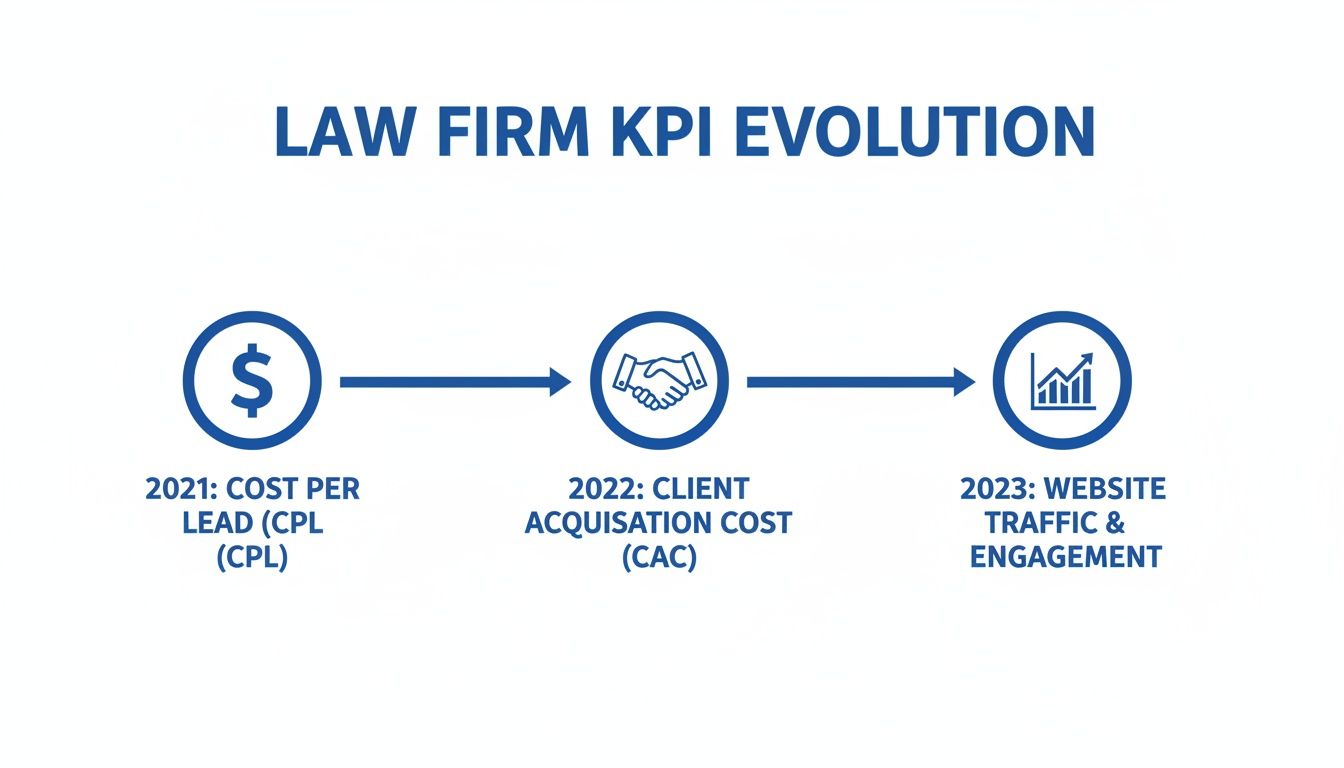
As you can see, the early game is all about managing your cost per lead (CPL). From there, you'll graduate to understanding your true client acquisition cost (CAC), and ultimately, you'll be tracking the growth of sustainable assets like your organic search traffic.
Month 1: Foundational Wins
The first 30 days are all about securing quick, high-impact victories. These early wins build a solid foundation for future success and start bringing in leads while your bigger, long-term strategies are just getting warmed up.
- Dial-In Your Google Business Profile: Don't just fill it out—perfect it. Max out every single section. Upload high-resolution photos of your team and your office space. Write detailed descriptions for each of your services. And triple-check that your hours and contact information are 100% accurate.
- Launch a "Sniper" LSA Campaign: Get a small Google Local Services Ads campaign running. Start with a hyper-targeted approach, focusing only on your primary practice area within a tight geographic radius. This keeps costs low and generates immediate, high-intent phone calls from people who need you now.
- Ask for Reviews (The Right Way): Personally reach out to 5-10 happy clients from the last few months. Don't just send a generic email. Make it personal and provide them with a direct link to your GBP profile to make leaving a review as easy as a single click.
Quarterly Tasks: Review and Optimize
Every 90 days, it's time to pull back, pop the hood, and see how the engine is running. This regular review cycle is what separates a static plan from a dynamic growth machine. It’s your chance to double down on what’s working and mercilessly cut what isn’t.
Consistent review is the difference between spending on marketing and investing in it. Data-driven adjustments ensure your budget is always working its hardest for your firm.
These quarterly check-ins are absolutely essential for steering the ship.
- Analyze Your KPI Dashboard: Get into your Google Analytics and call tracking software. How are your CPL, CAC, and conversion rates stacking up against the goals you set? Pinpoint which channels are your heavy hitters.
- Conduct a Content Audit: Look at your website’s top-performing pages. Find the articles and practice area pages that are already driving traffic and leads. Your next move is to figure out how to update, expand, or build upon those proven winners.
- Adjust Your Ad Spend: Reallocate your budget based on real performance data. If Local SEO efforts are bringing in a steady flow of low-cost leads, maybe it's time to invest more in content. If a particular PPC campaign is burning cash with little to show for it, pause it and dig into why.
If you need more inspiration for structuring your strategy, checking out different law firm marketing plan examples can spark some valuable ideas.
Common Questions About Putting Your Law Firm's Marketing Plan Into Action
Creating a solid marketing plan is a huge step, but the real test comes when you start putting it into practice. As you move from paper to the real world, you're bound to have some questions. Let's tackle a few of the most common ones I hear from firms.
How Often Should I Revisit My Marketing Plan?
Think of your marketing plan as a living, breathing guide, not a "set it and forget it" document. You'll want to do a deep dive and a full strategic review at least annually. This is your chance to look at the big picture—your primary goals, your total budget, and whether your core strategy still makes sense for the year ahead.
But don't wait a full year to check in. I strongly recommend a quarterly review. This is the perfect time to pull up your KPI dashboard, see what's working (and what's not), and adjust your tactics. Maybe one channel is outperforming everything else; this is when you can decide to shift more budget toward it.
What's a Realistic Marketing Budget for a Solo Attorney?
When you're a solo practitioner or running a small firm, every penny has to pull its weight. A great rule of thumb is to allocate 7-10% of your target gross revenue to your marketing efforts.
Let's say you're aiming for a $300,000 revenue goal this year. That puts your marketing budget in the ballpark of $21,000 to $30,000. The trick for a solo lawyer is to be ruthless with that budget. Focus it on high-impact activities that bring in leads now, like super-specific Local Services Ads or building a rock-solid Local SEO foundation.
With a smaller budget, focus is your superpower. Don't try to be everywhere at once. Pick one or two channels that promise the fastest, most trackable return for your practice area and master them.
How Long Until My SEO Efforts Actually Pay Off?
Patience is a virtue with SEO. It's a marathon, not a sprint. While you might spot some small positive movement in your rankings within the first 3-4 months, you're typically looking at 6 to 12 months before you see the kind of significant results that truly move the needle on organic traffic and new client inquiries.
Things like how competitive your legal market is and the current authority of your website will heavily influence that timeline. This is exactly why a well-rounded marketing plan is so important. You can lean on things like PPC for immediate leads while your SEO strategy builds up steam, creating a powerful, long-term asset for your firm.
At RankWebs, we specialize in helping law firms move past the planning stage and into building powerful, results-driven marketing engines. We provide the actionable insights and proven frameworks you need to navigate these challenges and grow your practice.