

A successful Google Ads campaign for your law firm doesn't start in the Google Ads interface. It starts with a pen and paper—or a whiteboard—long before you ever bid on a single keyword. This foundational planning is all about defining your ideal client, figuring out a realistic budget, and getting a handle on your ethical advertising obligations.
Skipping this part is the fastest way to burn through your marketing budget with nothing to show for it but a list of expensive, useless clicks.
Laying the Groundwork for a Profitable Campaign

Before you even think about writing ad copy, you have to build your strategic foundation. I've seen too many firms rush this part, and it's almost always the reason their campaigns fail. The goal here isn't just to get traffic; it's to attract the right cases from the right clients—the ones that are actually profitable for your firm.
This process begins with a deep dive into the mind of your ideal client. You need to go way beyond basic demographics and map out their specific legal problems and, just as importantly, the exact words they use when they're frantically searching for help online.
Define Your Ideal Client and Their Search Intent
A personal injury firm isn't just targeting "people who got hurt." A much better target is the 45-year-old construction worker with a back injury from a fall on the job site. Or the 30-year-old mother who was T-boned in a rideshare on her way to pick up her kids. Each person has a completely different set of concerns, fears, and search queries.
You need to create detailed client "personas" for every single practice area you plan to advertise. For each one, ask yourself:
- What's their immediate problem? Are they searching for an "emergency child custody lawyer" or a "workers' compensation attorney for back injury"? The language they use tells you everything.
- What's their emotional state? Let's be honest, they're probably stressed, confused, and looking for an authority figure they can trust.
- What questions are they typing into Google? Think about the long-tail keywords. "How much is a truck accident settlement worth" is someone doing research. "Truck accident lawyer near me free consultation" is someone ready to hire.
Your entire law firm Google Ads strategy hinges on this: You aren't just buying keywords; you're buying the attention of a real person with a real, urgent problem. Your ads, your landing pages, and even your intake process must all be perfectly aligned with that person's immediate needs.
Establish a Realistic Advertising Budget
Budgeting for legal ads means having a very clear-eyed view of just how competitive your market is. The cost for clicks varies wildly depending on the practice area, and you need to know what you're getting into.
The table below gives you a rough idea of how much CPCs can differ. It’s a critical piece of the puzzle for setting realistic expectations and not getting sticker shock on your first invoice.
Practice Area Cost Per Click (CPC) Comparison
| Practice Area | Typical CPC Range | Competitiveness Level |
|---|---|---|
| Personal Injury | $100 – $300+ | Very High |
| Criminal Defense (DUI/DWI) | $50 – $150+ | High |
| Family Law (Divorce) | $15 – $50 | High |
| Bankruptcy | $10 – $40 | Medium |
| Immigration | $3 – $15 | Low to Medium |
As you can see, saying the average CPC for law firms is around $8.58 is pretty misleading. A personal injury keyword in a major city can easily top $100 per click, while some immigration terms might be as low as $3-$15. Setting a budget without this context is a recipe for disaster. You can find more insights about Google Ads costs for law firms and what to expect in 2025.
A better way to set your budget is to work backward. Figure out how many new cases you need each month and what your average case value is. This helps you establish a target Cost Per Acquisition (CPA)—the absolute maximum you're willing to pay to sign a new client.
Navigate State Bar Advertising Rules
Finally, and this is a big one: compliance is non-negotiable. Before you even think about launching, you need to thoroughly review your state bar's advertising guidelines. These rules cover everything from whether you can use words like "expert" or "specialist" to the specific disclaimers you must have on your landing pages.
Keep an eye out for these common rules:
- Prohibitions on guaranteeing any kind of case outcome.
- Requirements to clearly label ads with "Advertising Material."
- Strict restrictions on using testimonials or past results without proper context and disclaimers.
Ignoring these regulations can lead to serious ethical trouble and can get your entire marketing effort shut down before it even has a chance to get going. This initial work—understanding your clients, setting a smart budget, and ensuring compliance—is the essential first phase of any law firm Google Ads strategy that actually works.
Finding the Keywords That Attract Real Clients
A powerful Google Ads campaign for a law firm is built on one simple, but absolutely critical, idea: attract clients, not just clicks. I’ve seen far too many firms burn through thousands of dollars bidding on broad, impressive-sounding keywords that do nothing but attract students, researchers, or even other lawyers.
The real art is mastering legal search intent—understanding what a potential client is really asking for with their search. Your first job is to separate the high-value searches from the low-value ones. Someone typing "car accident statistics" is doing homework. But a person searching for "emergency child custody lawyer near me" has a serious, immediate problem. That second query, what we call a commercial intent keyword, is precisely where your budget needs to go.
Building Your High-Intent Keyword Portfolio
Think of your keyword list as a strategic portfolio designed to catch clients at the exact moment they decide to hire an attorney. This means you need to get specific and move beyond simple, one-word terms. A solid portfolio mixes a few different types of keywords.
-
Commercial Intent Keywords: These are your moneymakers. They’re packed with terms that signal a strong desire to hire, like "free consultation," "attorney," "lawyer," "hire," and "near me." A personal injury firm, for instance, should be all over "motorcycle accident lawyer free consultation."
-
Long-Tail Keywords: These are the longer, more detailed phrases of three or more words. They get less traffic, but the conversion rates are often through the roof because they tap into very specific needs. A search for "attorney for rear-end collision with neck injury" is infinitely more valuable than a generic "car accident lawyer."
-
Local Variations: Potential clients are almost always looking for help nearby. It’s essential to weave city, neighborhood, and even county names into your keywords. Think "family law attorney in downtown San Diego" or "Harris County DUI lawyer."
Let me be clear: the goal isn't to get the most clicks; it's to get the right clicks. One click from a highly qualified, long-tail search is worth a hundred clicks from vague, informational queries. Every keyword you bid on should answer this question: "Is the person searching for this looking to hire a lawyer right now?"
The Unsung Hero: Negative Keywords
While you’re busy building your target list, don't forget the secret weapon that makes a law firm's campaign truly profitable: a robust negative keyword list. These are the terms you tell Google not to show your ads for. This is your number one defense against wasted ad spend.
For example, a family law firm would want to add negatives like "pro bono," "free," "paralegal jobs," and "forms." This simple step stops your budget from being drained by people looking for free legal aid, a job, or DIY templates. If you want to go deeper on this, you can explore our full guide on how to perform effective keyword research and selection for lawyer PPC campaigns.
Practice Area Specific Negative Keywords
Every practice area has its own unique set of budget-draining keywords you need to block. Here are a few real-world examples I've seen over the years to get you started:
| Practice Area | Common Negative Keywords to Add |
|---|---|
| Personal Injury | jobs, paralegal, salary, statistics, class action, how to file claim |
| Family Law | forms, DIY, self-help, free advice, pro bono, classes, mediator jobs |
| Criminal Defense | police report, public defender, court records, what happens if, legal aid |
Building out this list is a non-negotiable, ongoing task. Get into the habit of checking your "Search Terms" report in Google Ads every single week. Find the irrelevant queries that triggered your ads and add them as negatives. This one discipline can dramatically improve your return on investment.
Advanced Targeting Beyond Keywords
While keywords are the foundation, today's campaigns allow for much more sophisticated targeting. Layering on advanced geographic targeting can really zero in on your ideal audience. One of the most powerful tactics for this is geo-fencing, which lets you target users within a very specific physical radius.
Imagine you're a criminal defense attorney. You could set up a geo-fence around the local county courthouse or jail. Now, you can show your ads specifically to people in that location who are searching for your keywords, catching them at a moment of extreme relevance and urgency.
Likewise, a workers' compensation lawyer could target industrial parks, or a personal injury firm could target major hospital emergency rooms. When you combine high-intent keywords with this kind of precision location targeting, you ensure your ad spend is focused only on your most valuable potential clients.
Creating Ads and Landing Pages That Get You Cases
Think of your Google Ad as the first handshake and your landing page as the first meeting. Both have to be perfect. A great ad gets the click, but it's the landing page that actually gets you the client. Miss the mark on either, and you’re just wasting money.
The whole process starts by writing an ad that connects with someone in a stressful, urgent situation. Your ad copy has to cut through all the other noise online and speak directly to their problem. You need to sound authoritative but also empathetic. This isn't the place for vague promises—you need direct, reassuring language that builds trust from the very first glance.
What Goes into a High-Performing Legal Ad?
The best ads I’ve seen are a smart mix of psychology and straightforward information. They know what the searcher is thinking and give them a compelling reason to choose your firm over the dozen others on the page.
Here’s what you absolutely need in your legal ads:
- Headlines That Match Their Urgency: Your headlines need to mirror what they just typed into Google. If someone searches "emergency divorce lawyer," a headline like "Urgent Divorce Help – Speak to an Attorney Now" will crush a generic "Local Family Law Firm" every time. It shows you get it.
- Descriptions That Build Trust: This is your chance to showcase credibility. Mention your years of experience, a major award, or your specific focus. Phrases like "Over 25 Years Experience in Injury Law" or "Former Prosecutor Fighting for You" build instant confidence.
- A Clear Call-to-Action (CTA): Don't be shy. Tell them exactly what to do. "Call for a Free Case Review" or "Schedule Your Confidential Consultation" are direct commands that guide them to the next step. There's no room for confusion.
Here's a pro tip: use ad customizers to automatically insert the searcher's location into your ad copy. An ad that reads "Car Accident Lawyer in Houston" feels incredibly relevant and is far more likely to get a click than a generic one. This small adjustment can make a huge difference in your click-through rates.
The Five Must-Haves for a Law Firm Landing Page
Once you’ve earned that click, the landing page has to deliver. Its only job is to turn that visitor into a lead. If your page is cluttered, confusing, or looks untrustworthy, people will hit the "back" button in seconds, and you’ll have paid for nothing.
Every landing page that successfully generates cases for law firms is built on five core elements. These aren't just suggestions; they're requirements.
- A Headline That Matches the Ad: The headline on your landing page must echo the ad they just clicked. If the ad promised help for "truck accident victims," the landing page needs a big, bold headline saying something like, "Get Expert Legal Help for Your Truck Accident Claim." This creates a seamless experience and tells them they’re in the right place.
- Trust Signals You Can't Miss: Your potential client is actively looking for reasons to trust you. You need to put those trust signals "above the fold" where they're immediately visible. We're talking about logos from bar associations, "Super Lawyers" badges, and impressive case results (e.g., "$1.2 Million Settlement for Spine Injury Client").
- A Simple, No-Fuss Contact Form: Only ask for what you absolutely need: name, phone number, and email. Seriously, that's it. Every extra field you add is another reason for someone to give up and leave. Keep it short and easy.
- A Click-to-Call Phone Number: A massive number of legal searches happen on smartphones, often when someone is in distress. Your phone number must be at the top of the page and be "click-to-call," letting them contact you with a single tap.
- Real Client Testimonials: Stories from past clients are incredibly powerful. Use real photos and direct quotes that show how you helped someone through a difficult time. If you can get video testimonials, they're even better.
Getting these elements right isn't a one-and-done task. For a much deeper look into this, check out our guide on how to optimize landing pages for lawyer PPC ads. I've seen a simple change, like A/B testing a new headline, literally double a page's conversion rate. That’s how you turn wasted clicks into valuable new clients.
Structuring Campaigns for Maximum Control and ROI
I've looked under the hood of dozens of law firm Google Ads accounts, and I can tell you this: a messy account is the fastest way to light your marketing budget on fire. The firms that consistently lose money almost always have one thing in common—a chaotic structure that lumps all their keywords and case types together.
The secret to a profitable law firm Google Ads strategy is building an account that gives you surgical control over where every dollar goes. You need a clear line of sight into what’s working and what isn’t so you can double down on the winners. That kind of control is simply impossible without a logical, granular structure from day one.
Building Campaigns Around Practice Areas
Your first and most critical move is creating a separate campaign for each distinct practice area you handle. Think about it: someone desperately searching for a personal injury attorney after a car wreck has a completely different mindset, urgency, and potential case value than someone looking into a divorce. Treating them the same in your account is a fundamental mistake.
A multi-practice firm, for instance, should have dedicated campaigns like this:
- Personal Injury Campaign
- Workers' Compensation Campaign
- Family Law Campaign
- Criminal Defense Campaign
This separation is non-negotiable. It’s what allows you to set unique budgets, target specific locations, and use different bidding strategies for each service. The budget for a high-value personal injury campaign in a major city will—and should—be worlds apart from a campaign for uncontested divorces. Your account has to reflect that reality.
Drilling Down with Hyper-Specific Ad Groups
Once your campaigns are set, the real work begins inside of them. This is where you get hyper-specific with tightly-themed ad groups. An ad group is just a small container for a handful of closely related keywords, all answered by the exact same ads. It's how you connect a potential client's specific problem directly to your solution.
Let's stick with the "Personal Injury Campaign." You wouldn't just dump all your keywords into one giant ad group. Instead, you'd break it down by the actual case types:
- Truck Accident Ad Group
- Motorcycle Accident Ad Group
- Slip and Fall Ad Group
- Construction Site Falls Ad Group
Each of these ad groups contains only keywords related to that specific incident. So, the "Truck Accident" ad group gets keywords like "18-wheeler accident lawyer," while the "Slip and Fall" group targets terms like "premise liability attorney."
The Granularity Rule: When your keywords, ads, and landing pages all sing the same tune about a single, specific legal problem, Google rewards you. This alignment is what boosts your Quality Score, which is basically Google's way of giving you a discount on your cost-per-click and helping you outrank competitors, even those with deeper pockets.
Choosing the Right Campaign Types
Beyond just how you organize things, you need to use the right tools for the job. Google offers different campaign types, and a smart strategy uses a mix of them to attract new clients at different stages.
As the diagram below shows, your Google Ad is just the first handshake. It starts a journey that leads to your landing page, where elements like a powerful headline, trust signals, and easy-to-find contact info are what actually turn that click into a phone call.
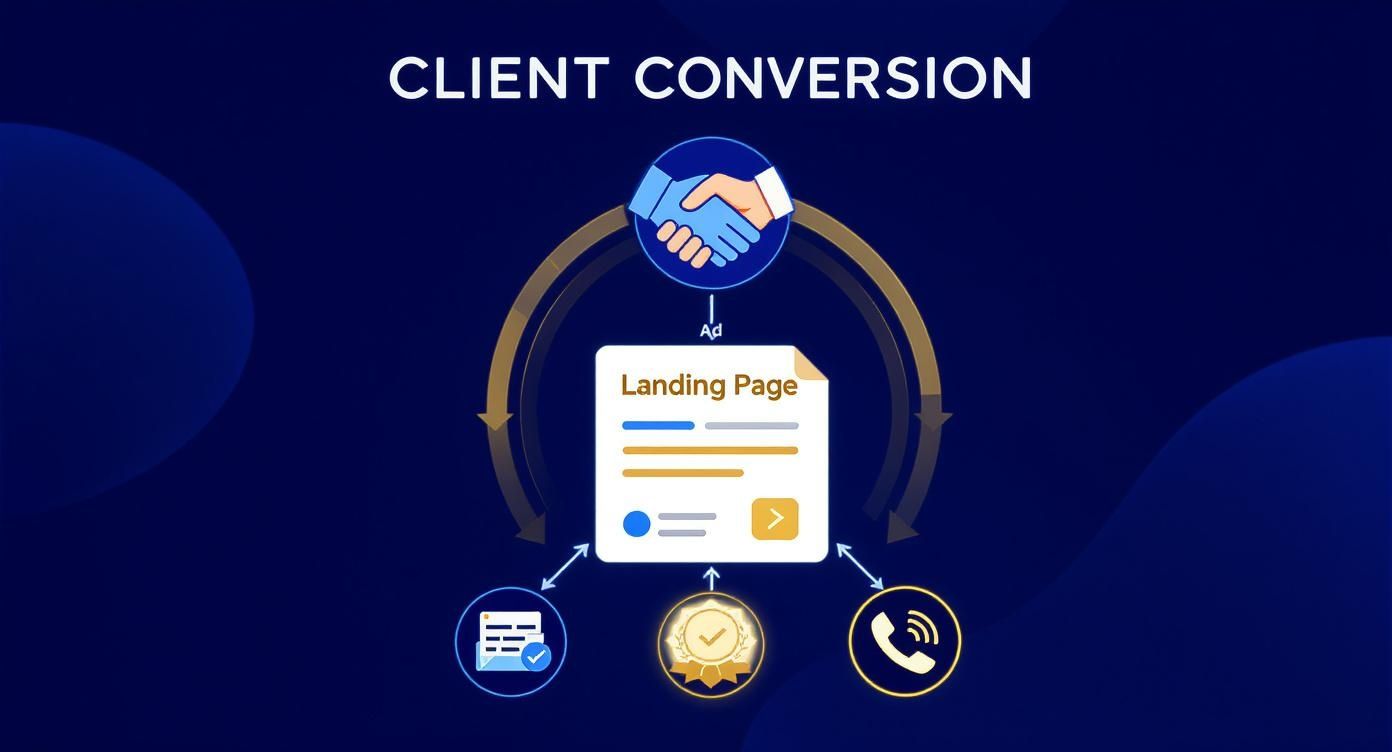
This entire flow hinges on choosing the right campaign to get that first click.
-
Search Campaigns: This is your bread and butter. Search campaigns put your firm in front of people who are actively typing legal queries into Google, capturing high-intent leads right when they need help the most.
-
Local Service Ads (LSAs): For most local law firms, LSAs are a total game-changer. They position you at the very top of the search results with a "Google Screened" badge of trust. The best part? You pay per qualified lead, not just for a click, making it an incredibly efficient way to make the phone ring.
-
Display Remarketing: What about the ones who visit your site and then leave? That's where Display Remarketing comes in. It allows you to show visual ads to people who've already been to your website, keeping your firm top-of-mind while they're still weighing their options. It's your second chance to make a first impression.
Managing Bids and Budgets Like a Pro
In the world of legal PPC, where competition is cutthroat, how you manage your budget and bids can make or break your entire campaign. It’s not about who has the deepest pockets; it’s about making every single dollar count. Getting this right is fundamental to running a profitable Google Ads account for your law firm.
When it comes to bidding, you’re essentially choosing between hands-on control and letting Google's automation take the wheel. The best choice really depends on how mature your campaign is.
Manual vs. Automated Bidding
Manual CPC (Cost-Per-Click) puts you in complete control. You tell Google the absolute maximum you’re willing to pay for any given click. I almost always start brand-new campaigns this way. It lets you collect some clean, baseline data and get a real feel for click costs in your market before an algorithm starts making decisions for you.
Once you’ve got a consistent flow of conversions coming in—I’m talking at least 15-20 a month—it’s probably time to explore Google’s automated bidding strategies. A real workhorse for law firms is Target CPA (Cost Per Acquisition). You simply tell Google your target cost for a new lead, and its machine learning goes to work, adjusting bids in real-time to hit that number.
For a deeper dive, check out our guide on effective PPC budgeting and bidding strategies for maximizing ROI.
Your bidding strategy needs to evolve. I recommend starting with manual bidding to establish a baseline, then switching to an automated strategy like Target CPA once you have enough conversion data to feed the algorithm.
Smart Budget Management Tactics
A winning campaign isn't just about bidding smart; it's about spending smart. This means allocating your budget where and when it will have the most impact. Top firms are ruthless about eliminating waste and seizing every opportunity.
The spending here is staggering. In 2024 alone, the legal services advertising industry poured over $2.5 billion into more than 26.9 million ads. This just underscores how critical strategic spending is. A solo practitioner might get by on $1,000-$2,000 per month, while a large firm could easily spend over $100,000. You can see more about these legal advertising trends and see where you fit.
Here are a couple of my non-negotiable tactics:
-
Dayparting: Don't run ads when no one is there to answer the phone. It's that simple. Dayparting, also known as ad scheduling, lets you run ads only during specific hours. If your intake team isn't working at 2 a.m., your ads shouldn't be either. Align your campaigns with your business hours to make sure every lead can be handled immediately.
-
Device Bid Adjustments: Your potential clients are on their phones, and they're often ready to call right now. Use device bid adjustments to bid more aggressively on mobile. For instance, you can tell Google you’re willing to pay 20% more for a click from a smartphone, which prioritizes the users who are just one tap away from becoming a client.
Common Questions We Hear About Google Ads for Law Firms
Running Google Ads in the legal space is a different beast altogether. It's competitive, it's expensive, and it can feel like a maze. We get a lot of the same questions from firms trying to get their campaigns off the ground or figure out why their current ones aren't delivering. Let's tackle some of the most pressing ones head-on.
How Long Until My Campaign Actually Generates Cases?
This is the big one, and the honest answer is: it’s a process. While you can get clicks flowing almost right away, turning those clicks into a steady stream of signed cases is a marathon, not a sprint.
Think of the first 30 to 90 days as your data-gathering phase. This is when you're learning what works. You’re figuring out which keywords bring in real people with real problems, which ad copy gets them to click, and which landing page convinces them to pick up the phone.
You should see your first few leads start to trickle in within a couple of weeks. But getting to a point where you have a predictable, profitable cost per signed case? That usually takes 2-3 months of relentless testing and optimization. Your budget, the competition in your practice area, and the skill behind the campaign setup will all play a huge role in that timeline.
Patience is everything in PPC. The initial investment in learning and data collection is what pays off later. It's what allows you to make smart, data-driven decisions that dramatically lower your client acquisition cost over time.
Should I Use Local Service Ads or Traditional Search Ads?
For most law firms, the answer isn't "either/or" — it's "both." They work together beautifully to blanket the top of Google's results, hitting potential clients at different stages of their search. It’s a strategic one-two punch.
-
Local Service Ads (LSAs): These are your go-to for capturing high-intent phone calls right now. The "Google Screened" badge builds instant trust. The best part? You pay per qualified lead, not per click. This makes LSAs a low-risk, high-reward channel, especially for practice areas like personal injury or family law where people often need immediate help.
-
Traditional Search Ads: This is where you get granular control and much wider reach. Search campaigns are perfect for targeting niche case types, running sophisticated remarketing campaigns to re-engage past website visitors, and sending traffic to detailed educational content. This is your playground for being strategic with more specific, long-tail keywords.
Running them in tandem means you're there for the person who needs to call a lawyer this minute and also for the person who is still in the research phase.
What Is a Realistic Landing Page Conversion Rate?
A "good" conversion rate is always relative, but a solid benchmark for a well-built law firm landing page is somewhere between 2% and 5%. In simple terms, for every 100 targeted clicks you pay for, you should be getting two to five quality leads (a phone call or a form submission).
Of course, some finely tuned campaigns can push into the 8% or higher range. But context is king. In a hyper-competitive market like personal injury in a major city, even a 1.5% conversion rate can be wildly profitable if the value of a single signed case is high enough.
The real goal isn't to hit a magic number but to commit to constant improvement. If you're stuck below 2%, that’s a loud and clear signal that something with your landing page—the messaging, the design, or the call-to-action—needs an urgent overhaul.
How Can a Small Firm Compete with Huge Budgets?
You compete by being smarter, not richer. You can't outspend the big players, so you have to out-think them. The key is to stop fighting them for the most obvious, expensive keywords.
Here’s how you can punch above your financial weight class:
-
Go Long-Tail: Don't bid on "car accident lawyer." Instead, focus on highly specific searches that signal serious intent, like "rideshare accident lawyer for passenger injury" or "attorney for rear-end collision in [your specific town]." The search volume is lower, but the conversion rate is often much, much higher.
-
Dominate a Niche: Instead of trying to be the go-to firm for an entire state, become the undisputed expert in a smaller, defined area. Own your local city, your county, or even a specific set of high-value neighborhoods.
-
Obsess Over Quality Score: This is the great equalizer. Google rewards relevance. By creating ads and landing pages that perfectly match what a user is searching for, you can earn a high Quality Score. This score directly impacts your ad rank and can give you a discount on your cost-per-click, allowing you to outrank bigger spenders without a bigger budget.
At RankWebs, we provide actionable insights and proven frameworks to help law firms navigate these challenges and implement strategies that drive real growth. Learn how our expertise can benefit your firm at https://rankwebs.com.