

Growing a personal injury firm today is all about combining the laser-focused precision of paid search with the relentless efficiency of AI-powered intake. When you get this right, you build a system that captures and qualifies the best leads automatically. This frees up your team to do what they do best: sign high-value cases. Honestly, this isn't a luxury anymore; it's the core survival strategy for any firm with serious growth ambitions.
The Growth Ceiling Facing Modern Personal Injury Firms

Let’s be real—the old playbook for growing a PI firm is broken. Relying on referrals, old-school advertising, or even just running basic PPC campaigns is a fast track to hitting a wall. The market is more crowded than ever, and the cost to get a single, qualified case through the door is just skyrocketing.
This creates a growth ceiling that even the most talented litigators can't break through by just working harder. You’re not just competing against the firm down the street anymore. You're bidding against a sea of practices for the exact same high-value keywords and, ultimately, the same clients.
The Soaring Costs of Competition
The personal injury law market is a beast, currently valued at around $61.7 billion in the U.S. alone for 2025. With more than 50,435 firms all fighting for a slice of that pie, the battle for a potential client’s attention has pushed digital ad costs to a place that feels completely unsustainable. You can get a deeper look at the market dynamics over at IBISWorld.com.
By 2025, we’ve seen PPC bids for super-competitive keywords like 'truck accident lawyer victorville' hit an eye-watering $976.50 per click. A term like 'car accident attorney lubbock tx' is averaging $560.26. These numbers tell a pretty clear story: just throwing more money at ads isn't a growth strategy. It’s a race to the bottom.
This is precisely why a smart integration of AI and PPC is no longer optional. It’s not about just buying traffic anymore; it's about converting that incredibly expensive traffic with maximum efficiency.
The real challenge today isn't just generating leads. It’s about managing the firehose of inquiries without burning out your intake team or your budget. AI is the intelligent filter that ensures only the most promising opportunities ever reach your team's desk.
The Scaling Challenge: Traditional vs AI + PPC Approach
To see the difference in action, let's compare the old way of doing things with a modern, integrated system. The contrast highlights why so many firms get stuck.
| Growth Factor | Traditional PI Firm Method | AI + PPC Integrated Method |
|---|---|---|
| Lead Response | Manual callbacks, business hours only. | Instant, 24/7 engagement via AI chatbots. |
| Qualification | Intake staff manually vets every lead. | AI pre-qualifies/scores leads instantly. |
| Cost Per Case | High due to wasted ad spend on bad leads. | Lower, as budget is focused on high-potential leads. |
| Intake Efficiency | Slow, prone to human error and bottlenecks. | Fast, automated, and consistent. |
| Data & ROI | Disconnected data; hard to track true ROI. | Unified data from click to client for clear ROI. |
| Scalability | Limited by staff size and budget. | Highly scalable with technology. |
As you can see, the AI + PPC method directly addresses the bottlenecks that hold traditional firms back, turning common pain points into strengths.
Why the Traditional Intake Funnel Fails
A classic, manual intake process just can't keep up with the volume and speed you need to truly scale. Every missed after-hours call, slow manual follow-up, or long-winded qualification interview creates a leak in your funnel. Each lead that slips through represents both wasted ad spend and a lost opportunity for a great case.
Here’s exactly where things fall apart:
- Speed to Lead: A potential client isn't waiting around. They expect an immediate response, whether it's 2 PM or 2 AM. A manual system can't deliver that.
- Qualification Bottlenecks: Your intake team is likely spending way too much of their day talking to people who will never become clients.
- Data Silos: Information from your ad campaigns rarely connects smoothly with your intake software or case management system. This makes it almost impossible to know your true cost per signed case.
The firms that are poised for explosive growth are the ones that have solved these problems. They understand that to scale a personal injury firm with AI + PPC, you need to build a system where technology handles the heavy lifting, so your people can focus on building high-value relationships.
Architecting Your High-Value PPC Campaigns
Forget just "running ads." A scalable lead generation system starts with a deliberately designed campaign structure. This isn't just about organization; it's about building the very foundation that allows AI to later turn your ad spend into a predictable pipeline of high-value cases.
The single biggest misstep I see firms make is cramming everything into one or two generic campaigns. A single "Car Accident Lawyer" campaign might feel simple, but it means you're using the same budget and bidding strategy for a minor fender-bender as you are for a catastrophic multi-vehicle pile-up. It's an incredibly inefficient and expensive way to operate.
The goal is to build a structure that mirrors your firm's most valuable practice areas. Think of each campaign as its own dedicated business unit, laser-focused on a specific, high-value case type.
Segment Your Campaigns by Case Value
Your entire campaign architecture needs to be built around distinct categories of personal injury cases. Each one gets its own budget, its own set of keywords, and its own ad copy. This segmentation is absolutely critical because the potential value—and the competition—for a traumatic brain injury case is worlds apart from a simple soft tissue claim.
When you create these separate campaigns, you gain incredible control and can push your budget where it will have the most impact. This is the first step in feeding clean, relevant data to your AI bidding models.
Here’s a real-world example of how this looks in practice:
- Campaign 1: High-Value | Commercial Vehicle Accidents
- Campaign 2: High-Value | Catastrophic Injuries (TBI, Spinal Cord)
- Campaign 3: Mid-Value | Standard Car Accidents (Clear Liability)
- Campaign 4: Niche | Premises Liability (e.g., Slip & Fall at Businesses)
This structure instantly allows you to be more aggressive with your budget for the campaigns that drive your most profitable cases. You're explicitly telling the ad platforms what you value most, which is the key to effective AI optimization. For a deeper dive on this, our guide on optimizing PPC campaigns for lawyers lays out some more advanced frameworks.
Master Keyword Strategy and Search Intent
With your campaigns neatly segmented, the next layer is a smart keyword strategy. This isn't about chasing the broadest, most expensive terms. It's about capturing searches that signal a person is ready to hire an attorney right now.
Focus your energy on long-tail keywords. These are longer, more specific search phrases. They might have lower search volume, but their conversion rates are often exponentially higher. Someone searching for "car accident lawyer" is probably just starting their research. But someone searching for "lawyer for head-on collision on I-5 with serious injury" is looking to make a call.
The secret to a scalable PPC strategy lies in mastering user intent. By targeting keywords that signal urgency and high case value, you filter out the noise and attract leads who are actively seeking representation for significant claims.
Get Hyper-Specific with Targeting
Beyond keywords, today’s ad platforms give us powerful tools to zero in on the right audience. Don't just target a whole city; get granular.
- Geotargeting: Don't just target Miami; target the blocks immediately surrounding the major hospitals, specific accident-prone intersections, or industrial parks where workplace injuries are common.
- Ad Scheduling: Look at your data. When are accident reports most often filed? When do your best leads typically call? You might find that bidding more aggressively in the evenings or on weekends pays dividends.
- Demographic Layering: For niche case types like medical malpractice, you might overlay specific age demographics who are more likely to be impacted by those issues.
This level of precision ensures your ads are only being shown to the most relevant people, which dramatically improves your return on ad spend before AI even enters the picture.
Your Data Has to Be Flawless
Let me be clear: none of this matters if your data is a mess. Your AI tools are only as smart as the information you give them. Setting up pristine conversion tracking is completely non-negotiable.
You need to track every single valuable action a potential client can take.
- Form Submissions: Every single lead form on your landing pages must be tracked.
- Phone Calls: Use dynamic call tracking numbers. This is the only way to know which specific keyword and ad drove a phone call.
- Chatbot Engagements: Track when a user starts a conversation with your AI-powered chatbot.
Each of these actions needs to be configured as a distinct conversion goal in Google Ads and your analytics platform. This creates the clean data feedback loop that AI bidding strategies, like Target CPA, need to learn and optimize effectively. It’s how you make sure you’re not just buying clicks—you’re acquiring qualified potential clients.
Automating Your Client Intake and Qualification Process
So, your PPC campaigns are finally humming along, sending a steady stream of traffic to your landing pages. This is great news, but it's also where many personal injury firms hit a brick wall. A flood of new leads can absolutely bury a manual intake process, leading to dropped calls, frustrated staff, and promising cases slipping through the cracks.
This is the critical handoff point where your paid traffic strategy meets intelligent automation. By putting AI-powered tools to work on your landing pages, you’re essentially building a system that can engage, screen, and qualify potential clients around the clock. It’s not just about speed; it's about creating an automated front line that filters out the noise and flags the high-value cases before your team even steps in.
Deploying AI Chatbots as Your 24/7 Screener
Don't think of an AI chatbot as just a fancy FAQ. It’s your new, tireless intake specialist. You can program it with a specific script designed to pull out the exact information you need to evaluate a personal injury claim. The best part? It never misses a lead, even the one that comes in at 2 AM on a Saturday.
A well-structured chatbot conversation guides a potential client through a logical qualification funnel. It delivers the instant response people expect today while doing the heavy lifting for your firm.
For instance, a simple chatbot script for a PI firm could look something like this:
- Initial Engagement: "Thanks for reaching out to our firm. To see how we can help, I just need to ask a few quick questions. First, what was the date of your injury?"
- Medical Treatment: "Have you seen a doctor or gone to a hospital for the injuries you sustained?"
- Liability Signal: "In a few words, can you tell me how the accident happened?"
- Contact Capture: "Thank you, that gives us a good starting point. If you could please provide your name and phone number, a case specialist will be in touch shortly to discuss the details."
This brief interaction weeds out irrelevant inquiries and gathers the core facts your team needs to have a productive follow-up call. The whole point of building effective PPC campaigns, as illustrated below, is to get the right people to these bots in the first place.
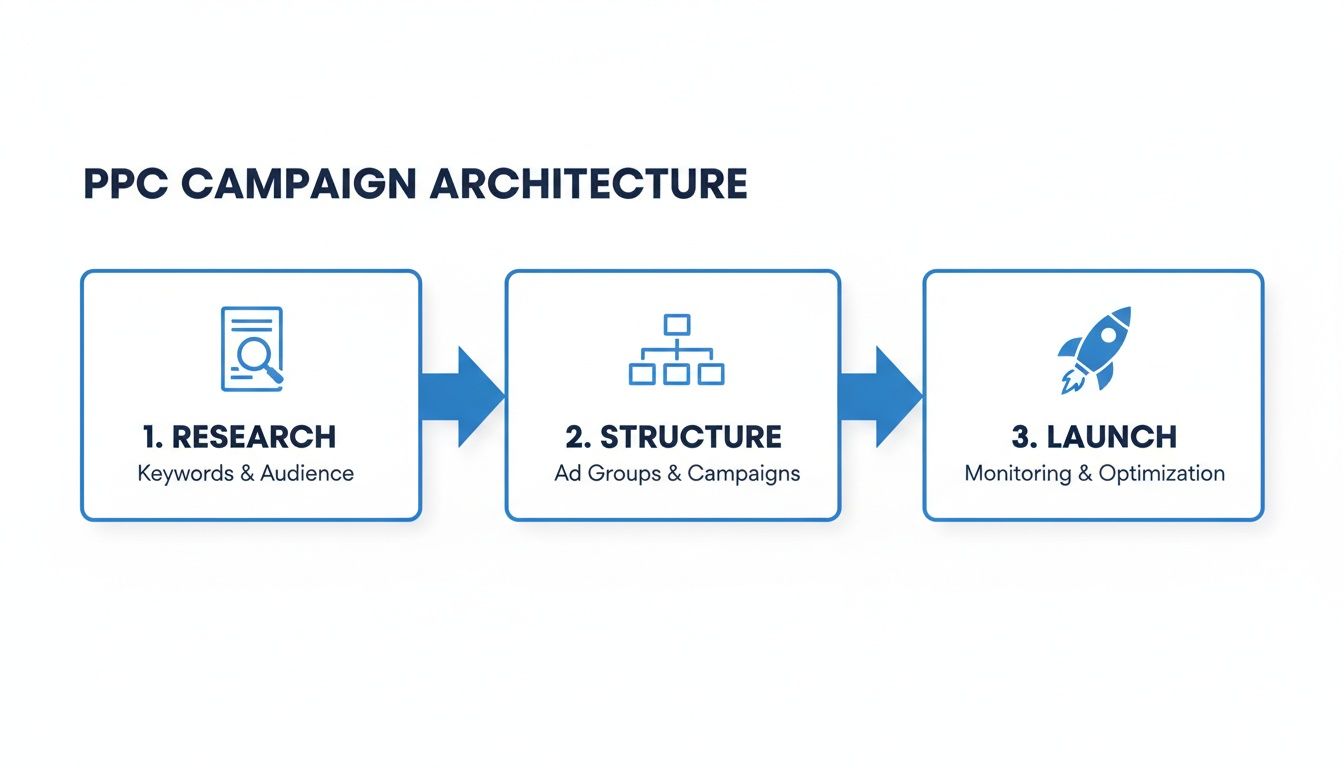
As the diagram shows, a successful campaign launch is built on a solid foundation of research and structure. This groundwork is what ensures you're feeding high-quality traffic into your shiny new automated intake system.
Integrating Intake with Your CRM for a Seamless Handoff
The real magic happens when your systems start talking to each other. The information your chatbot collects shouldn't die in a chat log; it needs to flow directly into your firm’s Customer Relationship Management (CRM) or Case Management Software (CMS).
This integration is the bridge connecting your marketing engine to your legal operations. Once a chatbot qualifies a lead, the system can automatically:
- Create a New Contact Profile: All the data—name, phone number, date of injury, accident summary—is used to build a new record in your CRM. No more copy-pasting.
- Assign a Lead Score: Based on the answers provided, the system can assign a preliminary score. A recent car accident requiring hospitalization gets a much higher score than a slip-and-fall from six months ago with no medical treatment.
- Trigger a Task: The system can instantly create a task for a specific intake specialist, telling them to follow up with a hot, high-scoring lead right now.
This seamless transfer of information kills manual data entry, slashes the risk of human error, and drastically cuts the time between a prospect’s first click and your team’s first call. For a deeper dive, our complete guide to AI intake automation for personal injury firms lays out more advanced frameworks.
By automating profile creation and lead scoring, you turn your intake process from a reactive, manual chore into a proactive, data-driven machine. Your team walks into every conversation with valuable context, so they can focus on what they do best: building rapport and signing the case.
Why This Automated Approach Is a Game-Changer
Putting this kind of automated funnel in place does a lot more than just save time. It gives you a serious competitive edge in a very crowded market. Many PI firms estimate that AI tools can slash the manual work involved in initial client screenings, with some projecting efficiency gains of up to 44%.
This means smaller, nimbler firms can now handle a volume of leads that was once only possible for massive operations with huge intake departments. To learn more about where the industry is heading, you can discover additional insights on how PI firms are growing.
Ultimately, automating your client intake is a non-negotiable step if you truly want to scale your personal injury firm with AI and PPC. It’s how you guarantee that the expensive, high-intent traffic you’re paying for is handled with maximum efficiency, turning more of those clicks into signed cases.
Using AI for Smarter Bidding and Ad Creative
Once your campaign architecture is solid and your intake process is humming along, you can really start to unleash the power of AI inside your ad platforms. This is where you graduate from simply buying clicks to making smart, real-time investments in potential cases. The days of manually tweaking bids keyword by keyword? They're long gone.
Modern ad platforms like Google Ads are now driven by some seriously sophisticated machine learning. In the split second before an ad auction, these systems analyze hundreds of signals—the user’s device, their location, search history, time of day, you name it—to predict how likely that click is to become a valuable lead for your firm.
Let AI Steer Your Bidding Strategy
For personal injury firms, I've found that two AI-powered bidding strategies consistently deliver the best results: Target CPA (Cost Per Acquisition) and Maximize Conversion Value.
When you use Target CPA, you’re essentially telling Google what you’re willing to pay for a qualified lead, whether that's a form fill or a phone call. The AI then takes the reins, automatically adjusting your bids up or down to hit that average cost. It brings a welcome sense of predictability to your lead gen budget.
Maximize Conversion Value takes it a step further. This is for when you've assigned different values to your conversions. For instance, you know a "Catastrophic Injury Inquiry" is worth a lot more than a "General Consultation Request." The AI will then actively prioritize spending your budget to capture those higher-value leads, directly tying your ad spend to your firm's bottom line.
The real magic of AI in PPC is that it removes the guesswork. Instead of basing bids on gut feelings, you're letting a powerful algorithm make thousands of micro-decisions every single day, all aimed at finding your next high-value case at the most efficient price possible.
Dynamic and Responsive Ad Creative
But AI doesn't just manage your bids. It’s also a game-changer for crafting and testing the ad copy that actually convinces a potential client to click. Ad platforms now use AI to generate and test dozens of headlines and descriptions, learning which combinations truly resonate with your audience.
This is a huge advantage for PI firms that need to connect with people in very specific, and often stressful, situations. AI helps you move beyond generic ad copy and create messaging that feels personal and immediate.
Here are a few ways AI sharpens your creative:
- Responsive Search Ads (RSAs): You feed the system multiple headlines and descriptions. The AI algorithm then mixes and matches them on the fly to create the best possible ad for each individual search. Over time, it learns which combinations earn the most clicks.
- Dynamic Keyword Insertion: This feature automatically slots the user's search term right into your ad text, making your ad feel hyper-relevant. It's a simple trick that really works.
- Location-Based Customization: You can dynamically insert a user’s city or even neighborhood into the ad copy. This creates a powerful sense of local presence and trust that's hard to beat.
Think about it: a firm could use AI to dynamically insert local landmarks into its ad copy. An ad shown to someone searching in a specific part of town might read, "Accident Near the Convention Center? Talk to Us." That small touch of localization can make a massive difference in your click-through rates.
AI Targeting for High-Intent Demographics
This level of optimization is absolutely critical when you're looking to scale in specific markets. For example, platforms can analyze bid adjustments in real-time to more effectively target high-intent searches in retiree-heavy states like Florida and Texas, where medical malpractice cases are rising by 2.4% due to aging populations. AI helps pinpoint these valuable demographic pockets, making sure your ad spend is concentrated where it will have the most impact. You can read the full research about these demographic trends to get a better handle on the market.
This data-driven approach allows you to scale your firm not by just reaching more people, but by reaching the right people with a message that speaks directly to their needs. It transforms your advertising from a broad net into a series of surgical strikes aimed at capturing your most valuable cases.
Connecting Your Systems and Measuring True ROI

Here's a hard truth: a brilliant PPC engine and a slick AI intake system are just expensive hobbies if they don't talk to each other. Your growth machine is only as good as the data flowing through it, and if your systems are siloed, you’re flying blind.
This is exactly where most firms stumble. They celebrate a flood of new leads without ever knowing which ones actually become profitable cases. To truly scale, you have to connect the dots.
We need to build a seamless data pipeline that tracks a potential client from the moment they click your ad, through the AI chatbot conversation, and right into your firm's case management software (CMS). Only then can you stop guessing and start measuring what really moves the needle.
The Integration Checklist
Getting your platforms connected isn’t just a tech chore; it’s a strategic imperative. When done right, you can trace every single dollar of ad spend to a signed case and, down the line, its final settlement value. This is called "closed-loop reporting," and it’s the secret to predictable, explosive growth.
Here’s your quick-and-dirty checklist for a clean data handoff:
- Platform-to-CRM Connection: The goal is automation. Use a tool like Zapier or the native integrations built into your software to push lead data from your chatbot and forms directly into your CMS, whether it's Filevine, Clio Grow, or Lawmatics. No more manual entry.
- UTM Parameter Tagging: Every ad URL must be tagged with specific UTM parameters. Think of them as digital breadcrumbs. They tell you precisely which campaign, ad group, and keyword brought in each lead, giving you crystal-clear attribution inside your CRM.
- Offline Conversion Tracking: This is the game-changer. You need to configure your systems to send a signal back to Google Ads or Facebook when a lead officially becomes a signed case. This feedback loop teaches the ad platforms' AI which clicks are actually valuable, letting them find more people just like your best clients.
This setup flips your marketing from a black-box expense into a measurable, high-yield investment.
Moving Beyond Clicks to True ROI
Once your systems are talking, you can finally build a dashboard that gives you a clear, real-time picture of your entire acquisition funnel. It's time to stop obsessing over vanity metrics like clicks and impressions—they look nice on a report, but they don't pay your paralegals.
The ultimate goal is to have a single dashboard that answers one simple question: For every dollar we put into this campaign, how many dollars in fees are we getting back? When you can answer that, you have a truly scalable system.
The proof is in the numbers. We’ve seen firms implement this kind of integrated system and achieve incredible results. One reported a 78% surge in product liability filings. They could directly attribute 30% of their new cases to their AI-powered PPC campaigns, which also dropped their cost-per-lead from $100 to just $65. You can dig deeper into these kinds of outcomes when you learn about current trends in the personal injury market.
Essential KPIs for an AI + PPC Scaling System
To get that crucial one-glance answer, your dashboard needs to focus on the metrics that directly impact your firm's bottom line. Forget the fluff. These are the non-negotiable KPIs you need to be tracking to measure the health and profitability of your entire marketing engine.
Essential KPIs for an AI + PPC Scaling System
| KPI | What It Measures | Why It Matters for Scaling |
|---|---|---|
| Cost Per Qualified Lead (CPQL) | The cost to acquire a lead that meets your firm's predefined case criteria (e.g., injury type, date of incident). | This filters out the noise and shows the true cost of attracting a viable potential case, not just a random form submission. |
| Cost Per Signed Case (CPSC) | The total marketing spend divided by the number of new cases signed from those campaigns. | This is your most important acquisition metric. It tells you exactly what it costs, in real dollars, to put a new client on the books. |
| Case Acquisition Rate | The percentage of qualified leads that become signed cases. | This metric shines a light on your intake process. A low rate might mean your intake team needs coaching, not that your ads are failing. |
| Marketing ROI | The total fees generated from a campaign divided by the total cost of that campaign. | The ultimate measure of success. This proves the direct profitability of your marketing and tells you where to double down. |
Focusing on these KPIs gives you the clarity to make smart, decisive moves. You’ll know with certainty which campaigns to pour fuel on, which to tweak, and which to cut entirely, forging a lean, efficient, and incredibly profitable growth engine for your firm.
Ethical Guardrails for Your Automated Firm
When you start blending AI with your PPC strategy, you're not just adding a tool; you're adding a layer of responsibility. It's easy to get caught up in the excitement of scaling intake and generating leads, but how you manage this power is what will define your firm's reputation for years to come.
The biggest red flag we see is with AI chatbots. You have to be incredibly careful that your bot doesn't stray into giving legal advice. It's a machine, but it represents your firm. That chatbot must have crystal-clear disclaimers baked into its script, making it obvious it's not a lawyer and is only there to gather information. This is non-negotiable and a major area of concern for state bar advertising rules.
Protecting Client Data and Privacy
Then there's the data. Think about the sensitive details a potential client shares during intake—medical records, accident specifics, personal contact information. This is gold for identity thieves and a massive liability for you if mishandled.
You have to dig deep into the security protocols of every single vendor you use, from your AI chatbot provider to your CRM. We're talking about vetting them for things like:
- Rock-solid encryption (both in transit and at rest).
- Clear data ownership policies (you own the data, not them).
- HIPAA compliance, if they handle any protected health information.
A data breach traced back to a third-party tool you didn't properly vet can destroy client trust overnight. Doing your homework on vendors isn't just a good idea; it's a critical part of protecting your practice.
Maintaining Compliance and Human Oversight
Look, at the end of the day, you can't just set this system up and forget it. You are 100% responsible for what your AI says and does. That means having a human in the loop is essential. You need clear, documented protocols for your team to review AI-generated ad copy, vet chatbot conversations, and audit the lead scoring process. For a deeper dive, check out our guide on AI compliance and ethics in legal marketing.
Getting this right does more than just generate leads; it builds a flexible, modern foundation for your firm. It means you can quickly adapt when a new mass tort emerges or you decide to expand into a new practice area. With an estimated 39.5 million injuries happening every year in the U.S., the demand isn't going anywhere. You can read more about these industry statistics on IBISWorld.com.
AI becomes the intelligent filter in this high-volume environment, helping you find the right cases and dramatically improving your shot at converting them. By building these ethical guardrails from the start, you ensure that as you grow, you're doing it the right way—protecting your clients, your team, and your firm's future.
Common Questions & Straight Answers
As you start blending AI with your paid ad campaigns, a few key questions always come up. Here’s a rundown of what law firm leaders usually ask, along with some no-nonsense answers based on what we see work in the real world.
How Much Do We Actually Need to Spend?
There isn't a one-size-fits-all budget, but you can get to a smart number by working backward. Start with how many new cases you want to sign each month and what an average case is worth to your firm. A healthy marketing budget is typically 10-20% of the revenue you expect from those new clients.
To really make this work, especially in a competitive market, you'll need a minimum monthly ad spend of $10,000 to $20,000. That's the baseline to get enough data flowing for the AI bidding tools to learn and start making smart decisions. Don't forget to factor in the cost of the AI software itself—that can run from a few hundred to a few thousand dollars a month depending on what you need.
Is the Goal Here to Replace Our Intake Staff with AI?
Absolutely not. Think of AI as a force multiplier for your intake team, not a replacement. AI is fantastic at doing the grunt work that bogs your team down—like handling initial inquiries 24/7, collecting basic info, and weeding out the leads that are clearly not a fit.
This frees up your best people to do what they do best: connect with high-potential clients. They can spend their time building trust and having the nuanced, empathetic conversations that a machine just can't handle. The winning formula is a hybrid approach where AI handles the volume and your team provides the essential human touch.
What's the Single Biggest Pitfall to Watch Out For?
The most common mistake we see is treating this like a "set it and forget it" system. AI automates a ton, but it's not magic—it needs a human strategist in the driver's seat. Firms run into trouble when they feed the AI messy conversion data, when their PPC goals don't align with their business goals (like signing more high-value brain injury cases), or when they fail to connect all the data back to their CRM.
This whole setup is a powerful engine, for sure. But it still needs an experienced driver to tell it where to go, check the gauges, and make sure you're actually heading toward your destination.
At RankWebs, we specialize in giving firms the practical frameworks and real-world insights to master these new tools with confidence. See how we can help you build a more intelligent marketing system for your firm at https://rankwebs.com.