


Think of it this way: what if you had a tireless associate who could comb through thousands of pages of discovery in minutes? Or a marketing whiz who qualified new leads while you were in court? This isn't some far-off fantasy; it's exactly how AI is becoming an essential part of a modern, competitive law firm.
Your New Strategic Partner in the Practice of Law

For a lot of attorneys, the term "artificial intelligence" probably conjures images of complex code or robots from the movies. The reality is much more down-to-earth and, frankly, more useful. It's best to think of AI not as a replacement for a lawyer, but as a powerful new partner—one that's built to handle specific, data-intensive jobs with incredible speed and precision.
This guide will cut through the noise and show you how AI is already a critical tool for law firms today. It’s an automation engine for the grunt work and a strategic assistant that sharpens everything from your client intake process to how you analyze a complex case. The goal was never to take the lawyer out of the equation. It's to make them better.
The AI Tipping Point is Here
Adopting AI isn't just a trend for tech startups anymore; it's a major business shift happening everywhere. AI use has hit an all-time high, with close to 78% of companies around the world now using these technologies. That’s a massive jump from just 50% in 2022, a spike driven almost entirely by the new, easy-to-use generative AI tools. You can dig into more AI adoption statistics, but the takeaway is clear: this is a fundamental change in how we work.
This technology is completely reconfiguring workflows and opening doors to new efficiencies. By taking over the routine, repetitive tasks, AI frees you and your team up to focus on what actually moves the needle:
- High-Level Strategy: You can spend more time building a winning case strategy instead of drowning in document review.
- Client Relationships: More bandwidth means more time for client communication, building trust, and delivering the counsel they hired you for.
- Winning Cases: You can use data-driven insights to find the holes in the other side's argument and strengthen your own.
By embracing these tools, law firms can unlock new levels of productivity and client service, securing a competitive advantage in a demanding field. It’s about working smarter, not just harder.
Winning More Clients with Intelligent Marketing

For decades, law firms thrived on a steady diet of referrals, reputation, and maybe a few well-placed ads. While those things still matter, the playbook for attracting new clients has been completely rewritten. AI is turning legal marketing from an art based on educated guesses into a science driven by hard data—one that works for you around the clock.
Think of your firm’s website as your digital front door. People don't just show up between 9 and 5; they arrive at all hours with urgent problems. An AI-powered chatbot can act as a virtual receptionist, greeting every single visitor, answering their basic questions, and collecting initial case details. This instant engagement means you never lose a potential client just because they came knocking after you've all gone home.
But this isn't just about grabbing a name and number. It's about pre-qualifying leads. A smart chatbot can ask targeted questions to see if a visitor’s problem actually matches your practice areas. This simple step saves your intake team an incredible amount of time by weeding out the inquiries that were never a good fit to begin with.
Pinpointing Your Ideal Clients with Predictive Analytics
Let's be honest: not all leads are created equal. Some cases are more profitable, a better fit for your firm’s expertise, or simply have a higher chance of success. The real challenge has always been figuring out how to spot these high-value prospects early on. This is where AI’s predictive power becomes a secret weapon.
Predictive analytics tools are designed to dig through mountains of data—your historical case files, client demographics, even online behavior—to find the hidden patterns that define your best clients. It’s almost like having a crystal ball that tells you which marketing channels are most likely to deliver the cases you actually want.
With this insight, your firm can:
- Focus Your Budget: Stop spreading your marketing dollars thin and instead pour them into the platforms and campaigns that consistently bring in high-value cases.
- Identify Emerging Trends: Get an early warning on new geographic areas or niche case types that are starting to heat up.
- Improve Intake Efficiency: Arm your intake specialists with crucial context by flagging leads that perfectly match your ideal client profile.
By learning from your past wins, AI helps you stop chasing every lead that comes your way and start strategically pursuing the ones that will genuinely grow your practice. It’s a fundamental shift from being reactive to truly proactive.
Optimizing Ad Campaigns in Real-Time
Running digital ad campaigns on platforms like Google Ads or Facebook can feel like you're constantly spinning plates. You're always adjusting bids, rewriting ad copy, and tweaking audience targeting, hoping you'll stumble upon the right formula. AI changes this by automating those adjustments with a speed and precision no human could ever match.
AI algorithms monitor ad performance 24/7, making thousands of tiny optimizations in real-time. If one headline starts performing better with a specific demographic, the AI will automatically serve it more frequently to that audience. If clicks get cheaper at 2 a.m., the system will instantly shift your bidding strategy to take advantage.
This relentless optimization cycle directly impacts your bottom line. Firms that use AI to manage their ads often see a major drop in their cost-per-acquisition (CPA). Put simply, they get more qualified leads for the same—or even less—money. To see just how much of an impact this can have, check out our guide on how AI can reduce marketing costs and boost your firm's overall return. This kind of intelligent automation makes sure your marketing dollars are always working as hard as possible to fill your pipeline with better, more profitable cases.
How AI Helps Your Firm Win the Local Search Game
For any local law firm, showing up first on Google is the digital equivalent of having the best office on the town square. It’s where your clients are looking, and AI is completely changing how firms fight for that top spot. It transforms content creation from a slow, painful task into a real strategic weapon.
Think of it as a brilliant, tireless brainstorming partner. AI can help you obliterate writer's block and get solid first drafts for just about anything—blog posts, practice area pages, you name it.
It all starts by using AI as a high-powered assistant, not the final author. You can give it a prompt like, “Outline a blog post on common mistakes after a car accident in Austin.” In seconds, you’ll have title ideas, introductory paragraphs, and a logical structure with subheadings. This creative jumpstart can save your team hours of work, but that’s just the beginning.
The next step is absolutely non-negotiable: rigorous human oversight. An AI has no real-world legal experience. It doesn’t understand the nuances of local statutes or your firm’s unique voice. A qualified legal professional must meticulously review, edit, and fact-check every single piece of AI-assisted content to guarantee accuracy and maintain ethical standards. We cover this in-depth in our guide to AI-generated content for law firms, which lays out a practical framework for getting it right.
Conquering Your Local Market with AI
Beyond just cranking out blog posts, AI gives you specific tools to own the local search results. Your Google Business Profile (GBP) is your single most important local marketing asset, and AI helps you keep it fresh and active—something search engines love to see.
Instead of racking your brain for weekly updates, use AI to draft them in minutes. For instance, give it a sanitized summary of a recent case win and ask for a 100-word GBP post that highlights your firm’s expertise in that practice area.
AI can also put your local keyword strategy on steroids. It can scan competitor websites to find “hyper-local” keyword gaps—those super-specific search terms your rivals are completely missing.
AI tools can analyze search data to pinpoint long-tail keywords like "truck accident lawyer near I-35 and Riverside" or "slip and fall attorney in the South Congress neighborhood." Creating content specifically for these terms is how you capture highly motivated local clients.
This kind of granular targeting used to take hours of manual digging. Now, you can get it done in minutes, giving you a clear roadmap to create content that speaks directly to clients in your own backyard.
Comparing Traditional vs. AI-Powered Content Workflows
To see the difference in action, here’s a look at how AI changes the day-to-day work of creating content and optimizing for local SEO. The gains in efficiency are massive, freeing up your team for higher-value strategic work.
| Task | Traditional Approach (Manual) | AI-Enhanced Approach |
|---|---|---|
| Blog Post Ideation | Hours of brainstorming, keyword tool research, and competitor analysis. | AI generates dozens of relevant, data-backed topic ideas in minutes. |
| First Draft Creation | A paralegal or marketing assistant spends 4-6 hours writing from scratch. | AI produces a structured first draft in under 10 minutes for human review. |
| Local Keyword Research | Manually searching Google and using complex tools to find hyper-local terms. | AI identifies specific neighborhood or landmark-based keyword gaps automatically. |
| Google Business Profile Updates | Content is often neglected due to time constraints, leading to a stale profile. | AI drafts weekly updates based on recent news or case studies in minutes. |
| Content Optimization | Manually checking for keyword density, readability, and SEO best practices. | AI tools analyze drafts and suggest immediate improvements for SEO performance. |
The takeaway is clear: AI doesn't just make the old process faster. It allows your firm to operate at a much higher strategic level, turning content from a cost center into a powerful client acquisition engine.
Keeping Pace with a Rapidly Changing World
The speed at which people have adopted AI is truly mind-boggling. The global AI user base has ballooned to 378 million people, with 64 million new users jumping on board just last year. This isn't some niche tech anymore; according to the latest AI adoption statistics on Netguru, the user base has more than tripled since 2020, proving it’s now a mainstream tool.
What does this mean for your law firm? It means your clients are already using and interacting with AI. They’ve come to expect instant answers and helpful, relevant content. Using AI in your local SEO strategy is no longer a futuristic idea—it’s how you meet those expectations and make sure your firm remains the obvious choice in your community.
Streamlining Research and Firm Operations

While AI is a game-changer for bringing in new clients, its deepest impact is often felt inside the firm's core operations. This is where the technology stops being just a marketing tool and becomes a true intellectual partner, augmenting the critical work that defines a lawyer's value.
This is especially true for legal research—the very foundation of any case strategy. For decades, this meant grueling hours spent poring over casebooks in a library or navigating clunky, keyword-based databases. Frankly, the way how AI is changing this process is nothing short of a revolution.
Think about an associate who can read, comprehend, and synthesize an entire library of case law, statutes, and legal journals in a matter of seconds. That’s not science fiction; it’s the reality of modern AI research platforms. These tools don't just search for keywords; they understand legal concepts and context, uncovering crucial precedents that a human researcher might take days or even weeks to find.
Accelerating Discovery and Document Review
In any complex litigation, the discovery process can unleash a mountain of documents—emails, contracts, internal memos, you name it. Reviewing this material by hand is not only mind-numbingly slow but also riddled with the risk of human error. We all know that one overlooked document can completely change the direction of a case.
This is where AI-powered e-discovery platforms come in. They are built specifically for this challenge, using natural language processing (NLP) to scan millions of pages and identify relevant documents with incredible accuracy.
This kind of technology can:
- Identify Privileged Information: Automatically flag documents with attorney-client communications to stop them from being disclosed by mistake.
- Perform Topic Modeling: Group related documents by theme, even if they don’t use the same keywords, which helps reveal hidden patterns in the evidence.
- Conduct Sentiment Analysis: Gauge the emotional tone of communications, helping you quickly find contentious emails or damaging internal chatter.
By automating the most exhausting first pass of document review, AI systems can slash review time by up to 70% or more. This lets attorneys focus on the strategic analysis of key documents instead of the manual labor of just finding them.
This efficiency means lower costs for clients and enables firms to take on document-heavy cases that might have been too resource-intensive before. It’s a genuine competitive edge.
Intelligent Contract Analysis
Contract review is another area just waiting for an AI assist. Whether it’s for a merger, a real estate transaction, or a basic vendor agreement, analyzing contracts for risks and non-standard clauses is tedious but non-negotiable work. AI tools now act as a powerful first line of defense, scanning entire agreements in seconds.
Trained on massive datasets of legal contracts, these systems can instantly flag potential problems, such as:
- Missing Clauses: Noticing when standard clauses like indemnification or limitation of liability are missing.
- Risky Language: Highlighting ambiguous or unfavorable terms that don’t align with industry norms.
- Conflicting Terms: Catching contradictions between different sections of the same document.
The AI isn’t replacing the lawyer's final judgment. Far from it. Instead, it delivers a detailed, annotated report that points the attorney’s attention exactly where it's needed most. This turns a multi-hour review into a much quicker, more focused validation process. This is how AI is helping lawyers take back billable hours from rote tasks and dedicate them to high-value strategic counsel.
Predictive Case Management
Finally, AI is beginning to reshape how firms manage their day-to-day business. Modern case management systems are evolving beyond simple calendars and document dumps. They're becoming intelligent hubs that help firms deploy their resources far more effectively.
By analyzing historical case data, AI can now predict case timelines with better accuracy, see potential workflow bottlenecks before they happen, and even suggest the best staffing for a specific matter. This data-driven approach allows partners to make smarter business decisions, ensuring their most precious resource—their legal talent—is always making the biggest impact. From research to review, AI is fundamentally rewiring the business of law.
Navigating the Ethical Maze of AI in Law
Bringing AI into your law firm is more than just a tech upgrade—it's a massive ethical undertaking. The promise of efficiency is tempting, but it puts your duties of client confidentiality, data security, and professional competence under a microscope. Using these powerful new tools without a rock-solid ethical framework isn't just risky; it’s a direct threat to your firm's integrity and your obligations to your clients.
The biggest red flag right out of the gate is client confidentiality. Think about how many popular, free AI tools work: they use your prompts to train their models. Uploading any shred of sensitive client information, case notes, or privileged communications into a public tool is a catastrophic ethical breach. You might as well be discussing the case at full volume in a packed coffee shop.
This is why your firm must commit to using only enterprise-grade AI platforms. These services come with robust data privacy agreements and explicitly state that your firm's data will never be used for training purposes. It’s a non-negotiable starting point.
Upholding the Duty of Technological Competence
The American Bar Association's Model Rules of Professional Conduct have long required lawyers to stay competent, and that includes understanding the tech they use. Today, that duty squarely covers artificial intelligence. You don't need to learn how to code, but you absolutely need to grasp what the AI tools you're using are actually doing.
One of the biggest landmines here is the issue of AI "hallucinations." This is what happens when an AI, trying to be helpful, just makes things up and presents them as fact. We've already seen it happen—AI models inventing fake case citations, twisting legal precedent, or creating entirely false factual summaries with complete confidence.
Relying on unverified AI output is a direct path to professional malpractice. Every single thing an AI generates—every legal citation, every case summary, every factual claim—must be independently verified by a human attorney. The AI is a powerful assistant, not the final word.
This really hammers home the point: AI is a fantastic tool but a terrible master. At the end of the day, the lawyer is the one responsible for the accuracy and integrity of every document and argument.
Creating a Firm-Wide AI Usage Policy
To get a handle on these risks, you need a formal, written AI usage policy. This isn't just a "nice-to-have"; it's an absolute must. A clear policy ensures that everyone from the managing partner to the newest paralegal understands how to use these tools safely and responsibly.
Your policy needs to lay down some very clear ground rules:
- Approved Tools: Maintain a specific list of vetted AI platforms that are approved for firm use. Make it crystal clear that public, consumer-grade tools are off-limits for any client-related work.
- Data Input Rules: Establish bright-line rules about what can and cannot be fed into an AI. Forbid any personally identifiable information (PII) or confidential client data from ever being used as a prompt.
- Verification Protocols: Mandate a strict human review process for all AI-generated content. Specify that legal arguments, facts, and especially citations must be cross-checked against primary sources.
- Disclosure Requirements: Define when and how your firm will disclose the use of AI to clients or the court. Transparency is key to maintaining trust and upholding professional standards.
Putting this policy together is the most critical step you can take. It allows you to tap into the incredible power of AI without falling into its biggest traps, protecting your clients, your reputation, and your license.
Building Your Firm's AI Implementation Plan
Jumping into artificial intelligence can feel overwhelming. With a flood of tools all promising to be the next big thing, just knowing where to start is half the battle. The secret isn't a massive, top-to-bottom overhaul. It's a thoughtful, step-by-step plan that builds momentum over time.
A successful AI journey doesn't begin with the tech; it begins with your firm's specific problems. Instead of getting distracted by the latest shiny object, focus on the "low-hanging fruit"—those operational bottlenecks that are actively costing you time and money right now.
Is your intake team buried under calls from unqualified leads? Does legal research for a certain practice area consistently blow past the budget? These are perfect starting points for targeted AI tools that can deliver a fast, tangible return.
Starting Small and Proving Value
The smartest way forward is a phased approach. Start with simple, low-cost tools that solve one of those specific problems you identified. This keeps the risk low and lets you prove the value of the tech before you ask the partners to sign a big check.
Here’s a practical, four-step roadmap to get you started:
- Identify and Prioritize: Make a list of daily tasks that are repetitive, manual, and data-heavy. Then, rank them. Which ones, if automated, would free up the most billable hours or time for high-value legal work?
- Vet Potential Vendors: Seek out AI tools built for the legal industry. Dig into their security protocols, data privacy policies, and testimonials from firms like yours. Always ask for a live demo focused on solving your specific problem.
- Launch a Pilot Program: Choose a small, forward-thinking team to test a single tool. This could be a couple of paralegals trying an AI research platform or a marketing assistant experimenting with a content generator. Set clear goals from day one.
- Measure and Present Results: After a fixed period, say 30 or 60 days, collect the data. Did the tool cut research time by 20%? Did it help you qualify 15% more leads? Bring these hard numbers to firm leadership to make the case for a wider rollout.
The goal of a pilot program isn't just to test software; it's to create internal champions for the technology. When a respected colleague can say, "This saved me ten hours last week," it's far more powerful than any sales pitch.
Getting Buy-In from Your Team
You absolutely need support from partners and staff for this to work. Many legal professionals are, quite rightly, cautious about new technology, especially with their ethical duties in mind. You have to frame AI not as a replacement for human lawyers, but as a tool that makes everyone better and more efficient at their jobs.
Keep the conversation focused on real-world benefits. Show them how an AI-powered intake system gets them better clients with less administrative hassle, or how research tools can uncover a critical case precedent in minutes instead of hours. When your team sees AI as a tool that helps them win, getting them on board becomes a whole lot easier.
This process flow shows the core ethical pillars that have to guide every single step of your AI plan. It’s about protecting your clients and your firm, first and foremost.
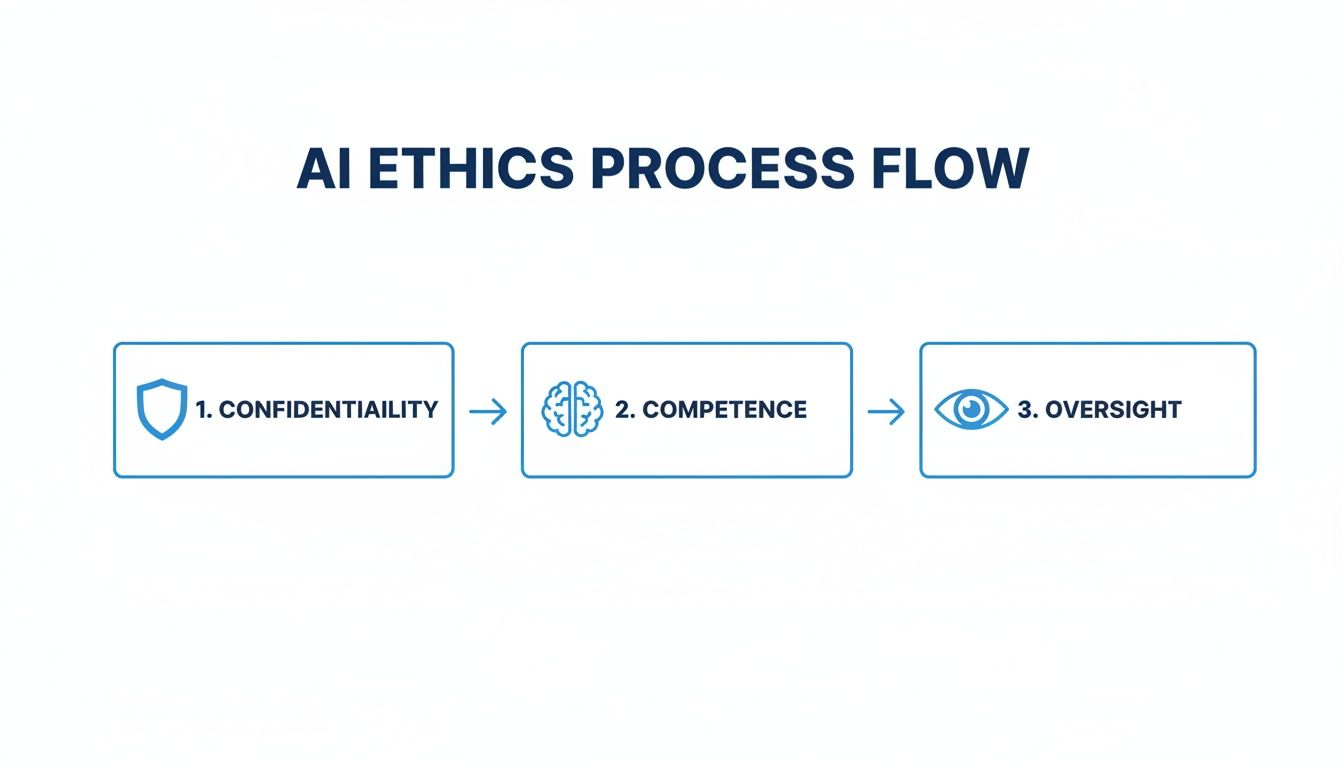
As the visual shows, any implementation plan has to be built on a foundation of Confidentiality, Competence, and diligent Oversight. For a deeper look at specific platforms, our guide on the best AI tools can help you compare options that live up to these high standards. Smart, incremental change is how you successfully bring this powerful technology into your firm.
Common Questions About AI for Law Firms
Jumping into artificial intelligence can feel like a big step, and it naturally brings up some very practical questions about ethics, cost, and even job security. Let's tackle some of the most common concerns head-on to clear up what AI really means for a modern law firm.
These aren't hypothetical answers. They're based on what we see working for firms right now, designed to cut through the hype and show you what this technology can—and can't—do for your practice.
Will AI Replace Lawyers or Paralegals?
The short answer is a definite no. The reality is that AI is an augmentation tool, not a replacement. Think of it less as a new team member and more as a force multiplier that makes your human talent even more effective.
AI is fantastic at chewing through the repetitive, data-heavy tasks that eat up so much time. We're talking about things like initial document review, sorting through contracts for specific clauses, and pulling together preliminary legal research. It does this work with incredible speed and accuracy.
This automation frees up lawyers and paralegals to concentrate on the high-value work that truly requires a human touch: crafting complex legal strategies, advising clients, negotiating settlements, and arguing in a courtroom. These are skills that rely on nuanced judgment, empathy, and creative thinking—abilities that are still way beyond what any algorithm can do. In essence, AI handles the "what," so you can focus on the "why" and "how."
How Can a Small Firm Afford to Implement AI?
The idea that AI is only for massive firms with huge budgets is one of the biggest myths out there. Getting started is more scalable than you'd think, and most firms find success by starting small with affordable, subscription-based tools that solve one specific problem.
You don't need a six-figure budget to get started. For example, you could begin with:
- AI-Powered Chatbots: For a surprisingly low monthly fee, these tools can handle initial client intake on your website, qualifying leads and booking consultations around the clock.
- Content Creation Assistants: Subscription services like these can help you draft a solid first version of a blog post or social media update, saving you a ton of marketing hours.
- Legal Research Platforms: Many modern legal research tools now have tiered pricing, which means smaller firms can get access to incredibly powerful AI search features without a massive upfront cost.
The key is to forget about a firm-wide overhaul from the start. Instead, pinpoint one area where you feel the most pain—like qualifying leads or just getting content written—and pick a tool that offers a clear and measurable return.
Is Using AI a Breach of Client Confidentiality?
This is probably the most important question of all, and the answer is yes, it absolutely can be if you aren't careful. The biggest risk comes from using free, public AI models like the consumer version of ChatGPT. These tools often use the data you give them to train their algorithms, which would be a catastrophic breach of client confidentiality.
To use AI ethically and securely, you must use enterprise-grade platforms. These professional tools come with strict data privacy agreements and explicitly guarantee that your firm's data will never be used to train their public models.
Never, ever input sensitive, privileged, or personally identifiable client information into a consumer-grade AI tool. A clear, firm-wide policy on this isn't just a good idea—it's an absolute professional responsibility.
At RankWebs, we provide the actionable insights and strategic frameworks your firm needs to integrate AI safely and effectively. Discover how to build smarter marketing efficiencies and drive sustainable growth by visiting us at https://rankwebs.com.