

Artificial intelligence is making a real, tangible impact on how law firms market themselves. It's not about replacing marketers, but about giving them a powerful new toolkit. Think of it as adding a digital marketing paralegal to your team—one that can handle the repetitive, time-consuming tasks, freeing up your human experts to focus on what they do best: building relationships and steering the firm's growth strategy.
This fundamental shift is making legal marketing far more efficient, responsive, and, most importantly, data-driven.
The New Reality of Legal Marketing with AI
For a long time, legal marketing was a mix of who you knew, where you advertised, and some basic digital marketing. Those fundamentals still matter, of course. But AI is now layering on a level of intelligence and automation that used to be out of reach for most small to mid-sized firms. It's no longer some futuristic concept; it's a practical tool being used right now to find and sign new clients.
This diagram shows how AI sits at the center of a modern marketing strategy, handling everything from automation to analytics.
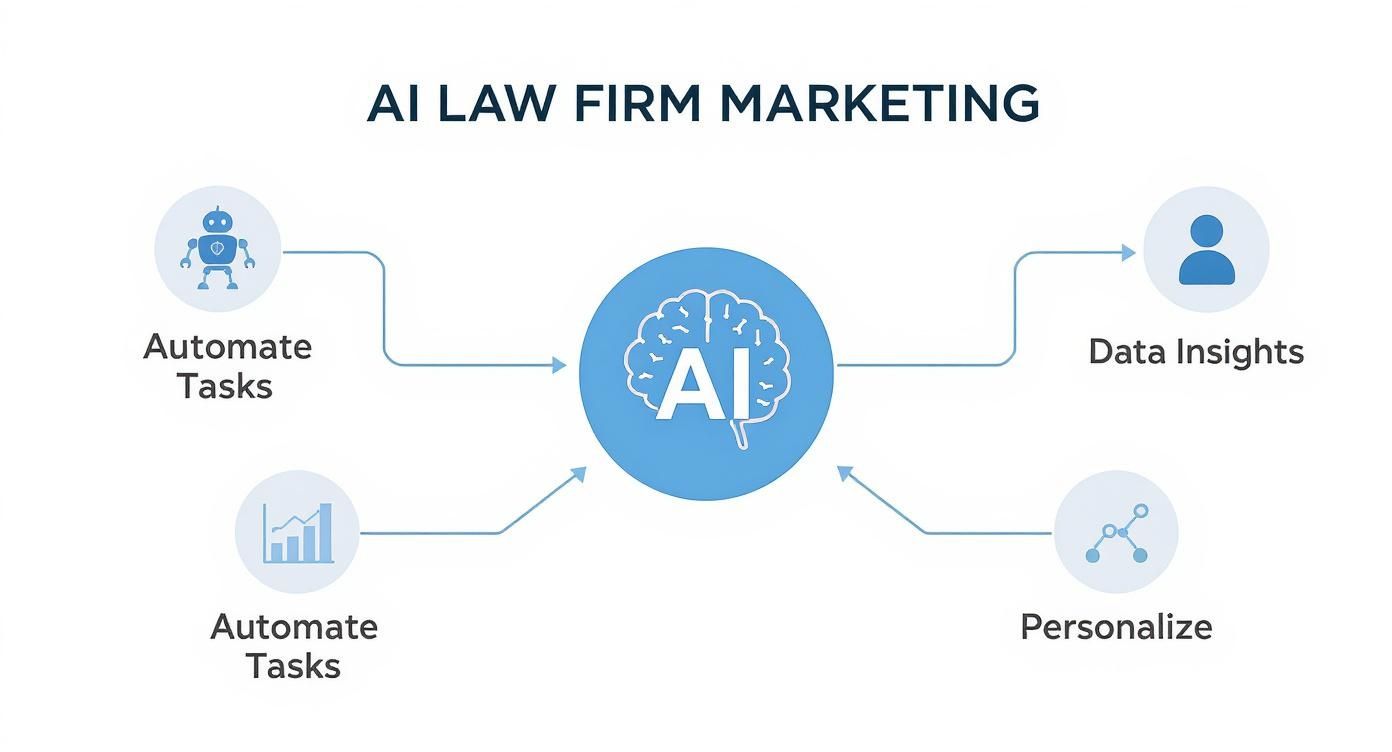
As you can see, AI's influence breaks down into three main jobs: automating the grunt work, digging up deep analytical insights from your data, and making personalized client communication possible at scale.
To see just how different this approach is, let's compare the old way of doing things with the new, AI-powered way.
How AI Transforms Key Law Firm Marketing Areas
| Marketing Area | Traditional Approach | AI-Powered Approach |
|---|---|---|
| Content Creation | Manual brainstorming, writing, and editing. Often slow and resource-intensive. | Generates outlines, first drafts, and topic ideas in minutes. Helps optimize for SEO. |
| Paid Advertising | Manual A/B testing, keyword bidding, and audience segmentation. | Automates bid strategies, predicts campaign performance, and identifies high-value audiences. |
| Client Intake | Relies on staff availability for calls and emails, leading to delays and missed leads. | 24/7 AI chatbots answer questions, qualify leads, and schedule consultations instantly. |
| Data Analysis | Manual review of website traffic and campaign reports. Often surface-level. | Identifies deep patterns in client behavior, predicts marketing ROI, and reveals hidden opportunities. |
| Personalization | Generic email blasts and website content aimed at a broad audience. | Delivers personalized content, case updates, and follow-ups based on individual client needs. |
This table just scratches the surface. The real story is how these individual improvements add up to a complete strategic advantage for the firms that adopt them.
From Manual Effort to Automated Excellence
The most immediate change AI brings is automation. Instead of a paralegal or marketing assistant manually drafting social media posts, AI can whip up several options in seconds. Instead of your front desk staff being tied up answering the same basic questions over and over, an AI chatbot can handle those inquiries around the clock.
This isn't just about saving time; it's about creating new opportunities for growth. When your team is freed from repetitive tasks, they can focus on high-value work like complex legal strategy and one-on-one client interactions that build your firm's reputation.
This isn't just theory—it's happening now. A recent survey found that 79% of legal practitioners are already using AI in their firms. The results speak for themselves. Personal injury firms using AI-powered intake systems have seen conversion rates increase by 40% because they can respond to new leads in under 30 seconds. That speed is critical, as data shows that responding to a lead within five minutes can boost conversions by a staggering 400%.
The Strategic Shift in Marketing Focus
With AI taking over more of the tactical, day-to-day work, the role of a legal marketer is evolving. They're moving from being a "doer" to a "strategist." The new focus is on:
- Human Oversight: Carefully reviewing all AI-generated content and campaigns to ensure they're accurate, ethical, and fully compliant with state bar advertising rules.
- Strategic Direction: Using the insights from AI-driven analytics to make smarter, data-backed decisions on where to invest the marketing budget for the best return.
- Relationship Building: Taking all that time saved by automation and pouring it back into networking, fostering referral partnerships, and strengthening client relationships.
This isn't just about working faster; it's about working smarter. By weaving AI into their marketing, firms can accomplish more with the resources they already have. To learn more about the financial impact, you can read our guide on how AI can reduce marketing costs.
Automating Content and Client Communication
Content has always been the workhorse of law firm marketing, but let's be honest—it’s always been a grind. The process of creating high-quality articles, blog posts, and practice area pages is slow and eats up valuable time. AI is changing that game entirely. It’s not about replacing attorneys; it’s about giving them a hyper-efficient paralegal that can handle the initial legwork.
This shift allows firms to finally produce content at the scale required to compete online without pulling attorneys away from client work. Instead of staring at a blank screen, your team gets a running start with AI-generated ideas, outlines, and even full drafts. The whole workflow just gets faster.

From Brainstorm to First Draft in Minutes
The most immediate win for any law firm using AI is in the early stages of content creation. These tools are brilliant at analyzing what potential clients are searching for, what your competitors are writing about, and what questions people constantly ask. From there, they can generate a long list of rock-solid topics for your blog or website.
Think about it this way: a personal injury firm could ask an AI tool for a content plan around "what to do after a car accident." Within seconds, the AI might suggest specific article titles, build out detailed outlines for each one, and then write the first draft. The heavy lifting is done.
Crucial Reminder: AI-generated content is just a starting point. It's a fantastic first draft, but it can never replace the expertise, legal precision, and authentic voice of an experienced attorney.
This process takes content creation from a monumental chore to a manageable, almost simple, task. It gives smaller firms a fighting chance to keep up with the big players who have massive marketing departments.
Why Human Oversight is Non-Negotiable
While an AI can write a draft with incredible speed, it has zero legal judgment. It doesn't understand nuance, and it definitely doesn't have a law license. Every single word generated by AI must be meticulously reviewed, edited, and approved by a qualified attorney. This isn't just a suggestion; it's a requirement.
Here’s why you can't skip this step:
- Legal Accuracy: AI models can pull outdated information or simply get the law wrong. An attorney must verify every legal detail is correct for your specific jurisdiction.
- Ethical Compliance: State bar advertising rules are no joke. A human needs to ensure your content is fully compliant and doesn't make misleading claims or guarantee outcomes.
- Firm Voice and Tone: Your content is your digital handshake. An attorney needs to shape the AI's generic text so it reflects your firm's unique personality and builds genuine trust.
- Strategic Insight: An AI writes based on data patterns. An attorney weaves in real-world case examples, personal stories, and strategic insights that show you’re a true expert.
The best way to think of it is this: AI is like a first-year associate who puts together the initial research. The senior partner still has to write, sign, and file the final brief.
24/7 Client Engagement and Intake
Beyond just writing content, AI is completely overhauling how firms connect with potential clients. Think AI-powered chatbots and automated email responders. These tools offer immediate, around-the-clock support, making sure you never miss an inquiry just because it came in after hours.
This is a massive advantage, especially for smaller and mid-sized firms that can't staff their phones 24/7. When someone visits your website at 2 a.m. after getting into an accident, an AI chatbot can be there to greet them.
These tools can handle the first point of contact by:
- Answering common questions like "Do I have to pay for a consultation?" or "Where is your office located?"
- Gathering basic contact information and the key details of their potential case.
- Scheduling a free consultation directly on an attorney’s calendar.
That kind of instant response makes a huge impression. It tells potential clients that your firm is accessible and ready to help from the very first click, dramatically improving your chances of turning a late-night website visitor into your next client.
2. Navigating AI-Powered SEO and Advertising
https://www.youtube.com/embed/_s2h7X-c2jE
For years, search engines have been the main arena where law firms fight for attention. But AI is completely redrawing the battle lines. The old playbook of just stuffing keywords and building links is gathering dust. Winning in search today means deeply understanding how AI is shaking up both organic search and paid ads.
Think of it this way: AI gives you some incredible offensive tools. It’s like having a digital scout who can dissect your competitors' SEO strategies, find the valuable keyword gaps they've overlooked, and show you how to fine-tune your website content to climb the rankings. It can tell you exactly what potential clients are asking and help you answer them better than anyone else.
At the same time, AI forces you to play defense. The very platforms you depend on, like Google, are using AI to fundamentally change how they present information. This directly impacts how many people find your firm, and it’s a shift you can't afford to ignore.
Adapting to the New SEO Reality
When Google started rolling out AI-powered summaries and answers right at the top of the search results, it changed everything. Potential clients who used to click through a list of law firm websites now get their basic questions answered without ever leaving the results page.
This is a double-edged sword. On one hand, AI-driven ad platforms like Google's Performance Max have cranked up the competition in keyword auctions, driving up the cost-per-click. On the other, Google’s AI overviews for legal questions have siphoned off clicks from law firm websites—by an estimated 20-40%. The digital real estate for both ads and organic listings is shrinking. This has caused a dip in organic traffic, forcing many firms to double down on paid ads and create exceptionally high-quality content just to stay in the game.
The goal of SEO is no longer just to rank on the first page. It's to become the authoritative source that Google's AI trusts enough to quote. Your content has to be so good, so comprehensive, that the AI points to you as the definitive answer.
This reality calls for a major strategic shift:
- Go Deep on Expertise: Forget surface-level blog posts. Create content that proves you are a true specialist. Dive into the complex questions and niche scenarios that a simple AI summary can't possibly cover.
- Collect Authority Signals: AI looks for proof of your credibility. That means getting high-quality backlinks from reputable sites, earning glowing client reviews, and being mentioned in legal publications. These are the trust signals that matter.
- Optimize for Real Intent: Stop chasing broad keywords. Focus on the long-tail keywords and specific questions that signal someone is ready to hire a lawyer, not just doing preliminary research.
Winning the AI-Powered Advertising Game
Paid advertising has morphed into a high-stakes digital auction where your firm's AI-managed campaigns go head-to-head with your competitors' algorithms. Platforms like Google's Performance Max use machine learning to automate nearly everything—from bidding and targeting to mixing and matching ad copy.
This means the days of manually tweaking your bids are over. The firms that win now are the ones who feed the AI the best data. Your job is to supply the high-octane fuel that makes the advertising engine run.
This "fuel" consists of three key ingredients:
- Crystal-Clear Conversion Goals: You have to tell the AI exactly what a win looks like. Is it a submitted contact form? A phone call? A booked consultation? Be specific.
- High-Quality Audience Data: Hand over your first-party data. Things like lists of past clients or website visitor information help the AI build powerful lookalike audiences to find more people just like them.
- A Buffet of Ad Creative: Don't just give the AI one headline and one image. Provide a wide variety of compelling headlines, descriptions, images, and videos. The AI will then run thousands of tests to figure out the perfect combination that gets results.
Managing these campaigns is no longer about granular, manual adjustments. It's about strategic oversight. You’re not just a bidder anymore; you’re a teacher, training an AI to find your next best client. For a deeper look at this, check out our guide on using AI for PPC optimization. Thriving in this new environment means seeing AI not just as another tool, but as a core strategic partner in your firm's growth.
4. Supercharging Your Client Intake Process
Beyond creating content and running ads, AI is making one of its biggest waves right where it counts most: your client intake process. This is that make-or-break moment when a potential client reaches out. How your firm responds in those first few minutes can mean the difference between signing a great case and losing it to a competitor.
AI turns what is often a bottleneck into a conversion machine that never sleeps.
Think about your current intake. It probably relies on a person at a desk. They can only handle one call at a time and they definitely don't work after hours. An AI-powered system is like having an entire team of perfectly trained receptionists on duty 24/7. They can handle unlimited inquiries at once, making sure no lead ever gets missed.

This jump from manual to automated intake is a perfect example of how AI is changing law firm marketing—it directly boosts both client acquisition and how smoothly your firm operates.
Real-Time Lead Qualification and Scheduling
The single greatest benefit of AI here is speed. When someone fills out your contact form at 10 p.m. on a Friday, they aren't going to sit around waiting for you to call them back on Monday. They're going to call the next firm on their Google search list.
AI closes that gap.
An AI-driven chatbot or automated text message can engage that person instantly. It can ask a series of smart, pre-set questions to figure out if they're a good fit for your firm.
- What kind of legal help do you need? (e.g., car accident, divorce, DUI)
- When did this happen? (to check for statute of limitations issues)
- Can you give me a quick summary of the situation?
- What’s the best way for us to get in touch?
Based on the answers, the AI makes a decision on the spot. If the lead looks promising, it can tap directly into your attorneys' calendars and book a consultation right then and there. If it's not a case you handle, it can politely provide a referral. This all happens in seconds, with zero human effort.
A Small Firm's After-Hours Advantage
Imagine a small personal injury firm. A potential client from a serious multi-car pileup fills out their website form late on a Saturday night. In the old days, that lead would just sit in an inbox until Monday morning. By then, that person has almost certainly hired someone else.
With an AI intake system, the story is completely different:
- An AI chatbot immediately pops up to greet the website visitor.
- It asks a few key questions about the accident.
- Realizing it's a high-value case, it gathers their contact info and confirms they're in the right geographic area.
- It automatically schedules them for a priority call with the firm's lead PI attorney for first thing Monday morning.
This isn't just about capturing a lead; it's about making an incredible first impression. The potential client feels heard and taken care of immediately. It tells them your firm is responsive, modern, and ready to fight for them, which massively increases the odds they'll sign with you.
Freeing Your Team for High-Value Work
This kind of automation does more than just bring in new cases—it frees up your people. Your paralegals and intake specialists are no longer stuck doing tedious data entry or playing endless rounds of phone tag.
Instead of just collecting basic information, they can now focus on what they do best: conducting detailed client interviews, prepping attorneys for consultations, and providing the genuine human empathy that builds strong, lasting relationships.
For firms considering these systems, it's worth seeing what modern tools can do. To dive deeper, we've put together a full breakdown in our complete guide to AI intake for law firms. By letting technology handle the initial screening, you empower your team to shine where it matters most.
6. Making Smarter Decisions with AI Analytics
For years, law firm marketing data felt like trying to drink from a firehose. We've been flooded with numbers—website traffic, click-through rates, bounce rates—that tell us something happened, but not always what it means. AI-driven analytics is finally changing the game by acting as a translator, turning that overwhelming data into a clear, strategic roadmap for your firm's growth.
It’s the difference between looking in the rearview mirror and having a GPS that shows you the best route ahead. You're no longer just asking "What happened?" but getting solid answers to "What will happen next?"

This shift from reactive reporting to proactive strategy is a perfect example of how AI is changing law firm marketing. It empowers you to make smarter, faster decisions based on what the data predicts, not just what it reflects from the past.
Uncovering Deeper Insights
Standard marketing metrics often fall short because they don't connect the dots. An AI analytics platform, on the other hand, can chew through thousands of data points at once, revealing hidden patterns in client behavior and campaign performance that a human would never spot.
AI analytics helps you understand the why behind the numbers. Instead of just knowing your website traffic dropped, you can learn that it was because a specific competitor's new ad campaign is outperforming yours with a particular demographic.
This deeper level of analysis lets you move with confidence. You can allocate your marketing budget to the channels and strategies that are actually proven to deliver the best results for your specific practice areas.
From Guesswork to Predictive Power
One of the most valuable applications of AI in analytics is predictive analytics. This is where the magic really happens. The AI uses your historical data to forecast future outcomes with a surprising degree of accuracy. For a law firm, this means it can predict which marketing channels are most likely to deliver high-quality leads in the coming quarter.
Here’s how it works in practice:
- Lead Scoring: AI can analyze the characteristics of your best past clients—the high-value cases you want more of—and build a profile. It then scores new leads in real-time, helping your intake team prioritize the calls and emails most likely to become valuable cases.
- Budget Allocation: The system can forecast the potential return on investment (ROI) from different campaigns. For instance, it might predict that increasing your local SEO budget by 15% will yield more high-value personal injury cases than spending that same amount on social media ads.
This forecasting ability strips away a huge amount of guesswork from your strategy, turning your marketing budget into a precision instrument for growth.
Mastering Attribution Modeling
Do you know for sure which marketing effort brought in your last big case? Was it the blog post they read six weeks ago, the Google Ad they clicked last Tuesday, or the email newsletter that finally made them pick up the phone? The answer is often "all of the above," and this is where AI-powered attribution modeling truly shines.
Traditional "last-click" attribution is lazy; it gives 100% of the credit to the very last thing a person did before contacting you, ignoring everything that came before.
AI, however, can map the entire, often complicated, client journey. It analyzes every touchpoint—from social media interactions to website visits and ad clicks—and assigns the proper credit to each one. This gives you a crystal-clear picture of what’s actually working. Instead of a blurry snapshot, you get the full story of how a potential client found and chose your firm.
Traditional Metrics vs AI-Powered Marketing Insights
Looking at the data through an AI lens provides a much richer understanding of your marketing performance. It’s not just about more data, but about more meaningful insights.
| Metric | Traditional Measurement | AI-Powered Insight |
|---|---|---|
| Website Traffic | Total number of visitors per month. | Identifies which traffic sources (e.g., specific organic keywords, ad groups) produce the most qualified leads, not just clicks. |
| Lead Volume | Total number of form submissions and calls. | Scores leads based on their likelihood to convert into high-value cases, allowing for prioritization. |
| Cost Per Lead (CPL) | Average cost to acquire any lead. | Predicts the Cost Per Acquired Case for different channels, helping you invest in what's truly profitable. |
| Conversion Rate | Percentage of visitors who contact the firm. | Reveals which specific user paths and content pieces are most effective at persuading ideal clients to take action. |
| Campaign ROI | Overall revenue generated vs. ad spend (often last-click based). | Provides multi-touch attribution, showing how different campaigns work together to influence a final decision. |
This granular view is critical. It allows you to stop spending money on channels that look busy but deliver little value and double down on the ones that consistently drive your firm's bottom line.
Implementing AI Ethically and Effectively
Jumping into AI for your marketing is a huge opportunity, but it’s not as simple as flipping a switch. For law firms, adopting any new technology means thinking through a whole new set of responsibilities. If you want to get the most out of AI without running into serious compliance issues, you have to navigate these ethical waters carefully.
The core principle hasn't changed: the technology is new, but your professional obligations are the same as ever. Every single piece of content generated, every automated chat, and every bit of data you collect has to meet the standards set by your state bar. That's just part of the deal in modern legal marketing.
Safeguarding Client Confidentiality
The first question you should ask about any AI tool is simple: "Where is my data going?" Think about it. When your team uses an outside AI platform to summarize case notes for a blog post or to check client emails for tone, you have to be absolutely certain that sensitive information stays private.
Many generative AI models actually learn from the data you feed them, which opens up a huge risk for accidental data leaks. You absolutely must:
- Vet Your Vendors: Dig into the privacy policies of any AI provider. Look for clear, explicit terms of service that guarantee your client data is protected and not used for model training.
- Set Firm Rules: Create a clear internal policy and train your team never to paste client names, case details, or any other personally identifiable information into public AI tools.
- Anonymize Everything: If you're using AI for data analysis, take the time to scrub all sensitive details from the dataset first.
Keeping an Attorney in the Loop
This might be the most important rule of all: there must always be meaningful human oversight. AI can and will get things wrong. It can be factually incorrect, legally imprecise, or just strike the completely wrong tone.
An AI can draft a blog post, but it cannot exercise legal judgment. Treating AI output as a finished product isn't just cutting a corner—it's a professional risk. A qualified attorney must review and approve every word published under your firm's name to ensure it's accurate and compliant with advertising rules.
This "attorney in the loop" model is your best defense against putting out misleading content or accidentally giving bad legal advice.
A Practical Roadmap for AI Adoption
You don't need a massive, firm-wide overhaul to start using AI. A measured, step-by-step approach is far more likely to get you real results. In fact, a strategic approach is already proving to be a powerful driver of growth. New data shows that 69% of firms with widespread AI adoption are reporting a positive impact on revenue, which just underscores the payoff of a well-planned rollout. You can see more insights like this in the 2025 Clio Legal Trends Report.
Here’s a simple roadmap to get you started:
- Start Small. Don't try to roll out five different AI tools at once. Pick one specific, high-impact area to focus on first—like an AI chatbot for your website—and get really good at it.
- Train Your Team. A tool is only as good as the person using it. Make sure your staff gets real training on how to use the new tech both effectively and ethically.
- Measure and Adapt. Set clear goals (KPIs) to track the tool's performance. Watch the results, get feedback from your team, and be ready to tweak your strategy based on what you’re learning.
Answering Your Questions About AI in Legal Marketing
Look, I get it. Every time a new piece of technology comes along, it's smart to be a little skeptical. Law firm partners are constantly asking me if AI is a real, practical tool for their practice or just the latest overhyped trend.
So, let's cut through the noise. Here are some direct answers to the most common questions and concerns I hear from lawyers who are thinking about using AI in their marketing.
Is AI Too Expensive for a Small Firm to Implement?
This is probably the biggest myth out there. While some massive, enterprise-level AI systems can run you a small fortune, many of the most effective AI marketing tools are incredibly affordable. In fact, you might find that some are already baked into the platforms you use every day, like your email marketing service or social media scheduler, for just a small extra fee.
Think of it less as a cost and more as an investment. For example, a good AI intake chatbot might run you a few hundred bucks a month. But if it captures just one or two valuable cases you would have otherwise missed, it has already paid for itself many times over. The trick is to start small with one specific tool that solves a real problem, not to try and overhaul everything at once.
Will AI Replace My Marketing Staff or Paralegals?
Absolutely not. Think of AI as a force multiplier, not a replacement. It's brilliant at handling the tedious, repetitive, data-crunching tasks that eat up your team's valuable time. By taking over things like first drafts of content, campaign data analysis, or initial lead qualification, AI frees up your people to focus on what humans do best:
- Developing high-level strategy and creative campaign ideas.
- Building real relationships with clients, full of empathy and understanding.
- Using their legal judgment to make sure every piece of marketing is accurate and ethical.
AI is the tireless assistant working in the background, prepping the research and handling the grunt work. This empowers your human experts to step in and deliver the final, polished product that actually wins new clients. It makes them better, not obsolete.
How Can I Ensure AI-Generated Content Is Accurate and Ethical?
Simple: you can't—at least not without a human in charge. An AI model isn't a lawyer. It has no concept of legal ethics, state bar advertising rules, or the subtle nuances of your practice area. This is why having an "attorney in the loop" is completely non-negotiable.
Your firm needs a rock-solid policy: every single piece of AI-generated content must be reviewed, edited, and officially approved by a qualified attorney before it ever sees the light of day. This is the only way to guarantee the information is legally correct, matches your firm's brand voice, and complies with all professional regulations. AI gives you the clay; your legal expertise is what shapes it into something trustworthy.
At RankWebs, we help firms work through these exact challenges every day. We provide the strategic roadmap to bring AI into your marketing in a way that’s effective, compliant, and always client-focused. Find out how we can help your firm by exploring our insights at https://rankwebs.com.