

Let's get straight to the point: law firms are in one of the most competitive industries online. While SEO is the long game—a marathon essential for building lasting authority—Google Ads is the sprint. It’s how you get your firm in front of potential clients the moment they need you. SEO alone takes time — paid ads are the fastest route to visibility and qualified leads.
After managing PPC for a top personal injury law firm for 10+ years, I've seen it all. This isn't a theoretical guide. This is a playbook built on in-the-trenches experience, designed to show you how today’s campaigns, which require more precision and AI-assisted strategy, can transform your ad budget into signed cases.
Why Google Ads Still Matter for Law Firms (Especially in 2025)

In the legal field, if you’re not visible, you’re invisible. You could be the sharpest attorney in your state, but if clients can't find you online when they're searching for help, you might as well not exist. For a long time, Search Engine Optimization (SEO) has been the cornerstone of digital marketing for lawyers, and for good reason. It builds sustainable, organic traffic over time.
But what about the person who was just in a car accident? Or the family member urgently seeking a wrongful death attorney? They aren't waiting for your SEO to mature. This is where paid advertising for attorneys becomes absolutely critical to your growth. Google Ads is the accelerator that puts your firm at the top of the search results precisely when someone is in crisis and looking for representation.
The Evolution of Google Ads in Legal Marketing
Not too long ago, you could get away with a simple strategy and still see new cases trickle in. 5–10 years ago, a basic “set and forget” keyword bidding approach worked. Try that today, and you're just lighting your marketing budget on fire. Paid advertising for lawyers has completely changed. Today, automation, smart bidding, and AI learning dominate performance.
This shift has, unsurprisingly, pushed costs way up. We have to talk about the elephant in the room: the sky-high cost-per-click (CPC) in the legal world. It’s normal to see some eye-watering click costs in competitive practice areas, but that's exactly why having a sharp strategy is no longer optional. While the CPC is higher, conversion efficiency can still improve with the right structure.
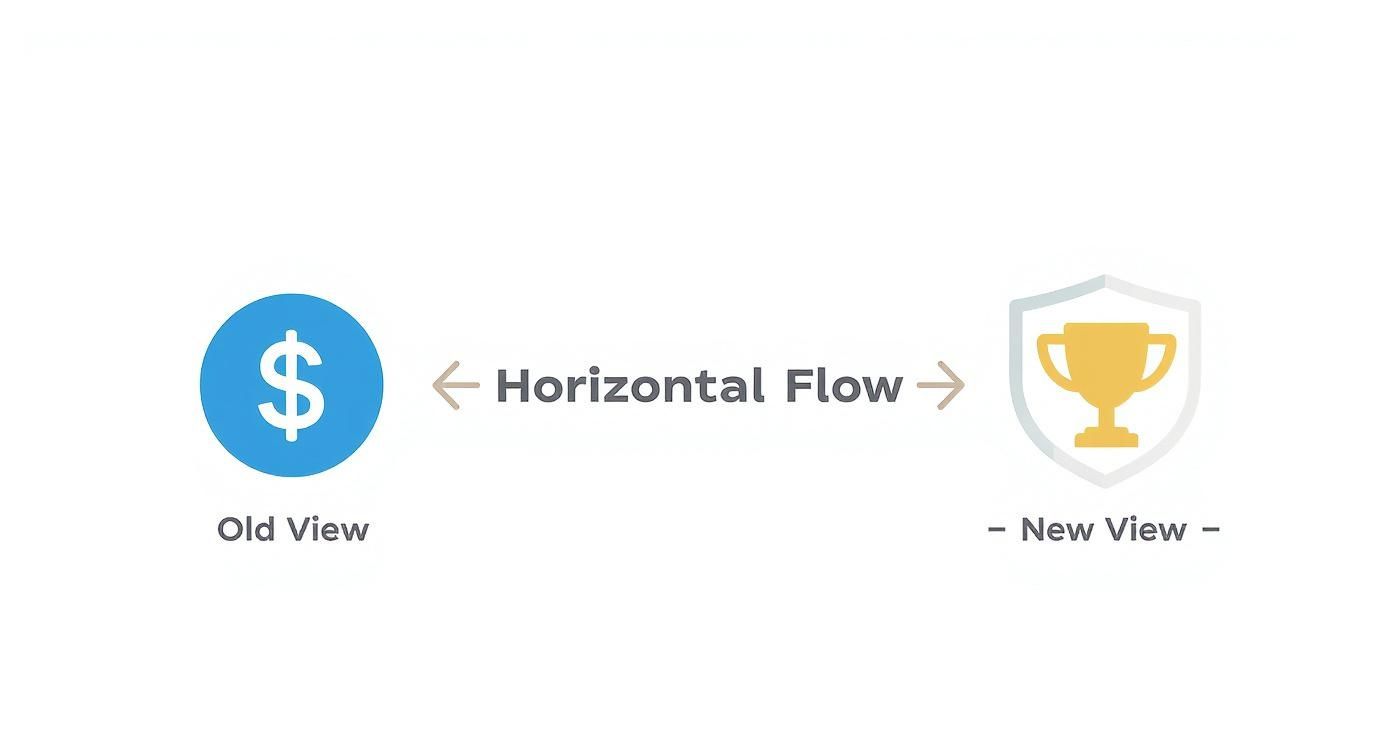
In personal injury, we routinely see clicks over $100, but what matters is cost per signed case, not cost per click. A $150 click that turns into a six-figure settlement isn't an expense; it's a phenomenal investment.
This change in mindset is the foundation of any modern law firm PPC strategy. You're not trying to find the cheapest clicks. You're trying to land the most profitable cases. With the right campaign setup and AI working for you, the efficiency of your conversions can skyrocket, making your ad spend more profitable than ever—even with those higher click costs. For a deeper dive, you can explore more legal marketing statistics that highlight these trends.
Setting Up for Success: Account Structure & Law Firm PPC Strategy
Think of building a Google Ads campaign like preparing a case for trial. Every piece needs a purpose, and the overall structure has to be airtight. The old way of doing things—Single Keyword Ad Groups (SKAGs)—is a relic. While SKAGs used to work by offering granular control, now machine learning can outperform manual segmentation when fed the right data.
A clean, logical structure isn’t just nice to have—it's essential for success. The best way to organize campaigns is by practice area, location, and match type. This hierarchy makes everything from daily management to monthly reporting and optimization a whole lot easier.
- Practice Area Campaigns: You need a dedicated campaign for each service you're trying to sell. If you're a personal injury firm, that means one campaign for "Car Accidents," another for "Medical Malpractice," and a third for "Slip and Fall."
- Geographic Targeting: Inside each of those practice area campaigns, you’ll use ad groups to target specific locations like cities or counties. This hyper-local focus yields better quality leads by connecting with the right people in the right places.
Budget Allocation and Negative Keywords
The big question is always, "How much do we need to spend?" For competitive practice areas like personal injury Google Ads, you have to be prepared to invest meaningfully. A minimum budget of $3,000–$5,000 per month is a realistic starting point for competitive PI markets. Anything less, and you're likely to get steamrolled by bigger firms.
If there's one thing that separates a profitable campaign from a money pit, it's an aggressive negative keyword strategy. These are the terms you tell Google not to show your ads for, and they are absolutely critical. Most firms ignore these and waste spend on junk clicks from searches like:
- "lawyer jobs" or "attorney salary"
- "free legal advice"
- Searches from law students or opposing counsel.
Your negative keyword list should be a living document. To get this right, you first need a strong keyword foundation. Our guide on how to perform effective keyword research and selection for lawyer PPC campaigns is the perfect place to start.
What Makes Legal Ads Convert (Your Insights)
Even the most brilliantly structured campaign will fall flat if the ads don't get clicked and the landing page doesn't convert. Turning a simple click into a signed retainer is where the real work begins.
Ad Copy Psychology and Extensions
Your ad is your first handshake. Forget clever wordplay; powerful ad copy for lawyers is all about urgency, trust signals, and credibility. Certain phrases just work because they hit on core psychological needs:
- "No Fee Unless We Win": This is the gold standard for risk reversal.
- "Free Consultation": This removes the fear of a surprise bill.
- "Over $100 Million Recovered": Specific numbers provide instant social proof.
The role of extensions (callouts, locations, sitelinks) is to make your ad bigger, more visible, and more inviting. Law firms that use a full suite of extensions see a click-through rate that is 10-15% higher on average.
Landing Pages and Conversion Tracking
Let me be blunt: your landing page matters more than the ad itself. The ad’s only job is to earn the click; the landing page is what secures the lead. A high-converting landing page is a specialized tool built for one thing: getting that person to call you or fill out a form. We go into great detail on this, and you can learn more about how to optimize landing pages for lawyer PPC ads in our dedicated guide.
To run profitable Google Ads for law firms, you must track the metrics that matter, such as:
- Conversion Rate: What percentage of visitors actually become a lead?
- Cost Per Lead (CPL): How much did it cost to get that call or form fill?
- Form-Fill Rate: The percentage of visitors who complete your contact form.
- Signed Cases: The ultimate bottom line.
To get this level of insight, you need the right tools. We rely on software like CallRail or HubSpot for conversion tracking to trace every single lead back to the exact keyword and ad that drove it.
Google Local Service Ads (LSAs): The Quiet Power Player
Let's talk about Google Local Service Ads (LSAs), which are often the unsung heroes of paid advertising for attorneys. LSAs are the "Google Screened" listings you see at the very top of the search results, even above traditional PPC ads.
Here’s how they differ from PPC: with LSAs, you pay per lead (a direct phone call or message), not per click. From my perspective, LSAs often produce better lead quality because the user has already seen your photo, reviews, and the "Google Screened" badge of trust. However, they offer very limited customization in terms of ad copy or targeting.
When should you use Google LSAs for lawyers vs traditional PPC?
- Use LSAs for: High-intent, local searches where you want pre-qualified phone calls. They are perfect for practice areas like family law or personal injury where a direct conversation is key.
- Use Traditional PPC for: Broader reach, more control over messaging, and the ability to drive traffic to specific high-value landing pages or content.
For most firms, the answer isn't "either/or." A comprehensive strategy uses both to dominate the search results page.
AI and Automation in Google Ads
AI in legal marketing isn't a future concept; it's the new reality for any law firm that wants to win on Google Ads. I used to manually adjust bids daily—now AI tools optimize in real time, analyzing thousands of signals to make smarter decisions than any human ever could. This fundamental shift changes your job from a micromanager to a strategist.
AI-Driven Bidding, Creation, and Automation
Here's how AI in legal marketing is changing the game:
- Automated Bidding: Strategies like Target CPA (Cost Per Acquisition) and Maximize Conversions let you focus on goals, not manual bid adjustments. You tell Google what a "win" looks like, and its AI works to achieve it.
- AI-Driven Ad Creation: Responsive Search Ads (RSAs) are a prime example. You provide a list of headlines and descriptions, and Google's AI tests endless combinations to find the perfect ad for each search. You can even use tools like ChatGPT to brainstorm ad copy variations in minutes.
- Audience Learning: Google's AI learns from your conversion data to find patterns and identify new audiences that look like your best clients, improving your targeting over time.
- Scripts and Data Layers: For advanced firms, using data layers and scripts for automation can be a game-changer. These are small snippets of code that automate repetitive tasks, like pausing underperforming keywords or generating custom performance alerts.
By embracing automation, you build a smarter, more resilient Google Ads for law firms account that can scale efficiently.
Measuring ROI and Tracking the Right Metrics

Most marketing reports are filled with vanity metrics. Clicks are irrelevant. When it comes to a law firm PPC strategy, you need to go beyond clicks and focus on conversions, signed cases, and ROI. The only number that truly defines success is the cost to acquire a signed case.
Connecting Ad Spend to Signed Cases
Mastering attribution tracking is key. This means accurately tracking a client's journey from their first Google search to the moment they sign a retainer. This requires tools that go beyond the standard Google Ads dashboard.
- Robust Call Tracking: A system like CallRail is non-negotiable. It shows which keyword made the phone ring and helps you gauge call quality.
- Offline Conversion Imports: This is the missing link. Once your intake team signs a case from Google Ads, that data must be imported back into Google. This tells the algorithm, "This is a win! Go find more people just like this."
When you start feeding signed-case data back into the system, you empower Google's AI to optimize for profit, not just clicks.
The Metrics That Actually Drive Profitability
Forget impressions and click-through rates. Your focus needs to shift to these real performance metrics:
- Cost Per Signed Case: This is your north star. It's the total ad spend divided by the number of new cases acquired.
- Call Quality: Use call recordings and duration tracking to differentiate between junk calls and legitimate potential clients.
- Return on Ad Spend (ROAS): For every dollar you put into ads, how many dollars in case value are you getting back?
AI-powered dashboards or reporting automations can integrate with your various systems to give you a single, real-time view of these crucial metrics. For a deeper look, check out our guide on the importance of ROI and analytics for lawyer PPC campaigns.
Common Mistakes Law Firms Make with Google Ads
After managing paid advertising for attorneys for over a decade, I've seen the same handful of expensive mistakes derail countless campaigns. These aren't just minor slip-ups; they're fundamental flaws that can completely drain a law firm's budget.
- Wasting money on broad keywords like “lawyer near me.” These terms attract a mix of everything you don't want: job seekers, students, and people looking for practice areas you don't handle. Focus on high-intent, specific keywords.
- Sending ads to the homepage instead of tailored landing pages. Your homepage is a digital brochure, not a conversion tool. Every ad should lead to a dedicated landing page that matches the ad's promise.
- No call tracking or offline conversion imports. Without these, you are flying blind. You have no real way of knowing which keywords are driving valuable phone calls versus which are just generating dead-end clicks.
- No negative keyword lists. This is your primary defense against irrelevant searches. Forgetting to build and maintain this list is like leaving the front door of your budget wide open.
- Relying entirely on agency reports without understanding performance. You need to get your hands dirty and understand the core data yourself. It's the only way to make smart, informed decisions about your firm's growth.
Conclusion: Where the Future of Paid Ads for Law Firms Is Headed
Let's pull all these threads together. SEO still matters and will always be the bedrock of a healthy, long-term marketing plan. But when you need to bring in cases now, the powerful combination of Google Ads + AI = immediate growth opportunity.
The New Competitive Edge
Things are moving incredibly fast in the world of AI in legal marketing. The firms that will win in legal advertising trends 2025 and beyond won't be the ones with the biggest budgets, but the ones who embrace a culture of constant experimentation and quick adaptation.
Marketing success in 2025 will belong to firms that embrace both AI efficiency and human strategy.
The future isn't about choosing a smart algorithm over a smart marketer. It's about how well you can make them work together. Law firms that master this blend of data-driven automation and strategic human oversight will consistently outperform their competitors, turning their Google Ads for law firms budget into their most reliable and predictable source of new cases.
Want to learn how to make your Google Ads campaigns more efficient? At RankWebs, we help law firms build paid ad systems that generate more cases — not just clicks. Learn more about our approach to legal marketing.
Article created using Outrank