


When we talk about data-driven marketing for personal injury firms, we’re talking about a fundamental shift in how you make decisions. It’s about moving away from gut feelings and intuition and instead, using hard performance data to guide your strategy. This approach is all about turning your marketing spend from an uncertain expense into a measurable investment that demonstrably lowers client acquisition costs and brings in more valuable cases. The end goal? A predictable, steady stream of qualified clients.
Moving Beyond Guesswork in Legal Marketing
In the cutthroat world of personal injury law, traditional marketing can feel like a roll of the dice. You spend a fortune on billboards, radio ads, and generic digital campaigns, but the actual return on that investment often remains a mystery. A data-driven approach flips that old model on its head by making every single dollar accountable for its results.

The idea behind it is straightforward: track everything, analyze what you find, and then fine-tune your strategy based on what the numbers tell you is actually working. You don't need to become a data scientist overnight. This is about making smarter business decisions that give you a real, sustainable competitive advantage.
From Spending to Strategic Investing
By digging into your performance data, you can finally get clear answers to the most important business questions. Which specific marketing channel is bringing in your most profitable truck accident cases? What’s the real cost to sign a client from a Google Ads campaign versus one who found you through an organic search? Answering these questions is what transforms your marketing budget from a line-item expense into a powerful, strategic investment.
This data-first mindset helps you:
- Pinpoint Your Most Profitable Channels: See exactly which platforms are delivering not just any leads, but the high-value, signed cases that fuel your firm.
- Lower Your Client Acquisition Cost (CAC): Confidently shift money away from campaigns that aren't working and double down on the ones that are, maximizing your ROI.
- Build a Predictable Intake Pipeline: Start forecasting your future caseload with genuine accuracy, all based on solid historical conversion data.
The financial difference between channels can be staggering. For instance, an analysis of 49 personal injury firms revealed the average cost per lead (CPL) for Google Search Ads is $442. In stark contrast, the CPL from SEO is just $183. That’s not a small gap—it shows how a well-executed SEO strategy can bring in qualified leads for less than half the cost of paid search, which is a game-changer for any firm looking to grow efficiently. You can see the complete breakdown in this personal injury CPL report.
This shift empowers your firm to move from broad, expensive advertising to precise, targeted efforts. It means you can attract more of the cases you want to handle, rather than simply taking whatever comes through the door.
Understanding the Competitive Edge
At the end of the day, committing to data-driven marketing is about building a sustainable growth engine for your firm. It gives you the insight to understand exactly what messages connect with your ideal clients, allowing you to constantly refine your approach and improve your results. By analyzing website traffic and user behavior, you'll uncover patterns that can inform your entire growth strategy.
When you measure the complete client journey—from their very first click on an ad all the way to a signed retainer—you gain a level of clarity that’s rare in this crowded market. That clarity becomes your secret weapon, letting you outmaneuver competitors who are still stuck in the past, relying on guesswork and outdated marketing playbooks.
Building Your Firm's Data Foundation
Before you can run a truly data-driven marketing program, you have to get the plumbing right. This means setting up a solid infrastructure to capture, track, and analyze every potential client's journey—from the very first Google search that led them to you, all the way to a signed retainer.
This foundation is what lets you stop guessing and start making decisions based on cold, hard facts.

The goal here isn't just to collect data for the sake of it. It’s about building a system that gives you clear, actionable answers. Without this groundwork, you're flying blind, unable to prove which marketing dollars are actually turning into profitable cases.
Core Tools for Your Data Stack
Your entire data strategy will rest on a few essential tools working in harmony. These platforms are the bedrock of your marketing analytics, gathering the raw information you need to measure what actually moves the needle for your firm's growth.
Here’s the essential starting lineup:
- Google Analytics 4 (GA4): This is ground zero for understanding your website. GA4 shows you how people find you, what they do once they arrive, and which pages are converting visitors into leads.
- Google Search Console (GSC): An absolute must for SEO. GSC pulls back the curtain on your organic search performance, revealing the exact keywords people use to find you and flagging technical issues that could be holding you back.
- Legal-Specific CRM: This is non-negotiable. A good CRM built for law firms, like Clio or Lawmatics, is where you connect the dots between a marketing lead and a signed case. It's the only way to track actual business outcomes.
This trio is powerful. GA4 and GSC tell you what’s happening at the top of your marketing funnel, and your CRM closes the loop by showing you what that activity generated in real revenue. For more options, check out our deep dive into the best software for legal marketing.
Tracking What Actually Matters
I’ve seen too many firms get bogged down in "vanity metrics." High website traffic and a ton of social media likes feel great, but they don't sign cases or keep the lights on. A truly data-driven approach means shifting your focus to the Key Performance Indicators (KPIs) that have a direct line to your firm's bottom line.
Your goal is to measure the entire funnel, from the initial click to the final signed case. Only then can you accurately calculate your return on investment and make confident, data-backed decisions about where to allocate your marketing budget.
Instead of just counting clicks, you should be obsessed with metrics like:
- Cost Per Signed Case: This is the ultimate measure of marketing efficiency. It tells you exactly how much you paid to acquire one paying client from a specific channel.
- Lead-to-Client Conversion Rate: This KPI uncovers the quality of your leads. If one campaign brings in 100 leads but only one signs, while another generates 20 leads and five sign, you know exactly where to double down.
- Average Case Value by Source: Are your PPC ads bringing in higher-value cases than your SEO efforts? Knowing this helps you pour resources into the channels that attract the most profitable clients.
To give you a clearer picture, here are some of the most critical KPIs for personal injury firms.
Key Performance Indicators for PI Firm Marketing
This table breaks down the essential metrics you should be tracking, what they mean for your firm, and a realistic benchmark to aim for.
| KPI | What It Measures | Why It Matters for PI Firms | Industry Benchmark |
|---|---|---|---|
| Cost Per Lead (CPL) | The average cost to generate one new lead (call or form submission) from a specific marketing channel. | Helps you understand the initial cost-effectiveness of your campaigns. | Varies widely by market: $150 – $400+ |
| Cost Per Signed Case (CPSC) | The total marketing spend for a channel divided by the number of signed cases from that channel. | This is the ultimate ROI metric. It tells you the true cost of acquiring a new client. | Highly variable: $2,500 – $10,000+ |
| Lead-to-Client Conversion Rate | The percentage of qualified leads that become signed clients. | Measures the quality of your leads and the effectiveness of your intake process. | 10% – 25% |
| Website Conversion Rate | The percentage of website visitors who complete a desired action (call or fill out a form). | Indicates how well your website convinces potential clients to take the next step. | 2% – 5% |
| Organic Search Visibility | Your firm's share of clicks for a targeted set of non-branded personal injury keywords. | A leading indicator of your SEO health and future lead flow. | Top 3-5 rankings for primary keywords. |
Tracking these numbers is what separates firms that get a real return from their marketing from those who just spend money.
Setting Up Essential Conversion Tracking
To measure these crucial KPIs, you absolutely must have conversion tracking configured correctly on your website. This is the technical setup that bridges the gap between a user's action and a specific marketing campaign. For any PI firm, there are two primary conversions you have to get right.
First is the contact form submission. When a potential client fills out a form, they should land on a dedicated "thank you" page. By setting this up as a goal in Google Analytics, you can see precisely which channel—organic search, a Google Ad, a social media post—generated that lead.
Second, and just as important, are phone calls. A huge number of potential clients will just pick up the phone. You can track these leads using a technology called dynamic number insertion (DNI). This clever tool shows a unique, trackable phone number on your website based on how the visitor got there. When they call, the system automatically attributes that lead back to the right marketing channel. No more guesswork.
Putting Your Marketing Data to Work
Alright, you've done the heavy lifting of setting up your data and tracking systems. Now for the fun part: turning all those numbers into smart decisions that actually grow your firm's revenue. This is where we move from just measuring things to actively making them better.
The goal here isn't to rip up your entire marketing plan and start from scratch. Instead, it’s about making a series of smart, calculated tweaks. Think of it as a methodical process of finding small wins that add up over time, giving you a real, sustainable edge over the competition.
Sharpening Your SEO and Content Strategy
Your Google Search Console (GSC) account is an absolute goldmine. Seriously. It’s a direct line into the minds of your potential clients, showing you the exact phrases they’re typing into Google right before they find you—or one of your competitors. It's time to stop guessing what to write about.
Jump into the "Performance" report in GSC. Your first stop should be filtering for search queries that are getting a decent number of impressions but almost no clicks. These are your golden opportunities. Maybe you're showing up on page two for a term like "commercial truck accident lawyer near me." That's a clear signal from the market telling you to build a dedicated, authoritative page targeting that high-intent keyword.
From there, you can map out a content plan driven by real user data:
- Zero in on High-Value Cases: Use your GSC data to find keywords related to your most profitable case types, whether that's traumatic brain injuries or complex multi-car pileups.
- Answer Real Questions: Look for queries phrased as questions, like "what is the statute of limitations for a slip and fall in Texas?" Creating detailed blog posts that answer these questions perfectly positions your firm as the go-to expert.
- Upgrade Your Underperformers: Find the pages that are stuck on page two or three for valuable keywords. Go back and beef them up with more detail, fresh information, and better internal links to give them the push they need to hit page one.
The core idea is simple: let search data guide your content creation. You’ll move from writing about broad topics to creating specific, valuable resources that attract the exact clients you want to represent.
Fine-Tuning Your Paid Search Campaigns
For most personal injury firms, paid search is the single biggest line item in the marketing budget. That makes data-driven optimization non-negotiable. Without it, you’re essentially just lighting money on fire and hoping for the best. With a data-first approach, you can systematically drive down your cost per signed case.
Start with relentless A/B testing of your ad copy. In the personal injury space, trust and emotion are everything. You need to test different angles to see what truly connects with people in a moment of crisis. For instance, you could run:
- Version A (The Empathy Angle): "Hurt in an Accident? We Fight For You."
- Version B (The Results Angle): "No Win, No Fee. Billions Won for Clients."
Track not just the click-through rate (CTR), but more importantly, the conversion rate of each version. You might find the empathy-focused ad gets more initial clicks, but the results-oriented copy actually generates more qualified intakes. That single insight could radically improve your campaign's ROI. For a deeper dive, exploring predictive analytics for lawyer advertising can even help you identify winning ad creative before you spend a dime.
The numbers game in PI law is tough. As a benchmark, some legal marketing statistics on Andava.com show that firms might need around 30,000 clicks to produce 3,000 leads, which could ultimately become 300 signed cases. Making that funnel efficient is only possible when you let the data lead the way.
A Real-World Example: Data in Action
Let's look at how this plays out in the real world. A mid-sized PI firm was spending $40,000 a month on a broad Google Ads campaign targeting keywords like "car accident lawyer." Their cost per signed case (CPSC) was stuck at $8,000, which was cutting their margins dangerously thin.
By diving into their CRM and Google Analytics data, they uncovered something huge. While the PPC ads were bringing in a ton of leads, the leads coming from their local SEO efforts—specifically from their Google Business Profile—were converting into signed cases at a 3x higher rate. These were local people, ready to hire someone now.
Armed with this insight, they made a strategic pivot. They reallocated 25% of their PPC budget ($10,000/month) and poured it directly into an aggressive local SEO campaign. They focused on optimizing their GBP listing, building local citations, and creating content specifically for "near me" searches.
The results after six months were stunning:
- Their total lead volume dipped slightly, but the quality of the leads went through the roof.
- Their blended CPSC from all digital marketing dropped from $8,000 down to $4,800—a 40% reduction.
- The firm started signing more high-value cases, which completely changed their profitability.
This is the power of connecting your marketing data to actual business outcomes. It wasn't about spending more money. It was about spending their existing budget smarter, shifting resources to the channels that their own data proved were delivering signed cases, not just vanity metrics like clicks.
Creating a Growth Loop for Your Firm
Collecting data is just the first step. The real magic—and the real growth for your firm—happens when you get into a rhythm of consistently analyzing and acting on what that data tells you. This is how you move from running one-off campaigns to building what I call an "Iterative Growth Loop." It's a sustainable cycle of launching, measuring, analyzing, and refining your marketing efforts.
This process turns your marketing into a self-improving engine. Each cycle spits out fresh data, which then fuels smarter decisions for the next one. It takes the guesswork out of scaling and gives you the confidence to reinvest your budget where you know it will perform.
Building Your Marketing Command Center
To run this loop effectively, you need a single source of truth—a marketing dashboard. Don't worry, this isn't about staring at a dozen confusing charts. It's about creating a simple, powerful command center that puts your most important Key Performance Indicators (KPIs) in one place.
A fantastic—and free—tool for this is Google Looker Studio. It hooks directly into your key data sources like Google Analytics, Google Ads, and even your CRM data (which you can pipe in via Google Sheets). This lets you build a customized dashboard that answers your most critical business questions at a glance.
The goal is to connect your different data sources to create a centralized view of your entire marketing funnel, from the very first ad click all the way to a signed case.
Your dashboard should be built around the core KPIs we've already covered:
- Cost Per Signed Case (CPSC): The ultimate bottom line for marketing efficiency.
- Lead-to-Client Conversion Rate: Tells you about lead quality from different channels.
- Average Case Value by Source: Shows you where your most valuable cases come from.
- Total Signed Cases by Channel: Tracks which channels are actually driving business.
Having these metrics update in near real-time means you can make quick, informed decisions instead of waiting weeks for someone to pull a manual report.
From Data Visualization to Decisive Action
Think of your new dashboard as more than just a reporting tool; it's a decision-making engine. It helps you spot trends, identify outliers, and jump on opportunities with speed and precision. This is what effective data-driven marketing for personal injury firms looks like in the real world.
Let's say you log into your dashboard and see a clear pattern emerging over the last quarter. The leads coming from your organic SEO efforts are converting into high-value brain injury cases at double the rate of leads from your social media campaigns. On top of that, the Cost Per Signed Case from SEO is 40% lower.
With that insight, your next move is obvious. You can confidently ramp up your investment in creating authoritative SEO content targeting those specific case types while pulling back on the underperforming social media ads.
This isn't about axing channels entirely. It's about smartly reallocating your resources to where they generate the highest return. This data-backed pivot ensures you're not just spending your marketing budget—you're investing it to maximize your firm's profitability.
The Iterative Growth Loop in Action
This simple but powerful loop—analyze, optimize, reduce—is the backbone of any marketing program that gets smarter and more efficient over time.
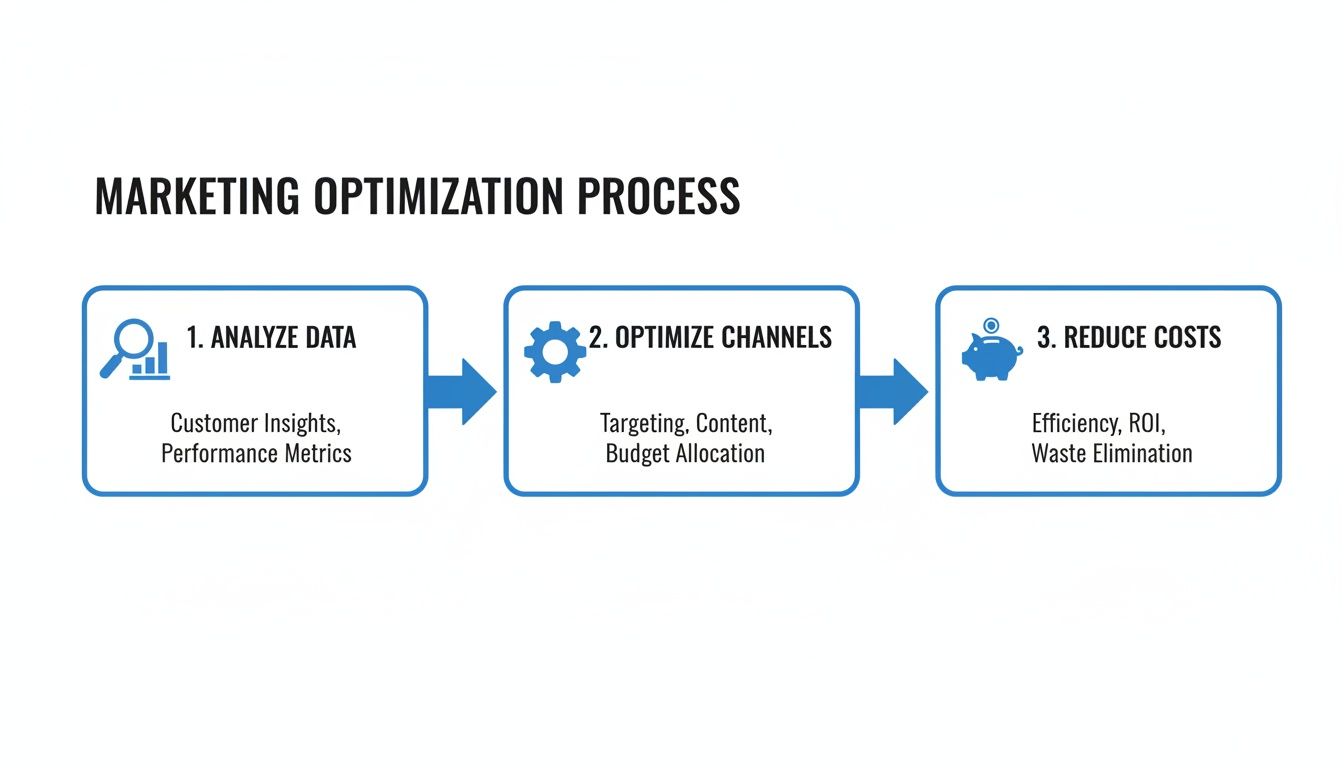
So, what does this cycle look like on a practical, week-to-week basis for a PI firm?
- Launch & Measure: You fire up a new set of Google Ads targeting "motorcycle accident attorney." You let the campaign run for two weeks, just gathering data on clicks, cost, and most importantly, form submissions and tracked phone calls.
- Analyze: At the end of the two weeks, you open your dashboard. You notice that Ad Group A, which uses emotional, client-focused language, is getting a much higher website conversion rate than Ad Group B, which just talks about your firm's big case wins.
- Refine & Repeat: Based on that data, you pause Ad Group B and push its budget over to expand Ad Group A. Then, you launch a new test, pitting your winning ad copy against a new version that highlights your "No Fee Unless We Win" promise. And just like that, the loop begins again.
By repeating this cycle across all your marketing channels—from the topics you choose for SEO content to how you target your local service ads—you build a culture of continuous improvement. Each one of these small, data-informed adjustments compounds over time, leading to major gains in efficiency and a steady drop in your client acquisition cost.
Navigating Ethical and Compliance Rules
Jumping into data-driven marketing for your personal injury firm unlocks incredible potential, but it also dials up the responsibility. The legal world operates under a microscope, and every marketing move you make has to pass muster with your state bar association's ethical and compliance rules.
This isn't just about ticking boxes to avoid a slap on the wrist. It’s about safeguarding your firm's reputation and honoring the trust people place in you during some of the worst moments of their lives.
When you start gathering more data, you're collecting incredibly sensitive information from contact forms, call logs, and your CRM. Protecting that data isn't optional. You need ironclad security to prevent breaches and maintain confidentiality right from that first click or call.
Adhering to State Bar Advertising Rules
Every state bar has its own thick rulebook on lawyer advertising, and they don't mess around. A simple misstep in your ad copy can land you in serious hot water. While data helps you sharpen your message, that message must always stay within the bright lines of the law.
The biggest thing to remember is to avoid any language that sounds misleading or promises something you can't deliver. Keep these non-negotiables in mind:
- No Guarantees, Period: You can never, ever use language that suggests a certain outcome. Phrases like "we guarantee the max settlement" are a fast track to disciplinary action.
- Handle Testimonials with Care: Client stories are incredibly persuasive, but they have to be 100% truthful and not misleading. Most states also require a disclaimer, something along the lines of "past results do not predict future outcomes."
- Be Careful with "Specialist" or "Expert": Tossing these words around is risky. Many state bars have very specific certification requirements you must meet before you can claim to be a specialist. Check your local rules before you ever publish those words.
I've seen firms get tripped up by this when A/B testing. They'll run an ad that promises a specific dollar amount because it gets a great click-through rate, only to find out it's a massive ethical violation. The fix is simple: have an attorney on your team review every single piece of marketing content—from a Google Ad to a landing page headline—before it ever sees the light of day.
Data should help you understand what potential clients need and how to communicate your firm’s value. It should never be used to find loopholes in advertising rules. Your entire data strategy has to be built on a solid ethical foundation.
Prioritizing Data Privacy and Transparency
Beyond the ad rules, you have a fundamental duty to protect people's privacy. Think about it: when someone fills out a form on your site describing a catastrophic injury, they're handing you a piece of their life. That trust is sacred.
Show them you take it seriously. Your website needs a privacy policy that's written in plain English, not legalese. It should clearly explain what data you're collecting, why you're collecting it, and the steps you take to keep it safe. This isn't just a legal formality; it's a huge trust signal for someone considering reaching out.
Your intake process needs to be a digital fortress. Whether you're using a system like Clio or a custom-built solution, confirm it meets modern data protection standards. Everyone on your team who touches that sensitive client information needs to be trained on how to handle it properly.
In the end, running an ethical, transparent marketing program isn't a limitation—it's a competitive advantage. It makes your firm more trustworthy and sustainable for the long haul.
Common Questions from Firms Like Yours
When you start digging into data-driven marketing, a lot of practical questions pop up. It’s only natural. Here, I'll tackle some of the most common things attorneys and firm owners ask me, giving you straight answers to help you move forward.
"How Long Until We Actually See SEO Results?"
This is always one of the first questions, and for good reason. While you can get the phone to ring almost instantly with paid ads, SEO is a different beast entirely. Think of it as building a long-term, high-value asset for your firm, not just flipping a switch for leads.
You'll probably start seeing some encouraging signs within 4 to 6 months. I'm talking about things like better rankings for keywords that matter and a noticeable bump in your organic website traffic. These are the early indicators that you're on the right track.
But the real prize—a steady stream of high-quality leads that become signed cases—that usually takes somewhere between 9 and 12 months to achieve. Your specific timeline really depends on where you're starting from, how fierce the competition is in your city, and how consistently you stick with the plan. The wait is worth it. The data is clear: SEO delivers an incredible return over time, making that initial patience a very smart investment.
SEO is a marathon, not a sprint. A data-driven approach ensures that once you build that momentum, you create a powerful client-generating machine that brings in top-tier leads for a fraction of what you'd pay for ads.
"What’s a Realistic Marketing Budget to Start With?"
There's no magic number here; your budget is going to depend almost entirely on how competitive your local market is. But we can definitely talk about some realistic starting points for a small to mid-sized PI firm.
If you’re in a smaller city or a less crowded market, you can make a serious dent with a starting budget of $5,000 to $8,000 per month. That's usually enough to cover the essentials:
- Foundational SEO: Building out your site's content and authority.
- Local SEO: Getting aggressive with your Google Business Profile.
- Targeted Google Ads: A small, laser-focused campaign on a few high-intent search terms.
Now, if you're in a major metro area like Los Angeles or New York, it's a completely different ballgame. The cost for a single click on a personal injury keyword can be mind-boggling. In those hyper-competitive markets, you'll likely need a starting budget of $15,000 to $25,000 per month just to get in the game and have a fighting chance.
The most important thing is to be smart with your money from day one. Start with a focused budget, track where every single dollar goes, and figure out which channels give you the lowest Cost Per Signed Case. Once you know what works, you can scale your spending with confidence, not guesswork.
"Should We Do This In-House or Hire an Agency?"
This is a big strategic decision. The right move really boils down to your firm's internal resources, expertise, and what you want to achieve in the long run.
Bringing marketing in-house means you need, at a minimum, one dedicated person who truly knows their stuff—digital marketing analytics, SEO, and paid ads, specifically for law firms. The upside is total control and a deep understanding of your firm's DNA. The downside? A steep learning curve and the potential for some very expensive mistakes while your team gets up to speed.
On the other hand, hiring a specialized legal marketing agency gives you instant access to an entire team of experts, sophisticated tools, and industry knowledge they've gained working with other firms. They’ve already made the mistakes and learned the hard lessons on someone else's dime.
If you do go the agency route, demand transparency. It's non-negotiable.
- Ask for a sample dashboard: You need to see exactly how they report on performance.
- Drill down on their KPIs: Ask them specifically how they track and optimize for Cost Per Qualified Lead and Cost Per Signed Case.
- Request relevant case studies: Look for proven success with PI firms your size, in markets like yours.
A great agency partner won't just be a vendor; they'll be an extension of your firm, completely focused on delivering real business results that grow your bottom line—not just vanity metrics like clicks and traffic.
At RankWebs, our goal is to give personal injury firms the strategic frameworks and know-how to build marketing programs that are both efficient and effective. We're here to help you cut through the noise with actionable insights made specifically for the legal world. To learn more about building a smarter marketing strategy for your firm, visit us at RankWebs.