

When you're trying to figure out what you should be paying for a personal injury lead, the numbers can feel all over the place. On average, a personal injury lead can cost anywhere from $100 to over $400. For the most competitive channels, like Google Ads, that price can climb even higher.
This range is so wide because it's not a one-size-fits-all situation. The final price tag depends heavily on where you're located, the specific types of cases you're targeting, and which advertising platform you're using.
What a Personal Injury Lead Should Actually Cost
In the high-stakes world of personal injury law, getting fixated on just the cost per lead (CPL) is a classic mistake. It's like a chef obsessing over the price of flour. Sure, it's an important ingredient, but it tells you nothing about the final cost or the quality of the bread. CPL is a foundational metric, but it isn't the whole story.
The real goal is to nail down your Cost Per Acquisition (CPA)—what it truly costs to sign one new client. Your CPL is just the first step in that calculation. It shows how good your ads are at getting potential clients to notice you, but turning that notice into a signed retainer agreement depends entirely on your intake team, how fast you follow up, and how well you qualify leads.
A cheap CPL means nothing if those leads are junk and never turn into real cases. On the flip side, a high CPL can be a fantastic investment if it consistently brings in high-value, signable clients.
Think of it this way: CPL measures the cost to get a potential client to raise their hand. CPA measures the cost to get them to sign on the dotted line. Both are essential, but only CPA tells you if your marketing is actually growing your firm.
To give you a practical starting point, let's look at how CPL breaks down across the most common marketing channels. Each platform attracts potential clients with a different mindset and level of urgency, which directly shapes both the cost and quality of the leads you'll get.
Average Personal Injury Marketing Cost Per Lead by Channel
Here’s a quick-reference table that breaks down the typical CPLs for PI law firms. This gives you a snapshot of what you can expect to invest across different digital platforms before we dig into the strategies that make these numbers work.
| Marketing Channel | Average Cost Per Lead (CPL) | Typical Lead Quality |
|---|---|---|
| Google Search Ads (PPC) | $200 – $450+ | High: Users actively searching for legal help. |
| Local Services Ads (LSA) | $150 – $550 | Very High: Pay-per-verified-lead model. |
| Facebook Ads | $100 – $300 | Variable: Targets users based on demographics, not active search. |
| SEO (Organic Search) | Varies (Long-Term Investment) | High: Attracts users seeking information and answers. |
These figures provide a solid baseline, but keep in mind they represent averages. Your firm's actual costs will be unique, influenced by the specific factors we'll explore next.
What's a Realistic Cost Per Lead in Personal Injury?
Here’s the thing about leads: where you find them matters. A lot. The cost per lead for personal injury marketing isn't a single, fixed number; it swings wildly depending on which digital channel you're using. If you don't get a handle on these differences, you'll burn through your marketing budget with very few signed cases to show for it.
I like to think of it like buying a car. You could scour Craigslist and maybe snag a deal for a few thousand bucks. Or, you could walk into a dealership and pay a premium for a certified pre-owned vehicle that comes with a warranty and a full service history. Both get you a car, but the quality, your confidence, and the buyer's mindset are completely different. Digital marketing channels work the same way.
The Premium Channels: High Intent, High Cost
At the top of the food chain, you have Google Search Ads. When someone frantically types "car accident lawyer near me" into Google, they aren't window shopping. They're in crisis mode and need help now. This is what we call a high-intent lead, and PI firms will pay dearly to be the first name they see.
That intense competition for prime digital real estate is exactly what drives the cost up. You’re in a bidding war against every other personal injury lawyer in your city for the most valuable search terms. It means a higher CPL, no doubt. But these leads are often the most qualified and are much further down the path to hiring an attorney, which can make that initial investment well worth it. If you want to really dig into this, our guide on how Google Ads for law firms can be a game-changer is a great place to start.
This chart breaks down what you can generally expect to pay for a lead across the major platforms.
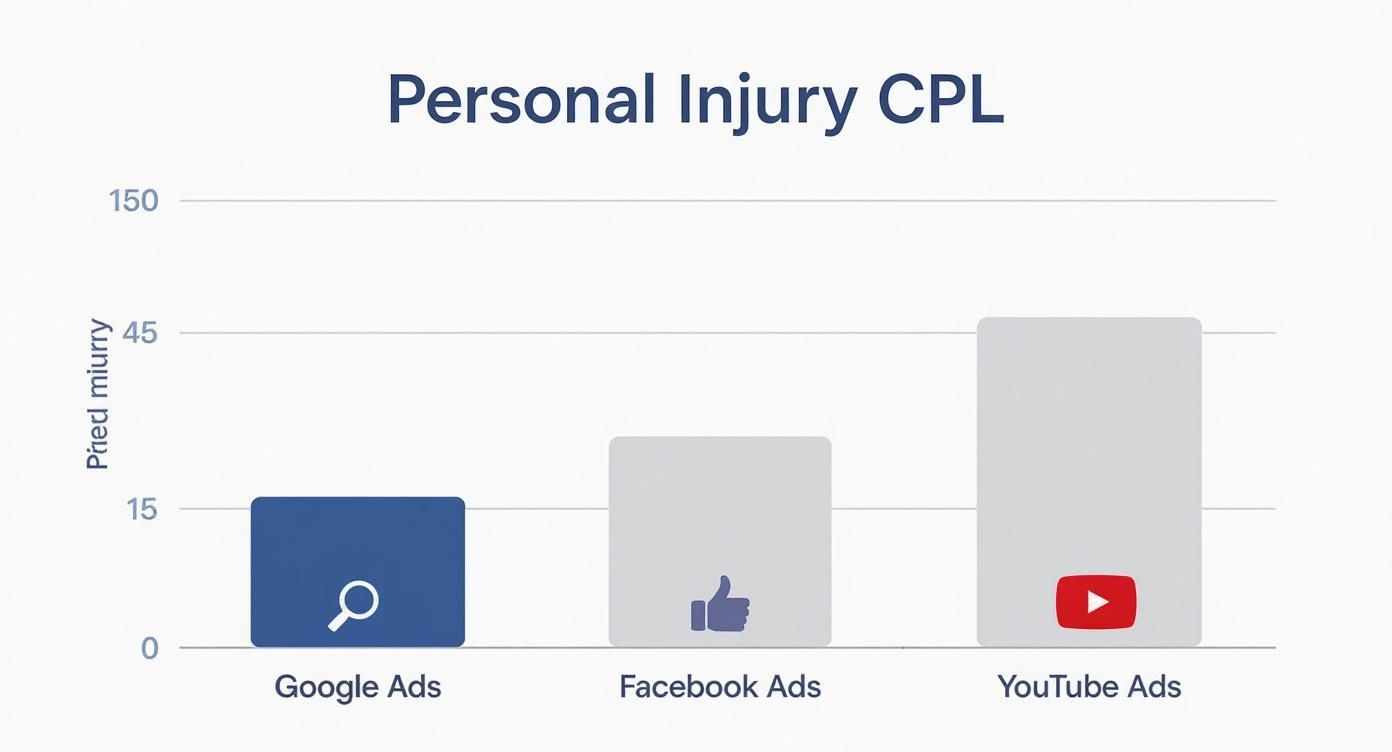
As you can see, Google Ads sits at the top. That price tag reflects its power to connect you with people who have an immediate, pressing legal problem.
The Alternatives: Lower Intent, Lower Cost
Then you have platforms like Facebook and YouTube. The strategy here is totally different. You're not catching people in the act of searching for a lawyer. Instead, you're interrupting their day—while they're scrolling through photos or watching a video—with an ad that’s targeted to them based on their location, interests, or online behavior.
Think of this as putting up a billboard on a busy highway. You’re casting a wide net. While some people driving by might need you now or remember you later, their immediate intent is much, much lower. The good news? The CPL is usually way more affordable. The trade-off is that you’ll likely need to generate a higher volume of these leads to land one signed case.
The core trade-off is clear: Pay a premium for high-intent leads that are ready to act now, or pay less for a higher volume of lower-intent leads that require more nurturing to convert into clients.
CPL is Just the Start—CPA is What Matters
At the end of the day, the initial lead cost is only one number on the spreadsheet. The metric that truly impacts your firm's bottom line is the Cost Per Acquisition (CPA)—what it actually costs you, all-in, to sign a new client. And trust me, the journey from a lead form submission to a signed retainer agreement is where the real costs start to pile up.
Costs in this space have climbed steadily. Looking at industry-wide data, Google Search Ads often have the highest CPL, hovering around $442, thanks to that fierce bidding war. By comparison, Facebook Ads are closer to $286, YouTube Ads are about $319, and Display Ads average $296 per lead.
But here's the kicker: the final CPA, once all is said and done, frequently lands somewhere between $2,500 and $3,000 to acquire a single signed case. That huge gap between CPL and CPA proves a vital point: a cheap lead isn't always a good deal. If you want to explore this pricing landscape further, First Page Sage has some fantastic in-depth research on the topic.
How to Calculate Your Firm's True Cost Per Lead
Industry benchmarks are great for a 30,000-foot view, but they won’t tell you if your firm is actually profitable. To get a real handle on the financial health of your marketing, you have to move past the averages and dial in on your specific numbers.
Calculating your firm’s true cost per lead isn't some dark art. It just requires a commitment to tracking your spending and your results with absolute accuracy.
Think of it like a road trip. The national average for gas prices is interesting trivia, but what really matters is how much you spent at the pump for your car on your journey. Let's walk through a clear, practical example to show you exactly how to do this for your personal injury firm.

Step 1: Pinpoint Your Total Marketing Spend
First things first, you need to isolate the total cost for a specific campaign over a set period. Be honest here—this needs to include every single dollar you spent, not just the ad budget.
For our example, let's follow a small PI firm, "Miller & Associates." They decide to run a Google Ads campaign for one month, targeting the keyword "car accident lawyer."
- Direct Ad Spend: They set aside $5,000 to spend directly on Google Ads for the month.
- Management Fees: They also pay their marketing agency a $1,000 monthly retainer to run the campaign.
- Total Campaign Cost: $5,000 (Ad Spend) + $1,000 (Management) = $6,000
This total cost is the foundation of your calculation. Forgetting about management fees, software costs, or other related expenses will give you an inaccurate—and often dangerously optimistic—CPL.
Step 2: Count Every Qualified Lead
Next, Miller & Associates needs to tally up every legitimate inquiry that this exact campaign generated. Their tracking shows that over the 30-day period, the campaign brought in 25 qualified leads.
These are real phone calls and form submissions from people who were in a relevant accident and are actively looking for legal help. It's crucial to filter out the spam, sales calls, and irrelevant messages to get a clean count. This tracking process is a core part of success, and you can learn more about measuring legal SEO success with key metrics and tools to sharpen your methods.
Step 3: Calculate Your Cost Per Lead
Now for the easy part. With your total cost and total lead count, the math is simple. The formula for Cost Per Lead (CPL) is:
Total Marketing Spend / Total Number of Qualified Leads = Cost Per Lead (CPL)
For Miller & Associates, the calculation looks like this:
- $6,000 (Total Spend) / 25 (Qualified Leads) = $240 CPL
This tells them it costs $240 to make the phone ring with a potential new client. But don't stop here. The goal isn't just to get leads; it's to sign cases.
Step 4: Determine Your True Cost Per Acquisition
This is the most critical step. You have to track those 25 leads all the way through your firm's intake process.
After reviewing each inquiry, the intake team at Miller & Associates finds that 2 of those leads ended up signing retainer agreements. This lets them calculate their Cost Per Acquisition (CPA)—the true price of getting a new client on board.
- Total Marketing Spend: $6,000
- Signed Clients: 2
- Calculation: $6,000 / 2 = $3,000 CPA
This final number, $3,000 CPA, is the metric that should drive your business decisions. It tells the firm precisely what it costs to acquire a new, fee-generating case from this channel, giving you the clarity needed to budget for predictable growth.
The Hidden Factors Driving Your CPL Up or Down
Getting a handle on the average cost per lead is a good first step, but it’s just the baseline. The real million-dollar question is why your firm's CPL is so different from the firm one town over. It’s not random. A handful of powerful, often overlooked factors are always at play, shaping what you ultimately pay to get a potential client on the phone.
Think of it this way: not all ingredients cost the same, and not all leads are created equal. The specifics of who you're targeting and how you handle them once they reach out have a massive impact on your marketing budget. By digging into these variables, you can pinpoint exactly where to make adjustments to lower your costs and get a much better return.

Case Type and Potential Value
By far, the biggest driver of lead cost is the type of case you’re going after. It's simple economics. A lead for a catastrophic commercial truck accident—a case with a potentially massive settlement—is going to be far more expensive than a standard slip-and-fall inquiry. Why? Because your competitors are willing to bid much, much higher for that high-value case.
You can see this play out across the entire personal injury spectrum. Auto accident leads, which make up a huge chunk of the market (over 40% of all PI cases), tend to run between $300 to $1,500. But a highly complex medical malpractice lead? That could cost anywhere from $200 to over $512. This is exactly why a one-size-fits-all marketing budget is a recipe for disaster. If you want to dive deeper into the nuances, you can explore a complete guide on personal injury lawyer leads that breaks down why firms waste thousands without proper tracking.
The Geography Game
Where your office is located has a huge influence on your marketing costs. A PI firm in a hyper-competitive city like Los Angeles or New York City is going to face a dramatically higher CPL than a firm in a quiet suburban or rural area.
- Cutthroat Competition: In big cities, more law firms are all bidding on the same keywords and ad placements, which naturally drives the price up for everyone involved.
- Higher Cost of Living: Advertising costs simply scale with the local economy. It costs more to do business in major metro areas, and that includes digital marketing.
Think of it like real estate. A storefront on Rodeo Drive is going to cost a whole lot more than one on a small town's main street. The same logic applies to your digital ad space—you're paying a premium for access to a dense, high-value audience.
Ad Creative and Landing Page Strength
Your ads and landing pages are your digital frontline. Their performance directly impacts your CPL. A powerful, emotionally connecting ad will get more clicks at a lower cost because platforms like Google Ads and Facebook Ads reward ads that people actually engage with.
But getting the click is only half the battle. Once they land on your site, the experience has to be seamless. A clunky page that’s slow to load, hard to navigate, or looks terrible on a phone will send potential clients running for the hills. That "bounce" signals to the ad platform that your page isn't helpful, and they may penalize you with higher costs. On the flip side, a clean, fast, and trustworthy landing page converts visitors more effectively, which directly lowers your CPL.
Your Intake Process: The Final Gatekeeper
Here's a hard truth: you can have the best ads in the world, but if your intake process is broken, you are lighting money on fire. How quickly you respond to a new inquiry is one of the most critical factors in turning that lead into a signed client.
Imagine two different firms:
- Firm A has a 24/7 intake team and a system to follow up with every web lead within 5 minutes.
- Firm B has office staff check for new leads every few hours during the workday, so the response time is 2-3 hours.
Firm A will sign more cases. Every single time. That delay from Firm B gives potential clients more than enough time to Google another firm and make another call. This internal friction kills your marketing ROI. Every lead that goes cold because of a slow follow-up makes your true cost to sign a case go through the roof.
To help you get a handle on these moving parts, we’ve put together a quick checklist.
CPL Influencers Checklist for Personal Injury Firms
| Influencing Factor | Impact on CPL | Optimization Tip |
|---|---|---|
| Case Type | High-value cases (e.g., truck accidents) significantly increase CPL due to higher competition and bids. | Focus ad spend on your most profitable case types but balance with lower-cost, higher-volume case types to manage the overall budget. |
| Geography | Dense, urban markets have much higher CPLs than suburban or rural areas because of increased competition. | Use hyper-local targeting (zip codes, neighborhoods) to find less competitive pockets within a large metro area. |
| Ad Creative | Weak, generic ads get fewer clicks and are penalized by ad platforms, leading to higher costs. | A/B test different headlines, images, and calls-to-action that speak directly to the client's pain points. Use video. |
| Landing Page | A slow, confusing, or non-mobile-friendly landing page causes high bounce rates, wasting ad spend and raising CPL. | Ensure your page loads in under 3 seconds, has a clear "Get Help Now" button, and is optimized for mobile viewing. |
| Intake Process | Slow response times allow leads to go cold and contact competitors, dramatically increasing your cost per signed case. | Implement a system for immediate follow-up (under 5 minutes), using a 24/7 answering service or CRM automation. |
By systematically reviewing each of these areas, you can start treating your marketing not as an expense, but as a finely tuned engine for growth.
Proven Strategies to Lower Your CPL Without Losing Quality
Knowing your numbers is one thing, but actually improving them is a whole different ballgame. Driving down your cost per lead in personal injury marketing doesn't mean you have to settle for junk inquiries or gut your advertising budget. It’s about working smarter, not just spending more.
The secret is to tune up every single step in your marketing process. I'm talking about everything from the keywords you bid on to how fast your intake team picks up the phone. Each small improvement adds up, creating massive savings and a much healthier return on your investment over time. Let's dig into some field-tested tactics you can put to work right now.
Master Your Keyword Strategy
Think of your keyword list as the foundation of your entire paid search campaign. If it’s shaky, the whole thing will cost you. So many firms burn through thousands of dollars bidding on broad, vague terms that do nothing but attract clicks from people who aren't actually looking for a lawyer.
The fix is a two-part strategy that’s all about precision and understanding user intent.
First, you need to build an iron-clad negative keyword list. These are the terms you explicitly tell Google not to show your ads for. Just think of all the searches related to an accident that have zero to do with hiring an attorney.
- Examples of Negative Keywords:
- accident reports
- free legal advice
- how to file a police report
- pictures of car accidents
- traffic camera footage
Adding these to your negative list instantly stops you from wasting money on clicks from students, reporters, or people who are just curious.
Second, start targeting long-tail keywords. These are longer, more specific phrases that scream high intent. A broad term like "car accident" is wildly expensive and vague. But a long-tail keyword like "attorney for commercial truck accident injury" is used by someone who knows exactly what they need. These searches have less competition, which means a lower cost-per-click and a much better lead.
Relentlessly A/B Test Your Ads and Landing Pages
Your ad copy and landing pages are your firm’s digital handshake and sales pitch, all rolled into one. A generic message just won't cut it when you’re trying to connect with someone who is scared, injured, and stressed. You have to find the perfect mix of words, images, and calls-to-action that truly speaks to your ideal client.
The only way to figure that out is through constant A/B testing. This is where you run two different versions of an ad or a page against each other to see which one gets better results.
- Ad Copy Elements to Test:
- Headlines: "Injured in an Accident?" vs. "Get Max Compensation for Your Injury"
- Descriptions: Focus on your years of experience vs. focusing on powerful client testimonials.
- Calls-to-Action: "Call for a Free Consultation" vs. "Get Help Now"
Your landing page is your ultimate conversion weapon. Even tiny tweaks, like moving a form or changing a button color, can have a massive impact on your CPL. A page that converts at 5% is literally twice as valuable as one that converts at 2.5%.
The goal here is to create a seamless, reassuring experience from the second they click your ad. For a deeper look at this critical piece of the puzzle, check out our guide on landing page optimization for legal ads to get specific techniques for boosting conversions.
Optimize the Entire Lead Funnel
Finally, always remember this: you pay for the click, but you only profit from the signed case. A shocking amount of marketing budget gets wasted after the lead comes in, simply because of a slow or clunky intake process. Your entire lead funnel needs to be lightning-fast, mobile-friendly, and hyper-responsive.
Put yourself in a potential client's shoes right after they click:
- Mobile-Friendly Forms: Can they easily fill out your contact form on a smartphone? Keep it short. No one wants to type their life story on a tiny screen.
- Click-to-Call Buttons: Make it dead simple for mobile visitors to call your office with one tap. No excuses.
- Lightning-Fast Intake: This is the big one. Data consistently shows that your odds of converting a lead plummet after just five minutes. Your firm must have a system to respond to every web lead almost instantly—whether that’s a 24/7 answering service, an automated text message, or a dedicated intake specialist who is always ready.
By optimizing from the first keyword to the final conversion, you make sure every dollar you spend is working as hard as it can. This is how you effectively lower your CPL while attracting better, more qualified cases for your firm.
Putting It All Together: Budgeting for Predictable PI Marketing Growth
Knowing the math behind cost per lead for personal injury marketing is one thing. Seeing it in action is where the lightbulb really goes on. Let's walk through two real-world budget scenarios to see how firms can build a predictable engine for growth.
Think of these as practical blueprints. They show exactly how different investment levels can turn into a steady stream of signed cases. Whether you’re starting small or scaling up, the principles of smart allocation and relentless tracking are exactly the same.
Case Study 1: The Small, Hungry Local Firm
Imagine a small but ambitious PI firm with a marketing budget of $10,000 a month. They aren't trying to take over the whole state—not yet, anyway. Their goal is much more focused: generate a consistent flow of local car accident and slip-and-fall cases, month in and month out.
They've put together a smart, balanced strategy to get immediate leads while building their local brand.
Here’s how they split their budget:
- Google Local Service Ads (LSA): $6,000/month. This is their workhorse. The pay-per-lead model is a lifesaver for a small firm, giving them tight cost control and connecting them directly with people who are actively searching for a lawyer right now.
- Targeted Facebook Ads: $4,000/month. This is their brand-building and audience-nurturing play. They run helpful campaigns—think auto safety tips or "what to do after an accident" guides—to capture potential clients earlier in the process.
Let's look at the results. Their LSA budget, with an average CPL of $300, brings in 20 high-quality leads. The Facebook campaigns, running at a much lower $150 CPL, generate another 27 leads.
That’s a total of 47 leads from their $10,000 investment, which works out to a blended CPL of just $213.
By pairing a high-intent channel like LSA with a lower-cost awareness channel like Facebook, the firm gets the best of both worlds. They get calls today while building a pipeline for tomorrow.
Case Study 2: The Mid-Sized Regional Player
Now let's scale things up. We have a mid-sized firm investing $50,000 per month into their marketing. Their goals are bigger, too. They need a higher volume of leads and are specifically hunting for more complex, high-value cases like commercial trucking accidents and serious workplace injuries.
To do that, they need a more diverse, multi-channel approach to maximize their reach and impact.
Here’s a breakdown of their more aggressive budget:
- Google Search Ads: $25,000/month. This is the powerhouse, targeting the most competitive and valuable keywords to get the phone ringing immediately.
- Long-Term SEO: $10,000/month. This is a long-term investment. They’re creating great content and fine-tuning their site's technical SEO, knowing it will build organic authority and steadily drive down their blended CPL over time.
- YouTube Ads: $10,000/month. Video is how they build trust and connect with their audience on a more human level, reaching thousands of potential clients across the region.
- Social Media & Retargeting: $5,000/month. This budget ensures they stay top-of-mind with past website visitors and stay engaged with their local community.
When we project the returns, the $25,000 in Google Ads, at a $400 CPL, should generate around 63 leads. The $10,000 YouTube campaign at a $320 CPL will likely add another 31 leads. That’s 94 immediate leads from their paid channels alone, not to mention the compounding value from their SEO work.
Their blended CPL from paid advertising is around $372. Yes, it's higher than the smaller firm's CPL, but this entire strategy is engineered to attract cases with much higher potential fees. The bigger initial investment is easily justified by the powerful, long-term ROI it delivers.
Frequently Asked Questions
When you're running a personal injury firm, marketing can feel like a maze. Let's clear up some of the most common questions we hear from law firm owners so you can make smarter decisions that actually move the needle.
What Is a Good Conversion Rate for Personal Injury Leads?
Getting a lead is one thing; turning it into a signed case is another. A solid benchmark for a lead-to-case conversion rate is somewhere in the 10% to 15% range for most PI firms.
But that's just an average. The real number depends heavily on where the lead came from. Someone actively searching on Google for a "car accident lawyer near me" is going to convert at a much higher rate than someone who just saw a social media ad. Your intake process is just as crucial. If your team is on the ball—following up within five minutes, even after hours—you'll push your conversion rate toward that 15% mark and watch your ROI climb.
Should My Firm Focus on SEO or PPC for Lead Generation?
This isn't an either/or question. The smartest firms use both SEO and PPC because they serve two totally different, yet complementary, purposes.
Think of it like this: Pay-Per-Click (PPC) is your sprinter—it gets you leads right now. Search Engine Optimization (SEO) is your marathon runner, building the endurance for long-term, sustainable growth.
PPC ads put you at the top of Google immediately, which is perfect for generating a quick flow of cases. But it's a tap you have to keep paying for. SEO, on the other hand, is the long game. It's about building your firm's authority so Google trusts you and ranks you organically. While it takes time, a solid SEO foundation delivers a much lower CPL over the long haul. The winning formula? Use PPC for immediate results while you invest in SEO for durable, cost-effective growth.
How Long Does It Take to See ROI From PI Marketing?
This is the million-dollar question, and the answer is: it depends entirely on the channel you're using and how long it takes for your cases to settle.
With a PPC campaign, you can have leads ringing your phone within a few days of launch. But you won't see a true financial return until those cases resolve, which could be months or even years down the road. For SEO, you might not see a steady stream of organic leads for a good 6 to 12 months while your rankings climb. The key is to track both short-term metrics (like CPL and Cost Per Signed Case) and the long-term ROI from settled cases. That's the only way to get a true picture of your marketing success.
At RankWebs, we don't just build campaigns; we build understanding. We give personal injury firms the strategic insights and proven frameworks they need to grow profitably. See how we do it at https://rankwebs.com.