


Chatbots are more than just a fancy tech add-on for your law firm's website; they're the digital front door that never closes. Think of them as your 24/7 digital receptionist, always ready to engage with potential clients, answer basic questions, and collect crucial information the moment someone lands on your site.
This simple tool transforms your static website from a passive brochure into an active client-intake machine.
Why Your Law Firm Website Needs a Chatbot
Picture this: it's 10 PM on a Tuesday. A potential client, stressed and searching for urgent legal advice after a car accident, finds your website. What do they see? A standard "contact us" form that promises a reply tomorrow morning?
In that moment of need, "tomorrow" feels like an eternity. That's a critical window where you can either capture a new case or lose it to a competitor who offers immediate help. This is precisely where a chatbot changes the game.
Client expectations have shifted dramatically. People are used to getting instant answers from every other service in their lives, and they now expect the same from a law firm. A delay of just a few hours can be the difference between signing a new client and never hearing from them again.
Meet Your Tireless Digital Paralegal
A well-configured chatbot is much more than a simple Q&A bot. It acts like a highly efficient digital paralegal, handling the initial, repetitive tasks that consume your staff's valuable time.
Instead of just answering "What are your hours?", a smart chatbot can:
- Qualify Leads: It can ask a few key questions to see if a visitor’s problem aligns with your firm’s practice areas. No more wasting time on calls you can't help with.
- Gather Case Details: It systematically collects the essential facts—the date of the incident, the nature of the legal issue, and of course, contact information.
- Schedule Consultations: By connecting directly to your firm's calendar, it can book an initial consultation on the spot, completely eliminating the back-and-forth emails.
A study from the American Bar Association reveals that nearly 80% of clients expect a law firm to respond within 24 hours. A chatbot responds in seconds, immediately showing a potential client you're attentive and ready to help.
By taking care of these first steps, the chatbot hands off a warm, pre-vetted lead to your team. All the initial information is already organized, saving your firm dozens of non-billable hours every single month. This not only makes your intake process incredibly efficient but also delivers a seamless, professional experience from the very first click.
Properly integrating live chat and chatbots for immediate client engagement is one of the most powerful moves you can make to get ahead. This guide will walk you through exactly how to do it.
Choosing Your Digital Legal Assistant
Picking the right chatbot for your law firm is a lot like hiring for a new role. You wouldn’t bring on a senior partner to answer the phones, and you wouldn't ask a receptionist to draft a complex brief. The same logic applies here—you need to match the technology to the specific job you need it to do.
Not all chatbots are built the same, and getting a handle on the key differences is the first step to making a smart investment for your firm. The choice really comes down to three main types: Rule-Based, AI/LLM-Powered, and Hybrid models. Each has its own strengths and is built for different goals.
Comparing Chatbot Technologies for Law Firms
To make sense of the options, it helps to see them side-by-side. Each type of chatbot technology works differently and is better suited for certain tasks. Think of this table as a quick reference guide to help you pinpoint which approach aligns best with your firm's immediate needs and long-term goals.
| Chatbot Type | How It Works | Best For | Potential Limitations |
|---|---|---|---|
| Rule-Based | Follows a strict, pre-programmed script (a "decision tree"). If the user says X, the bot does Y. | Simple, predictable tasks like basic lead capture (name, email), answering FAQs ("Where are you located?"), and routing visitors to the right webpage. | Cannot handle unexpected questions or complex conversations. Can feel rigid and lead to dead ends if a user goes "off-script." |
| AI-Powered (LLM) | Uses Large Language Models to understand and interpret natural, conversational language. Learns from interactions. | Engaging in more natural dialogues, understanding user intent, qualifying complex cases, and providing a more personalized intake experience. | Higher cost and complexity to set up. Requires careful training and oversight to ensure accuracy and compliance. |
| Hybrid | Combines the structure of rule-based bots with the flexibility of AI. It uses rules for simple steps and AI for complex ones. | The most versatile option for law firms. Manages initial intake with rules, then uses AI to understand the nuances of a potential client's legal issue. | Can be more complex to configure than a purely rule-based system, but often provides the best balance of cost and capability. |
Ultimately, the best choice depends on what you're trying to achieve. A simple rule-based bot can be a great starting point, but a hybrid or AI model offers the sophisticated engagement many firms need to truly stand out.
The Digital Phone Tree: Rule-Based Chatbots
Think of a rule-based chatbot as a sophisticated digital phone tree. It operates on a very strict, pre-written script. It guides users through a conversation based on a simple "if-then" logic—if a user asks X, the bot responds with Y. It’s predictable and reliable, which makes it great for straightforward tasks.
These bots don't understand nuance or context; they just follow the script you give them. This makes them a perfect, cost-effective fit for simple, high-volume interactions where you can easily map out the entire conversation.
Best for:
- Basic Information Gathering: Collecting names, phone numbers, and email addresses.
- Simple FAQs: Answering questions like "What are your business hours?" or "Where are you located?"
- Directing Traffic: Pointing visitors to the right practice area page on your site.
A rule-based bot is a solid, low-risk way for firms to start with automation. The main drawback is its rigidity. It can’t handle questions it wasn't programmed for, which can sometimes create a frustrating dead end for a user with a more complex issue.
The Junior Associate: AI and LLM-Powered Chatbots
If a rule-based bot is a phone tree, then an AI-powered chatbot is more like a sharp junior associate. These bots are built on Large Language Models (LLMs), allowing them to understand and interpret conversational language much like a person would. They can learn from each interaction and handle a huge range of unscripted questions.
This flexibility allows an AI bot to have a far more natural and helpful conversation with a potential client. It can figure out what a user is asking even if the phrasing is a bit clumsy, making the entire intake process feel more human. The legal world is catching on fast. AI adoption in law nearly tripled in just one year, jumping from 11% in 2023 to 30% in 2024.
The Best of Both Worlds: Hybrid Chatbots
A hybrid chatbot gives you exactly what it sounds like: the structured control of a rule-based system combined with the intelligent flexibility of AI. This approach is often the sweet spot for law firms because it's both efficient and smart. The bot can use simple, scripted rules for initial qualifying questions and then seamlessly hand the conversation over to its AI brain when things get more complex.
A hybrid model provides the perfect balance. It ensures routine tasks are handled with cost-effective precision while reserving powerful AI for moments that require a deeper understanding of a potential client's needs.
For instance, the bot might start with simple buttons ("Are you a new or existing client?"). If the user chooses "New client" and then types a detailed question about a multi-car pile-up, the AI takes over to understand the specifics. This balanced approach is often the ideal solution. And for firms looking to build out their marketing toolkit, you can also explore other AI tools for legal marketing that work well alongside a chatbot strategy.
This visual shows just how much faster a chatbot can engage a visitor compared to a traditional contact form.
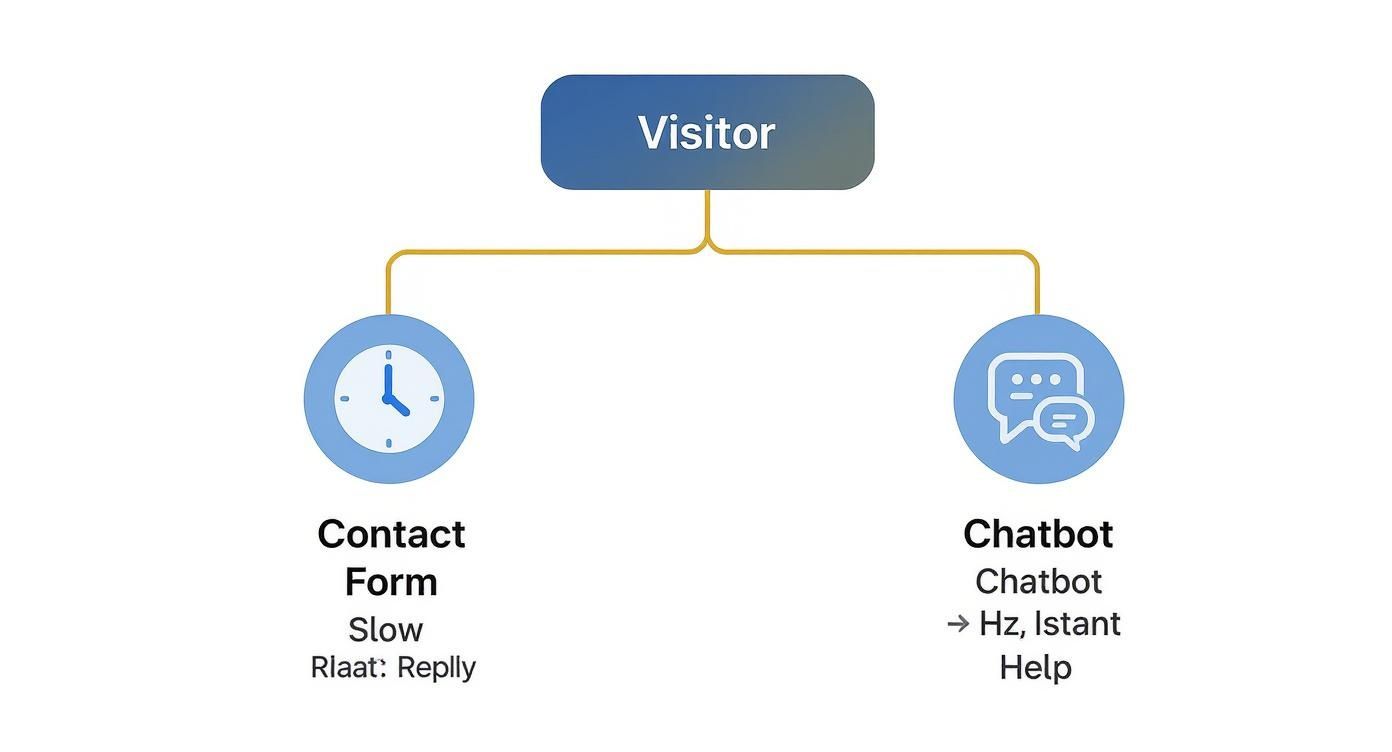
The key takeaway is that chatbots completely eliminate the waiting game. They meet the modern client’s expectation for immediate answers and support, which is a huge advantage in a competitive market.
Putting Your Chatbot to Work
Alright, now that we've covered the different kinds of chatbot tech, let's talk about what really matters: putting one to work for your firm. This isn't just about adding a cool gadget to your website. It’s a strategic move that can genuinely change how you find new clients, run your daily operations, and support the people you serve.
Think of your chatbot as a new hire, one that's ready to take on some of the most crucial—and often repetitive—tasks at your firm. When you give it the right jobs, you free up your human team for the high-value work that only they can do. Here are the most effective ways a chatbot can start delivering results from day one.
Capture and Qualify Leads Around the Clock
Your website is always on, and your intake process should be too. A potential client’s legal crisis doesn’t care about business hours. A chatbot acts as your firm’s first responder, always ready to engage with someone the moment they land on your site.
Instead of letting a potential case go cold overnight or over a weekend, a chatbot can jump right in.
- It gathers the essential contact details like their name, email, and phone number.
- It asks a few initial qualifying questions to see if their situation aligns with your practice areas.
- It provides an instant confirmation, letting the person know their message has been received and they aren't being ignored.
This 24/7 availability is a serious competitive edge. We've seen firms that implement these tools get incredible results—some report a 30% jump in client conversion rates. That boost comes from a simple principle: meeting people where they are, with the immediate response they expect. By handling those first critical steps, the chatbot ensures no lead ever slips through the cracks. If you want to dig deeper into this, you can learn more about AI intake for law firms.
Automate Appointment Scheduling Seamlessly
We’ve all been trapped in the back-and-forth email vortex just to schedule a single meeting. It’s a time-waster for your staff and a point of friction for a potential client. A chatbot can completely get rid of this problem.
By connecting directly to your firm’s scheduling software—whether that’s Calendly, Acuity, or the calendar inside your case management system—a chatbot can manage the entire booking from start to finish.
Here’s how it might play out for a personal injury inquiry:
- A visitor on your site says they were in a car accident.
- The chatbot confirms that personal injury is a case your firm handles.
- It then shows them a list of open slots for a free consultation with an attorney.
- The person picks a time, and boom—the appointment is on the lawyer’s calendar, complete with the initial notes from the chat.
This simple, automated process does more than just save administrative hours. It locks in a commitment from a potential client right when their motivation is at its peak.
Provide Smart Client Triage
Let’s be honest, not every person who contacts your firm needs to speak with an attorney right away. Different issues need to be handled by different people. Your chatbot can function as an intelligent router, sorting incoming messages and sending them exactly where they need to go.
By asking a few targeted questions, a chatbot can sort inquiries by practice area, urgency, or type, ensuring the right person on your team gets the right information from the start.
This means a question about setting up a trust gets routed to your estate planning paralegal, while a question from an existing client goes to their assigned case manager. It stops attorneys from getting bogged down with unqualified inquiries and makes sure potential clients have a smooth, professional first experience with your firm. This intelligent sorting is a key feature of the most effective chatbots for law firm websites.
Maintaining Ethical and Compliance Guardrails
While chatbots can be a game-changer for efficiency, they also introduce some serious professional responsibilities that you simply can't ignore. For any law firm, bringing in new tech is about more than just boosting the bottom line; it's about upholding the fundamental duty of care you owe every client. Launching a chatbot without first putting up clear ethical guardrails is a recipe for disaster.
These tools are often the very first point of contact for potential clients, so you have to get ahead of the potential pitfalls before the chatbot ever goes live. A badly programmed bot can easily step over the line, creating major ethical problems—from accidentally giving legal advice to mishandling confidential information. The only way to do this right is to be proactive and build your chatbot strategy on a solid foundation of professional responsibility.
Preventing the Unauthorized Practice of Law
Let's start with the most important rule: your chatbot must not give legal advice. Period. The unauthorized practice of law (UPL) is a massive ethical violation, and your bot needs to be programmed to provide information only, never legal counsel or strategy.
Think of your chatbot as a highly trained paralegal or an expert receptionist, not a first-year associate. It can explain what your firm does, define your practice areas, and gather basic facts about a situation. What it absolutely cannot do is analyze a user's problem and recommend a specific course of action.
- Good: "Our firm specializes in family law. The first step for all new clients is a confidential consultation to discuss the specifics of their situation."
- Bad: "It sounds like you have a strong basis for a custody modification. You should file a motion right away."
The difference is subtle, but it's everything. Every script, every prompt, and every automated response has to be carefully vetted to make sure it's guiding users toward your firm without ever crossing into giving a legal opinion.
Protecting Attorney-Client Privilege
The second someone starts typing details about their case into that chat window, they're expecting confidentiality. Attorney-client privilege is sacred in our profession, and your chatbot technology has to be set up to honor and protect that from the very first interaction.
This obviously starts with picking a vendor that offers a secure, encrypted platform. But technology is only half the battle. You also need to manage user expectations with crystal-clear disclaimers that explain exactly what the chatbot conversation is—and what it isn't.
A well-placed disclaimer right at the start of the chat is crucial. It should state plainly that using the chatbot does not establish an attorney-client relationship and that users should avoid sharing sensitive, confidential details until they've formally retained the firm. This kind of transparency protects both the user and your firm from future complications.
By setting these boundaries upfront, you prevent misunderstandings and show that your firm operates with the highest professional standards, even through automated tools.
Ensuring Data Privacy and Security
Beyond the specific issue of privilege, your firm has a broader responsibility to protect all personal data collected on your website. People might share names, phone numbers, and sensitive facts about their case. If that data isn't handled properly, it becomes a huge liability for your firm.
When you're looking at different chatbot vendors, their security measures should be at the top of your list. You need a partner who understands and complies with data protection laws like GDPR or CCPA and can show you exactly how they keep data safe.
Key Security Questions to Ask Any Vendor:
- Where will our chat data be stored? You need to know it's in a secure, compliant data center.
- Is all communication encrypted? Encryption for data both in transit (as it's being sent) and at rest (when it's stored) is non-negotiable.
- What are your data retention and deletion policies? You need to know how long data is stored and how it’s securely destroyed when it's no longer needed.
At the end of the day, your firm is responsible for the technology it uses. Choosing a vendor with proven experience in the legal industry can give you peace of mind that your digital front door is secure.
Your Implementation and Launch Plan

Adding a chatbot to your firm's website isn't as simple as flipping a switch. Think of it like preparing for trial—the upfront discovery, strategy, and preparation are what secure a win. If you rush the process without clear goals or the right partner, you could end up with a clumsy tool that frustrates potential clients instead of helping them.
This section is your playbook for getting it right. We'll walk through the two most critical phases: choosing the right technology partner and then rolling out your chatbot for a seamless launch. Follow these steps, and you’ll be able to manage the process with confidence, turning a great idea into a powerful asset that aligns perfectly with your firm's standards.
Selecting the Right Vendor
This is the most important decision you'll make. The market is flooded with chatbot providers, but very few understand the unique compliance, security, and client-service needs of a law firm. Your evaluation needs to go much deeper than just looking at flashy features; it has to focus on the foundational elements that protect your firm and serve your clients.
When you're vetting potential partners, these criteria should be at the top of your list:
- Legal Industry Experience: Has the vendor actually worked with law firms before? They need to understand the ethical guardrails, like avoiding the unauthorized practice of law, and offer features specifically built for legal intake.
- Security and Compliance Certifications: Don't be shy about asking for specifics on data encryption, storage protocols, and how they handle privacy regulations. If a vendor can't give you clear, confident answers on security, that's a major red flag.
- Integration Capabilities: Your chatbot can't operate in a vacuum. Make sure it can connect seamlessly with the tools you already use, like your case management software (CMS), client relationship management (CRM) platform, and calendar tools.
Adopting new technology is a big step, and firm size often dictates the pace. Generative AI adoption rates show that firms with 51 or more attorneys report a 39% adoption rate, nearly double the 20% among smaller firms. This really highlights how resources and existing infrastructure influence the rollout of tools like chatbots. You can explore more data on legal technology trends to see where your firm fits in.
Your Pre-Launch Checklist
Once you’ve locked in a vendor, the real work begins. This is where you breathe life into your vision by defining the chatbot's purpose, personality, and processes. A methodical approach here is your best defense against confusion and a rocky rollout.
Use this checklist to guide your team from setup to launch day:
-
Define Your Primary Goal: What is the single most important job you want this chatbot to do? Is it scheduling more consultations? Qualifying leads for a specific practice area? Maybe just cutting down on the repetitive questions your front desk answers all day? Start with one, crystal-clear objective.
-
Map the Conversation Flow: Get a whiteboard and sketch out the ideal conversation. What's the very first question the bot should ask? What are the likely responses, and how should the bot reply to each one? Think of it like creating a decision tree for your digital receptionist.
-
Craft Your Scripts Carefully: Write the chatbot’s responses in your firm’s authentic voice. Whether you're formal and professional or empathetic and approachable, make it sound like you. Most importantly, ensure every script includes an ironclad disclaimer that it is not a lawyer and cannot provide legal advice.
-
Establish Clear Escalation Paths: What happens when the bot gets stuck or a user gets frustrated? You need a plan. Define a clear trigger and a process for handing the conversation over to a live person, whether that’s by phone, email, or a live chat agent.
-
Conduct Thorough Internal Testing: Before a single potential client interacts with your bot, have your own team try to break it. Seriously. Ask it confusing questions, test every button, and go down every conversational path to find and squash bugs.
-
Plan for a Soft Launch: Don’t feel pressured to go live on your homepage from day one. Consider a soft launch on a less-trafficked part of your site, like a specific blog post or a niche practice area page. This lets you gather real-world data and make tweaks before the big rollout.
Measuring Your Chatbot's Real-World Impact
Putting a chatbot on your firm’s website is an investment. But like any good investment, you need to know if it's actually paying off. Proving its worth means looking past vanity metrics like the total number of chats. The real story is in the data that connects those conversations to your firm’s bottom line.
Think of it this way: knowing how many people walked through your office door is one thing. Knowing how many of them signed a retainer agreement is what really matters. Your chatbot is your digital front door, and the same logic applies. Solid measurement turns a neat website feature into a reliable business development tool.
Key Metrics That Matter for Law Firms
To really understand what's working, you need to track the KPIs that tie directly to client acquisition. These are the numbers that tell you if your chatbot is just talking to people or if it's actually growing your practice.
- Lead Conversion Rate: This is the big one. What percentage of chatbot conversations turn into a qualified lead—someone who hands over their contact info for a follow-up? This metric is the most direct measure of your bot's ability to generate real opportunities.
- Consultations Scheduled: How many initial consultations are getting booked through the chatbot, completely hands-off? This is a huge indicator of efficiency and shows that potential clients trust the system enough to take the next step.
- Cost Per Qualified Lead (CPQL): Take the monthly cost of your chatbot and divide it by the number of qualified leads it brought in. This simple calculation lets you compare its value directly against your other marketing efforts, like Google Ads or social media campaigns.
Focusing on these figures helps you prove how chatbots for law firm websites create tangible, measurable value for your firm.
Uncovering Insights from Chat Transcripts
Don't ignore the conversation logs—they're a goldmine. Reading through the actual transcripts gives you a raw, unfiltered look into the minds of your potential clients. You get to see their biggest concerns, their most common questions, and the exact words they use to describe their legal issues. This is pure client intelligence.
Diving into these conversations allows you to:
- Spot common questions and pain points your website content might be missing.
- Find new keywords and search phrases to fuel your SEO and content strategy.
- Tweak your chatbot's scripts to better meet user needs and guide them more smoothly toward a consultation.
Continuously Optimizing for Better Results
A chatbot isn't a "set it and forget it" project. The best performance comes from a constant cycle of data-driven improvement. One of the most effective ways to do this is through A/B testing.
A/B testing is simply trying out two different versions of a script or question to see which one works better. For example, you could test a formal greeting against a more casual, empathetic one. Or you could try two different ways of asking qualifying questions to see which version captures more high-quality leads.
This loop of testing, measuring, and refining is what separates a decent chatbot from a truly effective one. By keeping a close eye on your KPIs and paying attention to what the data is telling you, you can consistently improve your chatbot's performance and ensure it remains a powerful engine for bringing in new clients.
Frequently Asked Questions
Even with a solid game plan, bringing any new tool into the firm comes with questions. Let's tackle some of the most common things we hear from managing partners and firm marketers when they're thinking about adding a chatbot.
Can a Chatbot Truly Understand Legal Nuances?
This is the big one, and the answer is simple: it doesn't have to. A chatbot should never, ever give legal advice. Its job isn't to be a lawyer; its job is to be an incredibly efficient and intelligent receptionist.
Modern AI is excellent at understanding what a potential client is asking about, even if their language isn't perfect. It can quickly figure out if they have a personal injury case, a family law issue, or something else entirely. It gathers the basic facts and checks if their problem is something your firm actually handles.
For anything that seems complex or outside its script, the bot’s prime directive is to escalate. It should have a seamless handoff to a live person on your team. This way, no serious inquiry gets lost, and every complex legal matter gets the human expertise it deserves right away.
How Much Does a Law Firm Chatbot Typically Cost?
The price tag on chatbots for law firm websites can swing quite a bit. You can find simple, rule-based bots for as little as $50 to $200 per month. On the other end, sophisticated AI-driven chatbots built specifically for the legal field can run from $300 to over $1,000 per month.
What drives the cost? It really comes down to the features you need, how much traffic your website gets, and whether it needs to connect with your existing case management software. The key is to think about the cost in terms of return on investment. If it captures just one or two extra qualified leads a month or saves your intake team hours of work, it often pays for itself very quickly.
Will a Chatbot Make My Firm Seem Impersonal?
This is a valid concern, but it’s all in the execution. Done right, a chatbot actually makes your firm feel more responsive and modern, not less personal.
The secret is being upfront. The bot should always introduce itself as a digital assistant. For most people visiting your site—especially after hours—getting an immediate answer and a clear next step feels far better than filling out a form and waiting for a callback that might never come.
A well-designed chatbot provides instant gratification and a clear path forward. That feels a lot more attentive than a "we'll get back to you" message.
Think of it this way: the bot handles the initial, repetitive questions. This frees up your human team to give their full, personalized attention where it truly counts—during consultations and throughout the client's case. It creates a better, more efficient experience from the very first click.
At RankWebs, we help law firms build powerful marketing systems that drive measurable growth. We provide the strategic insights and actionable frameworks you need to stay competitive. Find out more at https://rankwebs.com.