


AI-powered lead scoring is really about using smart technology to figure out which of your incoming leads are most likely to turn into your best clients. The system automatically analyzes and ranks every inquiry, so your team knows exactly who to call back first. It’s a fundamental shift from sorting through a messy inbox to making sharp, data-driven decisions.
The New Competitive Edge for Law Firms
The days of relying on gut feelings to find your next big case are numbered. In a crowded legal market, the firms that respond fastest—to the right inquiries—are the ones that win. This is where AI-powered lead scoring truly changes the game for attorneys, turning your client intake from a reactive chore into a proactive engine for growth.
This guide isn't about hype. It's an actionable roadmap for putting this technology to work. We'll walk through the practical steps to build a smarter, more profitable pipeline for your firm.
Why Manual Lead Review Just Doesn't Cut It Anymore
The traditional intake process is often slow, inconsistent, and frankly, a bottleneck. A paralegal or intake specialist has to sift through dozens of web forms, emails, and phone calls, trying to pick out the winners. This old way of doing things is full of holes:
- Human Error: Great leads get missed when things get busy or when a case doesn't fit a perfect mold at first glance.
- Delayed Response: A high-value potential client won't wait around. While you're sorting, they're calling your competitor.
- Wasted Resources: Countless hours are spent on inquiries that go nowhere, driving up your client acquisition costs. You can learn more about how AI can reduce marketing costs in our related article.
This inefficiency doesn't just eat into your profits; it can hurt your firm's reputation. A slow response tells a potential client their problem isn't your priority.
In today’s market, speed is everything. An AI can score a new lead in seconds, picking up on subtle signals a human might easily miss on a quick scan. This frees up your team to connect with the best prospects almost instantly.
To truly understand the difference, let’s compare the old way with the new.
Traditional vs AI-Powered Lead Intake
| Metric | Traditional Intake | AI-Powered Intake |
|---|---|---|
| Response Time | Hours or days | Seconds to minutes |
| Accuracy | Subjective, prone to error | Data-driven, consistent |
| Prioritization | First-come, first-served | Highest-value leads first |
| Team Focus | Manual data entry & sorting | Strategic follow-up & client engagement |
| Scalability | Limited by staff availability | Scales instantly with lead volume |
This table makes it clear: moving to an AI-driven system isn't just an upgrade, it's a complete operational overhaul that puts your firm in a position to grow.
The Real-World Impact of AI on Firm Performance
Bringing AI into your firm isn't just about being more efficient; it's about seeing tangible results. Across the legal industry, a clear pattern has emerged: technology adoption is directly tied to better outcomes.
Recent data shows that 79% of legal professionals are already using AI tools. The benefits are hard to ignore, with 65% reporting improved work quality and 63% seeing better client responsiveness.
Here's the most compelling part: while 36% of all legal pros say AI has positively impacted revenues, that number skyrockets to 69% for firms that have widely adopted AI. This shows that going all-in drives serious financial growth, as highlighted in the 2025 Clio Legal Trends Report.
This data proves a critical point. AI-powered lead scoring isn't some far-off concept. It's a practical tool giving firms a competitive edge right now by making sure your most valuable asset—your attorneys' time—is spent on the leads that matter most.
Building Your Custom AI Scoring Model
Alright, let's move from theory to where the rubber meets the road. Building a custom AI model isn't about becoming a data scientist overnight. It’s about teaching a system to think like your firm's best intake specialist—to automatically spot the cases you’re built to win.
The whole process kicks off with one simple but crucial question: what does our ideal client actually look like? A PI firm is probably hunting for cases with clear liability and serious damages. A corporate law practice, on the other hand, might be looking for complex, multi-state litigation. Your answer to this question shapes the entire model.
This initial step is non-negotiable. It ensures your AI is trained on your firm’s definition of a great case, not some generic legal template.
Defining Success and Finding the Right Signals
Before you can score anything, you have to get crystal clear on what a "high-quality" lead means to you. Is it all about potential case value? The odds of a quick settlement? Or maybe it's about finding cases that fit a new practice area you're trying to grow? You have to be specific.
Once you know what you're looking for, you can start identifying the data points that signal a good match. The good news? You’re probably already collecting this information through your intake forms, phone calls, and initial consultations. Now, we just need to give it structure.
Your most powerful signals will likely come from:
- Case Type: Getting granular is key. Instead of just "personal injury," think "commercial vehicle accident" or "slip and fall at a big-box store."
- Geographic Location: Is the case in a jurisdiction where you have a killer track record or where the laws are more favorable? That matters.
- Explicit Details: Words matter. When a potential client writes "multiple surgeries required," "wrongful termination," or "breach of contract," those are powerful indicators.
- Lead Source: Let's be honest, an inquiry from a trusted referral partner is almost always warmer than a random Google search.
Isolating these variables is how you start creating the building blocks for a smart scoring model.
The visual below shows how this data flows through a simplified AI-driven intake process, turning a flood of raw information into decisive action.
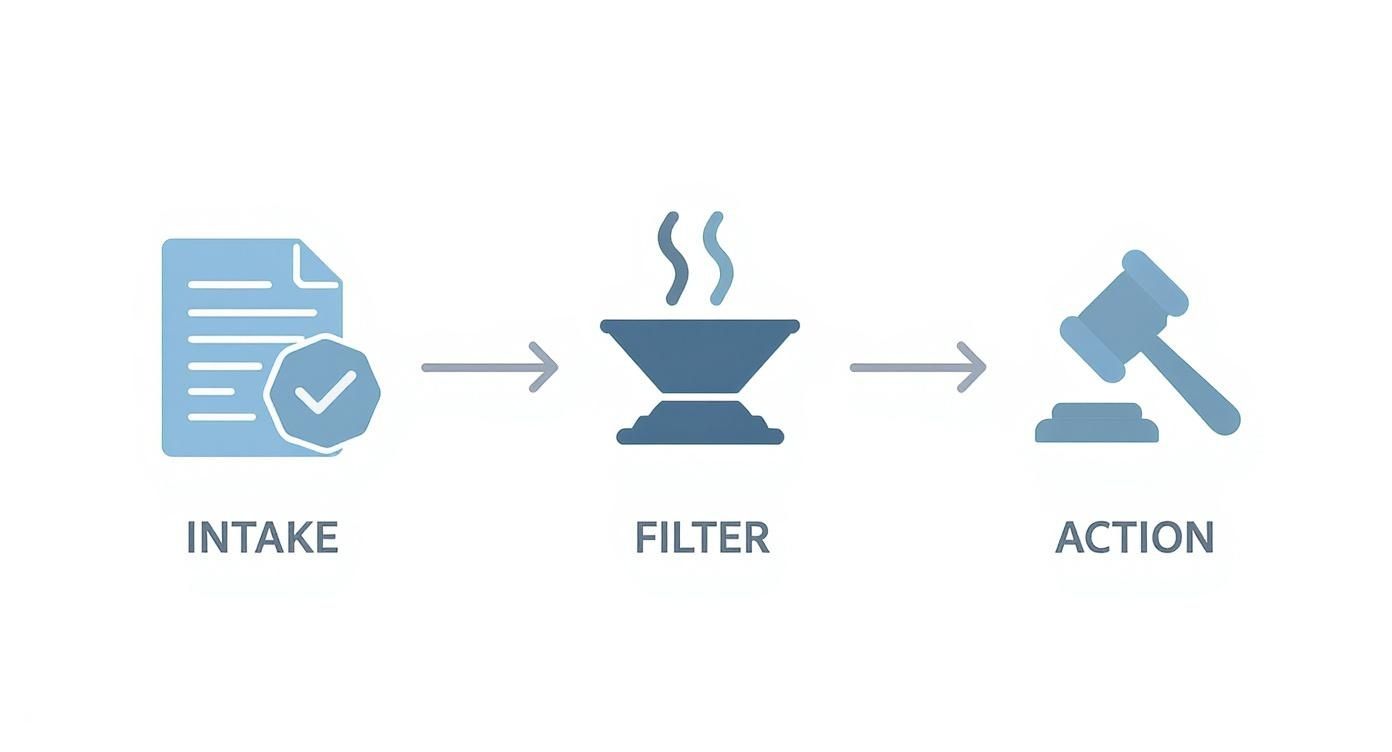
This workflow is the essence of it all: filtering out the noise so your team can focus their energy on the leads that need immediate, strategic attention.
Engineering Legal-Specific Features
This next part, known as feature engineering, is where your firm's unique expertise really comes into play. You're translating legal nuance into a language the AI can understand. You’re not just feeding the model keywords; you're teaching it context.
For instance, a family law firm might tell the model to assign a higher value to leads who mention "contested assets" or "business ownership," since those factors often point to a more complex and potentially higher-value case.
A great way to start is to pull the files on your last 20 best closed cases. What were the common themes, keywords, and circumstances in their very first emails or calls? Those patterns are the DNA of your future A+ clients.
Here’s how this might look in practice for different firms:
- Employment Law: The phrase "documented HR complaints" is a much stronger signal than a vague "I was treated unfairly."
- Real Estate Law: A lead mentioning a "commercial lease dispute" is almost certainly more valuable than one about a simple residential closing.
- Personal Injury Law: The mention of a specific injury, like a "traumatic brain injury (TBI)," immediately signals a higher potential case value than "minor whiplash."
This is how the AI model becomes yours. It starts to reflect your firm's hard-won experience and strategic focus.
From Raw Data to Actionable Scores
Once you've defined your key data points and legal-specific features, the AI model can finally get to work. It analyzes every new inquiry against the criteria you’ve set, digging through your historical data to find the patterns that correlate with your best outcomes.
The output isn't just a meaningless number. Modern lead scoring platforms can deliver qualitative scores that give your intake team clear, actionable direction.
| Score Category | Example Criteria | Recommended Action |
|---|---|---|
| Chase Hard | Clear liability, significant damages, matches a core practice area. | Immediate phone call from a senior paralegal or attorney. |
| Chase | Viable case, but may require more information or has moderate value. | Schedule a consultation within 24 hours via an automated link. |
| Refer | A good case, but better suited for another firm (e.g., outside your jurisdiction). | Route to a referral partner through an automated workflow. |
| Reject | Does not meet the firm's minimum criteria for a case. | Send an automated, polite rejection email with helpful resources. |
This tiered system completely transforms the old first-come, first-served intake model. Instead, your team can pour their time and energy where it will have the biggest impact, building relationships with the exact clients who will help your firm grow. The AI doesn’t replace human judgment; it makes it faster and sharper.
Choosing the Right AI Technology for Your Firm
Once you have a crystal-clear picture of what an ideal lead looks like, it's time to pick the engine that will power your scoring system. This isn't a one-size-fits-all decision. The best technology for a solo personal injury attorney is going to look very different from what a sprawling corporate firm needs.
The market offers a whole spectrum of options, from simple rule-based systems to highly intelligent machine learning models. Your final choice will come down to your firm's budget, technical know-how, and just how much custom-tailoring you really need.
Let's break down the main contenders to help you find the perfect fit.
The Three Main Approaches to AI Lead Scoring
Think of these options as different rungs on a ladder of automation and intelligence. Each has its own pros and cons, making them suitable for different kinds of law firms.
-
Rule-Based Systems: This is the most direct entry point into automated scoring. You essentially create a list of "if-then" rules. For instance, "IF a lead mentions 'commercial truck accident,' THEN add 20 points." It's less true "artificial intelligence" and more "structured automation," but it's still a massive leap forward from sifting through emails by hand.
-
Classic Machine Learning (ML) Models: This is where the real AI magic happens. Instead of you telling the system the rules, the model learns them by digging through your historical data. It can spot complex patterns in your past wins and losses that a human would likely never notice, leading to much more accurate and insightful scoring.
-
AutoML Platforms: These tools are built for the rest of us who aren't data scientists. They automate the heavy lifting involved in building, training, and launching a machine learning model. You feed it your labeled data, and the platform does the hard work, making sophisticated AI much more attainable for the average firm.
Each of these paths requires a different investment of time and money, so getting a handle on the trade-offs is absolutely essential.
Comparing Your Technology Options
To make this a practical decision, let’s see how these three approaches stack up against each other.
| Feature | Rule-Based System | Machine Learning Model | AutoML Platform |
|---|---|---|---|
| Setup Complexity | Low | High | Medium |
| Accuracy | Good (but rigid) | Excellent (adaptive) | Very Good to Excellent |
| Cost | Low | High (if custom built) | Medium to High (subscription) |
| Maintenance | Manual rule updates | Requires data science expertise | Minimal user maintenance |
| Best For | Firms just starting with scoring or those with very clear, simple criteria. | Large firms with unique needs and in-house technical talent. | Most small to mid-sized firms wanting high accuracy without a data team. |
As you can see, the right choice really does depend on your firm's specific situation. A rule-based system is a fantastic starting point, but an AutoML platform often hits that sweet spot for firms that want powerful results without hiring a dedicated data team. Looking into the different AI tools for legal marketing can give you a better sense of what's out there.
The Critical Build vs. Buy Decision
The last piece of the puzzle is deciding whether to build a custom solution from scratch or buy an existing product. This is easily one of the most important strategic calls you'll make in this process.
Building a custom model gives you ultimate control and a system perfectly molded to your firm’s unique intake process. The catch? It's a massive undertaking. It demands a serious investment in development talent, time, and ongoing maintenance. This path is really only for larger firms with highly specialized needs and the deep pockets to support a custom software project.
Buying a solution, on the other hand, is a much faster and more cost-effective route. This could be a legal CRM with built-in AI scoring, like Lawmatics or Clio. These platforms are designed specifically for law firms, integrate with your other software, and are fully maintained by the vendor. You trade some customization for convenience, but for 95% of law firms, this is the most practical and efficient choice.
Before you even think about building a custom system, ask yourself this: "Is our lead qualification process so unique that no existing tool on the market can handle it?" Most of the time, the answer is no. A specialized legal tech company has likely already solved the exact problems you're wrestling with.
At the end of the day, the goal is to choose a technology that fits into your intake workflow like a glove. It should empower your team with clear, actionable insights and, most importantly, deliver a return on your investment that you can actually measure. Whether you start with simple rules or go all-in on an AutoML platform, the key is to start using your data to make smarter, faster decisions.
Weaving AI Scoring into Your Daily Intake Workflow
An AI scoring model is a powerful tool, but it's completely useless if it sits in a silo. Its real value comes alive only when it’s seamlessly integrated into your firm's day-to-day operations. The goal here isn't just to get a number attached to a lead; it's to use that number to trigger immediate, intelligent action. This is where we plug the AI's brain directly into your firm's central nervous system—your CRM, case management software, and client communication channels.
You have to think in terms of practical automation. I like to picture it as setting up a series of digital tripwires. A great new lead comes in, the AI instantly flags it with a high score, and that single event kicks off a perfectly choreographed chain reaction designed to engage that person right now.

Connecting AI to Your Core Systems
For this to work, your lead scores can't just live on some separate dashboard your team has to remember to check. They need to show up right where your intake team lives and breathes every day. The most critical connection points are your Customer Relationship Management (CRM) system and your case management platform.
When a potential client fills out a form, the AI should do its thing and then immediately push the score—and just as importantly, the reasoning behind it—straight into that lead's profile in your CRM. This gives your intake specialists instant context without ever having to leave the screen they're working on.
Designing Score-Based Automation Playbooks
This is where your strategy truly takes flight. By setting up automated workflows, or "playbooks," for different score levels, you take the guesswork out of the equation. You guarantee that every single lead gets the right amount of attention at the right time. This is how you move from just talking about AI-powered lead scoring for attorneys to making it a core part of your business engine.
Let’s walk through a real-world example for a personal injury firm:
-
Score 90+ ("Five-Alarm Fire"): These are the cases you dream about. The system needs to act instantly and aggressively.
- An immediate SMS and email alert pings the senior intake specialist and maybe even a managing partner.
- A high-priority task is automatically created in your case management software, assigned to that specialist with a hard deadline of 15 minutes to make an outbound call.
- The lead is automatically added to a "Hot List" dashboard for daily review until contact is made.
-
Score 70-89 ("High-Priority"): These are solid, viable leads that demand a quick response.
- An automated, personalized email goes out immediately, offering a direct link to schedule a consultation.
- If that link isn't clicked within 2 hours, a task is created for a paralegal or junior intake specialist to follow up with a phone call.
-
Score 40-69 ("Refer or Nurture"): These leads could be good cases, but maybe not for your firm, or perhaps they just aren't ready to commit.
- If it's a solid case but outside your practice area (e.g., a family law matter), an automation can package the details and forward them to a trusted referral partner.
- If it’s a low-priority fit, the lead is automatically dropped into a long-term email nurturing campaign.
-
Score <40 ("No-Go"): Clearly not a fit. The system can send a polite, automated email explaining that the firm can't assist and provide helpful links to the local bar association.
The best playbooks are always built with the client's experience at the forefront. For that high-value lead, the speed and personalized nature of your response signals that their problem is your top priority from the very first click.
Giving Your Intake Team Superpowers
While automation handles the grunt work, your people are more important than ever. The beauty of this integration is that it empowers your intake specialists to do what they do best: connect with people. They're no longer sifting through a messy inbox, trying to figure out where to start. They begin their day with a perfectly prioritized list.
They see the lead, the score, and the "why" behind it, all in one place. This context allows them to have far more strategic and empathetic conversations right from the get-go. Their job shifts from data entry to relationship building, which is the heart of any modern, AI-driven intake process for law firms.
Ultimately, when you weave AI scoring into your daily workflow, you ensure the insights don't just gather digital dust. They drive real-world actions that lead to faster response times, better conversion rates, and a more efficient and profitable law firm.
Measuring Success and Navigating Ethical Compliance
Getting your AI lead scoring system up and running is a huge milestone, but it's really just the beginning. The real value comes from what you do next: meticulously tracking its performance and making sure you’re staying on the right side of your ethical obligations. Without a clear way to measure success, you're just guessing. You won't know if the investment is paying off or when the model needs a tune-up to keep it sharp.

Key Performance Indicators to Track
You need to watch a handful of key performance indicators (KPIs) that tie the AI’s output directly to your firm's bottom line. These aren't just numbers for a report; they're the vital signs of your entire client intake process.
Here are the core metrics I always tell firms to focus on:
- Lead-to-Client Conversion Rate: This is the ultimate proof. Are you actually signing more of the leads the AI flags as high-quality? If the conversion rate for your "A-List" or "Chase Hard" leads is climbing, you know it's working.
- Average Response Time: Speed is everything. How quickly is your intake team jumping on those top-scored leads? A good AI system should slash this time. You should be tracking the minutes from inquiry to first contact for each score tier.
- Cost Per Acquisition (CPA): This one is simple but powerful. By focusing your team’s energy on the leads most likely to convert, your CPA should drop. You’re simply wasting less time, money, and effort on dead ends.
- Model Accuracy Rate: You can't just set it and forget it. You have to periodically check the AI's work. Did those "A-List" leads actually become great cases? Were the "Reject" leads truly not a fit? This feedback loop is what allows you to fine-tune the model over time.
Keeping a close eye on these numbers gives you the hard data you need to justify the investment and make smart decisions about where to go next.
Navigating the Ethical Tightrope of Legal AI
For any attorney, bringing in new technology is never just about being more efficient. We're bound by a strict code of ethics, and that doesn't change when AI enters the picture. Using AI-powered lead scoring means you have to be proactive about protecting client data and upholding your professional duties.
From the moment a potential client fills out your contact form, your ethical obligations kick in. The information they share is often deeply personal and sensitive, and you have to treat it with the highest level of care, especially if a third-party AI tool is involved.
Your firm’s reputation is built on a foundation of trust and confidentiality. Using AI doesn't change that—it raises the stakes. You must hold your technology partners to the exact same stringent privacy and security standards you hold yourself to.
Protecting Data Privacy and Privilege
Data privacy laws like GDPR and CCPA have drawn a clear line in the sand for how personal information must be handled. Remember, even if a lead doesn't hire you, their data is still protected, and your firm is on the hook for keeping it secure.
When you’re looking at any AI vendor, you need to ask some very direct questions about how they handle data:
- Where is the data stored? You need to be sure their data centers comply with any jurisdictional rules and security protocols relevant to your practice.
- Is the data encrypted? The answer needs to be yes, for both data in transit (as it's sent to the AI) and data at rest (while stored on their servers). No exceptions.
- Who can access the information? The vendor must have rock-solid access controls to prevent anyone from seeing sensitive case details they shouldn't.
And don't forget about attorney-client privilege. This can attach even during an initial consultation. You have to be absolutely certain that the information your AI tool processes remains confidential and isn't being used to train some massive model for other law firms, which could be a disastrous breach of privilege.
Guarding Against Algorithmic Bias
An AI model is only as good as the data you feed it. If your firm’s historical data has some hidden biases—maybe you subconsciously took fewer cases from certain zip codes for reasons that had nothing to do with case merit—the AI can learn and amplify those biases. This is a serious risk that could lead to discriminatory outcomes, with the model unfairly downgrading leads from certain communities.
Here’s how you get ahead of that problem:
- Audit Your Model Regularly: Don't let the AI become a "black box." You or your team need to review its decisions, especially the rejections, and look for any patterns that don’t feel right.
- Ensure Your Data is Diverse: When you first train the model, make sure the dataset is a healthy reflection of the entire community you want to serve, not just a carbon copy of your past client list.
- Keep a Human in the Loop: The AI’s score is a powerful recommendation, not a final verdict. Your intake team must have the training, confidence, and authority to override the AI's score when their experience and judgment tell them to.
By pairing powerful technology with rigorous ethical oversight, you can grow your firm responsibly while upholding your duties to your clients and the profession. In my experience, that balanced approach is the only way to succeed with this kind of technology in the long run.
Common Questions About AI for Lead Scoring
Bringing any new tech into your firm can feel daunting, and when it touches something as vital as client intake, it's natural to have questions. Most lawyers I talk to are worried about adding more complexity to an already packed day. Let's tackle some of the most common concerns I hear so you can see where this technology really fits.
This isn't about letting a robot run your intake. It's about giving your team a cheat sheet—data-backed insights that point them straight to the leads that need their attention most.
Will AI Replace My Intake Team?
This is always the first question, and the answer is a hard no. AI lead scoring doesn't replace your people; it makes them more effective. Instead of drowning in an inbox full of form submissions and trying to guess who to call back first, your intake specialists get a clear, prioritized list of the best potential clients.
Think of it as a highly efficient paralegal who does the initial sift. The AI handles the repetitive sorting, freeing up your team for the work that actually signs cases:
- Building real connections: They can spend their time on meaningful, empathetic conversations with people who have high-value cases.
- Using their expertise: They can apply their legal knowledge to the nuanced situations that an algorithm could never understand.
- Creating a better first impression: When you follow up quickly with the right people, they feel seen and valued from the get-go.
The AI tells you who to talk to next, but your team still handles the how—building the rapport that turns a good lead into a great client.
Is This Technology Too Expensive for a Small Firm?
Not anymore. While a fully custom-built AI system can be a significant investment, the cost for off-the-shelf tools has come way down. Many legal CRMs and practice management platforms now offer AI-powered lead scoring as an affordable add-on or a standard feature in their premium plans.
The real question isn't "What does it cost?" but "What's the return?" Think about the value of the high-quality cases you're currently missing because of slow follow-up, or the countless staff hours spent chasing dead-end leads. This technology often pays for itself.
I’ve seen firms justify the entire annual cost by signing just one or two extra high-value cases that would have otherwise slipped through the cracks.
How Secure Is Client Data with AI Platforms?
This is, and should be, a deal-breaker. Any legitimate vendor in the legal tech space knows they're dealing with incredibly sensitive information and has to be serious about protecting attorney-client privilege. Your firm is ultimately responsible, so you have to do your homework.
Before you sign on with any platform, you need to grill them on security. Ask direct questions:
- How do you comply with data privacy laws like CCPA and GDPR?
- Is our firm's data encrypted both when it's being sent and when it's stored on your servers?
- What are your internal access controls? Who can see our data and why?
A vendor worth your time will have confident, transparent answers and a security posture to back them up. Don't ever compromise here. The whole point of using AI-powered lead scoring for attorneys is to build your practice, not put it at risk.
At RankWebs, we help law firms cut through the noise and implement smart, practical technology that actually drives growth. We can show you how to navigate these kinds of shifts and make them work for you. Find out more at https://rankwebs.com.