


Think of an AI legal intake system as the digital front door to your law firm—one that’s always open, always intelligent, and never misses an opportunity. It’s a sophisticated software that automatically handles the crucial first steps of capturing, vetting, and starting the onboarding process for new clients. Essentially, it works like a hyper-efficient digital paralegal, operating 24/7 to make sure no potential client slips through the cracks because of a missed call or a delayed email response.
This technology isn't just about simple automation; it’s about intelligently managing the entire client intake journey from the very first click.
What an AI Legal Intake System Really Is
Let's picture your firm's current intake process. Is it like a single receptionist juggling one phone line and a notepad, trying to answer every call, scribble down details, and figure out who actually has a case? That kind of manual system is a recipe for mistakes, missed leads, and frustrating delays that send good clients straight to your competitors.
An AI legal intake system completely changes that picture. It takes the chaos and turns it into a smooth, automated, and perfectly managed workflow.
This is far more than a simple website chatbot. While conversational AI is often part of the package, a true AI intake platform is a powerful engine built on several advanced technologies. These pieces all work in sync to create a seamless, professional experience for both your prospective clients and your team.
The Technology That Makes It Work
At its core, an AI legal intake system uses a few key technologies to do its job:
- Natural Language Processing (NLP): This is what lets the software understand human language. When a potential client fills out a form, sends an email, or uses a chat window, NLP deciphers what they're saying. For example, if someone types, "I was in a car wreck last Tuesday and hurt my back," NLP instantly flags it as a personal injury case and pulls out the key details.
- Machine Learning (ML): This is the "brain" of the operation. Machine learning allows the system to get smarter over time by learning from the data it processes. ML algorithms can analyze new inquiries, score them based on your firm's criteria (like case type or injury severity), and immediately alert an attorney to a high-value case while filtering out the noise.
- Process Automation: This is the connective tissue. Once the system qualifies a lead, automation kicks in to handle the next steps. It can instantly create a new matter in your case management software, book a consultation on an attorney's calendar, and fire off a welcome email to the client with all the details.
In short, an AI legal intake system doesn't just collect data. It understands what that data means, makes smart decisions based on it, and takes the right next steps—creating a fantastic first impression that builds client confidence from day one.
More Than Just a Chatbot
It's easy to confuse a comprehensive intake system with a basic website chatbot, but they're worlds apart. Many firms have simple bots that answer FAQs or grab a name and phone number. They’re helpful, but they don't have the deep integrations or analytical horsepower of a dedicated AI platform. As we cover in our guide to chatbots for law firm websites, these bots are often just the entry point into a much bigger automation strategy.
To give you a better sense of where these tools fit, this visual from Wikipedia shows the broader legal technology landscape.
As you can see, practice management, e-discovery, and client service tools all overlap. Intake systems are the critical hub connecting your marketing efforts to your active case files, ensuring that client information flows effortlessly from that first contact all the way through to case resolution.
Manual Intake vs AI-Powered Intake at a Glance
To really drive home the difference, it helps to see a side-by-side comparison of the old way versus the new way. The table below breaks down how a modern AI system transforms the core aspects of client intake.
| Aspect | Traditional Manual Intake | AI Legal Intake System |
|---|---|---|
| Availability | Limited to business hours. | 24/7/365, captures leads anytime. |
| Response Time | Hours or even days. | Instantaneous, engages clients immediately. |
| Data Entry | Manual, prone to typos and errors. | Automated, captures accurate data directly. |
| Lead Qualification | Subjective, inconsistent, staff-dependent. | Objective, based on preset criteria. |
| Follow-Up | Relies on manual reminders. | Automated, sends scheduled follow-ups. |
| Client Experience | Can feel slow and impersonal. | Fast, professional, and consistent. |
| Staff Workload | High administrative burden. | Frees up staff for high-value legal work. |
Ultimately, the shift isn't just about efficiency; it's about fundamentally improving how your firm acquires and serves clients right from the start.
Calculating the ROI of an Automated Intake Process
It’s easy to look at an AI legal intake system as just another line item on your budget. That's a mistake. The smart play is to see it for what it really is: a revenue-generating engine. The return on investment here isn't just about saving a few hours; it's about capturing real, measurable value that was slipping through your fingers. We're talking about converting more leads, cutting down on operational drag, and making much smarter business decisions.
The first place you’ll feel the impact is in lead capture and conversion. A potential client's first reach-out is everything. If they hit your voicemail or have to wait a day for an email back, they’re gone. They’ll just move on to the next firm on their list. An AI system, on the other hand, is on the job 24/7, ready to engage every single person who contacts you, instantly.
The High Cost of Missed Opportunities
Let’s run some real-world numbers for a personal injury firm. Imagine you miss just one qualified call a day—maybe the receptionist is tied up, or it’s after 5 PM. If your average case is worth $10,000 and you typically sign one out of every five good leads, then each one of those missed calls costs you $2,000 in potential revenue.
It adds up fast:
- Daily Loss: 1 missed lead x $2,000 = $2,000
- Weekly Loss: 5 missed leads x $2,000 = $10,000
- Annual Loss: 260 missed leads x $2,000 = $520,000
That’s a staggering half a million dollars walking out the door, and that figure doesn't even touch on the lost referrals from the clients you never signed. An AI system catches those leads automatically, turning a massive annual loss into a serious revenue gain. This is exactly how an investment in an AI intake system for law firms pays for itself many times over.
Quantifying the Efficiency Gains
Beyond just capturing lost revenue, your ROI also comes from huge gains in efficiency. Think about how much time your skilled staff spends on repetitive admin work. Manually punching in data, scheduling follow-ups, and weeding out unqualified inquiries are all necessary tasks, but they don't bring in money.
An AI legal intake system takes over these tedious jobs, freeing up your paralegals and intake specialists to do what they do best: building rapport with qualified clients, handling in-depth consultations, and ultimately, bringing new cases in the door.
This isn't just about making your team happier; it's a direct boost to productivity. If automation saves your intake team just five hours a week, that's over 250 hours a year that can be spent on activities that actually generate revenue.
This infographic really drives home the difference between the old manual way and an AI-powered approach.
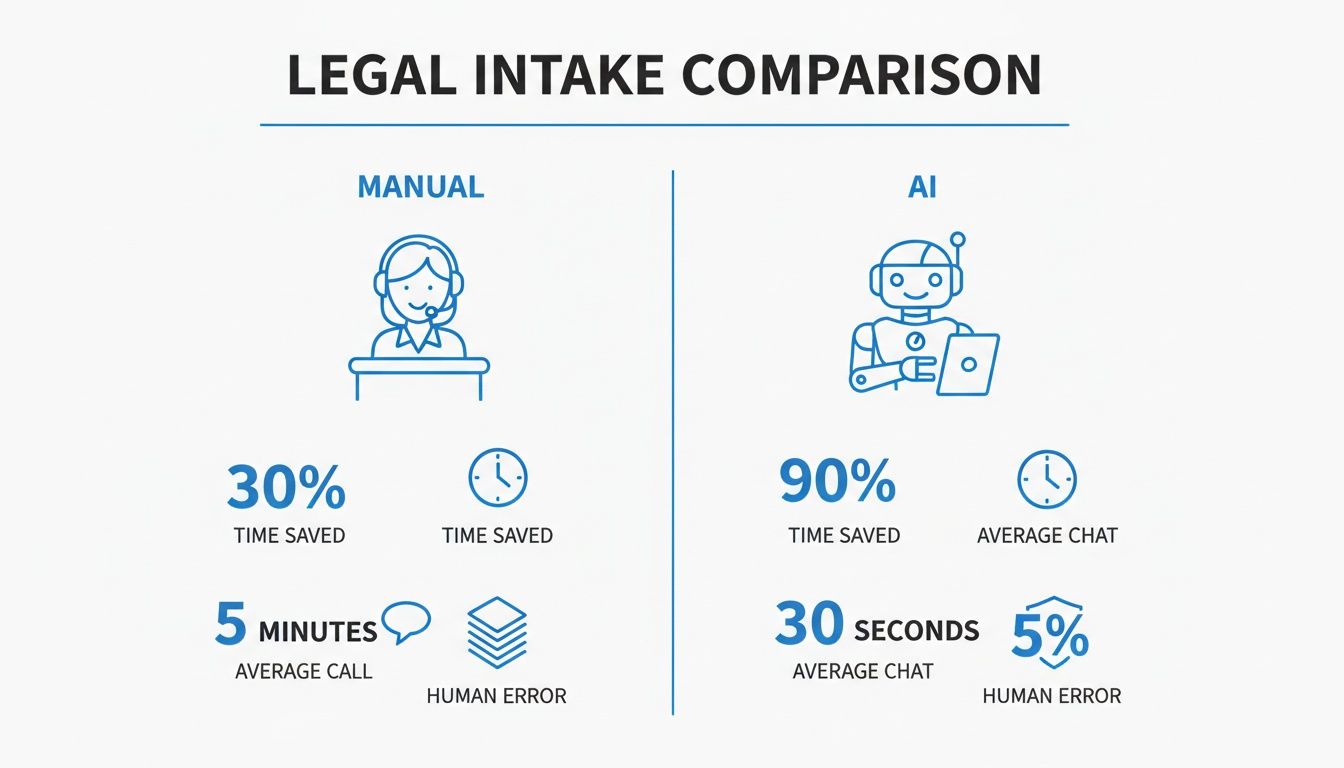
As you can see, AI turns the whole intake process from a slow, error-prone chore into a smooth, efficient workflow.
The Measurable Impact on Growth
The numbers from the wider industry back this up. There’s a direct line between adopting AI and a firm's bottom line. IDC predicts that by 2026, more than 60% of professional services firms will use AI tools to improve their client response times and stop leads from going cold.
And the firms already on board are seeing the benefits. A solid 69% of those who have widely adopted AI report a positive impact on their revenues. It’s not uncommon to see case studies showing lead conversion jumping by 10–30% just by cutting response times from hours down to minutes.
At the end of the day, calculating the ROI of an automated intake process is about a change in mindset. It’s not about the cost of the software; it's about the cost of doing nothing. When you tally up the missed revenue, reclaim your team’s valuable time, and speed up your conversion cycle, you build an undeniable case for an investment that will fuel your firm’s growth for years to come.
What to Look For: Core Features of a Modern AI Intake Platform

When you start looking at AI legal intake systems, it's easy to get buried in technical specs and marketing hype. To cut through the noise, you need to zero in on the core features that will actually make a difference for your firm’s bottom line and your clients' first impression.
Think of it like this: you wouldn't buy a car without an engine, wheels, and a steering wheel. In the same way, an intake platform needs a few non-negotiable features to do its job. Without them, you're just buying a clunky piece of software that creates more headaches than it solves.
Let's break down what really matters.
24/7 Lead Capture and Engagement
The absolute foundation of any good system is its ability to catch leads from every possible channel, 24/7/365. Potential clients don’t just have legal problems between 9 a.m. and 5 p.m., and your firm can't afford to miss their calls. A great intake system is your digital front desk, always on and ready to help.
This isn't just about a form on your website. True multichannel capability means the platform can seamlessly pull in inquiries from:
- Your Website: Through smart forms and AI-powered chat widgets.
- Phone Calls: By transcribing voicemails and automatically logging call information.
- Social Media: Connecting with platforms like Facebook Messenger to grab leads.
- Email: Scanning your inbox to find new inquiries and pull out the important details.
This way, no potential client ever falls through the cracks, no matter how or when they decide to reach out.
Smart Lead Qualification and Scoring
Let's be honest, not every person who contacts your firm is the right fit. Your team probably spends hours sifting through emails and messages just to find the viable cases. A solid AI legal intake system takes over this entire process with intelligent lead qualification.
Using rules you set up—based on practice area, case specifics, or even injury severity—the system can instantly figure out if a lead is a good match. It then assigns a score, pushing the most promising people to the top of the list for immediate attention.
This is more than just filtering spam. It’s about letting your team focus their valuable time on the people who are most likely to become paying clients. That kind of prioritization is a game-changer for any firm serious about growth.
You can get incredibly specific with this. To go deeper, check out our guide on AI-powered lead scoring for attorneys and see how much you can fine-tune the process.
Automated Scheduling and Key Integrations
The endless back-and-forth of trying to schedule a consultation is a massive time-waster for everyone. Automated scheduling is a must-have feature. It should sync directly with attorney calendars, letting qualified leads book a meeting on the spot.
But scheduling is just one piece of the puzzle. The real magic happens when your intake system talks to the other software you use every single day.
Crucial integrations to look for include:
- Case Management Systems (CMS): Automatically create new case files and fill them with the data gathered during intake.
- Customer Relationship Management (CRM): Send new lead info straight to your CRM to track follow-ups and marketing efforts.
- Document Storage: Instantly create dedicated client folders in places like Google Drive or SharePoint.
Without these connections, your shiny new AI tool is just another data silo, which completely defeats the purpose.
To help you visualize how these pieces fit together, here’s a quick breakdown of the most important features and the real-world impact they have on a law firm.
Essential AI Intake System Features and Their Impact
| Feature | What It Does | Benefit for Your Firm |
|---|---|---|
| Multichannel Capture | Gathers leads from your website, phone, email, and social media in one place. | You never miss a potential client, no matter how they contact you. |
| AI-Powered Chatbots | Engages website visitors in real-time, answers basic questions, and gathers initial case details. | Provides instant engagement, improving client experience and capturing leads after hours. |
| Automated Qualification | Uses custom rules to instantly sort and filter incoming inquiries. | Your team stops wasting time on unqualified leads and focuses only on high-potential cases. |
| Lead Scoring | Ranks qualified leads based on their potential value and urgency. | Immediately identifies your best opportunities so you can follow up with them first. |
| Automated Scheduling | Allows qualified prospects to book consultations directly into your calendar. | Eliminates frustrating back-and-forth emails and gets clients in the door faster. |
| Software Integrations | Connects with your CMS, CRM, and other tools to sync data automatically. | Saves hours of manual data entry and ensures all your systems are up-to-date. |
| Custom Workflows | Lets you create unique intake questions and processes for each practice area. | You gather the exact information you need for every case type, right from the start. |
In short, these features work together to create a system that doesn't just collect information—it actively helps you build a more efficient and profitable practice.
Navigating Data Security and Ethical Concerns

For any law firm, the duty to protect client information is ironclad. So, bringing an AI legal intake system into the mix naturally raises some critical questions about data security, attorney-client privilege, and ethical compliance. These aren't just minor details; they're the very foundation of legal practice.
Fortunately, reputable legal tech vendors get this. Modern AI intake platforms aren't built with security tacked on as an afterthought—it's woven into their very DNA. Think of it less like a simple app and more like a digital fortress, engineered from the ground up to safeguard your firm’s most sensitive information.
This protection comes from multiple layers of defense, making sure confidential data stays that way through every step of the intake process.
Fortifying Your Firm’s Digital Front Door
One of the most crucial security features in any AI intake platform worth its salt is end-to-end encryption. This basically scrambles all the data—from a potential client's first message to the final case file—making it gibberish to anyone without a key. It’s the digital version of sending a sealed, tamper-proof envelope instead of an open postcard.
Beyond that, these systems are usually hosted on hyper-secure cloud infrastructure like Amazon Web Services (AWS) or Microsoft Azure. These giants invest billions in physical and digital security, offering a level of protection that would be nearly impossible for an individual law firm to replicate on its own. We’re talking about robust firewalls, intrusion detection systems, and constant security audits to stay ahead of new threats.
And here’s a non-negotiable: make sure any vendor you consider is compliant with major data privacy regulations like GDPR or HIPAA (if your practice deals with health information). This certification is your proof that the provider meets the highest standards for handling data, giving both you and your clients peace of mind.
The goal of a well-designed AI legal intake system is not to introduce risk, but to centralize and secure a process that is often fragmented and vulnerable. It replaces scattered emails and insecure personal devices with a controlled, encrypted, and auditable environment.
The Hidden Danger of Shadow AI
Sometimes, the biggest threat to your firm's data security isn't a hacker from across the globe. It's the well-meaning paralegal using an unapproved tool to get their job done faster. This problem has a name: "shadow AI." It happens when staff use consumer-grade AI tools—like public chatbots or free transcription services—to handle client information because they don’t have an official, secure alternative.
This is a massive compliance and confidentiality risk. Any data fed into these tools could be used to train public AI models, stored on unprotected servers, or stripped of the safeguards needed to protect attorney-client privilege. The rapid rise of AI has created a real blind spot for many firms. Recent legal technology adoption reports show that while many firms are using AI, they often lack formal policies. The fact that only 40% of legal professionals use legal-specific AI tools tells you that many are relying on general AI that was never built for sensitive client data.
Establishing a Framework for Secure AI Use
The single most effective way to fight shadow AI is to give your team a better option. Implementing an official, firm-wide AI legal intake system removes the incentive for them to look for risky workarounds. It's a proactive move that tightens your security and gives your staff the powerful, easy-to-use tools they need.
Here’s how to make sure your rollout is secure and ethical from day one:
- Conduct Thorough Vendor Due Diligence: Go way beyond the sales pitch. Ask potential vendors for their security certifications, what their data encryption protocols look like, and who actually owns and can access the data.
- Develop a Clear AI Usage Policy: Don't leave it to chance. Create a firm-wide policy that clearly states which AI tools are approved and strictly prohibits using unvetted consumer platforms for any client-related work.
- Train Your Team: It’s not enough to just show them how to use the new system. You have to explain why data security is so important and walk them through the specific risks that come with shadow AI.
By thoughtfully navigating these issues, your firm can bring in an AI legal intake system that actually strengthens compliance and protects client confidentiality—turning it into a powerful asset, not a liability.
A Practical Implementation Checklist for Your Firm
Bringing an AI legal intake system into your firm isn't like flipping a switch. It’s a strategic project that demands a clear, thoughtful plan. A methodical approach is the best way to ensure a smooth transition, get your team on board, and see a real return on your investment sooner rather than later.
Think of this checklist as your roadmap. It breaks down what can feel like a massive undertaking into manageable, sequential phases, moving from big-picture strategy all the way down to the hands-on details. Following these steps helps you sidestep common traps, like picking the wrong software or dealing with staff pushback.
Phase 1: Define Your Goals and Map Your Process
Before you even start looking at vendors, you have to know what problems you're trying to solve. The very first step is to get an honest, unvarnished look at your current intake process and pinpoint exactly where it's breaking down.
Start by asking some tough questions:
- What's our biggest intake headache? Are you losing leads from missed calls after hours? Is your team drowning in emails? Or is inconsistent data entry creating chaos down the line?
- What does a win look like for us? Be specific. Do you want to boost your lead conversion rate by 15%? Maybe you want to cut down on manual data entry by 10 hours a week. Or perhaps the goal is as simple as making sure every single person who contacts your firm gets an immediate, professional response.
- Where are the bottlenecks? Trace the entire journey of a new lead, from the moment they first reach out to the day they sign a retainer. Make a note of every delay, every handoff, and every person involved.
This initial deep dive gives you concrete, measurable goals that will act as your north star when it comes time to evaluate different platforms and set up your new system.
Phase 2: Select the Right Vendor
With your goals clearly defined, you can start shopping for the right technology. This isn't just about buying software; it's about finding a genuine partner who understands the unique pressures and compliance hurdles that law firms face.
Your evaluation should zero in on a few critical areas:
- Core Features: Does the system actually do what you need it to? Check for the essentials you identified in Phase 1, like 24/7 lead capture, automated scheduling, and workflows you can customize for your specific practice areas.
- Integration Capabilities: This is a big one. How well does the platform play with your existing case management software (CMS), CRM, or document storage? You need seamless connections to avoid creating frustrating data silos.
- Security and Compliance: Don't be shy about asking for details on their data encryption, security measures, and how they handle privacy regulations. Client data is your responsibility.
- Support and Onboarding: What kind of help will you get? A vendor with a solid implementation process and a responsive support team can make all the difference between a smooth rollout and a bumpy one.
Don’t just take the sales demo at face value. Ask for case studies or, even better, references from firms that look like yours. Hearing directly from other lawyers and paralegals will give you priceless insight into how a platform truly performs in the real world.
Phase 3: Configure and Customize
Once you've chosen your AI legal intake system, the real work starts. This is the phase where you mold the platform to fit your firm's unique way of doing things. A good vendor will walk you through it, but your team's input here is absolutely essential.
The first order of business is building out your intake workflows. The questions you ask a potential personal injury client are going to be completely different from those for a family law matter. You’ll want to customize your intake forms with conditional logic so clients are only asked questions relevant to their situation.
Next, you'll set up the automation rules—the magic that saves your team from hundreds of hours of repetitive work. Define what happens when a qualified lead contacts you. Should an appointment with a specific attorney be scheduled automatically? Should a new matter be created in your CMS while a welcome packet is sent out? Getting these rules right is key.
Phase 4: Train Your Team and Go Live
Great technology is useless if nobody uses it properly. The final, and arguably most important, phase is all about training your staff and managing the change. Your goal here is to get everyone to actually adopt and embrace the new system.
Make sure the training is comprehensive. Don't just show your team how to click the buttons; explain why this new tool makes their jobs better. Focus on how it eliminates their most tedious tasks and gives them more time to focus on high-value, meaningful work.
Consider starting with a small pilot group or a single practice area. This lets you iron out any kinks before rolling it out to the entire firm. After you go live, keep the lines of communication open, gather feedback, and be ready to make tweaks. A successful implementation isn't a one-and-done event—it's an ongoing process of improvement.
How to Choose the Right AI Intake Partner
Picking an AI legal intake system isn't like buying a new piece of software off the shelf. It's more like bringing on a new business partner. The legal tech world is noisy, filled with vendors all claiming to have the next big thing. But a slick sales demo doesn't tell you the whole story. To find a provider who’s genuinely invested in your firm’s success, you have to look past the marketing fluff and start asking the tough questions.
The right partner won't just hand you a tool and walk away. They’ll offer a solution that can grow and adapt alongside your firm. This means they need to get it—they need to understand the pressures, ethical obligations, and day-to-day realities of running a modern law practice. Your evaluation should be a deep dive into functionality, support, and whether their vision aligns with where you want to take your firm.
Assess Deep Integration Capabilities
Let's be blunt: the single most important factor is how well the new system plays with the software you already rely on. An intake tool that lives on an island, disconnected from everything else, isn't an asset. It's just another administrative headache forcing your team to waste time on manual, error-prone data entry.
Your search should zero in on platforms that offer rock-solid, two-way connections with your key systems:
- Case Management System (CMS): Can it instantly create new matters in your CMS, filling them out with all the information captured during intake? This is non-negotiable. It cuts out redundant work and creates one definitive record for every case.
- Customer Relationship Management (CRM): Does it sync lead details, conversation histories, and status changes back to your CRM? This connection is crucial for tracking follow-ups and knowing which of your marketing efforts are actually paying off.
- Document Storage: Will it automatically create new client folders in places like Google Drive or SharePoint and file the right documents? This keeps your firm organized from the very first interaction.
A truly integrated system builds a seamless bridge for information, letting it flow effortlessly from the first client call all the way to case resolution. Anything less is just creating future bottlenecks for your team.
Scrutinize Customization and Flexibility
Your firm isn't a cookie-cutter business, and your intake process shouldn't be either. The questions you need to ask a potential personal injury client are worlds away from what you'd need for a divorce case. A rigid platform that can't adapt will force you to change your proven workflows to fit its limitations—which completely defeats the purpose.
Insist on a vendor that offers deep, meaningful customization. You need the ability to build out completely unique intake flows for each practice area. Look for features like conditional logic, where the intake form intelligently asks follow-up questions based on a person's previous answers. This ensures you get all the critical details without burying potential clients under a mountain of irrelevant questions.
Demand Transparent Pricing and Robust Support
There’s nothing worse than getting blindsided by hidden fees or finding yourself stuck with unresponsive support. You need absolute transparency when it comes to pricing. Ask every potential vendor for a complete, line-by-line breakdown of costs. This should include setup fees, per-user charges, and any extra costs for premium features or essential integrations.
Just as critical is the quality of their support and training. A true partner provides a dedicated onboarding specialist to walk you through the entire setup process. And don't just take their word for it—test them. During your evaluation, see how quickly they respond to your questions. Are their answers clear and genuinely helpful? A vendor who drags their feet during the sales process is a major red flag for what you can expect once you’ve signed the contract. Choosing the right AI legal intake system is about finding a partner who is committed to your success long after the ink is dry.
Common Questions About AI Legal Intake Systems
It's natural to have questions when you're looking at bringing a new piece of technology into your firm. No matter how clear the benefits seem, firm leaders tend to circle back to the same core concerns—from the impact on staff to the real cost and complexity of getting everything set up. Let's tackle those head-on.
Will This AI Replace My Intake Staff?
Not a chance. In fact, it’s the exact opposite. The whole point is to make your existing team more effective, not to replace them.
Think about all the repetitive, low-value work that bogs down your intake specialists: answering the same basic questions after hours, manually typing lead data, and chasing down missing information. An AI system handles all of that, 24/7.
This frees up your best people to do what they do best—building real relationships with qualified potential clients, conducting thoughtful consultations, and actually signing new cases. It's a force multiplier for your A-team, not a replacement.
Is This Technology Too Expensive for a Small Firm?
I hear this one a lot. While any new system is an investment, the cost of today’s AI intake tools is nowhere near what you might think. Most operate on a flexible subscription model that makes them surprisingly accessible.
The real question isn't about the cost, but the return.
How many leads do you miss after hours or on weekends? If this system captures just one or two valuable cases each month that you otherwise would have lost, it almost always pays for itself—and then some.
Frame it this way: compare the monthly software fee to the value of a single high-quality case. The math usually works out very favorably.
How Long Does Implementation Actually Take?
This isn't a six-month IT overhaul. Modern, cloud-based intake platforms are designed to get you up and running fast. We're usually talking about a matter of weeks, not months.
A good vendor won't just hand you the software and walk away. They’ll give you a dedicated onboarding specialist who walks you through every step: mapping out your intake process, connecting the AI to your existing case management software, and training your team. That hands-on support makes the whole process far smoother than most people expect, letting you see a return on your investment almost immediately.
At RankWebs, we provide actionable insights and proven frameworks to help law firms navigate changes and implement strategies that drive sustainable growth. Discover how to build smarter marketing efficiencies by visiting us at our website.