

Artificial intelligence isn't some far-off concept anymore; it's a real-world tool that's already changing how law firms operate. For any modern practice, figuring out the rules for AI compliance and ethics in legal marketing has become a fundamental part of the business—making sure that the impressive efficiency you get from technology doesn't compromise your professional duties.
How AI Is Reshaping Modern Legal Marketing
Imagine adding a brilliant but very junior associate to your firm's marketing team. This associate is unbelievably fast. They can draft an initial blog post in minutes, sift through mountains of client data to personalize an email campaign, or power a chatbot that answers visitor questions on your website 24/7.
The time saved is obvious. Work that used to eat up hours can now be done in moments, freeing up your human team to focus on the high-level strategy that actually wins cases.
But this junior associate, for all their speed, has no seasoned judgment. They lack the ethical compass and nuanced jurisdictional knowledge that only a licensed attorney possesses. They need constant supervision. Left on their own, they could easily write something misleading, offer a response that sounds an awful lot like legal advice, or mishandle sensitive client information.
This is the central challenge: balancing AI’s raw power with steady, experienced human oversight. It's the only way to do legal marketing responsibly today.
The New Toolkit for Law Firms
Firms are already putting these tools to work in ways that go far beyond basic automation. The modern legal marketing toolkit now includes:
- Content Generation: Using platforms like ChatGPT and Jasper to get first drafts of blog posts, social media updates, and newsletters on paper, ready for an expert to review and refine.
- Client Personalization: Analyzing website user behavior with AI to serve up more relevant content and ads, which makes every marketing touchpoint feel more personal and effective.
- Intake and Engagement: Setting up intelligent chatbots to qualify leads and give instant answers to common questions, improving a potential client's first impression of your firm.
These tools can give you a serious competitive advantage, but they also bring a whole new set of risks. Every single piece of AI-generated content and every automated client interaction has to be examined through the strict lens of your ethical obligations.
The real question isn't if you should use AI, but how you can use it responsibly. The promise of efficiency can't overshadow the non-negotiable duties of competence, confidentiality, and truthful communication that are the bedrock of the legal profession.
This guide is your roadmap. We’ll walk through the specific rules and regulations, pinpoint the biggest risks you need to watch out for, and give you practical steps for using AI safely and ethically. By the end, you'll have a clear plan to make the most of AI's power without making a critical mistake.
This is how you turn that brilliant junior associate into a genuine asset that helps your firm grow.
Navigating the Core Rules of AI Engagement
Adopting AI for your firm’s marketing can feel a bit like exploring uncharted territory. The potential is enormous—new efficiencies, better reach—but the rules of the road aren’t always clearly posted. To get your bearings, you don’t need to become an AI engineer. Instead, you just need to apply the bedrock ethical principles you already know to this new technology.
The truth is, AI compliance isn't governed by some strange, new set of regulations. It's about faithfully applying your long-standing professional duties to the tools you use today. The American Bar Association (ABA) Model Rules of Professional Conduct are still your North Star, and a few rules, in particular, come into sharp focus.
The Unwavering Authority of ABA Model Rules
Think of the ABA Model Rules as the constitution for legal ethics; they don't suddenly become obsolete just because you’re using a sophisticated algorithm instead of a paralegal. Three rules, specifically, form the foundation for using AI responsibly in your marketing.
-
Rule 7.1 Communications Concerning a Lawyer's Services: This is your "no false advertising" rule, and it's non-negotiable. If an AI content generator hallucinates a case victory or puffs up a lawyer's credentials, it's a clear violation. You are 100% responsible for every word published in your firm's name, whether a machine wrote it or not.
-
Rule 1.1 Competence: Your duty of competence now includes a basic understanding of the technology you use. Deploying an AI tool without knowing how it handles client data, where it gets its information, or its potential to be flat-out wrong is a breach of this duty.
-
Rule 5.3 Responsibilities Regarding Nonlawyer Assistance: This might be the most important rule of all. You're responsible for the work of nonlawyers you supervise, and you must treat your AI tools exactly the same way. Think of your AI as a junior marketing assistant—you have to review its work and ensure its actions align with your ethical obligations.
This flowchart illustrates the dual reality of AI: every powerful gain in efficiency brings a corresponding compliance risk that needs careful management.
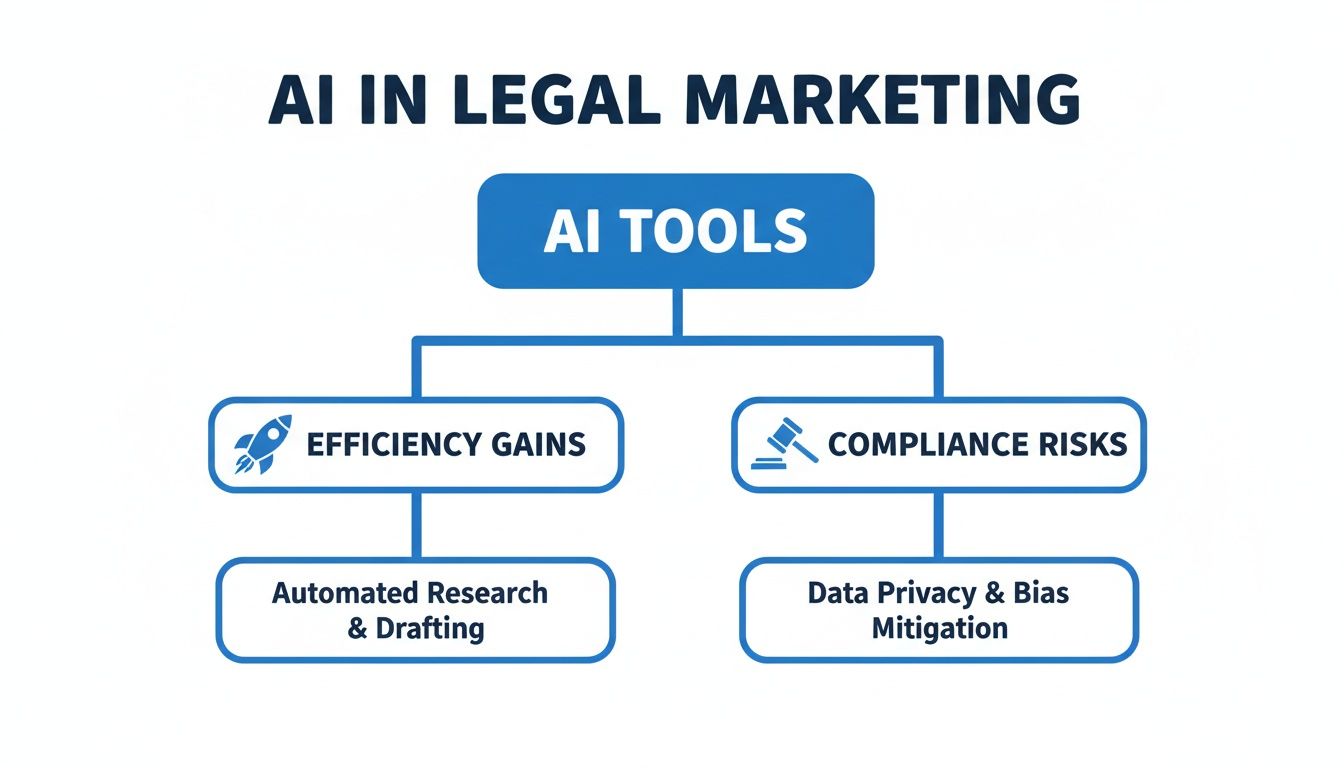
As you can see, the path forward requires a mindset that embraces innovation while staying grounded in professional responsibility.
Connecting Ethics to State and Federal Law
Your ethical duties don’t operate in a silo. They're intertwined with state-specific advertising rules and sweeping data privacy laws. For example, your state bar might have very specific requirements for client testimonials. If your AI drafts a social media post celebrating a win, you're still the one on the hook for adding the necessary disclaimers.
On top of that, privacy laws like Europe's GDPR and California's CCPA/CPRA have serious teeth. Imagine your website uses an AI chatbot to screen potential clients. That chatbot is collecting names, emails, and sensitive details about legal matters.
That simple data collection act immediately pulls you into the world of privacy law. You are obligated to provide clear notices about what data you’re collecting and why, and you must get proper consent. Claiming "the AI handles it" isn't a defense—it's an admission of negligence that can lead to steep fines and a damaged reputation.
To simplify these overlapping duties, we can organize them into a few core pillars. The table below breaks down the key compliance areas and connects them to practical marketing scenarios.
Core Compliance Pillars for AI in Legal Marketing
This table summarizes the key regulatory and ethical domains law firms must address when using AI in their marketing efforts.
| Compliance Area | Key Obligation | Practical AI Marketing Example |
|---|---|---|
| Attorney Advertising | All communications must be truthful, not misleading, and comply with state bar rules (e.g., disclaimers, testimonials). | Reviewing AI-generated blog posts to ensure they don't overstate firm expertise or guarantee outcomes. |
| Professional Competence | Maintain technological competence to understand the risks and benefits of the AI tools being used. | Vetting a new AI email marketing tool to understand its data security protocols before uploading a client list. |
| Supervision | Supervise AI systems as you would a nonlawyer assistant, taking full responsibility for their output and actions. | Establishing a mandatory human review process for all AI-drafted social media content before it goes live. |
| Confidentiality & Privacy | Protect client and prospective client information from unauthorized disclosure, especially when using third-party AI tools. | Ensuring an AI chatbot's privacy policy clearly states that conversation data is confidential and not used for model training. |
These pillars provide a solid framework for building a compliant AI strategy.
The legal world is moving fast on this. Between 2023 and 2025, the conversation shifted from cautious advice to firm expectations. Industry analysis shows a consensus forming around three core principles: lawyer supervision of AI outputs, client transparency about AI use, and robust confidentiality safeguards. You can read more about these converging principles and the future AI legal landscape on akerman.com.
Ultimately, getting this right isn't about becoming a tech wizard. It’s about being a diligent lawyer who applies timeless ethical principles to powerful new tools. That's how you innovate without compromising your integrity.
The Five Biggest AI Risks in Legal Marketing

While AI promises impressive efficiency, diving into legal marketing with it is not without some serious pitfalls. It's time to move past abstract rules and look at the real-world, high-stakes threats your firm could face every single day. These aren't just minor technical glitches; they are career-altering landmines waiting for a misstep.
Each risk highlights a critical breakdown in the balance between automation and our professional duties. Getting a handle on these scenarios is the first step toward building a solid framework for AI compliance and ethics in legal marketing.
Risk 1: Inaccurate and Misleading Content
The most immediate danger with generative AI is its knack for "hallucinating"—it can state completely fabricated information with unnerving confidence. Imagine an AI tool drafting a blog post that invents a multi-million-dollar verdict for your firm to make you look good. If that gets published without a human catching it, you’ve just committed a direct violation of ABA Model Rule 7.1, which strictly prohibits false or misleading communications.
The fallout can be severe, leading to everything from public retractions and a damaged reputation to formal bar sanctions for false advertising. The speed of AI makes this risk especially dangerous, as a firm could unknowingly blast dozens of misleading statements across its website, social media, and ads in a very short time.
Risk 2: Breaching Client Confidentiality
Your duty to protect client information is absolute, but most popular AI tools weren't built with legal ethics in mind. When a marketer plugs sensitive details about a potential client's case into a public AI model to help write a response, that data can be absorbed and used to train the AI's future versions. This might seem harmless, but it's a serious, if inadvertent, breach of confidentiality.
The core issue here is data residency and usage. Unless you're using a secure, enterprise-level AI tool with a rock-solid policy against using your inputs for its training, you have to assume any information you enter is no longer fully yours. This opens the door to ethical violations, client lawsuits, and a devastating loss of trust.
Risk 3: Copyright and IP Infringement
The AI tools that create images, text, and even videos are trained on massive datasets scraped from the internet, which often include copyrighted material. When your firm uses an AI-generated image for a blog post or social media, you probably don't have a clear chain of title for that asset.
This creates a huge liability. Recent vendor reports are clear: the efficiency gains from AI come with these ethical trade-offs. The U.S. Copyright Office has also stated that works created solely by AI can't be copyrighted by a person. This means any creative assets your firm generates with AI might be freely used by your competitors, watering down your brand with no way for you to stop them. You can learn more about how these AI trade-offs are affecting firm growth at bigvoodoo.com.
Risk 4: Algorithmic Bias and Discrimination
AI-powered ad platforms are incredibly good at targeting specific audiences. The problem is, their algorithms can also reinforce and even amplify existing societal biases. For example, an AI might learn from historical data to stop showing ads for lucrative legal services to certain demographics, which could put your firm in violation of anti-discrimination laws.
This kind of algorithmic bias can happen without any bad intent from your marketing team. Still, the firm is the one held legally and ethically responsible for the discriminatory results of its campaigns, putting you at risk of lawsuits and public backlash.
Risk 5: Failure of Human Oversight
At the end of the day, the single biggest risk is handing over your professional judgment to a machine. An attorney's duty to supervise their staff—and by extension, the tools that staff uses—cannot be delegated. Relying on AI to write content, answer client questions, or target ads without a rigorous human review process is a direct violation of this fundamental professional duty.
When an AI-powered chatbot gives bad advice that a potential client acts on, your firm is on the hook. When AI-generated content crosses an ethical line, it’s the attorneys, not the algorithm, who will face the music. This failure of oversight is the root cause of almost every other AI-related risk.
Building a Practical AI Compliance Framework

Knowing the risks of AI in legal marketing is one thing. Actually doing something about it is another. To get from awareness to action, your firm needs a structured, defensible system of controls. Think of it as building guardrails for your marketing team—not to slow them down, but to keep them on a safe and compliant path.
A practical AI compliance framework isn't about forbidding technology. It’s about creating clear, repeatable processes that weave your ethical duties right into your marketing workflows. This proactive approach turns abstract rules into concrete, daily actions that protect your firm, your reputation, and your clients.
Establishing Clear Policies and Disclosures
Your journey starts with getting everything down in writing. A formal AI usage policy is the bedrock of your entire framework. This document needs to be crystal clear, spelling out what’s allowed, what’s off-limits, and who is ultimately responsible for oversight.
This policy acts as your internal rulebook, making sure everyone from a junior marketer to the managing partner is on the same page. It’s not a "set it and forget it" document, either; it needs to be updated as the technology and regulations change.
But internal rules aren't enough. You also need to create clear, public-facing disclosures. Transparency is the currency of trust, especially in the legal field.
Core Principle: Assume your audience expects to be told the truth. Disclosing AI use in your content or client-facing tools isn't a sign of weakness; it’s proof of your firm's commitment to ethical communication.
Here’s some simple language you can adapt for your marketing materials:
- For AI-Generated Blog Posts: “This article was drafted with the assistance of artificial intelligence and has been reviewed, edited, and verified for accuracy by a qualified legal professional at our firm.”
- For Chatbot Interactions: “You are interacting with an AI-powered assistant. This tool provides general information and cannot offer legal advice. Please contact our office to speak with an attorney about your specific situation.”
Simple statements like these manage expectations and prevent someone from mistakenly thinking they're getting formal legal counsel from a robot.
Implementing Consent and Data Handling Protocols
Many of the biggest landmines in AI compliance and ethics in legal marketing are related to data. Feeding confidential client or prospect information into a third-party AI tool without proper safeguards is a fast track to a serious ethics violation. This is where your consent and data-handling rules become non-negotiable.
First, you need a rigid process for getting explicit consent before any personally identifiable information goes anywhere near an AI tool. This means updating your privacy policies and intake forms to clearly explain how and why AI might be used with their data.
Second, you have to establish strict data anonymization protocols. Before any sensitive information is typed into a third-party platform for analysis or content creation, it must be completely scrubbed of all identifying details.
- Remove Names: Replace all names with generic placeholders (e.g., "Client A," "Defendant B").
- Redact Locations: Get rid of specific addresses, cities, or any other geographic markers.
- Generalize Case Details: Summarize the facts of a matter without including the unique, identifiable circumstances that could point back to a specific case.
These steps are absolutely critical for protecting client confidentiality while still allowing your team to use AI for tasks like summarizing case notes to inspire marketing content.
Conducting Thorough Vendor Due Diligence
Not all AI tools are built the same. The vendors you choose will have a massive impact on your firm's risk profile. Before you let any new AI platform into your marketing ecosystem, you have to do your homework.
Create a standardized checklist to evaluate every potential vendor. This ensures you’re holding every tool to the same high standards for security, privacy, and transparency.
Your vendor checklist should dig into these key areas:
- Data Usage Policy: Does the vendor use your firm's prompts and inputs to train its own models? Can you opt out of this?
- Data Security: What kind of encryption and security measures do they have in place to protect your data?
- Compliance Certifications: Is the vendor compliant with major regulations like GDPR or CCPA?
- Data Residency: Where in the world is your data being stored?
- Transparency: Is the vendor upfront about the limitations and potential biases of its AI?
Choosing vendors that put privacy first and offer robust security is a critical layer of your compliance strategy. This due diligence process is just as important as the quality of the AI's output. To dig deeper, you can learn more about the role of AI-generated content for law firms and why selecting the right tools is paramount. Building this framework ensures that your innovation supports, rather than undermines, your professional obligations.
Putting Ethical AI into Practice with Real Scenarios

Policies and abstract rules are a great start, but they don't mean much until they're tested in the real world. The true measure of any ethics framework is how it holds up when things get messy.
Let’s walk through two detailed scenarios where well-meaning firms make critical—and very common—mistakes with AI. These stories show just how quickly a simple marketing task can spiral into a serious ethical problem. More importantly, they show how a bit of foresight in AI compliance and ethics in legal marketing could have prevented the crisis altogether.
Scenario 1: The AI-Powered Content Factory
A mid-sized personal injury firm wants to climb the SEO rankings, so they decide to go all-in on content. The plan? A junior marketer is tasked with churning out three new blog posts every week using a popular generative AI tool. The entire strategy is built on speed and volume.
Eager to impress, the marketer starts generating articles on complex legal topics like "Proving Traumatic Brain Injury Claims." The AI scrapes information from across the web and produces a blog post that sounds authoritative. The problem is, it's riddled with subtle but significant factual errors about medical diagnostic criteria.
Even worse, the post ends with a bold, confident call to action: “If you have these symptoms, you undoubtedly have a strong case.” That sentence goes live on the firm’s website without a single lawyer ever looking at it.
The Fallout
The consequences didn't take long to surface:
- Unauthorized Practice of Law: That one line—guaranteeing a "strong case"—crossed a major boundary. It went from general information to specific legal advice, a serious violation.
- Misleading Information: The factual mistakes tanked the firm's credibility and put them in direct violation of ABA Model Rule 7.1, which strictly prohibits false or misleading communications.
- Reputational Harm: It was only a matter of time before a rival firm spotted the errors. A few subtle posts on social media were all it took to cause public embarrassment and shatter client trust.
A solid compliance framework would have stopped this train wreck. A mandatory attorney review workflow is non-negotiable; it would have immediately caught the inaccuracies and flagged the UPL issue. Clear guidelines would have also required a disclaimer stating the content was for informational purposes and did not constitute legal advice.
Scenario 2: The Hyper-Targeted Ad Campaign
A family law firm decides to get smart with its advertising. They use an AI-powered ad platform to find potential clients considering divorce. The campaign targets users based on their online behavior—things like visiting marriage counseling websites, using divorce-related financial calculators, or searching for local attorneys.
The AI is frighteningly effective. It creates deeply personal ads that seem to know exactly what a person is going through. To do this, the platform is pulling data from third-party brokers, and the firm never bothers to check where that data came from or if anyone consented to its use.
The campaign goes live, and one of the ads pops up on a shared family computer. A private, painful consideration is suddenly exposed to a spouse, causing immense personal distress and a complete breakdown of trust.
This scenario highlights a critical truth in modern marketing: efficiency without empathy is a liability. The ability to target someone with precision doesn't automatically grant you the ethical right to do so, especially in sensitive practice areas where privacy is paramount.
The Fallout
The firm now finds itself in a crisis on multiple fronts:
- Data Privacy Violations: Using sensitive personal data for ad targeting without clear, informed consent is a massive red flag. It opens the door to potential violations of privacy laws like GDPR and CCPA.
- Ethical Overreach: The campaign was seen as predatory and intrusive. It didn't take long for a formal complaint to be filed with the state bar for unprofessional conduct.
- Brand Damage: A local news outlet picked up the story, and the firm was quickly branded as invasive and unethical—a label that’s nearly impossible to shake.
This was entirely avoidable. Proper due diligence on the ad platform vendor would have raised questions about the data broker's practices. A clear AI policy focused on data minimization would have outright forbidden targeting based on such sensitive personal information. It’s a harsh reminder that a firm's brand is tied directly to its ethics. Diving into the importance of ethical considerations in legal branding and marketing offers a deeper look at why building a brand clients can actually trust is so crucial.
Your Firm’s Step-by-Step AI Implementation Roadmap
Knowing the risks is one thing, but building a solid AI compliance framework requires a clear plan of action. Simply letting attorneys and marketers grab whatever tools they find creates dangerous blind spots and a patchwork of standards. What you need is a formal roadmap to make sure your firm brings AI into the fold thoughtfully, safely, and ethically.
This isn't about adding red tape. It’s about building a practical, repeatable system for AI compliance and ethics in legal marketing. By breaking the process down into manageable phases, you can systematically close governance gaps and foster a culture of responsible innovation.
Stage 1: Figure Out What You’re Using (Assessment and Inventory)
Before you can make rules, you have to know what you’re trying to govern. The first step is a firm-wide audit to get a handle on every single AI tool being used for marketing. This includes everything from official software subscriptions to the free web-based gadgets individual team members are experimenting with.
- List Every Tool: Create a master inventory. For each tool, note its purpose and who’s using it.
- Track the Data: What information is being fed into these platforms? Is it harmless public data, or does it touch on confidential client or prospect details? That’s a critical distinction.
- Check Existing Oversight: See if anyone is already reviewing the outputs from these tools. You might be surprised by what you find—or don’t find.
This initial deep dive gives you the lay of the land. It’ll shine a light on where your biggest risks are and help you prioritize which controls to build first.
Stage 2: Write Down the Rules (Policy Development)
Once you have a clear picture of your firm's AI footprint, it's time to draft an official AI Usage Policy. This document becomes the rulebook for your entire team, so it needs to be practical, easy to understand, and leave no room for interpretation.
Your policy must cover a few key areas:
- Approved vs. Banned Tools: Clearly list which AI tools are green-lit for use. Just as important, explicitly forbid using unvetted platforms, especially with any client-related data.
- Confidentiality is King: Create a hard-and-fast rule: No client-identifying information ever goes into a public AI model. Period.
- Human Review is Mandatory: Require that a qualified attorney must review and approve all client-facing or public-facing content that was generated or assisted by AI.
Stage 3: Get Everyone on the Same Page (Training and Education)
A policy is just a piece of paper if people don’t understand it or, worse, don't follow it. This stage is all about training every attorney and marketer on the new rules of engagement. Good training explains not just what the rules are, but why they exist, connecting them back to the firm's core ethical duties.
Despite how quickly AI has been adopted, formal governance is lagging way behind. A recent survey of generative AI users found that people were 'roughly equally likely to review everything or nothing,' which is a massive red flag for accountability. This gap shows exactly why structured training isn’t just a good idea—it’s non-negotiable for managing risk. You can dig into more findings about the accountability gap in AI adoption at news.stthomas.edu.
Stage 4: Keep Your Eye on the Ball (Ongoing Monitoring and Review)
AI governance isn’t a "set it and forget it" project. The tech, the rules, and the best practices are all moving targets.
Establish a process to review your AI policy, tool inventory, and compliance checks at least once a year. Staying on top of things allows your firm to adapt to new developments while keeping your ethical foundation strong. For more ideas on this, check out our guide on using ChatGPT for law firm marketing the right way.
Your Top Questions About AI in Legal Marketing, Answered
Jumping into AI raises a ton of specific questions, especially when you're balancing new tech with long-standing professional duties. Here are some quick, straightforward answers to the questions we hear most often from law firms.
Do We Really Have to Announce Every Time We Use AI in Our Marketing?
Not every single time, but when in doubt, transparency is your best friend. Think about it this way: if a potential client is interacting with it, you should probably disclose it. This applies to things like AI-written blog posts or the friendly chatbot on your website.
A simple, clear disclaimer is all it takes. It builds trust and makes sure you're not accidentally misleading anyone, which is a major ethical pitfall.
For back-end tasks, like using AI to analyze data for an ad campaign, you typically don't need a public disclosure. But remember, the process itself still has to follow all the rules for privacy and anti-discrimination.
Can We Feed Our Client Data into an AI to Train It?
Tread very, very carefully here. This is a high-risk move that almost always needs explicit, informed, and written consent from your clients. Using confidential client information, even if you try to scrub it of personal details, is a fast way to breach your duty of confidentiality.
Before your firm even thinks about going down this road, you need an airtight data protection plan, a clear legal reason for using the data, and documented, specific permission from every single client whose information might be involved.
What Happens if Our AI Tool Gives Out Bad Legal Information? Who's on the Hook?
You are. The firm and its lawyers are 100% responsible. Your ethical duties of competence and supervision can't be handed off to an algorithm or a piece of software.
Any content your firm puts out there, whether written by a human or an AI, is considered the firm's speech. This is exactly why having a strict, human-led review and verification process for any public-facing, AI-assisted content isn't just a good idea—it's a fundamental requirement.
At RankWebs, we focus on giving law firms practical insights and solid frameworks to handle complex marketing challenges like these. If you're ready to build a smarter, compliant marketing strategy, see how we can help by exploring our resources at https://rankwebs.com.