

At its core, AI case intake software is a smart assistant designed specifically for law firms. It takes over the repetitive, initial steps of bringing on a new client—capturing their information, figuring out if they're a good fit, and organizing the details—all without a human needing to lift a finger. Think of it as a virtual receptionist who works 24/7, making sure you never miss out on a potential case.
Why Manual Intake Is a Bottleneck for Growth
Picture this: a potential client has a legal emergency at 9 PM. They find your website, fill out your contact form, and then… they wait. The next morning, your paralegal sorts through a dozen emails, tries to call them back (hoping they're still available), and starts the painstaking process of typing their story into your system. This old-school approach is the reality for many firms, and it’s a massive drag on growth.
Manual intake is slow, riddled with potential for human error, and completely tied to your office hours. Every call that goes to voicemail or every email that sits unanswered overnight is a potential client you’ve likely lost to a competitor who was quicker on the draw. In a world of instant everything, clients expect an immediate response, and manual systems just can't deliver.
From Manual Hassle to Automated Efficiency
Now, imagine that same 9 PM website visitor is greeted instantly by an intelligent system. It asks the right questions, gathers their information, and maybe even schedules a consultation right then and there. That's the power of AI case intake software—it transforms your firm's "front door" from a manual gate into an automated, always-open welcome mat.
This isn't just a fancy gadget for big-shot firms anymore. It's a fundamental tool for any practice that wants to grow. By automating these first critical interactions, law firms can:
- Capture Every Lead: Engage with potential clients the moment they reach out, whether it's through your website, a social media message, or a late-night text. No more missed opportunities.
- Qualify Prospects Instantly: Set up rules to automatically screen inquiries. The system can quickly identify high-value cases and gently filter out those that don't match your practice areas, saving everyone time.
- Reduce Administrative Burden: Free up your team from the mind-numbing cycle of data entry and follow-up emails. This lets them focus on what they do best: serving clients and handling complex legal work.
The real purpose of AI intake isn't to replace your people, but to supercharge them. It takes care of the routine work so your expert staff can focus on the human connections that truly build a case and your firm's reputation.
Making this switch is a game-changer. It allows you to compete more effectively and deliver a modern, seamless client experience from the very first hello.
Manual Intake vs AI-Powered Intake at a Glance
To really see the difference, it helps to put the two methods side-by-side. The contrast highlights just how much efficiency is gained when you let technology handle the initial heavy lifting.
| Process Step | The Traditional Manual Method | The Modern AI-Powered Method |
|---|---|---|
| Initial Contact | Client waits for office hours or leaves a message. Response can take hours or days. | Instant engagement 24/7 via chatbot or smart form. |
| Data Collection | Staff manually types information from emails or phone notes into a system. | Client data is captured automatically and organized into a clean digital file. |
| Lead Qualification | A paralegal or lawyer reviews the case details to determine if it's a good fit. | Pre-set rules instantly qualify or disqualify leads based on your firm's criteria. |
| Scheduling | Back-and-forth emails or phone calls to find a time for a consultation. | Client self-schedules an appointment directly from a synchronized calendar. |
| Staff Focus | Tied up with repetitive data entry, follow-ups, and scheduling logistics. | Focused on high-value tasks like client strategy, legal research, and consultations. |
The table makes it clear: the shift to an AI-powered system isn't just an upgrade, it's a complete reimagining of how a law firm can operate and grow. It's about moving from a reactive, limited process to a proactive, scalable one.
How AI Turns a Website Visitor Into Your Next Client
Let's get practical. To really see what AI case intake software can do, picture this common scenario. It’s late Friday night, and a potential client, Sarah, has just been in a car accident. She's shaken up, stressed, and searching for legal help right now. What happens next depends entirely on your firm's intake process.
Sarah finds your website. With a traditional setup, she'd find a generic "Contact Us" form and a promise to hear back on Monday. But with AI, her experience is completely different.
The moment she lands on your site, an intelligent chat window pops up. This isn't one of those old-school, clunky bots. Thanks to natural language processing (NLP), it understands exactly what she means when she types, "I was in a car accident and need to know if I have a case." The conversation has begun.
The First Conversation: Gathering the Facts, Instantly
This AI-powered chat doesn't just ask for a name and number. It starts a guided conversation, asking the same critical screening questions a top-notch paralegal would, but in real time.
- The Basics: "I'm sorry to hear about your accident. Can you tell me when it happened?"
- Key Details: "Were you injured? Did the police come to the scene?"
- Document Upload: "If you have a copy of the police report, you can upload it securely right here."
This whole exchange happens at 10 PM on a Friday. Sarah feels heard. She knows her request isn't lost in an inbox. Your firm just made an immediate, professional, and empathetic first impression without anyone lifting a finger.
This image really drives home the difference between the slow, error-prone manual way and the fast, accurate journey AI creates.
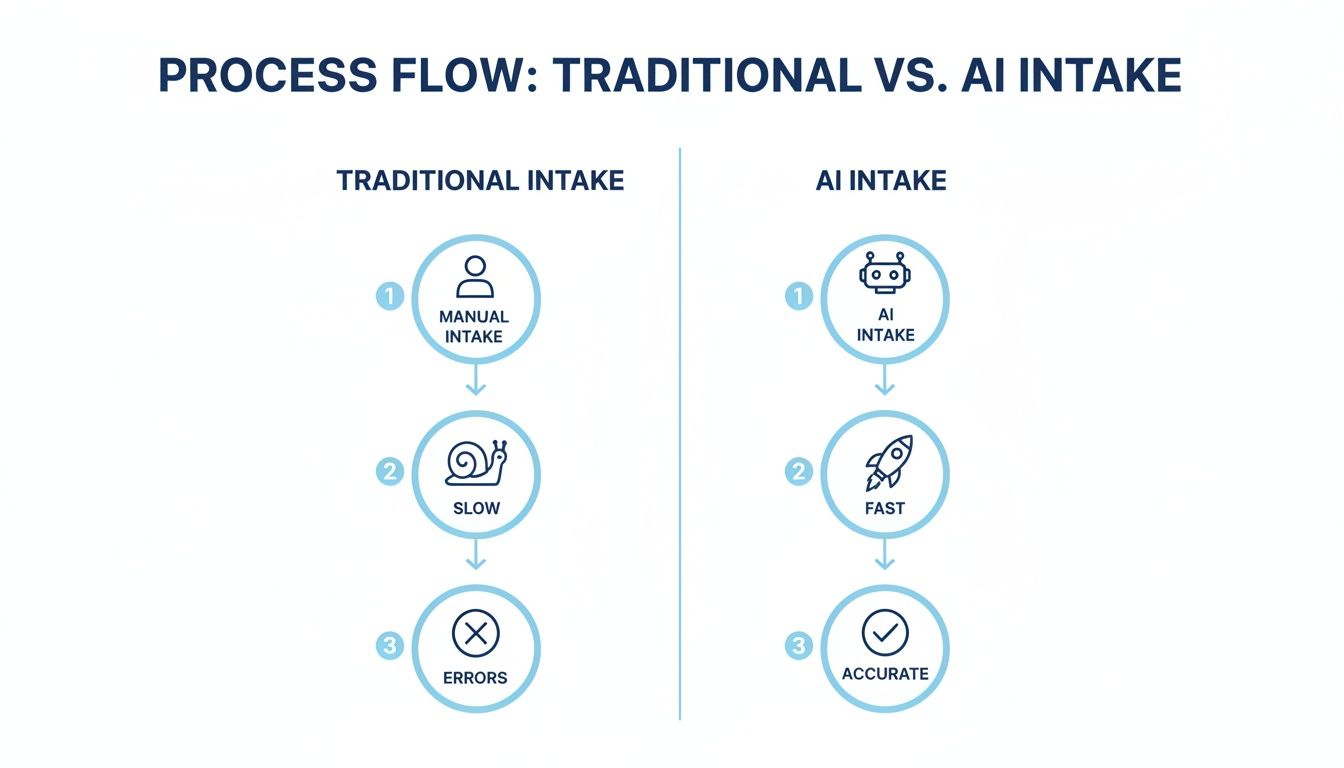
The point isn't just about speed. It's about building a fundamentally better, more client-friendly process from the very first click.
Behind the Scenes: Qualifying Leads on Autopilot
As the AI chats with Sarah, it’s also working silently in the background, performing one of its most valuable functions: lead scoring. The system is analyzing her answers against your firm's ideal client profile.
It’s looking at factors like injury severity, whether she went to the hospital, and how long ago the accident occurred. Based on this data, the software assigns a "lead score" to her case, instantly flagging it as high-priority. For a deeper look at this powerful capability, check out our guide on AI-powered lead scoring for attorneys.
This automatic qualification is a game-changer. Your team walks in on Monday morning to a prioritized list of the best potential cases, not a chaotic inbox they have to spend hours sorting through.
This lets your intake specialists focus their time and energy on the people who are the best fit for your firm, dramatically improving conversion rates.
The Final Step: From Conversation to Consultation
The AI doesn't stop once it's qualified Sarah. It takes the final steps to get her in the door.
- Automated Case File: All the information from the chat—contact details, accident summary, and uploaded documents—is used to automatically create a new matter in your case management system. This means zero manual data entry for your staff.
- Intelligent Scheduling: The chatbot then checks your attorneys' calendars and offers Sarah a few open slots for a consultation. She picks a time that works for her, right there in the chat. No more phone tag or back-and-forth emails.
- Confirmation & Follow-Up: Once she books, the system instantly sends a confirmation email and can be set to send a reminder text before the appointment.
By the time your team starts their week, Sarah isn't just another name on a list. She's a fully vetted lead with a complete file and a consultation already on the calendar. That’s how you turn a late-night website visit into a signed client before your competition has even had their first cup of coffee.
The Real-World Benefits of AI Intake Software

Bringing in new tech isn’t just about looking modern—it’s about making a real, measurable difference to your firm’s bottom line. AI case intake software does exactly that by tackling three of the biggest challenges for any practice: operational efficiency, lead conversion, and overall profitability. Think of it as an investment that pays for itself by plugging the holes where you’re losing time and money.
The first thing you'll notice is a massive leap in efficiency. Just think about all the non-billable hours your team sinks into administrative work like manual data entry, chasing down leads with follow-up emails, and screening calls. These tasks are essential, but they are a huge drain on your most precious resource: your team's time.
By automating these repetitive jobs, AI software frees up thousands of staff hours over the course of a year. Your paralegals and intake specialists can then stop being clerks and start focusing on high-value work that actually moves cases forward and keeps clients happy.
Supercharge Your Lead Conversion Engine
In the legal world, speed is everything. Faster responses almost always lead to higher conversion rates. When a potential client contacts you, they're often stressed and looking for someone to help them now. A delay of just a few hours can mean the difference between signing a great new case and losing it to the firm down the street that answered first.
AI intake software guarantees every single lead gets an instant, professional, and helpful reply, 24/7. It doesn’t just take a message; it actively qualifies them against your firm’s specific case criteria in real time.
This means your team can walk in every morning to a prioritized list of high-potential, pre-vetted leads who are ready for a real conversation. This smart filtering ensures your best prospects never get left waiting, which dramatically increases the odds of turning that first call into a signed retainer.
A study of personal injury firms found AI tools could analyze initial client details with 94% accuracy in spotting potential risks. That's a huge step up from the 85% accuracy of experienced lawyers doing the same thing. This shows how AI doesn't just speed up intake—it actually makes your qualification process better.
Drive Down Costs and Maximize ROI
When an AI-powered system handles the grunt work of initial client communication and data organization, it fundamentally changes your firm's cost structure. You can handle a much higher volume of inquiries without having to hire more administrative staff, letting you scale your practice much more profitably.
The financial upside is hard to ignore:
- Reduced Labor Costs: Automating tasks that used to take hours of manual effort directly cuts down on your administrative overhead.
- Increased Billable Hours: Your team is freed up to focus on the client-facing, billable work that actually generates revenue.
- Lower Client Acquisition Cost: With better conversion rates, you get more clients from your current marketing budget, which lowers the cost to acquire each new case.
To put it in perspective, one high-volume litigation team used an AI system to cut a specific drafting task from 16 hours down to just 3-4 minutes—a productivity jump of over 100-fold. While intake is different, the principle is the same: AI acts as a force multiplier for your team. You can find more examples of AI's impact on the legal field at aristeksystems.com.
At the end of the day, AI case intake software is an investment in efficiency that delivers a powerful return, helping you grow your firm smarter, not just bigger.
Choosing Your AI Intake Platform Wisely
Let's be honest: shopping for legal tech can be a headache. The market for AI case intake software is packed with vendors, each one claiming their platform will solve all your problems. It’s easy to drown in feature lists and buzzwords. The trick is to cut through the noise with a clear, practical checklist that separates the must-haves from the nice-to-haves.
You’re not just buying a tool for today; you’re investing in a platform that needs to grow with your firm. This means looking at the essentials—the absolute non-negotiables—and the advanced features that will give you a real leg up on the competition.
Foundational Features Every Firm Needs
Think of these as the engine of your intake system. Without them, nothing else matters. Any platform you're seriously considering has to nail these basics, as they form the backbone of a reliable, automated intake process. These are the tools that will keep your daily operations running smoothly, making sure every lead is captured, organized, and moved along.
-
24/7 AI Chatbots and Smart Forms: Your office might close at 5 PM, but potential clients look for help at all hours. Your platform must have an intelligent chatbot that can instantly engage website visitors, answer their basic questions, and gather key details—day or night. This needs to be paired with smart forms that change dynamically based on a person’s answers.
-
Customizable Intake Workflows: Every law firm runs differently. A cookie-cutter solution is bound to fail. You need the power to build and tweak your intake workflows without calling in a developer. This means you can set the exact questions, rules, and steps the AI uses to qualify leads for your specific practice areas.
-
Seamless CRM and Case Management Integration: Your AI case intake software can't be a silo. It has to connect cleanly with your existing Case Management System (CMS) or Client Relationship Management (CRM) software. When a lead is qualified, their information should automatically create a new contact or matter, killing manual data entry and stopping important details from getting lost.
Advanced Features for a Competitive Edge
Once you’ve vetted the basics, it’s time to look at the features that really separate the good from the great. These are the tools that take your intake from simply being efficient to becoming a powerful engine for signing new clients and gathering business intelligence.
These capabilities give you a much deeper understanding of potential clients and handle more complex tasks, freeing up your team for the work that actually requires a human touch.
Selecting a platform is about more than just automating tasks; it’s about acquiring a system that delivers actionable intelligence. The right tool doesn't just collect data—it helps you understand it, revealing which leads are urgent and what details matter most before you even make the first call.
Here are a few game-changing features to look for:
-
AI-Powered Document Analysis: The best platforms let potential clients upload documents—a police report, a medical record, a business contract—right into the chat. The AI can then scan the file, pull out key information like names, dates, and locations, and give you a summary. This gives your team a massive head start before the first conversation.
-
Sentiment Analysis: This is a brilliant feature where the AI analyzes the words a potential client uses to get a sense of their emotional state. It can flag language that signals urgency, frustration, or distress. This helps your team prioritize follow-ups, making sure the people who need help most urgently get a call back right away.
-
Automated Scheduling and Follow-Up: A truly intelligent system closes the loop. After qualifying a lead, it should be able to check your attorneys' calendars and offer open slots for a consultation. From there, it can send out confirmation and reminder messages, which dramatically cuts down on no-shows and administrative busywork.
Making the right choice means carefully matching these features to what your firm actually needs. It’s also critical to ensure the platform you choose operates within ethical marketing guidelines. For a deeper dive on that topic, our article on AI compliance and ethics in legal marketing offers some valuable guidance. By focusing on both the foundational and advanced capabilities, you can select an AI case intake software that becomes a true driver of your firm’s growth.
Implementing AI Without Disrupting Your Firm

Bringing new technology into your firm can feel like trying to change a tire on a car that's already moving. The fear is understandable: disrupting daily operations, frustrating your team, and making a costly mistake. But rolling out AI case intake software doesn’t have to be a nightmare. With a smart, step-by-step plan, you can make a smooth transition and start seeing the payoff almost immediately.
The secret is to stop thinking of it as a tech problem and start treating it as a strategic project for the firm. This means thoughtful planning, clear communication, and a genuine focus on empowering your team, not just giving them another tool to learn. A phased rollout gives you control, letting you build momentum without bringing your intake process to a screeching halt.
This isn't about flipping a switch and hoping for the best. It's about methodically weaving a powerful new asset into the very heart of how you win new clients.
Your Step-by-Step Implementation Roadmap
A successful launch isn't magic; it's a logical sequence that takes you from where you are now to full team adoption. Breaking the process down into these manageable stages takes the mystery out of it and helps you sidestep the common traps that cause new software initiatives to fail.
-
Assess Your Current Intake Process: Before you can improve something, you have to know how it actually works. Map out your entire intake workflow, from the moment a potential client reaches out until a case file is opened. Pinpoint the exact spots where things slow down, eat up too much time, or cause frustration.
-
Define Your Goals and Budget: What are you actually trying to accomplish here? Are you aiming to slash your lead response time? Boost your lead-to-client conversion rate? Cut down on administrative overhead? Set clear, measurable goals and then establish a realistic budget for the software and any support you'll need.
-
Engage Your Team Early: This is non-negotiable. Bring your intake staff and paralegals into the conversation from day one. You need to frame the AI software as a tool that will help them, not one that's meant to replace them. Their firsthand knowledge of daily intake challenges is gold when it comes to picking the right platform.
-
Launch a Pilot Program: Don't try to go firm-wide right out of the gate. Pick a small, motivated group or a single practice area to test the software first. This gives you a low-risk environment to work out the kinks, gather honest feedback, and prove the tool’s value before you roll it out to everyone.
Training Your Team for a Smooth Transition
A tool is only as good as the people who use it. Great training is the bridge between a powerful piece of software and the real-world results you're after. The entire point is to build confidence and show your team exactly how the AI case intake software makes their jobs easier and more impactful.
Always start with the "why" before you get to the "how." When your team understands the firm's big-picture goals and how this tool helps get there, they're far more likely to get on board.
The most successful AI adoptions focus on augmentation, not just automation. The software should be presented as a smart assistant that handles tedious tasks, freeing up skilled staff to focus on building client relationships and exercising legal judgment.
- Role-Specific Training: Your intake specialists and managing partners don't need the same training. Tailor the sessions to focus on the specific features each person will actually be using day-to-day.
- Hands-On Practice: Give everyone a "sandbox" or training environment where they can click around and experiment without the fear of breaking anything. Let them process mock intakes and see how the system handles different scenarios.
- Create a Go-To Resource: Designate an internal "champion"—an enthusiastic user who gets it. This person becomes the first line of defense for quick questions from their colleagues.
The investment in this space is exploding. Globally, the AI software market is growing at a 25% CAGR, and generative AI—the technology that powers smart intake—is on track to hit US$59.01 billion by 2025. This rapid growth means the tools are getting better fast, with some platforms already cutting costs on related tasks like document review by a massive 70-90%. You can dig into more AI market insights at abiresearch.com. Our own guide on automating client follow-up with AI also shows other practical ways to put these powerful advancements to work.
Measuring Your Return on AI Investment
So you've put a new AI system in place. The big question now is, was it actually worth it? Figuring out the value of your AI case intake software isn't about gut feelings; it's about tracking the right numbers to prove its worth. Measuring your return on investment (ROI) gives you the hard data needed to justify the cost and tweak your approach for even better results.
This goes way beyond just making sure a tool pays for itself. It's about understanding how this technology is fundamentally improving the health and efficiency of your entire firm. By focusing on a few key performance indicators (KPIs), you can turn those abstract benefits into concrete proof of growth.
Defining Your Key Performance Indicators
To see the real impact, you need to track metrics that matter. We’re not interested in vanity numbers here. The goal is to measure real changes in speed, efficiency, and your ability to turn inquiries into clients—the three areas where AI intake truly shines.
Here are the essential KPIs every firm should be watching:
-
Lead Response Time: How long does it take for a potential client to get a real response after they first reach out? A good AI system should slash this time down to mere seconds. No more leads going cold while they wait for a callback.
-
Lead-to-Client Conversion Rate: This is the big one—the percentage of qualified leads who actually sign on the dotted line. By engaging prospects instantly and filtering out the tire-kickers, your AI should push this number up, proving you're closing more of the cases you actually want.
-
Cost Per Qualified Lead: Figure out what you're spending on marketing to get one solid, pre-qualified lead through the door. As your conversion rate climbs and your team wastes less time on dead-end calls, this cost should drop. That means your marketing dollars are working much harder.
How to Continuously Optimize Your System
Your AI intake platform isn't a crockpot—you can't just set it and forget it. The data you're collecting from these KPIs is a roadmap for making the system smarter and more effective over time. Think of it as a constant feedback loop: analyze performance, spot the weak points, and refine how the AI interacts with potential clients.
For instance, if you see that your AI chatbot is losing people at a certain question, that's a clear signal to reword it or change the flow. Or maybe a specific type of case keeps getting miscategorized. That’s your cue to go in and adjust the workflow rules to be more precise.
The most successful firms treat their AI intake system not as a static piece of software, but as a dynamic engine for growth. Regular analysis and optimization are what turn a good tool into an indispensable asset for the firm.
This process of ongoing refinement is what ensures your intake process grows with your practice, getting more efficient and profitable with every small adjustment.
The data backs this up. In similar client-facing roles, AI has been shown to cut operational costs by 30% while significantly boosting productivity. For law firms, this can translate into huge overall productivity gains—anywhere from 26% to 55%—as AI takes over everything from that first point of contact to final case qualification. You can find more insights on this in a report about the state of generative AI at menlovc.com.
Got Questions? Let's Talk About AI Intake Software
Jumping into new technology always brings up a few questions. And when it’s something as critical as your firm’s front door—the intake process—it’s smart to get straight answers. Here’s what we hear most often from law firm leaders considering AI case intake software.
We'll tackle the real-world concerns about security, the impact on your team, and what it actually takes to get a system like this up and running.
Is Client Information Really Secure with an AI System?
Yes, it is—provided you choose a reputable vendor. Top-tier AI intake platforms are built from the ground up with bank-level security. They use end-to-end encryption, which means sensitive client data is protected from the moment a potential client starts typing until it lands safely in your system.
These platforms are also designed to meet strict data privacy laws like GDPR and CCPA. They go through regular, tough security audits to stay compliant. When you’re vetting vendors, make it a point to ask about their specific security measures and data policies. You need to be sure they live up to the legal industry's high bar for confidentiality.
Will This AI Replace My Intake Staff?
Not at all. The entire point is to make your existing team more effective, not obsolete. AI is fantastic at handling the repetitive, time-sucking tasks—collecting basic information, asking initial screening questions, and scheduling consultations. This is where you want automation.
By taking that work off their plate, you free up your skilled intake specialists and paralegals to focus on what humans do best. They can now spend their time building real connections with promising leads, diving deeper into the nuances of a potential case, and handling complex situations that absolutely require a human touch. In short, AI case intake software turns their role from administrative to strategic.
Think of it this way: The AI handles the "paperwork," freeing your team to practice the art of law and client service. It’s about making your best people even better at their jobs.
How Tech-Savvy Do We Need to Be to Run This?
You don't need a computer science degree, I promise. Most modern AI intake tools are built for people who aren't tech wizards. They are almost always cloud-based, which means the software company handles all the heavy lifting—the servers, the updates, and the maintenance.
Getting started is usually a guided process with the vendor's support team holding your hand. Day-to-day, you’ll be working with simple, often drag-and-drop, dashboards to tweak your intake questions or workflows. You won't need to hire an IT specialist or learn to code to get a major return on your investment.
At RankWebs, we help law firms figure out how to weave powerful tools like AI into their growth strategy. To learn more about building a smarter, more efficient practice, visit us at https://rankwebs.com.