

AI isn't some far-off idea for legal PPC anymore; it's what's happening right now. For law firms trying to stand out in a crowded digital world, it’s become essential. It’s all about using smart artificial intelligence tools and machine learning algorithms to make pay-per-click advertising work better, stretching your ad budget further and bringing in higher-quality case leads.
The New Reality of AI in Legal PPC

Let’s be honest: paid advertising for law firms is a battlefield. High-stakes keywords like "personal injury lawyer" or "family law attorney" can have eye-watering costs per click. Every single dollar has to pull its weight.
The old way of managing these campaigns by hand—constantly adjusting bids, pausing keywords, and writing endless ad variations—is quickly becoming a losing game. It’s just too slow and inefficient. This is precisely where AI for PPC optimization comes in, not to take over, but to give your human strategy a serious boost.
AI-powered tools are changing the game. They let you step back from the tedious, day-to-day busywork and focus on what really matters. Instead of being buried in spreadsheets, you and your marketing team can zoom out to the big picture: dialing in your ideal client personas, creating more compelling case offers, and actually analyzing the quality of the leads coming through the door.
The Core Challenges AI Solves for Law Firms
The legal industry has its own unique set of advertising headaches, and AI is uniquely equipped to solve them. These systems are brilliant at crunching massive amounts of data to find patterns a human analyst would never catch.
Think about these common pain points in legal marketing:
- Intense Keyword Competition: AI algorithms analyze thousands of signals in real-time during an ad auction. This helps them bid smarter, so your ads appear at the perfect moment without overpaying.
- Precision Targeting Needs: It’s about more than just keywords. AI can build audience segments based on complex behaviors, demographics, and subtle search intent, connecting you with potential clients who are genuinely looking for help right now.
- Budget Optimization: AI-driven bidding works around the clock to squeeze the most conversions or clicks from your budget. It automatically cuts spending on ads or keywords that aren't delivering, stopping the financial bleed.
By taking over the repetitive tasks, AI frees up your team's time to focus on creative strategy and long-term campaign growth. It’s about working smarter to get real, measurable results in a tough market.
At the end of the day, the goal is more qualified leads, not just more clicks. This guide is your practical roadmap for weaving AI into your firm's PPC strategy. We’ll skip the buzzwords and give you actionable steps for picking the right tools, setting up your campaigns for AI-driven success, and staying compliant with ethical rules. You'll walk away with a clear plan to gain a real competitive edge.
Building a Strong Foundation for AI Success
Jumping straight into AI for your PPC campaigns is a bit like building a skyscraper without bothering to lay the foundation first. It doesn’t matter how sophisticated the AI is; it can't fix a messy, poorly structured ad account. Before you even think about letting an algorithm take the wheel, you have to make sure your campaigns are built on solid ground.
This really comes down to getting your account structure, data collection, and goals in perfect order. AI isn't magic—it learns from the information you give it. If you feed it a chaotic mess, you’ll just teach it bad habits, which translates directly to wasted ad spend and results that fall flat. Think of this prep work as drawing a detailed, accurate map for the AI to follow.
The Critical Role of First-Party Data
At the very core of any smart AI for PPC optimization strategy is data. We're not talking about just any data, but your firm's own clean, ethically sourced first-party data. This is the information you collect directly from your audience, and for a law firm, it's pure gold. It’s the high-octane fuel that powers the machine learning engines in Google Ads and Microsoft Ads.
This is incredibly valuable information you're already collecting from places like:
- Client Intake Forms: Details from people who are actively looking for legal representation.
- Website Contact Submissions: Names, emails, and case information submitted through your "Contact Us" page.
- Live Chat Transcripts: Real-time conversations with potential clients, full of rich context and intent.
- Phone Call Data: Logs and details from every inbound call your firm receives.
When you compliantly feed this data back into your ad platforms, you're giving the AI a crystal-clear picture of what a high-value lead actually looks like. This lets the algorithms go way beyond basic demographics to find new audiences who mirror the exact traits of your best clients.
Setting Up Robust Conversion Tracking
If your first-party data is the fuel, then think of conversion tracking as the GPS. Without it, the AI is driving completely blind. A common mistake I see law firms make is tracking only one simple conversion, like a single form fill. That gives the AI a tiny, incomplete snapshot of what success really means for your practice.
An effective setup captures every valuable interaction a potential client has with your firm. The goal is to clearly tell the AI, "These are the specific actions that turn into actual, signed cases."
For law firms, a 'conversion' isn't just a click. It's a phone call from a distressed accident victim, a completed case evaluation form, or a live chat that turns into a scheduled consultation. Tracking these high-intent actions is non-negotiable for AI success.
To build a tracking framework that works, you absolutely need to be measuring:
- Phone Calls: Track calls coming directly from your ads and those made after someone clicks an ad and lands on your website. For personal injury or criminal defense firms, this is often the most valuable lead you can get.
- Form Submissions: Don't stop at the main contact form. Make sure you're tracking submissions for specific practice area inquiries, case evaluation forms, or even downloadable guides.
- Live Chat Initiations: When someone starts a chat, it’s a powerful signal of interest. Capturing this as a conversion event gives the AI another critical piece of the puzzle.
- Key Page Views: While it's more of a secondary metric, tracking visits to important pages like "Case Results" or "Attorney Profiles" can be incredibly useful for building powerful remarketing audiences.
Defining Crystal-Clear Campaign Objectives
Finally, you have to give the AI clear, unambiguous instructions. Fuzzy goals like "get more traffic" are completely useless. The AI needs a specific, measurable target to optimize for. Your campaign goals should be a direct reflection of your firm's actual business objectives.
So, instead of a generic goal, you need a precise directive. For example, a personal injury firm's objective shouldn't just be "get more leads." A much better, more effective goal would be: "Generate qualified motor vehicle accident case evaluation requests at a target cost-per-acquisition of $350."
This is the level of detail that allows AI for PPC optimization to truly shine. It tells the algorithm exactly what a win looks like, empowering it to tweak bids, targeting, and ad delivery to hit that precise outcome. You can explore a variety of AI tools for legal marketing to help with these processes, but you have to set the foundational goals yourself. A clear objective turns AI from a simple automation tool into a strategic partner in growing your firm.
Automating Bids and Budgets for Better Results
Once you have your campaign’s foundation locked in, it’s time to let AI do what it does best: automate the incredibly complex world of bidding and budget management. This is where you step away from the tedious, manual tweaks and let machine learning algorithms handle the heavy lifting. They’ll work around the clock to make sure your ad spend is delivering the best possible results.
For law firms, the days of manually setting cost-per-click (CPC) bids for hundreds, if not thousands, of keywords are long gone. Smart Bidding strategies inside Google Ads use AI to predict the odds of a conversion for every single ad auction. The system can then bid more aggressively when a potential client seems ready to convert and pull back when the data says otherwise.
This is all built on a simple, yet powerful, principle.
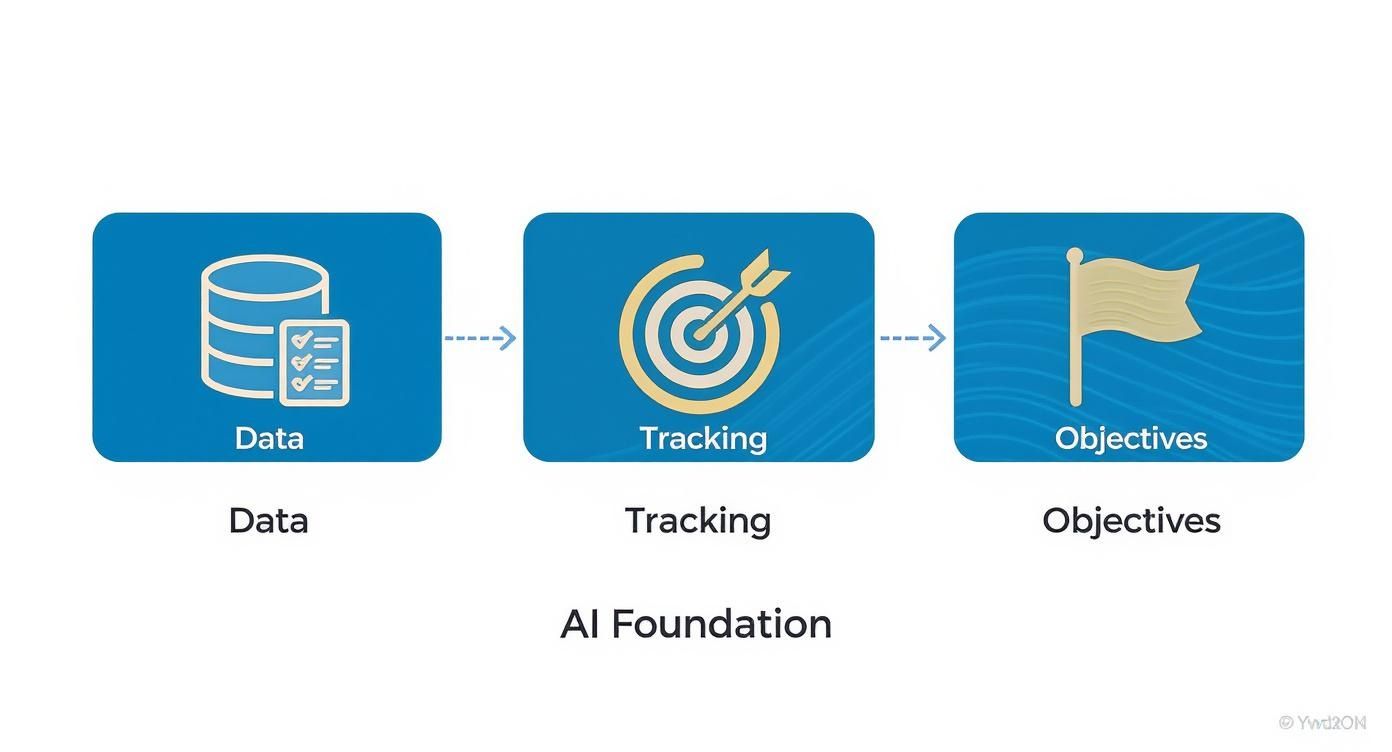
As you can see, clean data and rock-solid tracking are what feed the AI, giving it the fuel it needs to actually hit your campaign goals. Garbage in, garbage out.
Choosing the Right Automated Bidding Strategy
Google Ads gives you several AI-driven bidding strategies, but they’re definitely not one-size-fits-all, especially for a law firm's specific needs. The trick is picking the one that lines up perfectly with what you’re trying to achieve.
Let’s walk through a real-world scenario. A personal injury firm wants to generate more qualified leads, but they need to keep their cost per lead under control to stay profitable. Their main goal is getting signed cases, not just clicks.
In this situation, a couple of strategies really stand out:
- Maximize Conversions: This tells the AI, "Get me the most conversions—form fills, phone calls, you name it—within my daily budget." It's a fantastic starting point when you want to gather as much conversion data as possible without having a hard cost-per-lead target just yet.
- Target CPA (Cost Per Acquisition): This is the next level. Once you have a good handle on what a valuable lead is worth to your firm, you set a specific target. If you tell Google you're willing to pay $250 per lead, the AI will automatically adjust bids on the fly to hit that average over time.
The table below breaks down the most common options to help you decide.
Choosing the Right AI Bidding Strategy for Your Law Firm
| Bidding Strategy | Best For | Example Use Case (Law Firm) |
|---|---|---|
| Target CPA | Controlling lead costs while maximizing volume. You have a clear idea of what a lead is worth. | A family law firm sets a $200 Target CPA to acquire divorce consultation requests profitably. |
| Maximize Conversions | Getting as many leads as possible within a set daily budget, without a specific cost target. | A new criminal defense firm wants to quickly build a lead pipeline and gather initial performance data. |
| Maximize Conversion Value | Prioritizing high-value cases over sheer lead volume (requires value-based tracking). | An estate planning firm assigns higher values to "complex trust" leads than "simple will" leads, telling the AI to find the more lucrative clients. |
| Target ROAS | Focusing on return on investment from ad spend. Best for firms with clear case values tied to marketing. | An M&A law firm aims for a 500% Return on Ad Spend (5x ROAS), targeting high-value corporate clients. |
Ultimately, choosing the right strategy depends entirely on your firm's financial goals and how you measure success.
Moving from manual bidding to a Target CPA strategy is a perfect example of using AI for PPC optimization. You stop micromanaging keyword bids and start managing the overall financial health of your lead generation engine. To get a better grasp on these ideas, you might find our guide on effective PPC budgeting and bidding strategies for maximizing ROI helpful.
The Power of Performance Max Campaigns
Beyond just bidding, AI can now take the reins of your budget allocation across Google's entire network with Performance Max (PMax) campaigns. You can think of PMax as an all-in-one campaign that lets AI find your ideal clients across YouTube, Display, Search, Discover, Gmail, and Maps—all from a single setup.
For a law firm, this is huge. You simply feed the AI your ad copy, images, videos, and audience signals (like lists of past clients or website visitors). The system then gets to work, automatically testing countless combinations of those assets across every channel to pinpoint the highest-performing placements.
Performance Max takes the guesswork out of channel selection. The AI figures out where your budget is best spent to find people actively seeking legal help, whether they're watching a video on YouTube or looking for directions on Google Maps.
The results speak for themselves. Enhanced automation, which uses AI to find the best bids, has been shown to deliver a 60% lower median cost-per-acquisition compared to manual bidding. When you pair that with optimized targeting, the results get even better, with an additional 10% reduction in CPA.
Just remember, patience is key when you're working with automated bidding and PMax. These systems need time to learn. They go through an initial "learning phase" to gather data and figure out what works. You have to resist the urge to make big changes during this period, which usually lasts about one to two weeks. Give the AI clear goals and clean conversion data, and it will become one of the most powerful tools in your firm’s growth arsenal.
Crafting High-Converting Ad Copy with AI
Getting your bidding and budgeting automated is a huge win, but it’s only half the battle. Your ad copy is that critical first handshake—the thing that compels a potential client, often in a moment of crisis, to actually click.
In the hyper-competitive world of legal advertising, cookie-cutter headlines and generic descriptions are invisible. This is where generative AI tools like Jasper or even the built-in features in Google Ads and Microsoft Ads can become your most valuable creative partner.
Instead of staring at a blank screen trying to conjure the perfect phrase, you can have dozens of compelling ad variations in seconds. This lets you test, learn, and deploy new copy at a speed that was impossible just a few years ago. That rapid iteration is a massive advantage when it comes to AI for PPC optimization.
Moving Beyond Basic Prompts for Legal Ad Copy
The real trick to getting great copy from AI isn't just asking it to "write an ad for a personal injury lawyer." That's a recipe for bland, generic results. The magic happens when you feed it specific, strategic prompts that dig into the unique fears and motivations of your ideal clients. You have to guide the machine with real context.
Think about what makes your firm different. Is it your "no win, no fee" guarantee? Do you offer a truly free, no-strings-attached consultation? These aren't just features; they're powerful emotional hooks that a well-prompted AI can weave into headlines that grab attention.
Here are a few prompt formulas I've seen work wonders:
- For Empathy-Driven Copy: "Generate 5 ad headlines for a family law firm that convey compassion for people going through a divorce. Use words like 'guidance,' 'support,' and 'on your side'."
- For Urgency-Driven Copy: "Write 3 ad descriptions for a criminal defense attorney targeting someone just arrested for a DUI. Emphasize immediate 24/7 availability and the need for quick action."
- For Value-Driven Copy: "Create ad copy for a PI lawyer that clearly explains our 'No Win, No Fee' promise. Make it clear clients pay nothing unless we secure a settlement."
By giving the AI these kinds of detailed instructions, you get copy that speaks directly to a person's immediate needs and emotional state. That’s how you boost your click-through rate.
Your legal expertise isn't being replaced here—it's being amplified. Think of AI as a tireless brainstorming partner, one that can explore every possible angle from compassionate to assertive, helping you find the perfect message for the right audience.
A/B Testing Ad Variations at Scale
One of the biggest game-changers AI brings to the table is the ability to A/B test ad copy on a massive scale. In the past, manually writing, launching, and tracking dozens of ad variations was a logistical nightmare. Now, you can generate a whole suite of distinct ads in minutes and let the ad platforms’ own algorithms figure out which ones perform best.
This isn't just a fringe tactic anymore; it's rapidly becoming standard practice. A staggering 75% of PPC professionals are now using generative AI to write ads, and their satisfaction is high, with 69% reporting they are pleased with the results.
By constantly testing different emotional triggers, value propositions, and calls-to-action, you can quickly zero in on the messages that drive not just clicks, but actual client conversions. It takes the guesswork out of the creative process. If you need some initial ideas, looking at a few proven law firm ad copy examples can give you a great foundation for your AI prompts.
The Essential Human Review and Ethical Guardrails
This is the most important part: AI is an incredible tool, but it is not a lawyer. It has zero understanding of state bar advertising rules, attorney-client privilege, or the ethical tightrope you walk every day.
Every single word generated by AI must be reviewed by a qualified attorney at your firm.
This step is absolutely non-negotiable. An AI could easily write copy that accidentally guarantees an outcome ("We will win your case!") or makes a claim that can't be substantiated. Those kinds of mistakes can lead to serious ethical violations and sanctions from the bar.
Your final review process has to confirm that all AI-generated copy is:
- Factually Accurate: It correctly describes your firm's services and track record.
- Legally Compliant: It follows every single advertising guideline from your state and local bar associations.
- Ethically Sound: It avoids making promises or guarantees about results.
The best way to think about it is this: the AI is your brilliant junior copywriter, but a licensed attorney is always the final editor-in-chief. That partnership ensures your ads are not only powerful but also perfectly compliant.
Keeping an Eye on Performance and Upholding Your Ethical Duties
Getting your AI-powered campaign live isn't the finish line—it's the starting gun. The real magic of using AI for PPC optimization happens in the weeks and months that follow, through a constant loop of monitoring performance, understanding the data, and making smart adjustments. This is where your expertise is irreplaceable, steering the machine to make sure it’s hitting your firm’s goals and staying within ethical lines.
Forget about vanity metrics like clicks and impressions. For a law firm, success isn't just about getting traffic; it’s about signing cases. Your focus has to be locked on the key performance indicators (KPIs) that actually grow your practice.
Pinpointing the KPIs That Truly Matter for Law Firms
The AI is brilliant, but it will only optimize for the goal you set. If you tell it to chase clicks, it will. That's why you have to give it the right targets. Your entire performance analysis should revolve around these core metrics:
- Cost Per Qualified Lead (CPQL): This is your north star. It's the cost to get a lead that your intake team has vetted and confirmed meets your criteria for a potential case. A cheap lead that goes nowhere is worthless.
- Lead-to-Client Conversion Rate: This shows you what percentage of those qualified leads actually sign on as clients. It’s the ultimate report card on both your lead quality and your intake process.
- Return on Ad Spend (ROAS): This is the bottom-line calculation: how much revenue did you generate for every dollar you put into ads? For firms that can track case values, ROAS tells you in plain terms if your campaigns are profitable.
- Average Case Value: Knowing what different case types are worth allows you to set smarter Target CPA or ROAS goals. This data helps you tell the AI which leads are most valuable to the firm.
When you track these KPIs, you can have a real conversation with your data. You’re not just seeing what the AI is doing, but you’re starting to understand why and whether its decisions are leading to real growth.
Giving the AI Time to Learn
One of the biggest mistakes I see firms make is getting nervous and pulling the plug too soon. When you first launch an AI-driven bidding strategy, it goes into a "learning phase." This usually takes about one to two weeks.
During this initial period, performance can look a little chaotic. The algorithm is busy gathering data, testing the waters, and figuring out what your audience and conversion patterns look like.
Resist the urge to make big changes during the AI's learning phase. The system is running experiments to find the best path forward. Constantly tweaking things will only confuse the algorithm and drag out the process.
Patience is key here. Let the system do its thing, collect data, and find its footing. Once it stabilizes, you can start making small, informed adjustments to nudge the AI toward your specific CPQL and ROAS targets.
Walking the Ethical Tightrope of Legal Ads
For lawyers, using AI in advertising brings a heavy and non-negotiable set of ethical responsibilities. The ability to target potential clients with incredible precision has to be balanced with an absolute commitment to privacy, confidentiality, and fairness. Dropping the ball here isn’t just a marketing mistake—it can get you in serious trouble with your state bar.
Your ethical checklist needs to cover a few critical areas:
- Data Privacy and Confidentiality: If you're using first-party data (like a past client list) for lookalike audiences, you must ensure that data is completely anonymized and handled according to all privacy laws. Never upload sensitive case details or personally identifiable information without getting explicit consent first.
- Avoiding Discriminatory Targeting: AI can unintentionally create biased outcomes by favoring or excluding certain demographic groups. It is your job to regularly audit your audience settings and make sure your ads aren't unfairly targeting people based on protected characteristics like race, gender, or religion.
- Preventing the Unauthorized Practice of Law: Be extremely careful with AI-powered chatbots on your landing pages. They must be programmed never to give anything that could be interpreted as legal advice. Every chat should be framed as purely informational, with clear disclaimers and an obvious way to connect with a person at your firm.
At the end of the day, AI is just a tool. You're the professional in charge. It's your duty to make sure every single part of your AI-powered PPC strategy holds up to the highest ethical standards of our profession. By pairing vigilant performance tracking with a strong ethical compass, you can grow your firm responsibly and powerfully.
Common Questions About Using AI in PPC
It's completely normal to have questions when you start bringing AI into your law firm's advertising strategy. After all, these are powerful systems, and it’s smart to understand their impact, their limits, and how to get started on the right foot.
Let's cut through the noise and tackle the most common questions we hear from legal marketers. I want to clear up any confusion and give you the confidence to move forward.
Will AI Completely Replace My PPC Manager?
This is the big one, and I can tell you definitively: no. Think of AI as a force multiplier, not a replacement for human expertise. It's brilliant at handling the mind-numbing, data-intensive tasks that bog down even the best campaign managers—things like making thousands of micro-bids in real-time or split-testing hundreds of ad headlines.
What it can't do is replicate the strategic thinking, legal knowledge, and gut instinct of an experienced professional. Your PPC manager's role simply shifts. They graduate from being a hands-on-keyboards operator to a high-level strategist.
AI is the "how." It's the engine that adjusts a bid in a split-second auction. Your human team provides the "why"—defining the target cost-per-lead, crafting the core message, and ensuring every single ad is ethically sound and compliant with state bar rules.
How Much Data Does AI Actually Need to Work?
There's no single magic number, but the answer is: a decent amount. AI algorithms are hungry for data, and their performance is a direct reflection of the quality and volume of information they get.
A great benchmark comes straight from Google Ads. For automated bidding strategies like Target CPA to really hit their stride, Google recommends having at least 30 conversions in the last 30 days.
Here’s what that looks like in the real world:
- Learning Curve: The more quality conversion data you provide, the faster the AI learns your account's patterns and starts making smart decisions.
- Quality is Everything: A handful of high-value conversions (like a submitted "Free Case Evaluation" form) is infinitely more valuable to the AI than hundreds of clicks on your phone number from existing clients. This is exactly why your conversion tracking has to be airtight.
If your firm is just starting out and has very little data, don't worry. You can kick things off with a broader strategy like Maximize Conversions. This tells the AI to just go find as many conversions as it can, which is a great way to build up that initial data history before you narrow its focus.
Can I Use AI for PPC with a Small Budget?
Yes, and you absolutely should. In fact, AI tools can be a small budget's best friend. When every single dollar has to pull its weight, you simply can't afford to waste money on clicks that lead nowhere. AI for PPC optimization is all about efficiency.
Think about it: a bidding strategy like "Maximize Conversions" is designed to get the most leads possible within the daily budget you set. The AI works around the clock to sniff out the cheapest possible conversions, stretching your limited funds much further than manual bidding ever could.
The key, again, is making sure your conversion tracking is perfect. The AI needs to know exactly what a valuable lead looks like for your specific practice area.
What's the Biggest Mistake Law Firms Make with PPC AI?
Hands down, the most common pitfall is treating AI like a crockpot—"set it and forget it." I've seen firms launch an automated campaign, get nervous when they don't see record-breaking results in three days, and either panic and start changing everything or just shut it down. That approach is a recipe for failure because it completely misunderstands how machine learning works.
AI-driven campaigns need two things from you:
- Patience During the "Learning Phase." The first week or two is a critical data-gathering period. Performance will be all over the place as the algorithm learns. If you jump in and start making major changes, you reset the whole process, and the AI never gets a chance to stabilize.
- Strategic Oversight. The AI is brilliant but it isn't a mind reader. You have to give it clear goals. If you don't align its objectives with your firm's actual business goals (e.g., "we need personal injury leads for under $250"), it might start optimizing for the wrong thing entirely.
The most successful firms I've worked with treat AI like a brilliant but very junior associate. It needs clear instructions, good data, and patient guidance to do its best work.
At RankWebs, we focus on giving law firms actionable insights and proven frameworks to master modern digital marketing. We help you bridge the gap between knowing what to do and actually doing it, building strategic campaigns that drive real, sustainable growth. Find out how to get your competitive edge at https://rankwebs.com.